


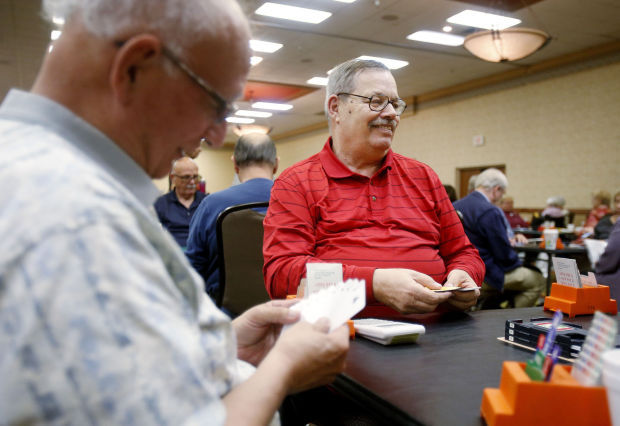

At a bridge club Bob Hinkle once owned, Ace of Clubs, Margaret Koenig refreshed her love for the game she gave up years ago.
When she plays now, she still catches herself saying, “according to Bob” — a tribute to the man who taught bridge in Tucson for more than 20 years and began writing weekly bridge columns for the Arizona Daily Star in 2014.
Since joining Tucson’s bridge scene in the late ’90s, Koenig often meets other players grateful for Hinkle’s tutelage.
He will be missed.
Hinkle, 69, was found dead in his home Friday, Sept. 30. The cause of death is still unknown, said Phillip Gambill, who considered Hinkle a father.
On Monday, the Adobe Bridge Club played in memory of Hinkle. Services may be postponed until November, so snowbird bridge players can attend.
“He’s one of the best teachers I ever met in my life, and I come from a teaching background,” said Arleen Harvey, who learned the game from Hinkle about 16 years ago. “He is passionate and loves the game and loves people and wants to see them succeed, and he wants everyone to understand what a great game it is and how much enjoyment you can get out of it.”
Harvey, who has lived in Riverside, California, since 2007, is now the associate national tournament director for the American Contract Bridge League.
“I would not be in my job, if not for Bob,” Harvey said.
Faith Alster, another of Hinkle’s students, has Hinkle to thank for becoming a Life Master in the game.
Alster started playing bridge toward the end of 2003 after the death of her husband.
She scanned Tucson’s phone book and left messages with three bridge clubs.
Hinkle called back.
With no previous experience with the game, Alster still remembers how Hinkle helped her meet a challenge set before her by an acquaintance.
“I had an acquaintance who said to me, ‘You’ll never become a Life Master. You’re starting this too late,’” Alster recalled.
In her 70s at the time, she told her teacher she wanted to go for it.
Hinkle didn’t blink. “Of course!” he told Alster.
Hinkle and Alster trained together, taking trips to tournaments where she could earn the points necessary for the title, which she earned in “record time.”
Alster fronted the cost of the trips, but “people would assume he was taking this little old lady under his wing and taking care of me,” she said, remembering how he would ham it up and laugh.
“He loved it,” she said.
Hinkle’s sense of humor prevailed, even in pain.
Gambill remembers it emerging after a fall that broke Hinkle’s leg.
“He’s sitting there with a broken leg, and as the paramedics are carrying him out of the apartment, he says. ‘I was bored with this lack of action,’” Gambill said. “That’s the humor. No matter what, he was upbeat and happy and out there for anybody.”
Even a diagnosis of multiple myeloma about 10 years ago didn’t knock Hinkle down.
He talked to the Star in 2014, recounting a successful stem-cell transplant.
“For about two years, I was out of it,” Hinkle told the Star. “I would drop in (to the bridge club) and say hello, but I couldn’t survive the afternoon without taking a nap. But I got back to it as fast as I could, because since 1972 when I played in my first tournament, I’ve tried to play as much as I could.”
The cancer was in remission until just a few months ago, Gambill said
Hinkle, born in Bloomington, Illinois, on Sept. 27, 1947, learned to play bridge in high school.
“I lived on a farm in Illinois, and the neighbors wanted to play bridge,” Hinkle said in a previous interview. “That’s how it all started. My dad was a farmer, and by 8 in the evening it was bedtime for him, so my mother said, ‘OK, let’s go.’”
So to the neighbors’ they traipsed.
He never stopped loving the game.
“I think he’s a huge loss to the Tucson bridge community,” Harvey said. “He is responsible for bringing new players and introducing the game and passion to hundreds of people throughout the years.”
Matt Koltnow, who worked as a game director under Hinkle at the Adobe Bridge Club and now lives in Bothell, Washington, remembers Hinkle’s range of teaching venues, from Pima Community College to private homes to retirement facilities. It wasn’t about the money. Hinkle, who previously worked in special education and addiction rehabilitation, wanted others to find the joy he had discovered.
That will continue at least through the year. Hinkle, who is survived by two sisters, wrote enough bridge columns to last the Star that long.
Hinkle stepped into the lives of Gambill and his two brothers when Gambill was still a kid. He helped him with homework, and over time their relationship deepened.
Gambill will most miss “the way he carried himself with people,” beloved not just for his mastery of the game, but because he was a people person, the king of heart.
“He never once, in the 16 years I knew him, belittled anybody,” Alster said. “When you talk about a fine character, I would say Bob was right up there.”

