

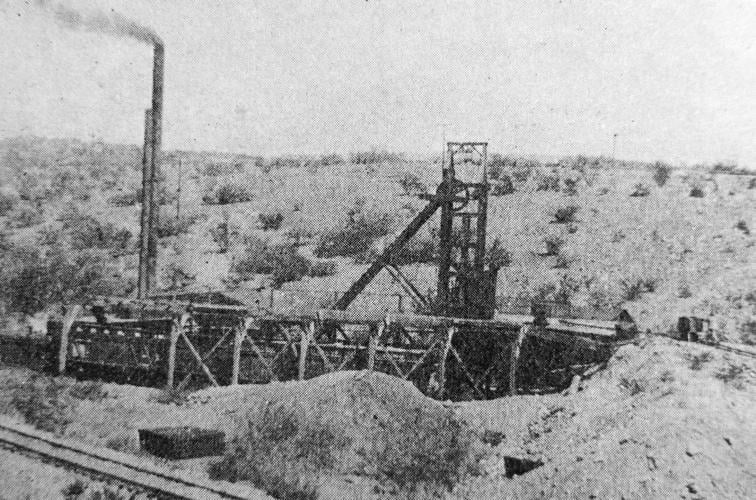
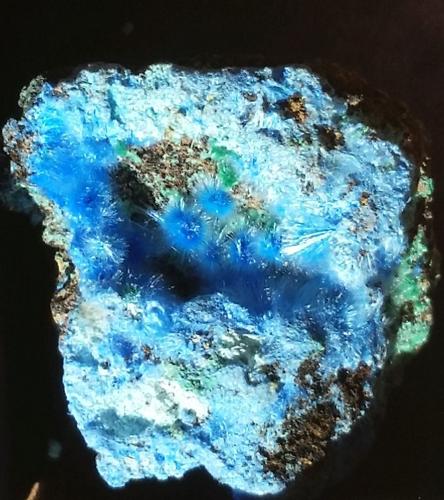
Early 20th-century reports sensationalized a great copper deposit at the now-defunct town of Courtland.
Surface reports the previous decade indicated that Courtland possessed a major copper bonanza according to mining geologists.
Located half a mile southeast of Turquoise Mountain on the south side of the Dragoon Mountains in the Turquoise District, copper mines such as the Humbot claim accredited by W. J. Young, Jr., president of the Great Western Copper Co., produced $100,000 worth of oxidized copper ore in 1901.
Anticipation that Courtland would become another Bisbee enticed Phelps Dodge Co. and Calumet & Arizona to invest money into purchasing claims. The Calumet & Arizona invested several hundred thousand dollars on the Bill Holmes’ Leadville Claims. These consisted of the Silverton, May, April Fool and Germania mines, along with the Maid of Sunshine Mine, whose equipment included a 250-horse-power steam plant, along with two hoists, air compressor and blacksmith shop.
Extensive churn drilling through limestone, quartzite and monzonite on property revealed existing ore bodies reported to have carried about 8 percent copper. The high-grade upper levels of the Mary and Germania mines confirmed these findings.
Courtland became the hub of railroad activity with the Arizona Eastern and the El Paso and Southwestern railroad companies establishing branch lines serving the local mines. The completion of rail at Courtland was hailed as a victory not only for ore transport, but also among saloon owners who had previously been prohibited by law from selling liquor close to railroad construction camps. Rail also replaced the necessity of wagons of ore hauled by mule teams and horses 30 miles to the town of Cochise, a shipping point along the Southern Pacific Railroad.
Commercial development and a real estate boom followed the arrival of the railroad in Courtland in 1909. C.M. Renaud, who served as president of the Dragoon Mining & Smelting Co., operated a mercantile store at Courtland. Others included the Great Western Hardware Co. affiliated with the Great Western Mining Co.
The Courtland Meat Co. operated by Balis L. McKinney sold produce and other commodities from local farmers and ranches in the Sulphur Spring Valley.
Unfortunately, Courtland’s mines lost their luster when it was discovered the rich ore bodies were replaced by molten porphyritic rock lacking in copper about 300 feet below the surface.
It was bad fortune that befell Young’s Great Western Mining Co. After making several hundred thousand dollars from the Mary’s Mine, Young lost it all investing heavily in attempting to find additional ore reserves in the area.
The miners at Courtland were an interesting lot following an ordinance called the Anti-Sunday Work Law. Sometimes the law overlapped into the early part of the following week, wherein miners preferred to take multiple days off work as a means of rest and relaxation.

