

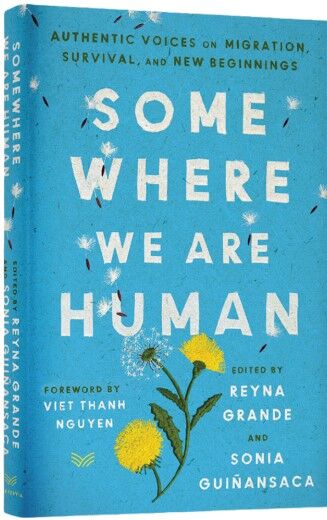

A new anthology of essays, poetry and art created and compiled by undocumented or formerly undocumented migrants includes a Tucson author and is a first of its kind, say the book’s editors, who are also formerly undocumented.
“It’s a crucial collection of stories that haven’t been told from us, by us, in this completely undocumented-driven vision,” says Sonia Guiñansaca, one of the book’s editors.
“Somewhere We Are Human: Authentic Voices on Migration, Survival, and New Beginnings” is a collection of 41 works by migrants, refugees and Dreamers, published by HarperVia, that “illuminate what it is like living undocumented today” and “seeks to shift the immigration debate toward one rooted in humanity and justice,” a press release about the book said.
While there have been many zines, journals and other small independent projects in this vein, to have a book where the editors and decision makers are also undocumented and formerly undocumented migrants while also being published by a large publishing press is “a critical step forward,” says Guiñansaca, an internationally acclaimed poet, cultural organizer and activist.
When putting together the proposal, Guiñansaca and co-editor Reyna Grande, who are both acclaimed writers, reached out to some award-winning artists to ask for contributions to the book. Then they put out a call for contributors, during the first year of the pandemic and not knowing what the response would be, and got more than 150 submissions.
It was important for them to bring in acclaimed writers but also movement leaders, organizers and cultural workers, Guiñansaca said.
“This all came together because this was a perfect cultural moment,” Guiñansaca said.
When “American Dirt” came out, the bestselling 2020 novel by Jeanine Cummins about an immigrant mother and son, it became clear there was a hunger for immigrant stories and voices, Grande says.
With her own memoirs, “The Distance Between Us” and “A Dream Called Home,” Grande has found a community of other immigrants who were inspired by her work. She is also the author of the novels “Across a Hundred Mountains” and “Dancing with Butterflies.”
“It’s been many years now that I’ve been fantasizing and dreaming of having a collection of immigrant voices, but in particular, undocumented immigrant voices,” she says. “I wanted to create opportunities for other immigrants to tell their own stories because we do have a lot of similarities in our experiences, but then everybody has a unique voice and every immigrant story is singular in its own way.”
Javier Zamora, author of the poetry collection full-length poetry collection “Unaccompanied” and an upcoming memoir “Solito,” is a Tucson-based writer who has three poems in the anthology.
Zamora, who is 32, came to the U.S. as an unaccompanied minor to reunite with his parents when he was 9. He only moved to Tucson in 2020, two years after receiving his green card.
It was only after receiving his green card that Zamora felt comfortable living as close to the border as Tucson, and the poems in the anthology come from that place of having “the freedom or the privilege” to live or even be that near the border for the first time, he said.
Before being asked to contribute to this anthology, Zamora had stepped away from poetry because he had felt drained and used by the publishing community that didn’t really understand or respect his experience, he says. Being a part of this anthology was a completely different experience.
“I feel seen and not really used,” he says. “I felt freer, and I think free in the way that a human should feel. I think that is why I went to poetry first. The opportunity to be part of this anthology reminded me of that freedom.”
It was important to Grande and Guiñansaca to include diverse voices in the anthology. There are a number of Latino artists in the book from all parts of Latin America, but there are also Asian voices and Black voices, Grande says.
“We were very deliberate in terms of selecting our contributors, and we wish we had gotten more people from other countries,” she said. “Sometimes we think of undocumented immigrants as being Black or brown, but there are a lot of also white undocumented immigrants, too. So to me it’s important to try to include as many voices as possible from different parts of the world.”
As well, the two editors wanted to include issues besides immigration. A lot of the contributors are LGBTQ artists, whose works touch on issues that include body dysphoria and trans-rights, Guiñansaca says.
“So not just thinking of migration through this one singular lens of border immigration but thinking through a reproductive-justice lens, to parenting to mental health to LGBTQI issues,” Guiñansaca says.
As well, some of the works are about DACA, which just had its 10th anniversary on June 15. They offer an interesting perspective on the policy that has allowed some undocumented migrants who came here as children to legally remain in the country, Grande says.
“People have been talking about how much this collection means to them, how they were looking for something like this in their lives, and just seeing themselves reflected in these pieces, Grande says. “And for people who don’t know a whole lot about the immigrant experience, it gives you a very nice insight into it, a very personal insight into what it’s like.”
Book Soup, the iconic book store in West Hollywood, recently held a reading of the anthology, and someone asked if there would be another edition to include submissions that didn’t make it into the book.
“I think that was a really important note, a flag, that shows us there’s a hunger there for these kinds of works, and we’re barely meeting it,” Guiñansaca said. “I’m excited that hopefully this seeds more opportunities and other publishers see the importance of publishing these kinds of writers.”
Order “Somewhere We Are Human” through Tucson’s independent Antigone Books or anywhere books are sold.

