


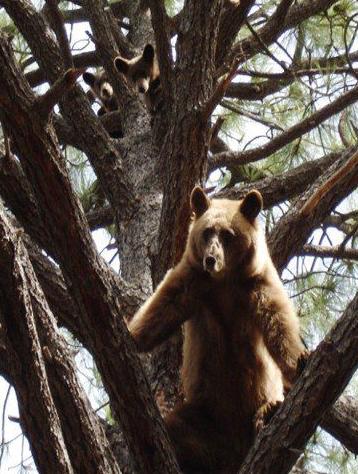
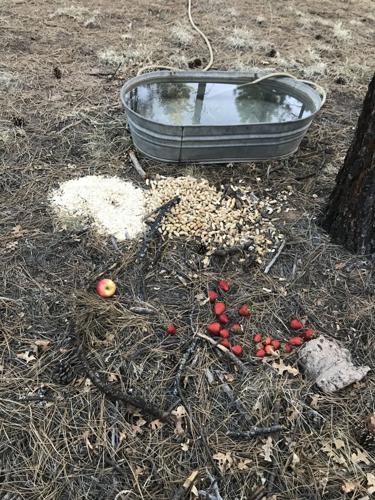

Recent bear encounters with people — including an incident in which a bear tried to enter a home in Payson — have prompted warnings from state wildlife officials about the dangers of making food available to the big animals.
“The biggest thing we’re trying to get across is that people shouldn’t feed bears or leave food where they can get it,” said Bill Andres, a spokesman for the Arizona Game and Fish Department. “A fed bear will be a dead bear” in many cases.
The advice is important for Tucson-area residents because bears have wandered out of nearby mountains and prowled neighborhoods here several times over the years. Food-seeking bears also have caused problems in the community of Summerhaven in the Catalina Mountains north of Tucson.
“Bears naturally wander to find food,” Andres said. “If they wander into your neighborhood and find trash or pet food or a greasy barbecue grill, they’re going to think it’s a place to find food and then just stick around.”
That, Andres said, poses a serious danger.
“People don’t realize how dangerous a bear can be,” he said. “Get between a bear and food and it could be trouble. A bear is a wild animal, and adult males can be in the 300-pound range. It isn’t a German shepherd.”
INCIDENT IN PAYSON
Game and Fish wildlife officers responded to reports last week that a bear attempted to break into a house in Payson after previously raiding a garbage can containing dog food.
The officers live-trapped the adult male bear at the residence, evaluated it and later euthanized it because of the bear’s aggressive behavior and apparent lack of fear around people.
It was that sort of outcome that led to Andres’ comment about a fed bear being a dead bear.
Relocating a “problem bear” to minimize risk to people works sometimes, but not always.
“Approximately half of all bears relocated will return to where they were captured, no matter how great the distance,” according to a news release from the Game and Fish Department.
HEARTY BEAR APPETITES
The Payson incident and others around the state underscore the fact that “bears are very opportunistic omnivores,” Andres said, noting that the bears in Arizona are a type known as black bears regardless of their color.
“A bear can eat 15,000 to 20,000 calories a day,” he said. “They have a metabolism needing so many calories a day. That’s why they normally wander over a large territory. They normally eat berries, grass, grubs and carrion. But if a bear finds a dumpster, it will find its 15,000 to 20,000 calories pretty quickly.
“Once it becomes accustomed to eating human food, it starts to lead to problems,” Andres said. “Most human-bear conflicts happen because humans did the wrong thing.”
See the related information box for tips on keeping food sources from attracting bears.

