



A planned state water-quality review of streams is sparking concerns among Pima County officials that two in Southeastern Arizona may lose their strict legal protection.
The Arizona Department of Environmental Quality, at the request of Hudbay Minerals Inc., will review the state’s past decisions to protect 22 streams across the state, including Davidson Canyon and Cienega Creek near Tucson, that are classified as Outstanding Arizona Waters. This work will be part of a broader state review of surface water-quality standards typically done every three years.
At the same time, some heavy metal contamination has already been discovered in both streams, officials said last week. While Outstanding Arizona Waters are legally supposed to have good water quality, ADEQ is noncommittal as to the contamination’s impact on the streams’ future status.
Hudbay’s letter and the state’s response have triggered suspicion from County Administrator Chuck Huckelberry that Hudbay wants to remove key protections for Cienega and Davidson.
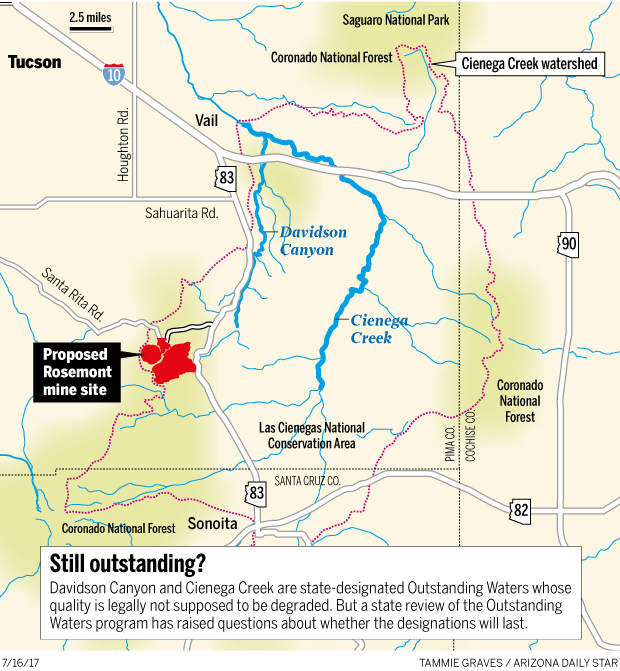
They and the other Outstanding Arizona Waters are supposed to be legally protected from pollution that degrades their quality. They’re also flash points in the controversy over Hudbay’s proposed Rosemont Mine, because much debate over the $1.9 billion project has centered on whether the mine will damage the two streams.
Last week, the Pima County Board of Supervisors voted 3-2 along party lines to oppose removing those protections. In a letter to ADEQ, Huckelberry accused Hudbay of making a “thinly disguised” effort to weaken protection for the streams to make it easier to get a federal permit to build the mine. That attempt “should be summarily rejected as a self-serving gesture to facilitate pollution of Arizona surface waters,” the administrator wrote.
Hudbay declined to comment on Huckelberry’s claims and said it would have no comment on this issue beyond what one of its officials, Kathy Arnold, wrote to ADEQ in a letter last January.
The contamination was first disclosed at the board meeting by Republican Supervisors Ally Miller and Steve Christy, who voted against the resolution to oppose weakening the streams’ protection. ADEQ spokeswoman Caroline Oppleman confirmed that samples from both streams have found the water quality exceeded state standards for “several metals” during storms.
Hudbay’s sampling found high levels of lead and two other contaminants in Davidson Canyon, said Christy, who said he’d been told that last week by Arnold, environment director of Hudbay’s Arizona business unit.
Hudbay would not comment on its water quality sampling results. Christy said the company was trying to establish a baseline so it won’t be blamed if the same contamination is discovered after the mine opens.
Asked if the pollution could affect the creeks’ status as Outstanding Arizona Waters, Oppleman said ADEQ will work with various interest groups and individuals “to develop consistent, clear and unambiguous rule language that will validate and protect designated OAWs.”
Getting input from various interest groups is required in its triennial reviews, and Hudbay’s request falls within the review’s scope, Oppleman said.
What it takes to be “outstanding”
About 3.2 miles of Davidson Canyon and 28.3 miles of Cienega Creek are classified as Outstanding Arizona Waters. To gain that protection, they had to meet state standards that they contain perennial or intermittent stretches of running water, are free-flowing and are cleaner than required by state standards.
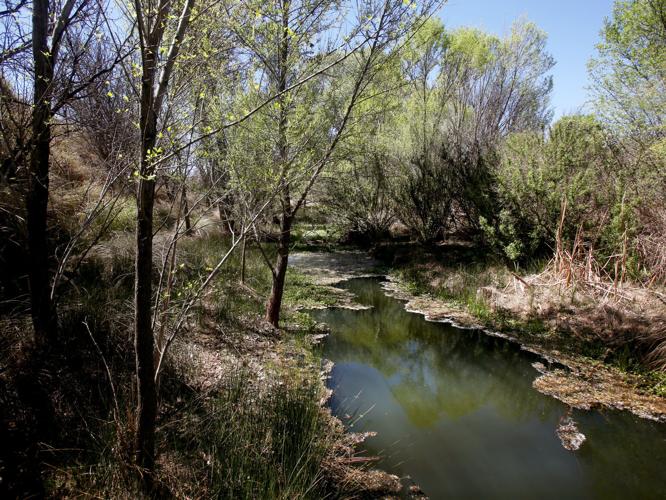
The state’s 2008 decision on Davidson said it “provides one of the most important wildlife migration corridors in Southern Arizona, linking the Santa Rita Mountains to the Rincon Mountains.” It credited Davidson’s stream-side riparian habitat with supporting several of the vulnerable species protected by the county’s Sonoran Desert Conservation Plan, including the longfin dace, a native fish, and the lowland leopard frog.
ADEQ could not locate records last week explaining its decision to classify Cienega Creek as an outstanding water. But nomination papers written in the 1990s for separate stretches of the creek by Pima County and the environmental group Forest Guardians noted that it contains the country’s largest population of the endangered Gila topminnow as well as the Gila chub, which has since been listed as endangered. The creek also plays host to the endangered Southwestern willow flycatcher and the threatened Western yellow billed cuckoo and Chiricahua leopard frog.
In Arnold’s letter to ADEQ in January, she asked for a review of the state’s rule-making, listing process and historical water quality data underlying its decisions to list each of the 22 Outstanding Arizona Waters. She said the company encourages ADEQ to also evaluate the contributions of stormwater runoff to the streams.
The state last changed its rules for these waters in 2009.
ADEQ is doing the broader review “solely” to meet federal Clean Water Act requirements, to address federal rule changes and to advance a partial review that the state conducted last year, ADEQ Deputy Director Bret Parke wrote to Huckelberry on Tuesday.
Huckelberry points
to Email exchange
Huckelberry, however, wrote in a memo last week that Hudbay has a longstanding interest in weakening water quality protections for Davidson Canyon, at least. He cited a February 2016 internal ADEQ email exchange in which department staffer Linda Taunt told a colleague, speaking of Arnold, that “Kathy again asked when we were going to run a rule to ‘un-O’ the OAW.”
“It’s a direct request,” Huckelberry said in an interview about Arnold’s comment.
Huckelberry also noted in a June 29 letter to ADEQ that the Outstanding Arizona Waters designation has been raised as a concern by a federal agency that must decide on the final permit needed for the Rosemont Mine.
The Army Corps of Engineers wrote Hudbay last year that one reason its Los Angeles District recommended denying Rosemont a Clean Water Act permit is that the mine would “contribute to the degradation of Outstanding Arizona Waters.” A higher-level Corps office will make a final decision on the mine, presumably this year.
“Pima County will be prepared to defend the OAW designation” for Davidson, Cienega and a third creek, Buehmann Canyon, a San Pedro River tributary lying northeast of Tucson, Huckelberry wrote to the Board of Supervisors in a July 12 memo.
Rosemont opponents Farmers Investment Co., Save the Scenic Santa Ritas and the Sierra Club also opposed any loosening of protections for Davidson and Cienega in written comments to ADEQ this month.
Christy on what Hudbay wants
“The notion of dispensing with Outstanding Water designations so that hardrock mining, with all its negative impacts, can be made easier is outrageous,” wrote Gayle Hartmann, Save the Scenic Santa Ritas’ president.
Supervisor Christy said he has no problem with Hudbay seeking an Outstanding Arizona Waters review, adding that the company is “just trying to make sure that everyone is on the same page.”
“They’re probably asking for clarification — they want to know exactly what they’re dealing with,” Christy said.
Democratic Supervisor Richard Elías denounced Hudbay’s request as a “shell game” aimed at weakening water quality protections.
Supervisor Sharon Bronson, a Democrat, noted that studies have found 20 percent of this region’s groundwater supply comes from the Cienega Creek watershed, so it needs protection. Contamination is no reason to abandon the Outstanding Waters’ protection, she said. “We need to clean it up.”

