


This story was originally published in Spanish in La Estrella de Tucsón
For the last 43 years, Pima Community College has offered English classes to refugees who seek to start anew in Tucson.
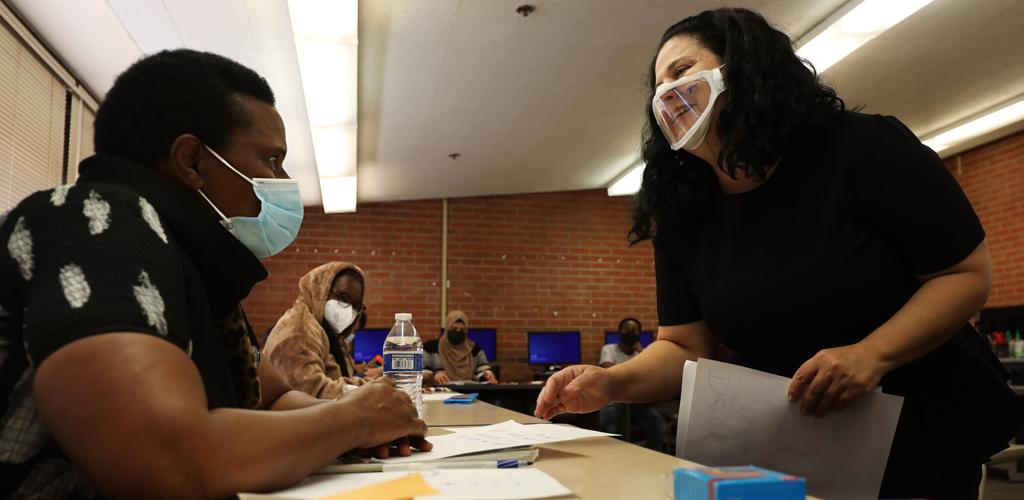
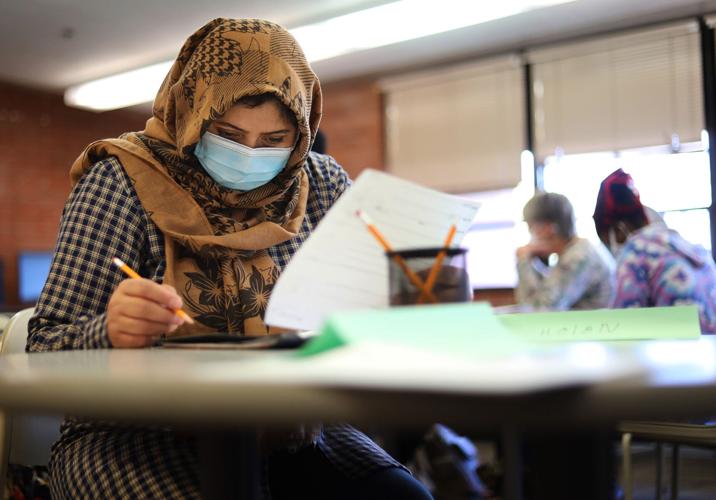
On a Wednesday morning last month, a small group of adults from various African and Asian countries were focused on their exercise: writing a get-well-soon letter to one of their classmates who underwent surgery.
Upon finishing, the instructor, Tania Hinojosa — who is originally from Mexico — compiled all of the messages, getting them ready to send off to the recovering student, an idea that she borrowed from one of her co-workers. This exercise, apart from showing affection and bringing together the members of this diverse community, is helping to strengthen the skills these adult learners are hoping to refine: writing in another language they have only begun to study.
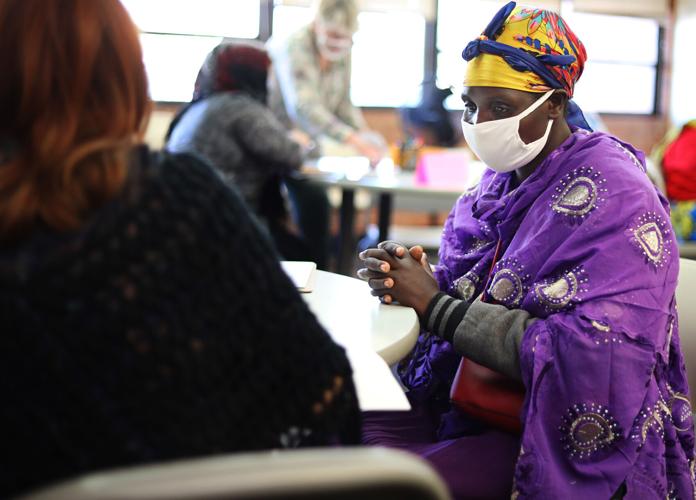
Although the 12 students composing letters come from a variety of cultural backgrounds — from countries like Ethiopia, Eritrea, Congo, Burundi, Somalia, Syria and Afghanistan — they share a common goal. In the company of friends, be it refugees, asylees or special immigrant visa holders, they have come to Tucson because this city has opened its doors and afforded them the opportunity to start a new life.
Gem of a program
“Our program is like this little secret of Tucson,” says Clare Cox who has been teaching for five years at PCC as part of the Refugee Education Program. “It is very special to know that for 40 years we have been helping people that have been coming to this country, and see that they become valuable members to the community, people that are working in restaurants, starting their own business, going on to college.”
Cox is part of a determined group of instructors who, whether in-person or virtual, create a much needed space where vital refugee education can take place to help with their immersion into American culture.
As the Refugee Education Program (REP) coordinator Sara Haghighi explains, in general when refugees arrive in Arizona they first go to a resettlement agency and later are referred to Pima Community College. After registration, they take an exam to assess their level of English and based on the results are placed in a class.
“These classes are very critical actually because many of our students start their classes within the first months of their arrival to the United States,” says Haghighi. “Some of them have been traumatized, they are just trying to figure their lives out, and they are in a process of culture shock so our teachers play a very critical role in their lives, because once they come here, teachers do not just teach them the language, but they teach them a way of life, showing them how to live in this country, in this city, how to make a home here. They welcome them here, they are the first people that they see in the United States.”
Counting money, making small talk
In December 2017, after living in Hermosillo, Mexico, for eight years, Cuban-born ballerina Lorena Carrión decided to emigrate with her two young children. In search of a brighter future for her family, she became an asylum seeker by applying to Customs and Border Protection at the border in Nogales.
“You have no idea what immigration to the United States can be like, even though you have immigrated before (to a different country),” says Carrión.
While officials evaluated her documents and started the asylum process, Lorena waited for eight hours with her children in a holding cell. “They were speaking to me in English and I did not know what to say,” she recalls. “I could see in their eyes what they were thinking: How can you come to a country without knowing the language?”
Because the Cuban case is considered special (as stated in U.S. refugee law), at the end of the day Carrión received a provisional document that allowed her to reside in the U.S. and also was granted a work permit.
“The next day I started looking for help with the refugee offices and, almost immediately, I started studying English at REP,” she says.
In the following months, thanks to her teacher, Clare Cox, Carrión learned essential skills such as counting American money and having basic conversations with other moms when she took her children to play in the park.
Little by little, her world in Tucson grew. Now she is finishing her degree in translation and interpretation at Pima Community College.
“You have to get it out of your head that it’s too difficult,” she says. “There are always obstacles in the way. Although there are processes that make you cry and feel frustration, in response we have to open our minds and carry on with what makes us stronger.”
Starting from the beginning
Some students may have Ph.D.s or master’s degrees and may have been doctors, lawyers or engineers in their countries of origin — which could mean they have a very high level of English. Others come to the United States with little or no educational background but are proficient in non-Roman languages such as Arabic. This makes them unfamiliar with the Roman alphabet, and they have to start learning the language from the beginning. The colors, the letters, the numbers, the days of the week must be learned.
“We also have adult emergent readers,” Haghighi says. She refers to individuals that may have been in refugee camps for 15 to 20 years and were not afforded the opportunity to work or study. “These are the majority of students we receive — people that are not familiar with the process of formal studying — and this will be the first time for them to go to school. And they are not generally literate in their native language either.”
Jennifer Makowsky, one of the instructors from the program, moved to Tucson from Washington, D.C., in 2005 and started working at Pima in 2015.
“When I came to this program, I realized I was also teaching students how to hold a pencil or basic organization skills, or reading from left to right, learning the Roman alphabet. … I have one student who came to my class — he came from Syria — he didn’t know any English or the Roman alphabet, and he learned all of that, and now he is in my higher-level class, and it is amazing to see. His English has improved so much over the five years that he is actually going to take his citizenship test this month, so I am very proud of that. That is inspiring.”
COVID hurdles
Although REP has been in operation for more than four decades, the COVID-19 pandemic brought about great challenges and lessons.
A lack of access to technology or limited literacy skills were among the challenges. After conducting a survey of the students, the directors and teachers began to use mobile phones and applications such as WhatsApp to connect.
“In addition, our program was generous enough to lend iPads and hotspots out to our students, and we used those to transition our students to WhatsApp and Zoom,” Haghighi said. Printed materials were also sent to students’ homes to help with the switch from in-person to virtual.
“Now we are shifting to have hybrid options,” says Haghighi.
That presents its own set of challenges, including child care issues, transportation and work schedules, Haghighi says.
Teachers have worked to provide flexibility, allowing students to log on to classes when they were on break at work, when they were taking care of their children, or even when they were in the hospital.
New connections
Being that Tucson is a city that has welcomed refugees and asylees in the United States for decades, the English program for adult education at Pima Community College is an example of inclusion and solidarity.
Now that some in-person classes have returned, the students hope to resume activities that united them before the pandemic: sharing homemade dishes from their countries, listening to traditional music, watching videos and learning words in different languages.
“You learn that we are all Tucson,” Carrión said. “REP not only opens the doors for us to learn the language or go to the university, but it also opens the doors to a new universe.”

