




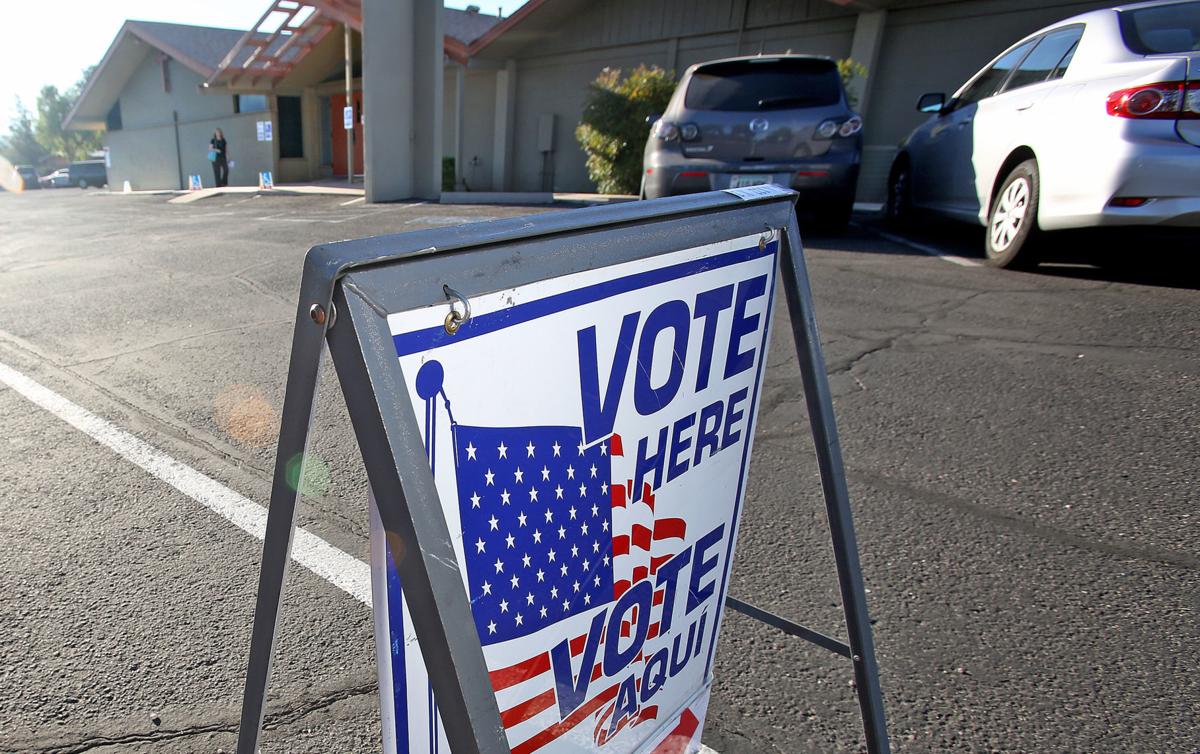
With some voters concerned for their health because of the coronavirus pandemic, a concentrated effort is underway across Arizona to encourage people to vote by mail.
Tucson-area voters are being reminded that mailing their ballot is a safe option, and information is being offered about how to join the permanent early voting list (PEVL) to receive a ballot in the mail, said Pima County Recorder F. Ann Rodriguez.
The effort comes as President Trump said last week without evidence that mail-in balloting leads to election fraud.
Rodriguez recently released a video showing how mailed ballots are counted, reassuring voters that voting by mail is safe.
She said she has heard myths that early ballots and provisional ballots are counted only in close races.
All early ballots are counted as long as the signature matches, she said. The county also counts all provisional ballots that are approved, which is usually about 83% of provisional ballots.
A lot of Pima County voters are already comfortable voting by mail, Rodriguez said.
In the 2016 presidential election, 76% of Pima County residents who voted returned an early ballot.
Deadline to request mail ballot is July 24
Rodriguez said more voters have been requesting a ballot by mail for the upcoming elections, and she has been adding more voters to the PEVL in recent weeks.
The deadline to request a ballot by mail for the Aug. 4 primary is July 24.
While people are being encouraged to vote by mail, the Recorder’s Office is still taking precautions for those who prefer to vote early in person or drop off their mail ballot at an early-voting location.
Early voting for the Aug. 4 primary starts July 8 in person and by mail in Pima County.
Rodriguez said her office is working to identify early-voting locations where a person can drop off their ballot by handing it to a poll worker without having to leave their car.
She is also encouraging voters who prefer to vote in person to do so at early-voting locations to avoid election-day crowds and lines.
The push toward early voting from Rodriguez’s office comes with the safety of voters and poll workers in mind.
Poll workers are often retired citizens who are at higher risk of contracting the virus because of their age, Rodriguez said.
“Is there going to be a younger generation stepping up to become poll workers?” she asks.
Pinny Sheoran, state advocacy chair for the League of Women Voters of Arizona, said the league plans to ask legislators to use coronavirus funds to make sure polling locations are big enough to allow for social distancing and that poll workers have proper protection to keep them safe from COVID-19.
Alison Jones, Pima County Democratic Party chair, said the party is also encouraging people to vote by mail, and she believes it’s the government’s “duty to make voting as easy and safe as possible.”
The Pima County Republican Party will likely consider including a message in their mailers telling voters that if they are worried about voting in a polling place they can request a mail ballot for this election cycle or can add their name to the PEVL, said David Eppihimer, Pima County Republican Party chairman.
“One outlook that Republicans kind of share on this, and it’s kind of put very simply by many people is, if you can go to the grocery store, if you can go to Walmart, you can go to the polls and vote,” he said.
Parties finding ways to REACH NEW VOTERS
Pima County Republican Party members register voters year round, but they had to cancel plans at libraries and other public places for the last couple of months, Eppihimer said.
He said gun shows are a popular place to register Republicans, and that’s something party representatives intend to do when those events resume.
The party has turned to Zoom and Facebook to hold meetings and keep voters engaged during stay-at-home orders, Eppihimer said. The party will continue to stay active online to try to help GOP candidates, he said.
“We’re staying active and engaged, and we’re ready to go,” Eppihimer said.
“We’re glad things are opening up so we can get our boots on the ground.”
Jones said the Pima County Democratic Party has also found ways to engage voters online by hosting candidate debates virtually and boosting Facebook posts.
The League of Women Voters has also turned to mailers to remind people to vote this election, and members are calling voters to encourage them to get on the PEVL, Sheoran said.
As university classes shifted online, Arizona Students Association members had to adapt their strategy and rethink how they could reach out to get students registered to vote ahead of the general election.
Misinformation called “THREAT TO DEMOCRACY”
Kyle Nitschke, organizing director of ASA based out of Flagstaff, said the association still plans to get 15,000 students registered to vote in the fall.
Members are reaching out to professors asking if they can join their Zoom classes to inform students on how to be engaged in politics, Nitschke said.
With almost daily press conferences from elected leaders, Jones believes some people may be thinking about upcoming elections more often during the pandemic.
The coronavirus has moved local government leaders to the forefront as they make more decisions about schools, businesses, health care and funding that are affecting people every day.
“There’s so many caveats going on right now,” Rodriguez said.
“But we don’t want to lose focus on, you know, there’s so many important elections coming up right now.”
Karlyn Bradley, director of the Arizona Students’ Association at the University of Arizona, said he hopes the issues the pandemic has brought to light, not just in universities but across the nation, will activate students to be more engaged in politics.
When people get their ballot in the mail, they have more time to research candidates and issues and inform themselves before voting, Sheroan said. Voters are also more fully engaged in elections when they can take the time to do their research.
“I think these are confusing times and we hope that we get voters to make a decision not based on confusion but based on information that’s reliable and accurate,” Sheroan said.
“I believe misinformation is the greatest threat to our democracy.”
Photos: Archeological dig by the Historic County Courthouse
Archeological dig by the Historic County Courthouse
Updated
Homer Thiel, left, from Desert Archaeology works at the site of an archaeological dig just west of the historic Pima County Courthouse on Feb. 13, 2019.
Archeological dig by the Historic County Courthouse
Updated
Researchers look for artifacts at an archaeological dig site just west of the historic Pima County Courthouse on Feb. 13, 2019. Pottery shards from the site are providing new insights into life at the original Tucson presidio.
Archeological dig by the Historic County Courthouse
Updated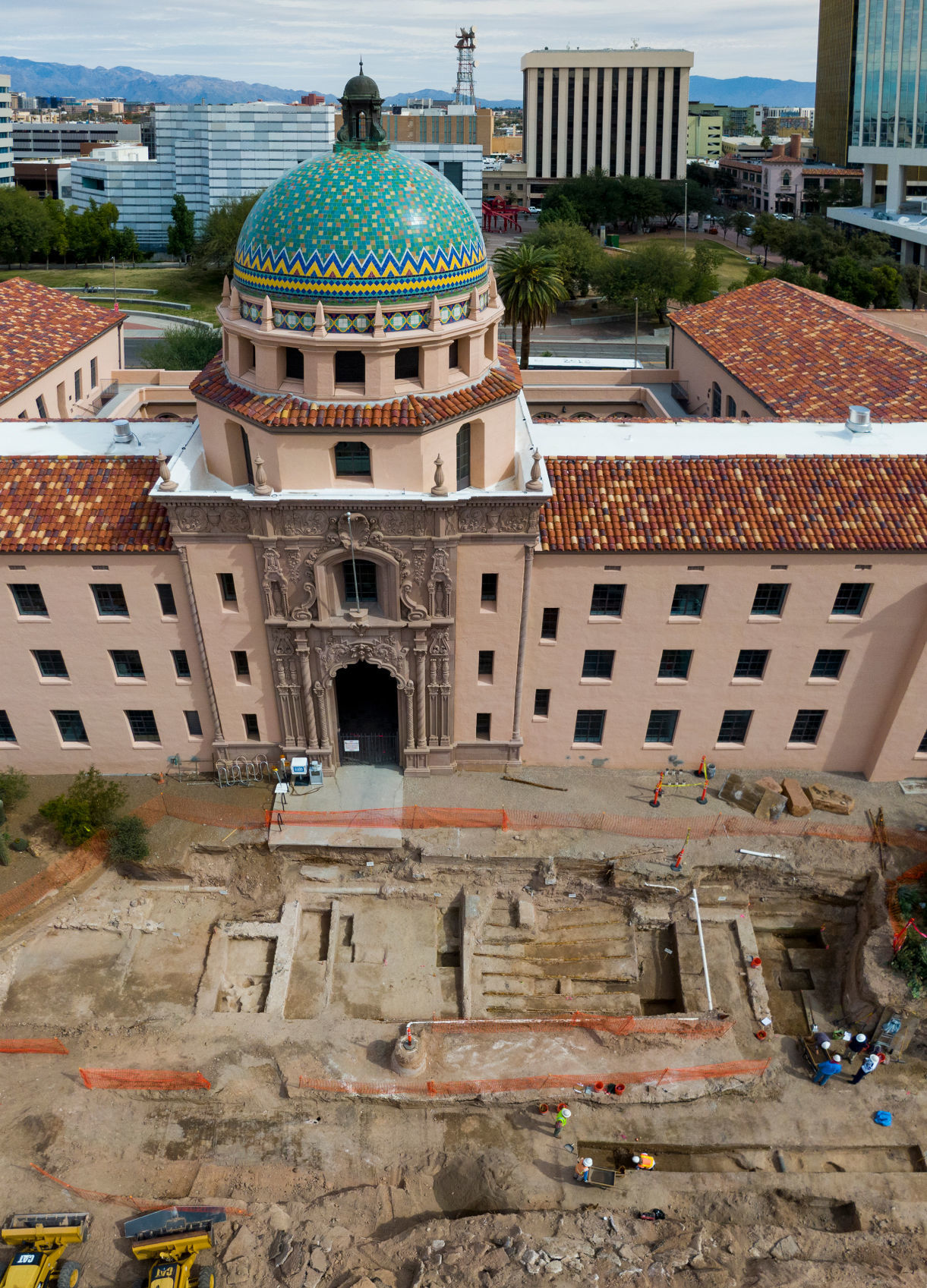
A drone provides an aerial view of an archaeological dig that was completed in 2019 to make way for construction of the new January 8th Memorial next to the historic Pima County Courthouse.
Archeological dig by the Historic County Courthouse
Updated
Workers dig for artifacts from Tucson's presidio past ahead of construction of the new January 8th Memorial on the west side of the historic Pima County Courthouse downtown.
Archeological dig by the Historic County Courthouse
Updated
A researcher holds out an artifact unearthed during a 2019 archaeological dig in downtown Tucson.
Archeological dig by the Historic County Courthouse
Updated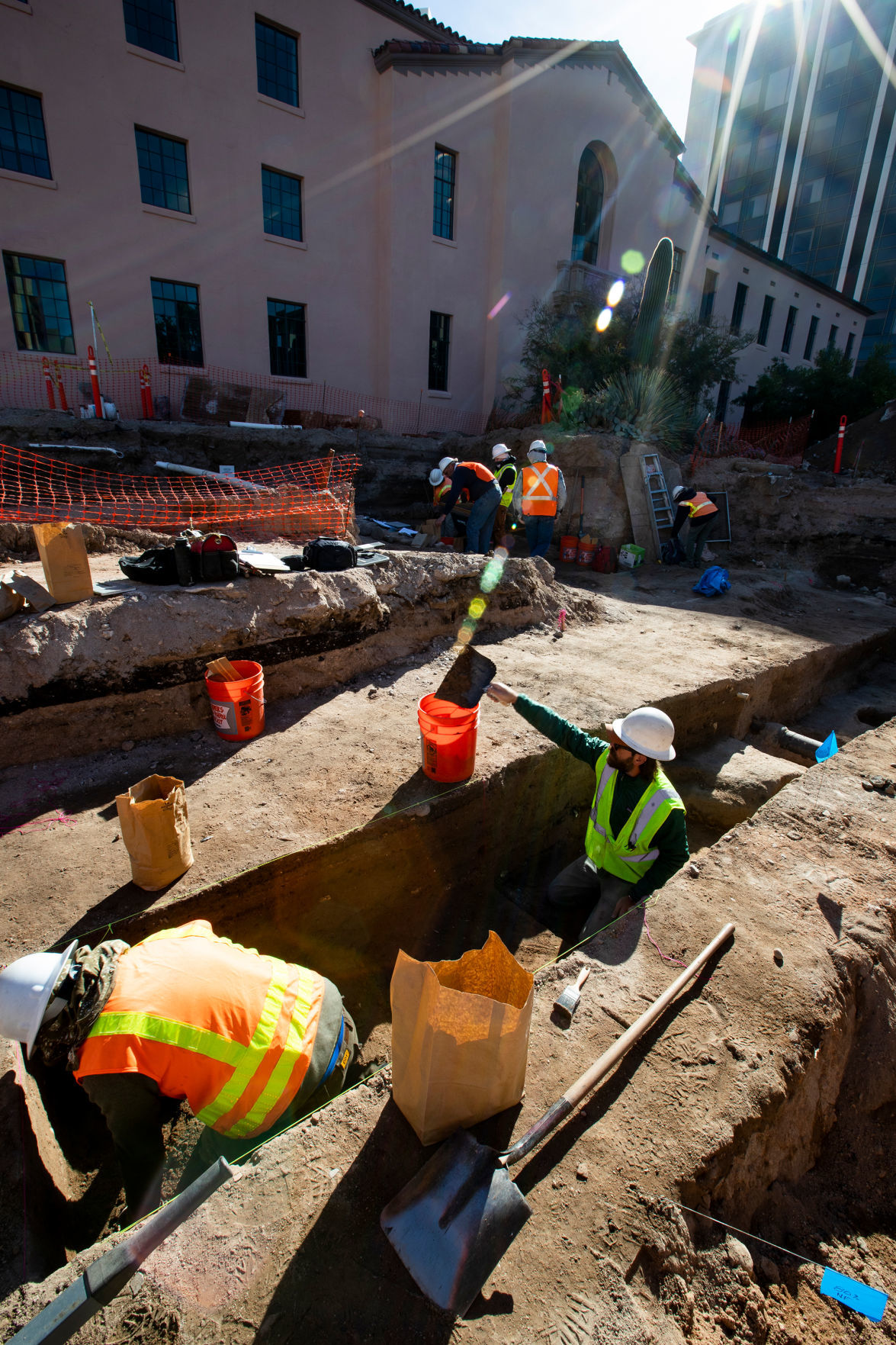
Workers search for artifacts at an archaeological dig west of the historic Pima County Courthouse in 2019.
Archeological dig by the Historic County Courthouse
Updated
A sign marks the location of a long-buried downtown street that was unearthed during an archaeological dig in 2019.
Archeological dig by the Historic County Courthouse
Updated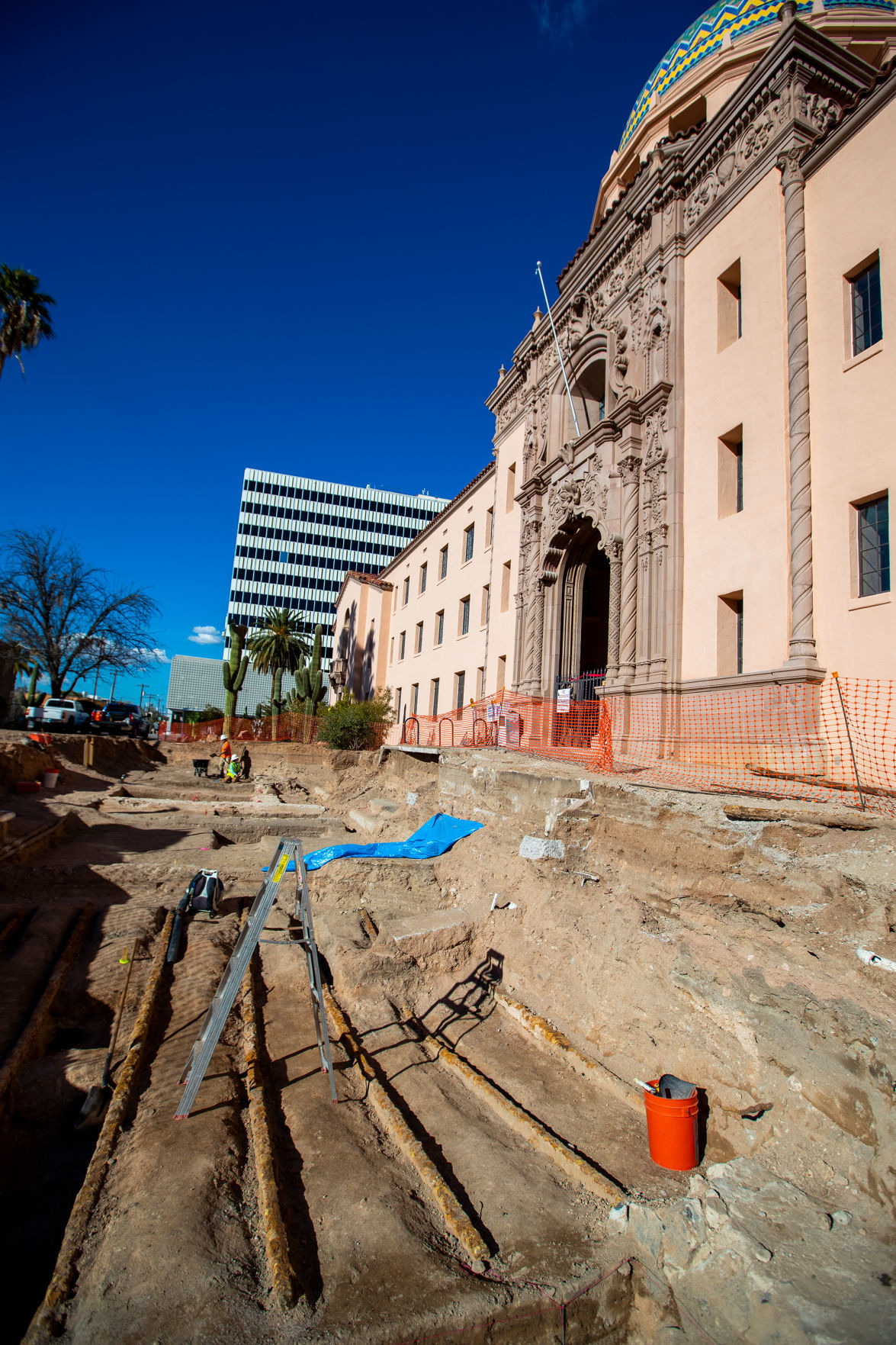
A trench marks the location of an archaeological dig conducted in 2019 in advance of construction on the new January 8th Memorial downtown.
Archeological dig by the Historic County Courthouse
Updated
A drone photo show progress on a downtown archaeological dig in 2019 that unearthed artifacts from the original Tucson presidio.
Archeological dig by the Historic County Courthouse
Updated
During the archaeological dig at the historic Pima County Courthouse, artifacts like this tile fragment from the 1929 courthouse were found.
Archeological dig by the Historic County Courthouse
Updated
These pieces of Mexican majolica pottery were among the artifacts found during an archaeological dig at the historic Pima County Courthouse.
Archeological dig by the Historic County Courthouse
Updated
An archaeological dig at the historic Pima County Courthouse turned up such artifacts as this French-made clay pipe stem.
Archeological dig by the Historic County Courthouse
Updated
This belt buckle was among the artifacts discovered during the archaeological dig in downtown Tucson in 2019.
Archeological dig by the Historic County Courthouse
Updated
Numerous farm animal bones, mostly from cows, were found during a downtown archaeological dig in 2019 that unearthed artifacts from the original Tucson presidio.
Zuni Indian pottery
Updated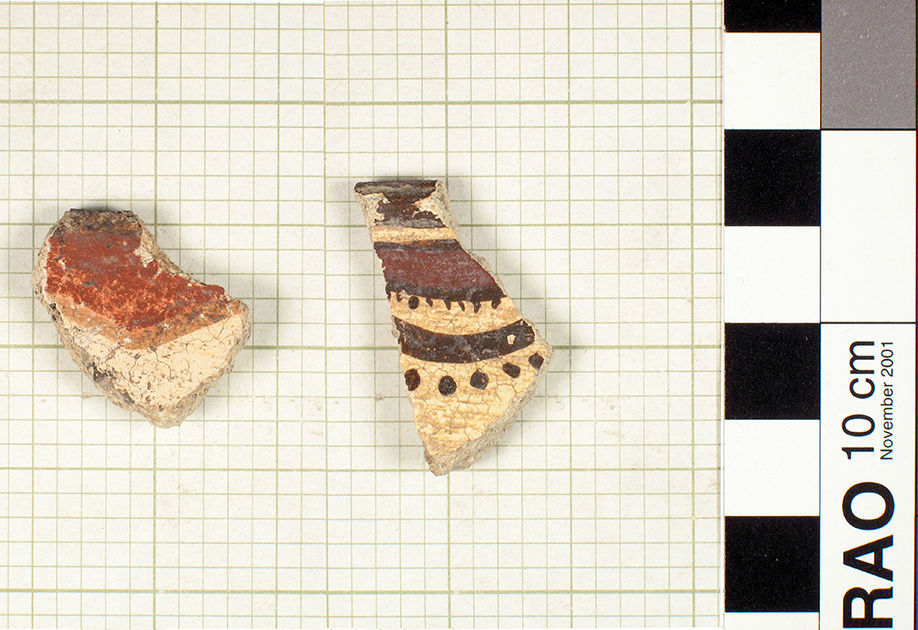
Researchers believe these pieces of Zuni Indian pottery unearthed from the site of the original Tucson presidio may date back to the late 1700s.
Zuni Indian Pottery
Updated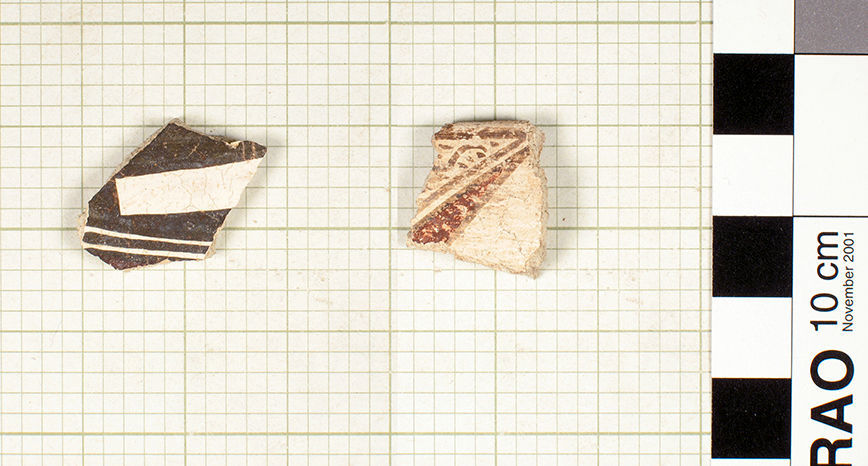
Spanish soldiers may have brought Zuni pottery with them to Tucson after a 1795 military expedition to what is now northwestern New Mexico.

