



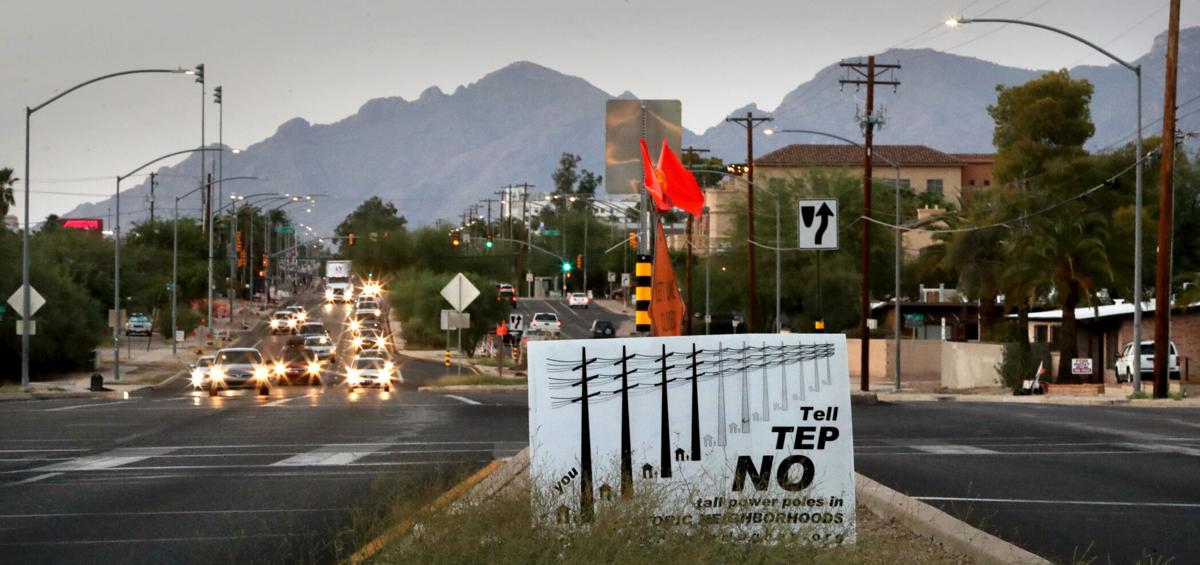
A proposed high-voltage transmission line that would run through central Tucson may be closer to fruition after the Tucson City Council approved certain exceptions Tuesday for utilities to build overhead power lines in scenic and gateway corridors.
Tucson’s planning commission approved amendments to the city’s Uniform Development Code, which prohibits overhead power lines along city-designated scenic and gateway corridors, on June 15.
The city council made further changes to the commission’s amendments but ultimately voted unanimously to approve a set of rules allowing utilities to avoid the costly undergrounding process in city-designated scenic and gateway corridors under certain conditions.
TEP is seeking to build a 138-kilovolt transmission line — with metal poles from 75 to 110 feet tall — from a substation at South Kino Parkway and East 36th Street up Kino to a new substation next to the Banner University Medical Center, and then up Campbell Avenue to a substation at its DeMoss-Petrie power plant just east of Interstate 10 off West Grant Road.
The conversation around the city’s undergrounding requirements has evolved since the city’s zoning administrator determined last summer the Kino transmission line must abide by the city’s undergrounding rules. The proposed route along North Campbell is a gateway corridor.
After a series of appeals, council members directed city staff to explore a special exception process for its undergrounding code, which would apply to any future utility transmission lines, including the Kino project.
Opponents of TEP’s transmission line — including the Tucson Underground Coalition, a group of about a dozen neighborhood associations in affected areas of the proposed line advocating for it to be built underground — raised concerns over the line obstructing scenic views, diminishing property values and invading historic neighborhoods.
TEP said the new line is needed to increase capacity and reliability amid growing demand and to serve the University of Arizona, which has agreed to buy 100% renewable power from the utility. Plus, installing the line underground would cost more than 10 times the cost of overhead lines with the extra cost estimated at up to $60 million through ratepayer revenues, according to the utility.
“On one hand, our growing city has a need for increased grid capacity and reliability. This could not be more evident as we strive to electrify our transportation system … we want to remove ourselves from fossil fuels and use much more electricity, which is perceived to be a cleaner energy source,” Mayor Regina Romero said at Tuesday’s meeting. “On the other hand, we collectively struggle with aesthetics and the aesthetics of having large transmission lines in our neighborhoods is something we do not want to see throughout our beautiful city.”
The amendments allow a zoning examiner to approve special exceptions for overhead power line installations if a proposed project meets at least two of a list of a criteria, including that a project is deemed compatible with surrounding zoning and land uses, would have “minimal impact on residential areas,” or would “provide electrical service to critical customers,” including the Davis-Monthan Air Force Base.
The city council made some changes to the amendments the planning commission approved at the request of Council member Steve Kozachik, who has spearheaded the effort to minimize any negative impacts of TEP’s proposed transmission line.
The changes include any repairs or upgrades to existing facilities cannot be larger than 10% of the height or width of existing facilities, down from the 25% the planning commission approved.
Four of the criterion listed were moved to blanket requirements instead of factors projects must qualify for at least two of, including that projects must be “as unobtrusive as possible” and must “remain consistent with the overall purpose and integrity” of gateway and scenic routes.
Kozachik clarified the intention of the code amendments, which allow for a thorough public review process.
“To suggest that the special exception — and I’ve heard this — a special exception is capitulation to the utility is simply false,” he said. “This is setting up a process by which the public will have a robust and multi-layered level of input into each request for an exception to the undergrounding requirements.”
The council’s decision gives TEP the opportunity to win zoning approval to install at least part of the Kino-DeMoss Petrie transmission line overhead, but the utility would still have to request specific exceptions through a public process before a zoning examiner.
Collection: Read more on Tucson Electric Power's proposed power line
Read the latest coverage of Tucson Electric Power's proposed power line plans.

Local residents can hear an update and comment on a high-voltage power line Tucson Electric Power proposes to build through much of central Tucson.

 Tucson Electric files for state approval of controversial power-line plan
For Star subscribers: Approval of a controversial power line that would cut through some of Tucson's historic neighborhoods could be months away.

Historic Tucson neighborhoods opposed to overhead lines and the city want the Kino-DeMoss Petrie line put underground, but TEP says it's too costly.
Residents of Sam Hughes, Jefferson Park, West University, Iron Horse and other neighborhoods listed as historic districts have opposed running the new transmission line, with 110-foot poles, through their neighborhoods.

Tucson residents will see new high-voltage power lines go up on the east side starting next year as Tucson Electric Power Co. builds a new transmission line to boost system reliability, especially for Davis-Monthan Air Force Base.

About 190 households among the 1,500 housing units the city owns are behind in rent and risk eviction. Notices are expected to go out in September.

The Arizona Department of Transportation is hosting a virtual meeting to provide information and gather input on a statewide electric vehicle charger deployment plan.

Pima Community College's Advanced Manufacturing building at the Downtown campus in Tucson is on track and expected to start hosting students next spring.

For Star subscribers: Tucson is devoting nearly $1.5 million to hire staff and upgrade systems to relieve delays in permit and plan approvals now lasting months.

