



Over the weekend, thousands of women took to social media, posting the words “me too” in solidarity with victims of sexual abuse and harassment in Hollywood.
“Right now, we’re on the front pages with this issue,” Tucson Mayor Jonathan Rothschild said Wednesday morning, as representatives from public-safety agencies across Pima County gathered to recognize what they called an epidemic of domestic violence.
“What’s been more important is the response to what’s been on the front page, which is so many women coming forward to talk about the harassment and assault they’ve experienced, wherever they work and wherever they live,” the mayor said.
But what struck Rothschild most about the issue was how the narrative focused on the number of people who have been raped or abused, rather than the number of people who have been the perpetrators of rape and abuse.
“We need to ask the same question of domestic violence: Why do we speak in terms of the number of victims rather than the number of abusers?” Rothschild asked.
“We need, as a society, to speak about the problem a different way. A way that places the responsibility squarely where it belongs: On the perpetrators.”
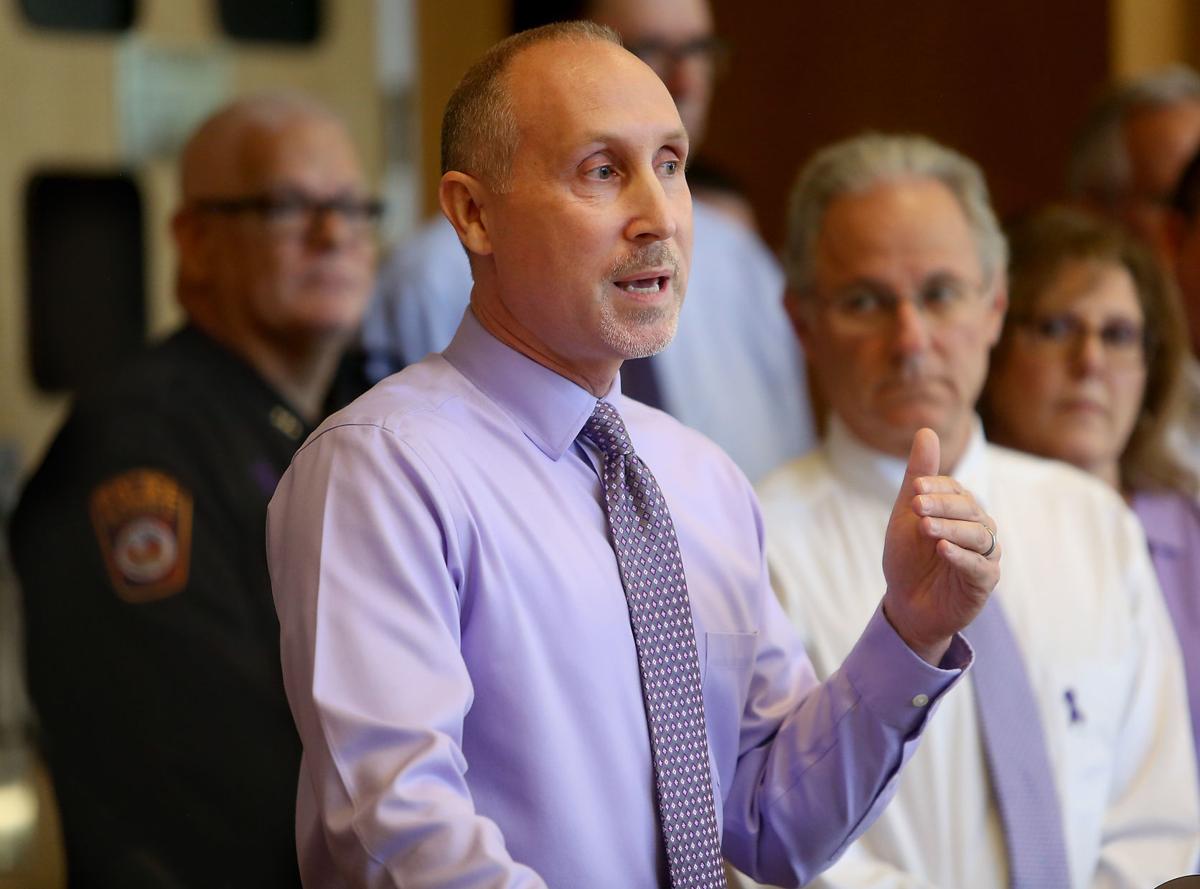
On an average day in Pima County, 16 new domestic violence victims seek help from Emerge! Center Against Domestic Abuse, said the agency’s CEO, Ed Mercurio-Sakwa.
“It’s the 30th anniversary of domestic violence awareness month, and while that’s something to celebrate that for three decades we’ve been working hard to raise awareness about this issue, it also speaks to the fact that decades and decades later, we’re still talking about this issue,” Mercurio-Sakwa said. “While we know that this is a slow process ... if we have many more decades of this celebration, honestly I feel like we’ve failed.”
Each year, local law enforcement responds to 15,000 calls related to domestic violence and 6,000 victims and children enter the shelter, Mercurio-Sakwa said.
“We cannot allow time to continue to click away as this happens,” he said.
Law enforcement’s role in serving domestic violence victims is critical, but it’s not just that they respond to 911 calls, Mercurio-Sakwa said.
“How you choose to respond is critical. That is what can make the difference as to whether a victim decides that it’s safe to continue to ask for help,” he said. “Whether taking that very real, physical risk of asking for help is the smart thing to do at the moment.”
With representatives from the Pima County Sheriff’s Department and the Tucson, Marana, Oro Valley and University of Arizona police department standing by, Mercurio-Sakwa thanked the departments for their work and asked them to continue to respond with the same level of care and concern.
“Domestic violence touches every gender, every socioeconomic class and it erodes the quality of life in our community for so many,” said Pima County Sheriff Mark Napier.
“Victims of domestic violence need to realize that law enforcement passionately cares about this crime and we’re committed to eradicating and discouraging domestic violence in our community.”
To date, the Sheriff’s Department has responded to 3,000 domestic violence calls this year, Napier said.
Over the past 30 years, the way domestic violence is viewed and handled by law enforcement and the Legislature has changed significantly, said Pima County Attorney Barbara LaWall.
Law enforcers now understand that in domestic violence, there is always an element of control held by the abuser over the victim, and training has changed as a result.
“These are things that are progressive that have improved the way we deal with domestic violence, but there’s still a long road ahead,” LaWall said. “This is an issue that we’re dealing with right now today in this country.
The situation has to change, she said.
“We’re working on them, they’re incremental changes, but we need to move ahead faster,” she said.
“We need to give out the message to the community that if you are abusive, if you’re guilty of this crime, we will hold you accountable.”
The Tucson Police Department is on track to have 9,500 cases of domestic violence investigated this year, said Assistant Chief Carla Johnson.
“There’s something about our society that sends the message that it must be OK on some level to do this, and it’s not,” Johnson said. “We need to send a stronger message.”
In 2017, TPD added a sergeant and three detectives to the domestic violence unit, but it’s still not enough, Johnson said.
Part of the problem is the idea that domestic violence is a private matter, and oftentimes friends and neighbors may not come forward when they suspect abuse, Mercurio-Sakwa said.
“This issue thrives in silence because people believe it’s a private matter. That culture has led to many deaths in our community,” he said.
“When you’re talking about 15,000 911 calls a year ... that isn’t a private matter. That’s a public safety and a public health issue.”
When the culture shifts so that people understand that everyone has a responsibility to end domestic violence by changing what’s viewed as acceptable, people will start speaking out, Mercurio-Sakwa said.
As of now, only one in 10 instances of domestic violence gets reported to police, Mercurio-Sakwa said.
“There’s something about the way we speak about domestic violence that gets people thinking about the victim, and what the victim could have done and should have done differently, and that is totally wrong,” Rothschild said.
“The only legitimate question is what the perpetrator could have or should have done differently, and the answer to that is not to commit the abuse.”

