


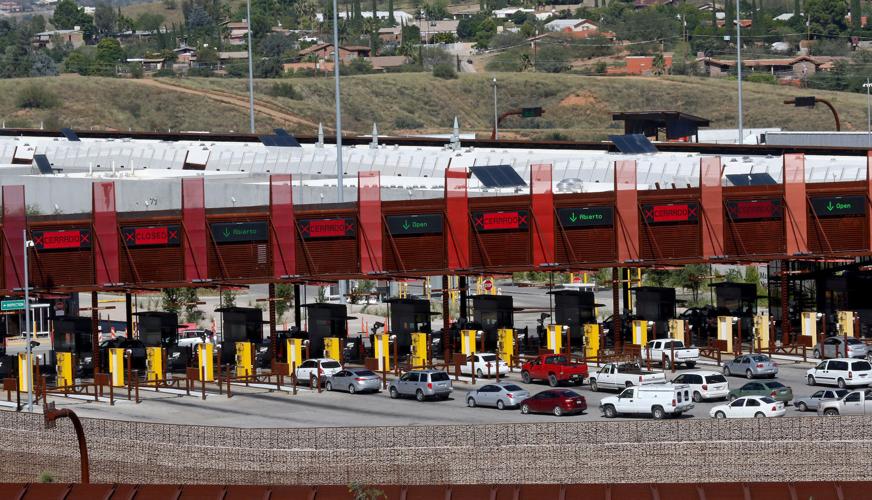
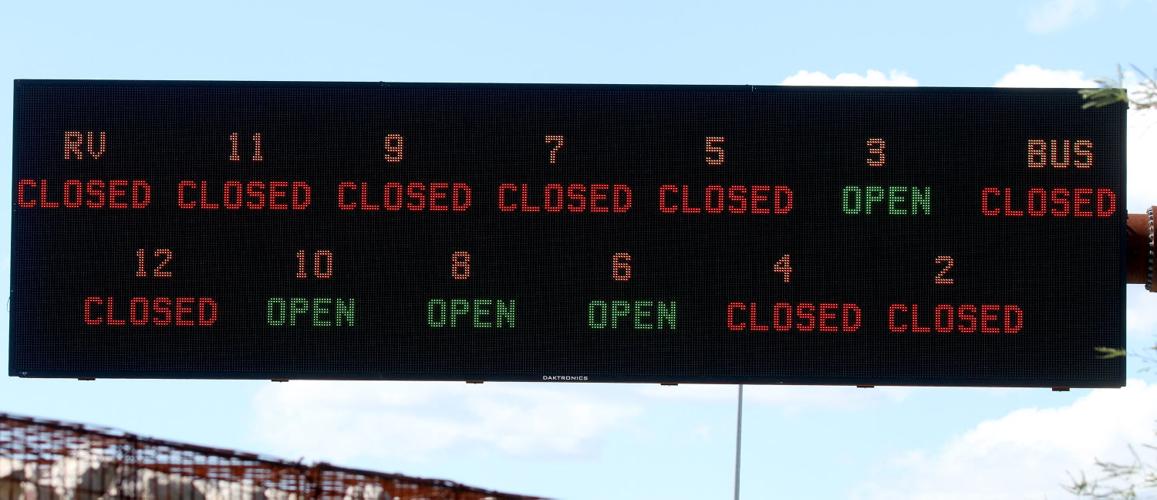
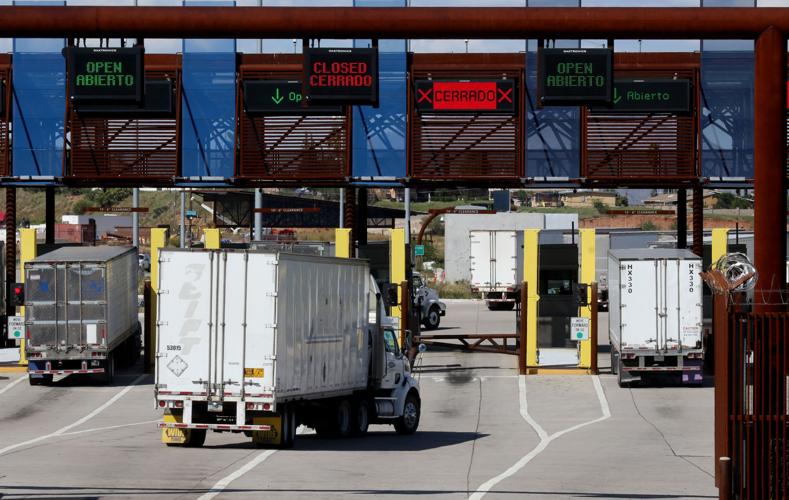
A shortage of customs officers at the newly expanded Mariposa Port of Entry in Nogales means there are days when many of the 20 lanes are closed.
The staffing shortage is part of a national problem. Customs and Border Protection got approval last year to hire 2,000 customs officers by the end of this fiscal year — including 170 in Arizona — but the federal agency has filled only about 800 of them. Officials attribute the shortfall to a background investigation contractor’s data breach, low polygraph clearance rates among applicants and a shortage of federal polygraph examiners, all combined with the attrition of existing customs officers.
To ease the shortage and get cars moving through the port, which is crucial to trade between the U.S. and Mexico, the city of Tucson is helping the agency find qualified applicants by hosting a job fair on Nov. 9. The Tucson Police Department will also participate.
Tucson Mayor Jonathan Rothschild said the idea for a job fair came out of his visit with CBP officials in Washington, D.C., over the summer. The event will target recent college graduates, criminal justice majors, veterans and anyone looking for a career in law enforcement.
At the federal level, Arizona U.S. Sens. John McCain and Jeff Flake and U.S. Rep. Martha McSally, all Republicans, introduced bills in both chambers to expedite the hiring of veterans as customs officers by having the Department of Defense and the Department of Homeland Security work together. The bill, the Border Jobs for Veterans Act, awaits the president’s signature. About 30 percent of CBP employees are military veterans.
“It takes as long as 12 to 18 months to get a clearance. That’s insane,” McCain said during a recent visit to Tucson. “Somebody who gets out of the military is not going to wait 12 to 18 months to get a job, so we’ve got to accelerate that.”
CBP did not respond to repeated requests about the number of applicants and positions that have been filled locally and nationally. The Nogales International newspaper reported that Arizona ports are approved for up to 920 positions, but have just over 700 staffed.
WHY STAFFING MATTERS
Arizona’s ports of entry serve as gateways to an annual $41.6 billion in U.S.-Mexican trade. Nearly $16 billion is attributed to Arizona’s bilateral trade with Mexico, the Arizona-Mexico Commission has said.
If the ports are not properly staffed, McCain said, “Maybe over time some of these goods and services will go to another port of entry someplace else, and that’s not good for Arizona.”
That prospect worries business and government officials in the region.
The Mariposa Port of Entry’s $250 million expansion was completed in October 2014. The project increased the port’s capacity to process more than 4,000 trucks a day, up from the 1,500 to 2,000 trucks it processes now during the peak season. It also added eight car lanes, bringing the total to 12 lanes for cars and eight for commercial trucks.
The port of entry is one of the 10 busiest cargo ports along the U.S.-Mexico border and the one where most of the Mexican produce imported into the United States comes through.
“We are making big progress,” Rothschild said. “Last year, Arizona had a 22.2 percent increase in exports and imports. Tucson grabbed $8.6 billion, 15 percent of that number.”
But for the region to become the logistics and transportation hub officials think it can be, he said, “We need infrastructure built, roads, and we need ports to be as efficient as possible.”
Slow HIRING PROCESS
Nationwide, there are about 22,000 customs officers, but the hiring and training process is time-consuming, usually taking about 1ƒ years. Applicants must go through an online application, cognitive exam, fingerprint collection, financial disclosure, structured interview, fitness test, medical exams, background investigation, drug test and polygraph exam — before a four- to six-month academy.
As of October 2012, all customs officers and Border Patrol agents are required to take a polygraph test, which was part of the Anti-Border Corruption Act of 2010. In fiscal 2012, 50 percent of CBP applicants failed, a Government Accountability report found.
One problem, said Steve Lenkart, executive director of the Federal Law Enforcement Officers Association, is that the job is attracting a large number of unqualified applicants, but the agency still must go through all the applications to weed them out.
“People doing the hiring are completely overwhelmed, from background investigators to polygraph examiners,” he said.
The lack of an educational requirement is partly to blame, he said.
“One of the theories is that if you set a minimum educational requirement, you start at least weeding through some of the lowest-qualified candidates.”
The agency takes into account professional experience if an applicant does not have a college degree.
Other problems, Lenkart said, are competition with the private sector and cartels trying to infiltrate the agency, which means CBP has to be even more diligent in who it hires.
About 1 percent of applicants make it through the entire process, said Karla Avalos, community organization and development coordinator for Tucson, who is helping organize the job fair.
In response to a letter from McCain and Flake asking about staffing at Arizona ports of entry, DHS officials said they’ve added questions to the application process to screen out unsuitable candidates. They’ve also posted multiple job opportunity announcements, increased the number of sites where applicants can complete a required cognitive test and boosted the agency’s polygraph examination capacity.
When the agency realized it wasn’t going to be able to meet its goal of filling the 2,000 positions by the end of this fiscal year, which ended Sept. 30, officials should have done more, McCain said.
But the agency has said it is committed. “Now we are doing everything we can to make sure they have the number of people they need,” he said.

