




Three federal agents visited long-time Tucson restaurant La Indita this week, seeking to verify the legal status of its employees, which the owner called an attempt at “intimidation.”

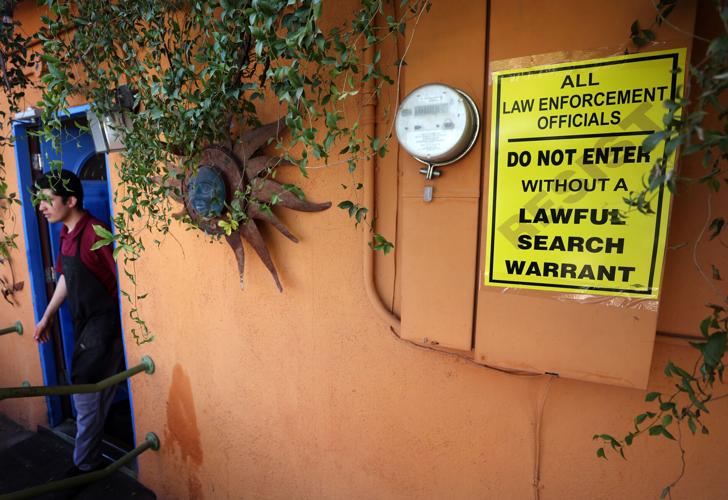
A sign hangs near the back door at La Indita Restaurant, 722 N. Stone Ave. Investigators from Homeland Security visited the restaurant Tuesday.
“It’s never happened before in 40 years,” said La Indita owner Denise Schafer. “It just feels like we’re under the microscope and that we were targeted because we are an Indigenous restaurant.”
Schafer said an employee called her midday Tuesday to say three agents with Homeland Security Investigations, part of U.S. Immigration and Customs Enforcement, or ICE, were at the restaurant.
“I thought he was joking,” said Schafer, who said she was in the middle of an internal audit of her employees’ documentation — who all have legal status — at the time of the call.
Schafer immediately contacted civil rights attorney Stacy Scheff and asked her to meet her at the restaurant on North Stone Avenue, where it’s been located since 2021.
Scheff said the HSI agents didn’t have a warrant, which isn’t required to access the public-facing area of a business, and didn’t appear to be targeting any particular employee. Under an I-9 audit, a business has three days to provide identification and employment-eligibility documentation for each employee, she said.
“They have the right to do it, but they generally save their energies for cases where there’s some evidence of wrongdoing,” Scheff said. “These guys seem to be doing this for no reason other than to intimidate, to harass, to target Hispanic businesses and locate folks that could be deported.”
Schafer said she asked the HSI agent why they were chosen for an audit and he said every business registered with the Arizona Corporation Commission would be audited, unless they are already enrolled in E-Verify, the federal employment-eligibility verification program.

Schafer
Tucson immigration attorney Mo Goldman said these audits have picked up in recent months, even before President Donald Trump took office, and businesses should be on the lookout for discriminatory tactics.
At least two other local businesses — a bakery and a construction company — have undergone a Form I-9 audit in recent weeks, as ICE seeks to boost its arrest numbers, said Alba Jaramillo, an immigration attorney and organizer with Coalición de Derechos Humanos, a human-rights advocacy group in Tucson.
At the bakery, agents did make one targeted arrest of someone who likely already had a removal order, and agents also asked other employees about their legal status, said Jaramillo, who spoke with the business owner immediately after the ICE visit last month. The employees declined to answer and referred agents to the owner, she said.
ICE will often visit a business to pick up a known target, then inquire about the legal status of people nearby the target in hopes of making “collateral arrests,” she said.
ICE spokeswoman Yasmeen Pitts O’Keefe said she could not share any Tucson data on the number of Form I-9 audits conducted here.
“I don’t have local numbers at present but what I can tell you that these are ongoing investigations and limited information is available,” she said in a Wednesday email. She could not answer the Star’s query about how businesses are selected for an audit.
Schafer said the HSI agent told her the business was not under investigation.
“They’re saying one thing (publicly) and they’re telling us another, so which is it?” she said. “Do you have an ongoing investigation and if you do, why didn’t they let us know we are under investigation?”
ICE agents are now facing arrest quotas, as the Trump administration ramps up pressure to increase arrests and deportations. Top immigration officials have been frustrated by the pace of deportations so far: The Washington Post reported Tuesday that two top ICE officials were demoted from their positions, as the agency struggles to meet those targets and as some detainees have been released from custody, due to detention space constraints.
Immigrant-rights advocates emphasize that those without legal status have the right to remain silent when questioned by ICE agents and do not have to volunteer information about their immigration status. Advocates recommend asking to speak with a lawyer, if questioned by agents, and asking, “Am I free to leave?”

Francisca Garcia cooks up tortillas for use in dishes at La Indita Restaurant, 722 N Stone Ave.
If ICE agents want to enter a home or private space, they must have a judicial warrant, signed by a judge. An ICE warrant, also called an administrative warrant, does not give the agency permission to enter a home without consent.
La Indita, opened by Joseph and Maria Garcia in 1983, specializes in Mexican and Tohono and Tarascan native foods and has been a gathering place for civil rights lawyers and activists for years, Schafer said. A sign outside warns law enforcement not to enter without a lawful warrant.
Schafer, owner of La Indita since April 2024, said she’s speaking out about the audit because she wants to push back against what she called a “fishing expedition” at a local business that’s a proud supporter of community organizers. She wants Tucson businesses to be prepared.
“Assert your rights, make sure the paperwork doesn’t look dodgy,” she said. “Just because we ask questions doesn’t mean we’re doing something wrong.”

