



After five federal agents showed up unexpectedly at their home south of West Ajo Highway last week, Venezuelan nationals Yoleidy and her husband Juan said their four children couldn’t sleep.
They stopped playing their usual games and couldn’t even concentrate on their favorite TV shows, fearful that agents from U.S. Immigration and Customs Enforcement would separate their tight-knit family.

On Tuesday, Venezuelan nationals Yoleidy and Juan anxiously waited inside of their southwest Tucson home for a visit from U.S. Immigration and Customs Enforcement agents. Five agents from ICE’s investigative unit, HSI, had showed up unexpectedly the day before, saying they’d return the next day to ensure the couple’s children weren’t being trafficked. Yoleidy said her sons couldn’t sleep, and stopped playing their typical games, for fear of being separated from their family and retuned to Venezuela. “We don’t know why this is happening,” she said at her home on Tuesday.
The couple said they fled widespread violence in Venezuela in 2022 and are in the process of pursuing asylum protection. But on Monday, agents from ICE’s Homeland Security Investigations unit told Juan they were investigating whether their children were trafficking victims. The agents said they’d return on Tuesday at 4 p.m., when the kids were home from school, the couple said.
For her four boys, all under age 13, the waiting period was filled with “anxiety and terror,” Yoleidy said, speaking in Spanish. One of her sons was “trembling,” during what she called a nervous breakdown.
“We don’t know why this is happening,” Yoleidy said, sitting at her kitchen table Tuesday. The Star is only using the family members’ first names due to their fear of separation.
In the family’s home, immigration attorney Luis Campos said he intended not to let the agents enter unless they had a judicial warrant, signed by a judge. The family has been attending all ICE appointments as they pursue asylum, he said.
“They’re in full compliance. No criminal history of any kind, no prior removals,” he said Tuesday. “They shouldn’t be a target.”
With 30 minutes before agents were to return, and all necessary paperwork for the children prepared, the only thing for the family to do was wait.

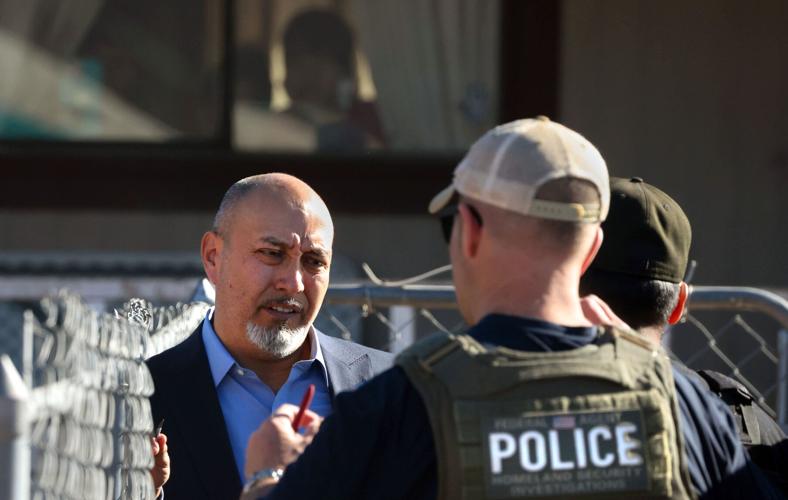
Attorney Luis Campos talks to agents from Homeland Security Investigations, a division of U.S. Customs and Immigration Enforcement, in front of Yoleidy and Juan’s Tucson home on Tuesday, Feb. 25. The agents were “civil,” and asked to see the children, Campos later said. The four boys came out onto the porch and 10-year-old Carlitos flashed a thumbs up and told agents, in English, “We’re a good family.”
Tucson advocates are organizing to help undocumented and mixed-status families cope with prolonged fear and anxiety, stemming from a heightened presence of immigration agents in Tucson, and an endless stream of news — as well as false rumors and misinformation — about the Trump administration’s mass deportation campaign.
Experts have warned that U.S. authorities are intentionally wielding fear in hopes of scaring immigrants — including those who entered the U.S. legally, via programs since canceled by the Trump administration — into self-deporting.
Local advocates with Coalición de Derechos Humanos, or Human Rights Coalition, have formed a mental-health committee and on Saturday, the group offered a free Spanish-language wellness session, led by trauma therapist Sandra Martínez, focused on emotional well-being during uncertain times.
“We’re hoping this is one more tool that the community can access to take care of themselves,” said Violeta Dominguez, volunteer with Derechos Humanos.
A program of the National Autonomous University of Mexico, known as UNAM — in partnership with Mexican consulates and the Mexican Foreign Ministry — now offers virtual mental-health assessments and treatment, free of charge, for migrants of any immigration status in the U.S. or Canada, as well as those recently returned to Mexico, either voluntarily or through deportation.
The platform, Acción Migrante, or “Migrant Action,” is also available for advocates and organizers, who can themselves experience secondary trauma through their work with the immigrant community, said Mexican Consul in Tucson Rafael Barceló.
Undocumented families say they’re avoiding going out, dropping their kids off at school or even shopping for groceries for fear of being caught up in heightened immigration enforcement since President Donald Trump took office.
As during the COVID-19 pandemic, being trapped inside and socially isolated can exacerbate anxiety and lead to depression, mental health exerts say.
In Tucson’s immigrant communities, “There is a constant and mounting stress,” Consul Barceló said. “This definitely is having a toll on the mental health. You’re restraining your normal activities, to reduce to a minimum the risk of being deported or detained by authorities.”
There isn’t a clear line marking when difficult situations became traumatic, therapist Martínez said. But risk factors include chronic stress, as well as sudden and unexpected incidents, such as an ICE raid or home visit, she said. Previous unaddressed trauma increases the risk, she said.
“That pathological stress is the one that is sustained over time, that is increasingly intense and leads to difficulties in concentration, sleep disturbances, eating problems, even increased intake of substances,” Martínez said. Saturday’s self-care forum aims to help attendees “identify if they are at risk and what they can do to prevent a situation that is out of their control from occurring.”
Children susceptible, including citizens
Family separation, or witnessing one’s parents interrogated or detained by armed agents, are life-changing experiences for children, said Alba Jaramillo, community organizer for Coalición de Derechos Humanos and co-executive director of Immigration Law and Justice Network.
“These kids are going to grow up with this trauma for the rest of their lives, and the distrust in law enforcement, in the government,” she said.
Heightened ICE enforcement not only affects undocumented people: There are 4 million mixed-status families in the U.S., including 5 million U.S. citizen children with undocumented family members, according to the American Immigration Council.
Children are absorbing the anti-immigrant rhetoric that has surged since the 2024 election cycle, advocates say.
In Texas, 11-year-old Jocelynn Rojo Carranza died by suicide Feb. 8, after reportedly being bullied by classmates who threatened to call ICE on her parents. Jocelynn, who was on life support for five days before she died, was born in the U.S., according to her obituary. Her parents told news outlets the school didn’t inform them Jocelynn was being bullied.
“We don’t know if she made the decision in fear of being alone … Or if she had been told to do it, so that she would not be left alone,” her mother Marbella Carranza told CNN. “These are unanswered questions that I still have, why, why did she do it.”
Open communication with children during times of uncertainty is key, as is making a safety plan for the worst-case scenario, said Martínez, curriculum-development director with Arizona Community Health Workers Association.
“It’s important to talk to them about, ‘What do you think? What are the fears you have?’ And from there, start to make action plans,” which can help lower tension in the brain, she said.
“That is the most we can do right now,” she said. “But we have to be sincere, and talk about fear, and even talk about anger.”

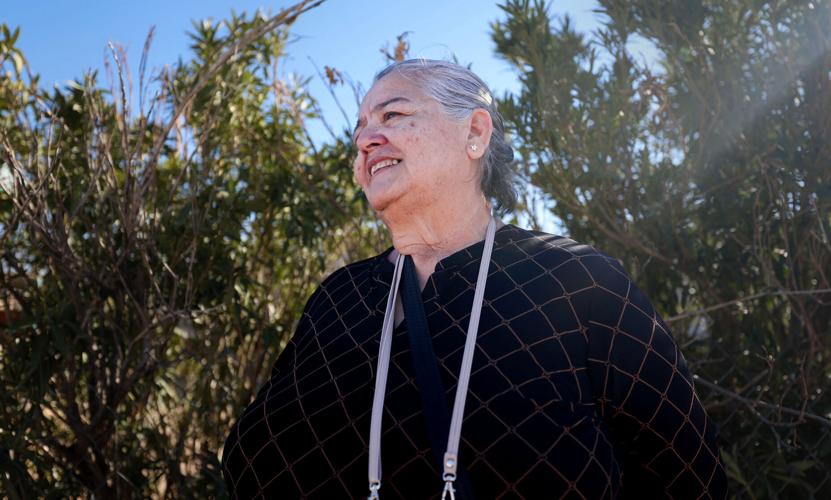
Maru Carrasco, an organizer with Coalición de Derechos Humanos, is part of the advocacy group’s “Rapid Response” network. After hearing about Yoleidy and Juan’s impending ICE visit on Tuesday, she and other volunteers quickly arrived at the family’s home to bear witnesses and ensure rights weren’t being violated. Throughout Tucson’s immigrant communities, families are “in panic,” Carrasco said, speaking outside the family’s home in southwest Tucson on Feb. 25.
The Trump administration has issued a stream of executive orders and policy changes that seek to close access to humanitarian protection in the U.S., even retroactively rescinding legal status for asylum seekers who waited months for a chance to enter the U.S. through a port of entry as U.S. officials recommended.
Trump’s ICE is now seeking to require a certain pool of non-citizens, including undocumented immigrants without prior contact with immigration officials, to register with the government, or face criminal prosecution and up to six months in jail.
Venezuelan families like Yoleidy and Juan’s, who initially received “Temporary Protected Status” under a Biden-era program, are newly vulnerable since the Trump administration announced it has terminated the protection program, starting in April.
Under U.S. law, as well as international accords, it is legal to request asylum once on U.S. soil — though it may not be granted — regardless of how one entered the country, Campos said.
By canceling all pathways to asylum, “to a large extent, the United States is acting unlawfully in how they treat individuals requesting asylum,” Campos said. “We’re now ensuring they be criminalized and removed from the country.”
The Trump administration is further destabilizing immigrant communities by rescinding prior ICE guidance that limited enforcement in “sensitive locations,” such as churches, schools and hospitals, Campos said.
“That’s an example of the additional trauma being inflicted on children and families, this feeling that no place is safe in the United States,” he said.
Finding ways to maintain social connections from home, and access mental health services virtually, can help alleviate isolation, Barceló said. Avoiding misinformation and rumors, and seeking out quality information from reliable news outlets, and the Consulate’s Office, is also critical, he said.
“Being close to your community, to your trusted core and to your family is a good way to take care of yourself, and to take care of the people you care about the most,” he said.
'We’re a good family'
The Trump administration is also directing ICE to track down, and potentially deport, children who arrived in the U.S. as unaccompanied minors, Reuters reported, which experts said could further traumatize children who have already experienced family separation and likely spent months in Office of Refugee Resettlement facilities.
“The deployment of armed ICE agents to the homes of immigrant children and their sponsors does not enhance their safety; it exacerbates their trauma and undermines the values we hold dear in this country,” said a statement from the Young Center for Immigrant Children’s Rights in Chicago.
That recent directive may have been what prompted HSI’s visit to Juan and Yoleidy’s home, attorney Campos said.
Three years ago, the couple and their 10-year-old son surrendered to border agents after crossing the border near the El Paso port of entry. But their other three boys entered the country through the port of entry, with their aunt, after receiving an appointment through CBP One. That’s the Biden-era scheduling app that Trump canceled the day of his inauguration.
Because the boys were not with their parents, they were separated from their aunt and processed as unaccompanied minors. They spent weeks in an ORR shelter before being reunited with their parents in Tucson.
On Tuesday afternoon, a handful of reporters and volunteers with Coalición de Derechos Humanos’ “Rapid Response” network stood outside Yoleidy and Juan’s home as two unmarked vehicles slowly drove toward the home.
Two armed agents from one of the vehicles approached the gated yard and were greeted by Campos, who asked them to stay outside the yard. The agents were “civil,” and asked to see the children, Campos later said.
The four boys joined their parents on the front porch and waved. Ten-year-old Carlitos flashed a thumbs up and told agents, in English, “We’re a good family.”
The agents left without incident, waving to reporters as they drove away.
“I thought they were going to send us back there” to Venezuela, Carlitos said in Spanish, standing on his porch after agents left. “I told them we’re very comfortable here, that we’re okay.”
But the experience still haunts the family, Yoleidy told the Star on Friday. While the agents were present, “I didn’t let myself give up or let my guard down, for my children,” she said. But since then, she’s felt physically ill and emotionally exhausted.
“The truth is, I still feel the same stress that they could return and separate me from my children. That’s my main fear,” she said.
Campos said he doesn’t know what would have happened had there not been reporters and activists present Tuesday.
“I can only imagine the worst-case scenario would be that the children would have potentially been taken. As egregious as that sounds, there’s precedent for that,” he said.
Top Trump officials such as Stephen Miller and “border czar” Tom Homan have a history of “using children as tokens, or as pawns, to punish parents,” he said, referring to the mass family separations that occurred in Trump’s first term. “Given that history … I can’t put that beyond them.”
'Worst of the worst'
Trump administration officials have said deportations would be focused on people with criminal histories.
“Last week, ICE continued arresting the worst of the worst criminal illegal aliens first,” the Department of Homeland Security posted on social media on Feb. 25.
But during the first two weeks of February, 41% of the 4,400 people arrested by ICE had no criminal record, compared to 28% under Biden in 2024, according to data obtained by NBC News.
Yasmeen Pitts O’Keefe, ICE deputy communications chief for the southwest region, has said the agency does not have any Tucson data to share, in response to the Star’s repeated requests for how many local arrests have been made.
While Trump officials have falsely suggested all immigrants without legal status in the U.S. are “criminals,” immigration experts emphasize being present in the U.S. without legal status is a civil violation, not criminal.
Even some of the 178 Venezuelan migrants who’ve been detained at Guantanamo Bay have no criminal history, or only minor violations, such as riding a bicycle on the wrong side of the street, the Miami Herald reported. Some entered the country through a port of entry for scheduled appointments to request asylum, the report said.
“They’re going after anyone; it’s no longer about criminals,” Jaramillo said. “I think that language worked really well during their campaign period, because people could sympathize with that. But the reality is that this administration does not want immigrants at all, whether they’re here lawfully or unlawfully.”
Advocates say many of the Trump administration’s policy changes are aimed at increasing the pool of deportable immigrants. The agency has struggled to make enough arrests to fulfill ICE’s new quotas of between 1,200 and 1,500 arrests per day, the Washington Post reported.
Trump administration officials have decried efforts to inform undocumented immigrants about their rights under the U.S. Constitution, including the right to remain silent when questioned by ICE agents. Advocates also emphasize that unless an ICE agent has a judicial warrant, signed by a judge, they can’t enter a private home or space without consent.
Those educational efforts, which experts say are clearly protected under the First Amendment, have stymied ICE attempts to make “collateral arrests” while detaining people who are known targets, Jaramillo said.
The work has angered Homan, who told Fox News he asked the Department of Justice to look into whether Democratic Rep. Alexandria Ocasio-Cortez was “impeding” law enforcement by hosting a “Know Your Rights” webinar this month. “Maybe AOC is going to be in trouble now,” Homan told Fox News.
Ocasio-Cortez, of New York, has not backed down and, in a letter Thursday to Attorney General Pam Bondi, asked for clarification on the possible investigation, which hasn’t materialized.
“Homan has nothing,” Ocasio-Cortez wrote on X, formerly Twitter. “The Fourth Amendment (protecting people from unreasonable searches and seizures) is clear and I am well within my duties to educate people of their rights.”
In Tucson, and across the country, education has been a powerful tool to protect vulnerable populations, Jaramillo said.
“Communities are organizing and defending themselves, and I don’t think the Trump administration was ready for this rapid mobilization that we’re doing in all communities,” she said. “That is what our power is. That’s how we can defend ourselves — showing up as a community and standing up to the government.”

