



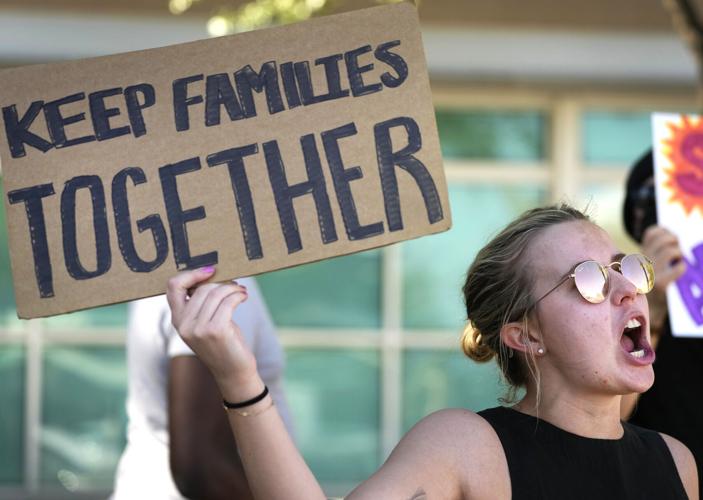

The Trump administration’s deportation campaign is now targeting U.S. courthouses, pursuing immigrants as they attend required court hearings, at the same time that the Department of Homeland Security has moved to reopen thousands of immigration cases previously deemed “low-priority” and closed, local attorneys say.
Over the last week, immigration agents, often wearing masks, have been conducting mass arrests outside federal courthouses in major U.S. cities, including Phoenix. The arrests mostly came swiftly after judges suddenly dismissed immigrants’ cases, leaving them vulnerable to deportation, attorneys say.
The Arizona Daily Star has learned of only one such case at Tucson’s immigration court, on West Congress Street, which is significantly smaller than Phoenix’s courthouse. Critics say the arrests reflect a joint effort of the government’s attorneys, who file the motions to dismiss, and U.S. Immigration and Customs Enforcement, whose agents have been positioned to immediately detain those with dismissed cases.
The arrests have included asylum seekers and people who entered the U.S. legally, through a port of entry, using the Biden-era CBP One scheduling app, which Trump has since canceled.
The arrests ignore immigrants’ right to contest or appeal a case dismissal, and will discourage many from attending court proceedings, said Alba Jaramillo, an organizer with Tucson’s Coalición de Derechos Humanos, or Human Rights Coalition.
“The fact that ICE is picking people up as soon as their case is dismissed is a huge due-process violation,” Jaramillo said. “The right to appeal is part of our fundamental rights under the Constitution. ... (The arrests) undermine our community safety, and add to the trauma and the violence that our immigrants are experiencing. This is not what our country should represent, and this is not what our court system should be.”
Phoenix immigration attorney Ben Wiesinger told the Star that government attorneys are “colluding” with ICE agents, who have been ready to immediately detain those whose cases were dismissed.
Wiesinger witnessed multiple immigrants arrested outside Phoenix’s immigration courthouse in the last week.
“A set-up is really honestly the best way to describe it,” Wiesinger said. “I have seen immigrants be arrested when ICE determines they’re removable. I’ve even seen them go inside the courtroom itself to try to arrest somebody. What I have never seen before is a highly coordinated effort between the two offices to basically set immigrants up, to get them detained and deported.”
DHS re-opening closed cases
Meanwhile, Tucson attorneys also report that DHS has been re-calendaring previously closed immigration proceedings, often more than a decade after the cases were first closed due to being deemed “low priority” under previous administrations, Tucson attorneys say.
These cases were “administratively closed” but not terminated, so immigrants were able to maintain and renew their work authorizations, as the cases were still technically “pending.” But that came with the risk that the cases could be reopened later, attorneys said.
In President Donald Trump’s first term, DHS also took aim at administrative closures by reopening cases that had been closed. The use of these administrative closures began surging in 2012, under then-President Barack Obama and again under President Joe Biden, according to an April memo from Sirce E. Owen, acting director of the Executive Office for Immigration Review, or EOIR. That’s the Department of Justice sub-agency that oversees the immigration courts.
In an email to the Star, DHS said the move to re-calendar old cases is aimed at “helping aliens who have been forced to live in limbo because of the previous administration’s policy of administratively closing immigration cases.” The unnamed DHS spokesman said that was a strategy the Biden administration used to make the immigration court backlog seem smaller.
The backlog includes 3.7 million active cases, which advocates attribute to an under-resourced system and inadequate number of immigration court judges. About 400,000 cases nationwide are administratively closed, said Aaron Reichlin-Melnick, senior fellow with immigrant-rights research group American Immigration Council, citing federal data. Hundreds of such cases are being reopened weekly now across the U.S., he said.
“This administration is following the rule of law and ensuring every alien has their case heard before an immigration court,” the DHS statement said.
Immigration attorneys say DHS’s response is a mischaracterization: The Obama and Biden administrations used administrative closures as a form of prosecutorial discretion, allowing government attorneys the ability to decide where to prioritize limited judicial resources, and which “low priority” cases to let go.
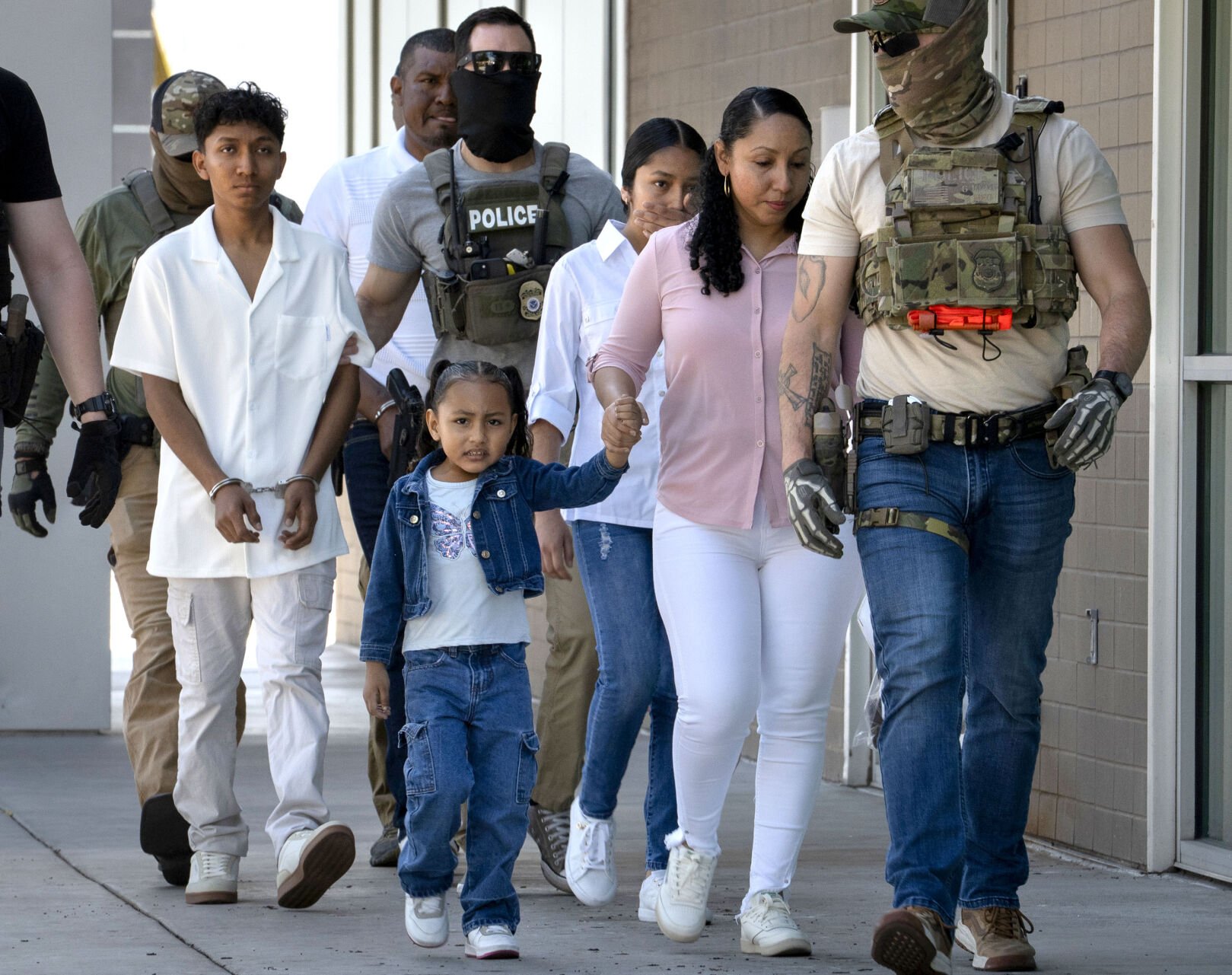
Officials detain people outside of a Phoenix immigration court on Wednesday. ICE agents have been ready to immediately detain those whose cases were dismissed at courthouses. “A set-up is really honestly the best way to describe it,” said Phoenix immigration attorney Ben Wiesinger.
Tucson immigration attorney Jesse Evans-Schroeder — who said more than 15 of her clients’ closed cases have been reopened this month — said the DHS statement, claiming they’re “helping” immigrants by reopening their cases, is “Orwellian.”
For undocumented immigrants who want to regularize their status, administrative closure can be the best outcome, due to the steep barriers to securing legal status, she said.
Evans-Schroeder said most of her clients who accepted administrative closures checked almost all of the boxes required to regularize their status, such as having at least 10 years continuously in the U.S., a clean record and family ties here, such as a U.S. citizen spouse or child.
But they also faced the requirement to prove “exceptional and extremely unusual hardship” if they were to be deported, which usually involves a situation like a seriously ill child who couldn’t get treatment in their home country, she said.
One of Evans-Schroeder’s cases that has been reopened this month involves a woman who just got her legal permanent residency, or a green card, after marrying a U.S. citizen.
The DHS notice, moving to open her case again, falsely said the woman had no path to legal status, said Evans-Schroeder, who has filed a motion to terminate the case, since the client is no longer deportable. But the woman and her U.S. citizen husband are still panicked over the DHS notice, she said.
“Why are they using the court’s resources to put these people in removal proceedings?” she said.
Tucson attorney Mo Goldman called DHS’ explanation “some serious gaslighting.” He said the U.S. immigration system makes it “nearly impossible” for immigrants to fight deportation and get legal status.
Administrative closures allow people to keep providing for their families and contributing to the U.S. economy, in light of Congress’ decades-long failure to reform the outdated system, said Goldman, a Democrat who is running for Arizona’s Congressional District 6 seat, now held by Republican Rep. Juan Ciscomani.
“This was an avenue to utilize our finite resources in a logical manner,” Goldman said. Re-calendaring those cases doesn’t help immigrants, but seeks “to separate families and focus our resources on policies that cost taxpayers more, while reducing our tax base and workforce.”
At least 15 of Goldman’s clients have had their closed cases reopened this month, he said.
“When this administration came in, their whole promise was for mass deportation of criminals,” he said. “But when they can’t find enough criminals out there, then this is what happens.”
Evans-Schroeder said she suspects the widespread re-opening of closed cases to be aimed at overwhelming the immigration courts — rather than properly resourcing them — by adding to its massive backlog, in order to justify denying due process to immigrants.
The Trump administration has fired dozens of immigration judges since taking office, despite that backlog. An EOIR spokesperson said in a statement the agency had no comment on the firings.
Local attorneys say there are about 10,000 administratively closed cases in Arizona — about 1,000 of them in Tucson — and immigration court officials told attorneys the Trump administration wants to re-calendar all of them.
Courthouse arrests
Over the last week, dozens of ICE agents have been carrying out arrests outside Phoenix’s immigration courthouse, as in other large cities across the country.

Officials detain people outside of a Phoenix immigration court on Wednesday. Immigrants following the rules by attending their court hearings are “low-hanging fruit” for ICE agents, Tucson immigration attorney Luis Campos said.
So far, Tucson activists have only hard of one such case in the Tucson immigration court, said Maru Carrasco, an organizer with Coalición de Derechos Humanos.
A California man contacted the Tucson human-rights advocacy group seeking help on Tuesday, after he said his parents’ immigration case was unexpectedly dismissed by the judge. The couple was then handcuffed and arrested while leaving the Tucson courthouse, Carrasco said.
The man had been on the phone with his mother, who was happily telling him about the dismissal, when she suddenly said she and her husband were being detained, Carrasco said. Apparently, ICE agents had been waiting in the courthouse lobby, she said.
The man was almost crying and said he doesn’t know where his parents are being held, Carrasco said.
“He was so desperate, he didn’t know where to look for them,” she said.
An ICE spokesperson said in a Thursday statement that the courthouse arrests target people subject to “expedited removal,” a fast-track deportation proceeding without a court hearing.
The Trump administration has expanded who is eligible for rapid deportation, to include not only people detained near the southern border, but also immigrants in the U.S. interior who can’t prove they have lived in the U.S. for at least two years.
“An immigration judge has reviewed DHS’s motion to dismiss proceedings and agreed that dismissal is appropriate in these cases,” the ICE statement said. “All aliens in violation of U.S. immigration law may be subject to arrest, detention and, if removable by final order, removed from the United States. Those who were arrested are going into ICE custody pending removal from the United States.”
The American Immigration Lawyers Association described the courthouse arrests, and reliance on expedited removal, as “cruelty disguised as policy.”
“Let’s be clear: people are following the rules by appearing in immigration court as they promised when released from custody, doing exactly what the system demands of them, only to be targeted, arrested, and detained because the government has changed its mind on detention,” AILA president Kelli Stump said in a Wednesday statement. “This tactic is not only morally wrong, it’s self-defeating. If the goal is court compliance, these tactics achieve the opposite: they terrify people away from the very process they’re supposed to trust, undermining the rule of law at its foundation.”
Protected locations targeted
Advocates say the courthouse arrests are another example of Trump’s deportation net widening to target previously protected “sensitive locations,” where immigration operations had been discouraged or limited.
In January, the Trump administration reversed earlier guidance telling ICE to avoid enforcement at sensitive locations including schools, hospitals and churches. “Criminals will no longer be able to hide in America’s schools and churches to avoid arrest,” a DHS statement said at the time.
The reversal didn’t say whether courthouses were included, but in his first term, Trump canceled guidance limiting enforcement at the courts. The Biden administration reinstated limits on courthouse enforcement in a 2021 memo.

A crowd of protestors clashes with officials as they detain people after immigration court hearings on Wednesday in Phoenix. The arrests ignore immigrants' right to contest or appeal a case dismissal, and will discourage many from attending court proceedings, said Alba Jaramillo, an organizer with Tucson's Coalición de Derechos Humanos, or Human Rights Coalition.
Local human-rights advocates are scrambling to respond to the slew of threats against the immigrant community from the Trump administration.
“Everything is going so fast,” said Carrasco of Derechos Humanos. “They (the government) are regrouping and organizing so fast, so we need to do the same.”
Advocates are seeking volunteers to act as observers outside the courthouse and to accompany immigrants to their court dates, she said. They’re planning to also hold signs outside the courthouse, displaying advice immigrants should know when attending their court dates.
That advice includes:
— In the courtroom, you can object to your case being dismissed. Wiesinger said respondents have the option to request 10 days to respond in writing to the motion to dismiss.
— If your case is dismissed, you have the right to appeal to the Board of Immigration Appeals and should express that to the immigration judge.
— Tell the judge — or the ICE agent, if you are detained — if you fear persecution or torture in your home country and want to request asylum.
— Know that if you don’t attend your immigration hearing, you’ll likely get an order of deportation.
The courthouse arrests come two weeks after immigration agents arrested an undocumented Tucson resident outside Carondelet’s St. Joseph’s Hospital, said Tucson immigration attorney Luis Campos, who was representing the man. The Star has identified him by only his first name, Francisco.
Francisco was initially facing criminal charges for illegal entry and re-entry, after a 2011 deportation, but prosecutors dropped the charges without explanation earlier this month.
Francisco has since been deported to his home country of Mexico, leaving behind a wife and two step-daughters in Tucson, who are also from Mexico and received asylum protection after arriving in Arizona in 2019, Campos said.

Laura Pearl chants while protesting against ICE enforcement and removal gather outside U.S. Immigration Court in Phoenix on Thursday.
Immigrants following the rules by attending their court hearings are “low-hanging fruit” for ICE agents, Campos said.
“If they’re having to meet (arrest) quotas, this is easy; you just show up at the courthouse,” he said.
Campos said he’s also alarmed by what he calls the apparent “complicity” of immigration court judges, who are approving these sudden motions to dismiss.
Immigration judges are employees of the U.S. Department of Justice’s EOIR, which critics have long pointed to as an inherent conflict of interest. Wiesinger said challenges to that “perceived partiality” have been struck down by appellate courts.
“Why are they agreeing to have the cases dismissed? It’s just not normal,” Campos said. “Any judge would wonder, Why are you suddenly dismissing this case?”
Campos said he intends to begin filing petitions asking if his clients can appear in court virtually, although it’s up to the judge whether to grant it.
“I’m going to say, in order to protect my client, his legal posture and physical well-being — because we’ve seen how these operations go down — ‘I’m asking you to do this virtually’,” he said.

