



Sandra Yessenia Argüelles Zazueta sits in her wheelchair, patiently waiting for her life to change.
The 20-year-old has taken an eight-hour bus ride from Ciudad Obregon to Nogales, Sonora, her mother and brother by her side, to be first in line at the prosthetics clinic run by Arizona Sonora Border Projects for Inclusion.
Early-morning light floods the warehouse space that the group calls home as Sandra Yessenia is wheeled into the building. She smiles between yawns.
“I’m nervous and sleepy,” she says. “Is that strange?”
She and her mother are led behind one of the makeshift privacy partitions, where they wait for the prosthetic technicians to start working.
Sandra Yessenia is eager to go back to school, to walk into the kitchen and help her mother with dinner, to brush her black hair from her eyes — all the things she did before and that she took for granted.
It has been less than six months since a bacterial condition forced the amputation of her legs at the knees and her fingers all the way down to her hands.
Though her body was broken, she never lost her resolve. She is still the happy young woman who has always taken adversity in stride.
“She’s the one that gives me hope,” says her mother, Sandra Zazueta. “I would cry a lot when it first happened and she would comfort me.”
Sandra Yessenia says she had faith that things would work out.
“Why be depressed if we’re alive?” she asks.
Although Zazueta receives income from her late husband’s pension and her older daughter works, the family still has a hard time making ends meet, let alone being able to afford the prosthetics Sandra Yessenia needs.
Her plight is what the Border Projects for Inclusion was created for.
A true need
The group was born out of a border conference on disabilities in 2008.
Burris Duncan, a professor at the University of Arizona’s College of Public Health, wanted to go beyond the conference and try to leave something more permanent behind.
“We wanted to have medical devices, built by people who use them, and get these in the hands of the people who needed them but couldn’t afford the whole cost,” Duncan says.
After some initial funding struggles, the group was able to hire Francisco Trujillo to run the operation in Mexico and Gabriel Zepeda to begin building all-terrain wheelchairs.
“A lot of people here in Nogales would receive donated wheelchairs from the United States, but they’re not designed to operate in conditions like we have here — the hills, the cracked streets,” Trujillo says.
While the wheelchairs continue to be in high demand, Trujillo says they’ve been surprised by the response they’ve received to the prosthetics program. Since it started in 2013, the clinic has helped more than 100 people.
Three to four more sign up every week.
“There’s a lot of need out there. We launched it a year ago, and it’s just kept growing.”
Easy to despair
Sandra Yessenia is one of dozens who have shown up to the clinic this morning. Many sit in wheelchairs, others balance on crutches.
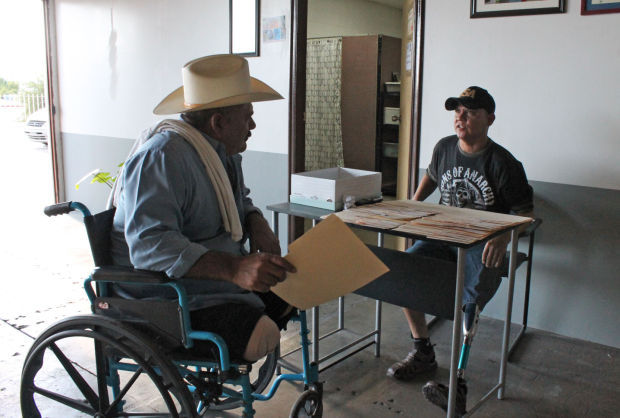
Most people have already been interviewed by Adalberto Rivera, the project’s resident prosthetic technician, who sits behind a table, handing out number tickets and sorting through patient files.
Among them are an 8-year-old girl with cerebral palsy who is waiting to be fitted with braces and a man who lost both legs in a mining accident.
He is there to be measured for prostheses, and needs to get back to work, he says. Back to normal.
Rivera, 34, knows how easily someone who has lost a limb can fall into despair, especially when economic pressures compound the damage.
He was 23 years old, had a wife and son — a normal life — when he lost his leg in a motorcycle crash.
After a month in the hospital, he was determined to regain his mobility. He learned to use crutches and went to the DIF, Mexico’s family welfare office, to get a prosthetic.
It cost $2,300. He didn’t have it.
But his friends pitched in and he was able to buy a leg, a rigid prosthetic more akin to a steel bar. But at least he was ready to return to his job. Rivera worked at a tomato-packing plant, standing by a conveyor belt all day. The prosthetic became more and more painful to wear.
One night he took off his prosthetic and expected to see sweat pooled in the socket like always, but this time it was blood. His stitches had given way.
“I felt like I wanted to die,” he says. “I asked God, ‘Why?’”
The next day he crammed a sponge and some rolled up toilet paper in the socket and headed back to work. But the fix was temporary.
“I felt like I had a red-hot coal in my knee. It was on fire and I was burning.”
He started abusing drugs and alcohol as he sank deeper into depression.
He told his wife to take their son and go live with her family because he couldn’t take care of them.
In the depths of hopelessness, he asked her to find someone else. They decided to take a break for three months.
Throughout that time, he continued to court her. Drunk and high, he would serenade her and tell her how much he loved her. She would cry and say she wanted him back.
But part of their agreement was that he had to clean up his act.
“The problem wasn’t them, it was me,” he says. “I would tell myself I was worthless, that I was a burden for my family. I was jealous of everyone.
“In short order, I lost my leg, I lost my job, and I lost my family.”
Forever changed
Sandra Yessenia was working to save enough money to continue school. She wanted to study cooking or nursing.
When she woke up that Monday feeling sick and with a fever, her mother took her to see the doctor. She was told it was the flu, given some antibiotics, and sent home.
But the week went on and she didn’t feel better. By Friday, when her family took her to the hospital, a rash had broken out all over her body.
She was diagnosed with dengue hemorrhagic fever, a viral illness for which there is no known cure.
Over the weekend, her condition worsened and she was put on a respirator. Doctors told her mother she might not live through the night.
“She was about to die. They told me she had a 1 percent chance of survival,” says her mother. “She was in septic shock, and they said few recover from that.”
But Sandra Yessenia was tough, and spent three weeks on a respirator. By the time doctors from Mexico’s Social Security Institute examined her and realized it was a rickettsial infection — a bacterial condition caused by a tick bite — it was too late.
Her legs and fingers had to be amputated if she was to survive.
“I thank God she made it,” her mother says. “And she doesn’t hold a grudge against the doctors. Sometimes things happen.”
Through the dark
Sandra Yessenia’s determination and willingness to move forward are rare, Rivera says.
But stories like hers and the selflessness of those who seek to help are what inspired him to do what he does.
After he lost his family, he decided to try and get his life back. Asking only for somewhere to sleep, he volunteered with a program similar to the Border Projects for Inclusion in his native Sinaloa.
He started out doing odd jobs — sweeping, driving, carpentry work — and saw the impact that the right prosthetic could make. The gratefulness and joy that patients expressed were a revelation to Rivera.
Inspired, he asked to become an apprentice with the program and learn about building prosthetics.
He also gave away his own leg to an elderly woman who couldn’t afford one. When he had learned enough, he figured, he would make himself a new one.
He observed, read books, started tinkering.
“When I first got my new leg, I would wear it up and down. If it bothered me, I would take it off and modify it. I would try again, and if it pinched me, I would adjust it, work on it until I was able to walk, able to ride a bike, drive a car, even dance,” Rivera says. “And I’m a pretty good dancer.”
Eventually he took over as head prosthetic technician in Sinaloa, where he spent six years before being hired by the Border Projects.
With the help of material and technicians from Hanger, a national firm — with offices in Tucson — that builds prosthetics and orthotics, Rivera is able to repurpose used parts for the prosthetics that the Border Projects provides.
He also shares his experience with anyone who comes to the group and needs more than physical help.
“People tell me their stories. Couples come in and talk about the problems between them because of a loss of a limb, because the person feels less than other people,” Rivera says. “The solution is to have patience. I tell them that I went through what they’re going through, and I lost everything.
“I don’t want that to happen to them.”
Working together
Along with Hanger, the Border Projects for Inclusion gets support from companies and organizations from both sides of the border, including several colleges within the UA, Rotary International and the Foundation of Sonoran Businesses.
A day at the clinic is full of activity, as students from the university, prosthetists with Hanger and local volunteers do their part to make sure everything runs smoothly and that patients are comfortable, even if it just means making sure there’s enough coffee.
“It’s people from both sides of the border — it’s not just the rich Americans that go down and give to the Mexicans — it’s the Mexicans jumping in and solving it,” Duncan says.
The project was originally housed at a public technical school, but as soon as the prosthetic clinic was launched, it was evident they had outgrown the space. The current location is being donated rent-free by the Nogales Industrial Park, along with utility costs. The program is designed to charge a fee for services, Duncan says, with the goal of at least recuperating costs.
An all-terrain wheelchair, which retails for approximately $900, is offered for $300. Prosthetic legs sell from between $10,000 and $15,000, but thanks to recycled parts from Hanger, families are asked to pay just $400.
Most people just pay what they can, though.
“We want them to pay what they feel they can afford to pay, and then we try to get subsidies to take care of the rest of it,” Duncan says. “Even if they cannot pay, that’s OK.”
Although the group has limited resources, there are big plans for the future, including offering solar-powered hearing aids and building a simple prosthetics shop in Nogales.
“This whole thing has just kind of mushroomed,” Duncan says.
Hope for the future
Sandra Zazueta gently strokes her daughter’s arm, once in a while playfully poking her to keep her busy while they wait.
“I’m afraid I’ll fall. I’m afraid I won’t be able to use them. I’ll have to start from zero,” Sandra Yessenia says as the prosthetists from Hanger flit in and out of the room.
“I’m afraid and happy at the same time.”
Then, suddenly, it’s time.
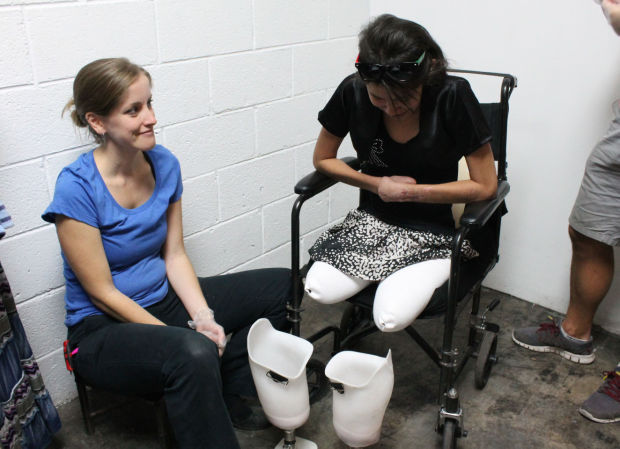
Volunteers bring in her temporary, half-sized legs, which she will use to practice her balance. Once she’s ready, she will move on to the full prostheses, perhaps next year.
They help her out of the chair and up on her new legs. She sways nervously, but eventually gets the hang of it and stands firm. She takes a few steps and beams.
Soon, it’s time to fit her hands.
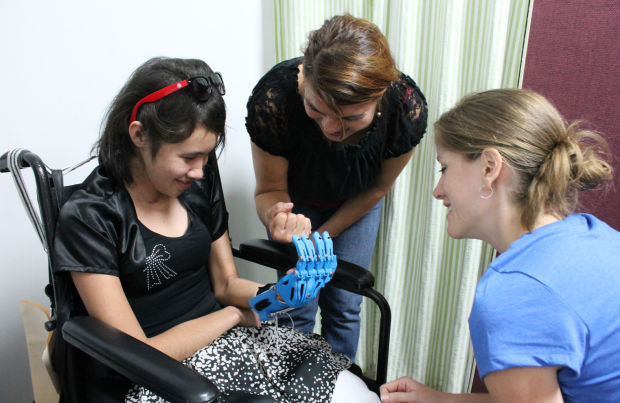
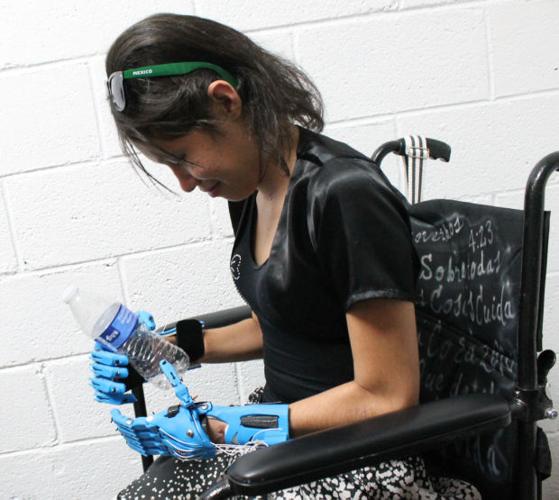
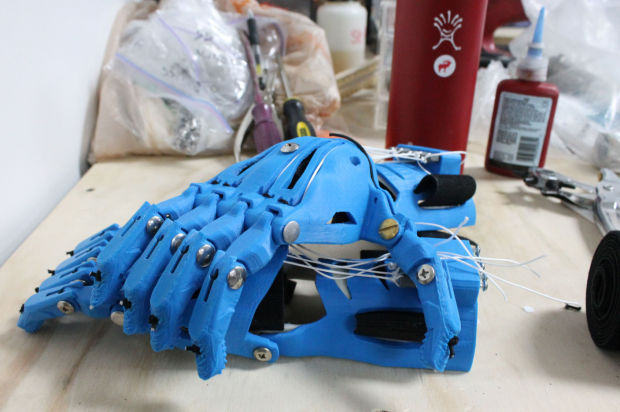
Prosthetists attach the bright blue hands and show her how they move as she flexes her wrist. They adjust and trim, tighten and loosen, until Sandra Yessenia can close her hands with ease.
Before long, she is using them to squeeze gauze, to pull down her sunglasses, to run blue plastic fingers through her hair.
She laughs and blows a kiss.
Her life will never be what it was before her illness, and she still has years of therapy ahead of her, her mother says. But seeing her daughter happy makes her share in the optimism and gratitude.
“I thank God that he saved her, and God bless those people that help others,” she says.
Before she leaves, the prosthetists hand Sandra Yessenia a plastic water bottle to hold. She smiles, and everyone laughs as she tries to unscrew the cap.
“Maybe not just yet,” she says.
But soon.

