April Time Machine: A look back at historical headlines
From the Time machine special sections series
-
Johanna Eubank
Online producer

Past Aprils stories include the San Francisco earthquake of 1906, the announcement of the names of the Mercury astronauts, the assassination of Martin Luther King Jr., Apollo 13 and the Oklahoma City bombing.
Thursday, April 19, 1906 front page: Earthquake in San Francisco
Updated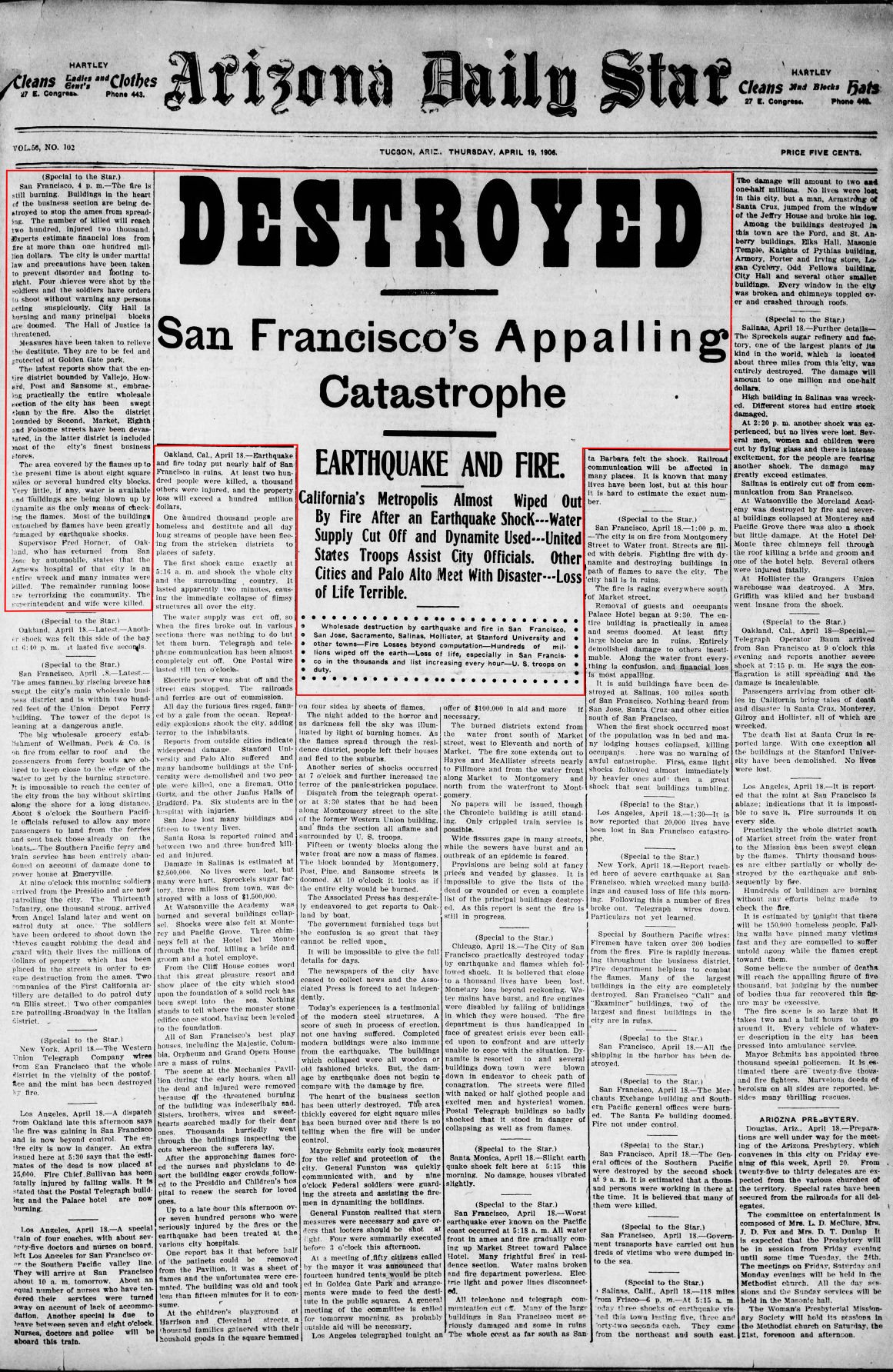
Download a PDF that you can enlarge for easier reading
DESTROYED
San Francisco's Appalling Catastrophe
EARTHQUAKE AND FIRE.
California's Metropolis Almost Wiped Out By Fire After an Earthquake Shock ─ Water Supply Cut Off and Dynamite Used ─ United States Troops Assist City Officials. Other Cities and Palo Also Meet With Disaster ─ Loss of Life Terrible.
Wholesale destruction by earthquake and fire in San Francisco, San Jose, Sacramento, Salinas, Hollister, at Stanford University and other towns ─ Fire Losses beyond computation ─ Hundreds of millions wiped off the earth ─ Loss of life, especially in San Francisco in the thousands and list increasing every hour ─ U.S. troops on duty.
(Special to the Star.)
San Francisco, 4 p.m. [April 18]─ The fire is still burning. Buildings in the heart of the business section are being destroyed to stop the flames from spreading. The number of killed will reach two hundred, injured two thousand. Experts estimate financial loss from fire at more than one hundred million dollars. The city is under martial law and precautions have been taken to prevent disorder and looting tonight. Four thieves were shot by the soldiers and the soldiers have orders to shoot without warning any persons acting suspiciously. City Hall is burning and many principal blocks are doomed. The Hall of Justice is threatened.
Measures have been taken to relieve the destitute. They are to be fed and protected at Golden Gate park.
The latest reports show that the entire district bounded by Vallejo, Howard, Post and Sansome st., embracing practically the entire wholesale section of the city has been swept clean by the fire. Also the district bounded by Second, Market, Eighth and Folsome streets have been devastated, in the latter district is included most of the city's finest business stores.
The area covered by the flames up to the present time is about eight square miles or several hundred city blocks. Very little, if any, water is available and buildings are being blown up by dynamite as the only means of checking the flames. Most of the buildings untouched by flames have been greatly damaged by earthquake shocks.
Supervisor Fred Horner, of Oakland, who has returned from San Jose by automobile, states that the Agnews hospital of that city is an entire wreck and many inmates were killed. The remainder running loose are terrorizing the community. The superintendent and wife were killed.
Saturday, April 7, 1917 front page: War declared
Updated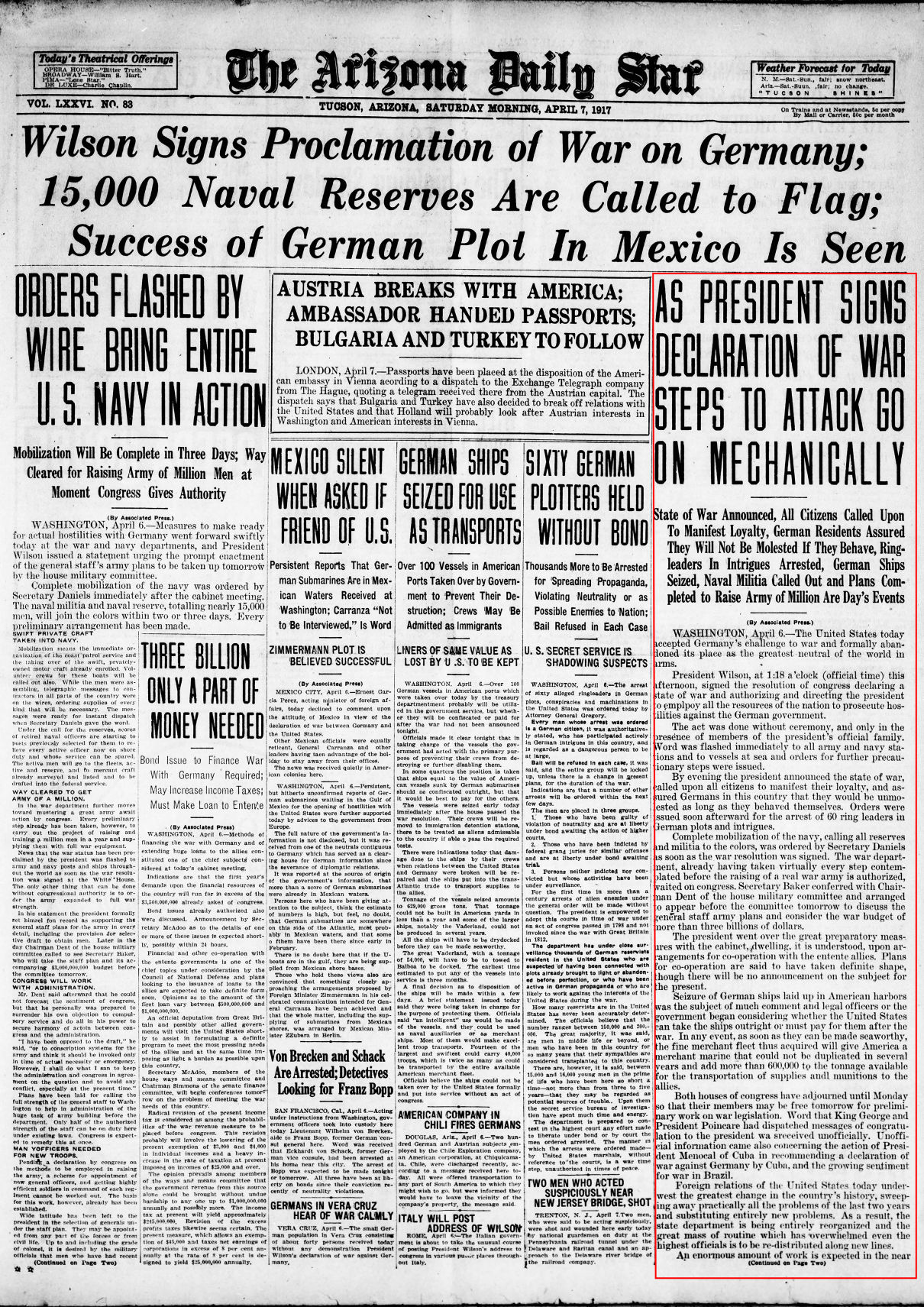
Download a PDF that you can enlarge for easier reading
AS PRESIDENT SIGNS DECLARATION OF WAR STEPS TO ATTACK GO ON MECHANICALLY
(By Associated Press.)
WASHINGTON, April 6. ─ The United States today accepted Germany's challenge to war and formally abandoned its place as the greatest neutral of the world in arms.
President Wilson, at 1:18 o'clock (official time) this afternoon, signed the resolution of congress declaring a state of war and authorizing and directing the president to employ all the resources of the nation to prosecute hostilities against the German government.
The act was done without ceremony, and only in the presence of members of the president's official family. Word was flashed immediately to all army and navy stations and to vessels at sea and orders for further precautionary steps were issued.
By evening the president announced the state of war, called upon all citizens to manifest loyalty, and assured Germans in this country that they would be unmolested as long as they behaved themselves. Orders were issued soon afterward for the arrest of 60 ring leaders in German plots and intrigues.
Complete mobilization of the navy, calling all reserves and militia to the colors, was ordered by Secretary Daniels as soon as the war resolution was signed. The war department, already having taken virtually every step contemplated before the raising of a real war army is authorized, waited on congress. Secretary Baker conferred with Chairman Dent of the house military committee and arranged to appear before the committee tomorrow to discuss the general staff army plans and consider the war budget of more than three billions of dollars.
The president went over the great preparatory measures with the cabinet, dwelling, it is understood, upon arrangements for co-operation with the entente allies. Plans for co-operation are said to have taken definite shape, though there will be no announcement on the subject for the present.
Seizure of German ships laid up in American harbors was the subject of much comment and legal officers or the government began considering whether the United States can take the ships outright or must pay for them after the war. In any event, as soon as they can be made seaworthy, the fine merchant fleet thus acquired will give America a merchant marine that could not be duplicated in several years and add more than 600,000 to the tonnage available for the transportation of supplies and munitions to the allies.
Both houses of congress have adjourned until Monday so that their members may be free tomorrow for preliminary work on war legislation. Word that King George and President Poincare had dispatched messages of congratulation to the president was received unofficially. Unofficial information came also concerning the action of President Menocal of Cuba in recommending a declaration of war against Germany by Cuba, and the growing sentiment for war in Brazil.
Tuesday, April 28, 1931 front page: Louise Marshall shoots her husband
Updated
Download a PDF that you can enlarge for easier reading
MRS. MARSHALL MUST ANSWER CHARGE OF ATTEMPTED MURDER WHEN BULLETS FROM HER GUN FAIL TO KILL HUSBAND
County Attorney Says Case Will Be Pushed In Superior Court
JEALOUSIES HINTED
Wealthy Woman Wed to Manager of Her Estate
Mrs. Louise Marshall, semi-recluse wife of Thomas K. Marshall, 85 Rincon road, has been held to answer a charge of assault with intent to murder by Edwin F. Jones, justice of peace, while her husband, in a critical condition from four bullet wounds, lies in the Southern Methodist hospital as a result of a shooting which occurred shortly after midnight Monday morning.
Marshall was rushed to Southern Methodist hospital in what was believed to be a dying condition, and an emergency operation performed by Dr. J. B. Van Horn. Mrs. Marshall was kept in the home, under constant guard of police officers until brought before Judge Edwin F. Jones in justice court Monday noon for arraignment on charges of assault with attempt to commit murder.
Monday noon Marshall was reported to be resting well and not in a critical condition. The report was given out by William G. Hall, county attorney, who stated that Dr. Can Horn advised him that Marshall had an excellent chance to survive.
The accused woman was widely known in Tucson because of her philanthropies and her wide business interests all of which were administered by her husband.
As Miss Louise Henrietta Foucar she came to Tucson from Boston in 1899 and was an instructor in French, Latin and botany at the University of Arizona. Marshall was a member of the student body at that time and met his wife to be when he was retained as a manager of her properties. Later, despite the disparity of their ages, marriage followed in 1904.
Officers interested in the investigation of this case were reticent in making statements or explanations of the affair. James D. Boyle, Tucson attorney and representing Mrs. Marshall, refused to make any statement and, at the time of arraignment, waived preliminary examination. Mrs. Marshall was ordered held to answer to superior court under a $5000 bond. Boyle intimated that the defendant would present a certified check for this amount as surety, which was done early Monday afternoon.
Jealousy Blamed
In the meantime rumors spread thick and fast as to the cause or motive of the attempted killing. One, partially verified, sounded the age-old motive of jealousy; another injected the equally old triangle in human relations into the picture. Investigating officers tentatively admitted both of these rumors as possible motives.
In the first instance it is said that the shooting was caused by the jealous suspicions of Mrs. Marshall toward her husband and a former housekeeper at the Marshall home. Several months ago the housekeeper left the employ of the Marshalls after several years of service, it is said.
Mrs. Marshall has believed that at least three attempts have been made to take her life, via the arsenic poisoning method, it was reported and that last Friday a laboratory report was returned with the information that dangerous quantities of arsenic were present in Mrs. Marshall's system.
Note to readers: Thomas K. Marshall died in a hospital in California as a result of the shooting May 20, 1931, having reconciled with his wife by phone. Louise Marshall was charged with murder. The trial was moved to Nogales, Ariz., because of the amount of publicity in Tucson. On Sept. 23, 1931, Louise Marshall was acquitted of murder by reason of temporary insanity by a jury that deliberated only 49 minutes. At the announcement of the verdict, those in the gallery broke into applause. The Marshall Foundation continued it philanthropic ventures and does so even today. Louise Marshall lived quietly in Tucson until her death in 1956.
Thursday, April 12, 1945, front page: Tucsonan among freed prisoners
Updated
Download a PDF that you can enlarge for easier reading
TUCSONAN AMONG FREED PRISONERS
Three American officers, recently freed from German prison camps by the advancing Russians, are in a happy mood as they arrive in Boston. Left to right are Lt. William Wall, San Francisco; Lt. Jack Tidwell, Tucson, a former University of Arizona student, who was captured while fighting with the 5th Army in Italy; and Lt. William R/. Swanson, El Centro, Calif. (AP Wirephoto.)
Brunswick By-Passed, Yanks Roar Through Heart Of Reich
Allied Crossing Of Last Water Barrier Before German Capital Believed Imminent As Nazi Opposition Is Almost Non-Existent
PARIS, Thursday, April 12. ─ (AP) ─ Armored columns of the U. S. Ninth Army swept within 57 miles of Berlin and within 115 miles of the Russian front yesterday in a startling advance of more than 50 miles that carried to the Elbe river at Magdeburg. A crossing of this water barrier before the German capital was believed imminent.
The sensational eastward drive, longest single day's thrust yet made on German soil, was accomplished by the Second (Hell on Wheels) Armored Division, which by-passed the manufacturing city of Brunswick and roared through the heart of the Reich against practically non-existent opposition. A late front dispatch said the river could be bridged within a few hours unless unexpected resistance developed. This would set the stage for an early junction with the Red Army. Correspondents said the linkup might be made within a few days.
57 Miles From Berlin
Lt. Gen. William H. Simpson's Ninth Army troops were 57 miles away from the southwestern limits of Greater Berlin, which includes Potsdam, and the Russians were 32 miles from the capital on the east with the city itself stretching some 25 miles between these two points
Essen and Dortmund, two mighty industrial cities of the Ruhr, were captured by infantrymen of the Ninth Army operating far in the rear of the armored spearheads, and other doughboys of the Ninth drove into Bochum and Brunswick.
The Canadian First and British Second Armies fanned out toward an imminent junction that would close a steel trap on possibly 200,000 German troops in Holland and northwest Germany, making advances of up to 15 miles.
Lt. Gen. Courtney H. Hodges' U. S. First Army broke loose on a 22-miles rampage that carried within 48 miles of Leipzig, putting these American troops within 120 miles of a linkup with the Russians.
Coburg Is Captured
The Third Army captured ancient Coburg and clamped a news blackout on two armored divisions after they had rumbled forward at least 12 and 15 miles, respectively.
The Seventh Army completely encircled the famous ball-bearing manufacturing city of Schweinfurt and stormed into it from two sides. The French First Army fought forward three miles into the northern edge of the Black forest, southeast of Karishuhe.
British troops in the north punched to within 45 miles of Hamburg, but were still held four miles outside the port of Bremen; to their west the Canadians crossed the Issel river deeper into Holland, where scores of thousands of Germans were trapped.
Friday, April 13, 1945, front page: Franklin Delano Roosevelt has died
Updated
Download a PDF that you can enlarge for easier reading
HISTORY-MAKING 4TH TERM ENDED BY UNTIMELY DEATH
War President's Career Spanned Dark Days Of Depression And Pearl Harbor, Closed With Peace Dawn Breaking
By The Associated Press
The Presidency of Franklin Delano Roosevelt, longest in United States history, spanned a 13-year period from the dark days of the 1932 depression to the first dawn glimmerings of peace in the European war. It saw also the massing of great naval and troop strength in ever-closer strikes at the Japanese foe in the Pacific. Death came to the nation's war leader as he was busy planning measures for lasting world peace while still plunged deep in the task of directing master strategy for complete victory
The first president of the United States to be elected for four terms, was born January 30, 1882, at Hyde Park, N. Y., the son of James and Sara (Delano) Roosevelt. He was a direct descendent, eighth generation of Claes Martenzan Rosenvelt or Roosevelt who left Holland in 1649. Claes' son, Nicholas, was the Progenitor of both Theodore Roosevelt, 25th president, and Franklin D., the 31st president. The former descended from Nicholas' son Johanus; Franklin from Nicholas' son Jacobus.
The President's mother was the daughter of Warren Delano, banker and Far East trader. She became James Roosevelt's second wife at the age of 26. The President's father, a lawyer and financier, was a fourth cousin of Theodore Roosevelt.
NEW LEADER PLEDGES EFFORTS TO WIN WAR
WARM SPRINGS, Ga., April 12. ─ (AP) ─ President Franklin D. Roosevelt, his strength sapped away as commander in chief in America's greatest war, died suddenly this afternoon.
His duties fell on Vice President Harry S. Truman who, sworn in as the 32nd President in a White House ceremony at Washington, issued this statement:
"The world may be sure that we will prosecute this war on both fronts, east and west, with all the vigor we possess, to a successful conclusion."
It was at 4:35 p. m. eastern war time that Mr. Roosevelt died of a cerebral hemorrhage. It was 7:09 p. m. , that a solemn-faced Truman took up the burden and the honor of President.
Mr. Roosevelt's last works were:
"I have a terrific headache."
Tuesday, April 5, 1949, front page: NATO pact signed
Updated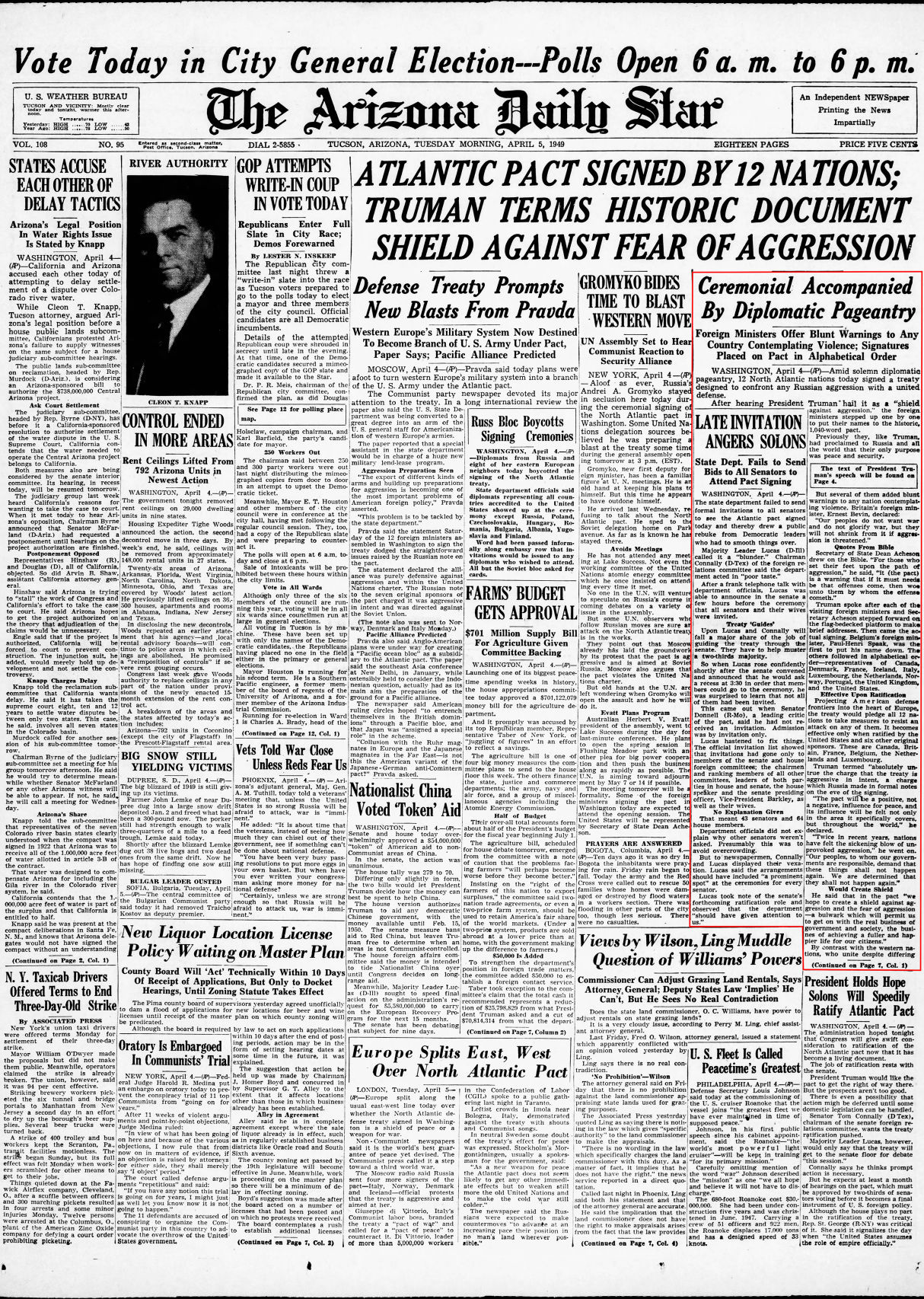
Download a PDF that you can enlarge for easier reading
ATLANTIC PACT SIGNED BY 12 NATIONS
Ceremonial Accompanied By Diplomatic Pageantry
Foreign Ministers Offer Blunt Warnings to Any Country Contemplating Violence; Signatures Placed on Pact in Alphabetical Order
WASHINGTON, April 4 ─ (AP) ─ Amid solemn diplomatic pageantry, 12 North Atlantic nations today signed a treaty designed to confront any Russian aggression with a united defense.
After hearing President Truman hail it as a "shield against aggression," the foreign ministers stepped up one by one to put their names to the historic, 1,040-word pact.
Previously they, like Truman, had proclaimed to Russia and all the world that their only purpose was peace and security.
But several of them added blunt warnings to any nation contemplating violence. Britain's foreign minister, Ernest Bevin, declared:
"Our peoples do not want war and do not glorify war, but they will not shrink from it if aggression is threatened."
Quotes From Bible
Secretary of State Dean Acheson drew on the Bible. "For those who set their feet upon the path of aggression," he said, "it (the pact) is a warning that if it must needs be that offenses come, then woe unto them by whom the offense cometh."
Truman spoke after each of the visiting foreign ministers and Secretary Acheson stepped forward on the flag-bedecked platform to make brief addresses. Then came the actual signing. Belgium's foreign minister, Paul-Henri Spaak, was the first to put his name down. The other followed in alphabetical order ─ representatives of Canada, Denmark, France, Iceland, Italy, Luxembourg, the Netherlands, Norway, Portugal, the united Kingdom, and the United States.
Effective Upon Ratification
Projecting American defense frontiers into the heart of Europe, the treaty would pledge all 12 nations to take measures to resist an attack on any of them. It becomes effective only when ratified by the United States and six other original sponsors. These are Canada, Britain, France, Belgium, the Netherlands and Luxembourg.
Truman termed "absolutely untrue the charge that the treaty is aggressive in intent, a charge which Russia made in formal notes on the eve of the signing.
"The pact will be a positive, not a negative, influence for peace, and its influence will be felt not only in the area it specifically covers, but throughout the world," he declared.
"Twice in recent years, nations have felt the sickening blow of unprovoked aggression," he went on. "Our peoples, to whom our governments are responsible, demand that these things shall not happen again. We are determined that they shall not happen again."
Friday, April 10, 1959: America's first astronauts introduced
Updated
Download a PDF that you can enlarge for easier reading
Pioneer Space Travelers For America Selected
One Will 'Pilot' Rocket In Orbit Around Earth
WASHINGTON, April 9 (AP) ─ America's first space travelers-to-be were put on view Thursday ─ seven calm, steel-nerved married men in their thirties. They said they're sure they'll come back safe from the most terrifyingly dangerous voyage yet conceived for a human being.
One of the seven will be the first American ─ the first of any nation, if things go right ─ to be rocketed into orbit around the earth
Nobody knows yet which one will get the first historic ride. Each of the seven says it's something he has long dreamed of.
Each also said at a news conference that it's okay with the wife and/or children for him to make the first satellite flight.
In fact, quipped Navy Lt. Malcolm S. Carpenter, 33, of Garden Grove, Calif., one of the Astronauts, his going was his wife, Rene's idea:
"I was at sea so my wife called Washington and volunteered for me."
The National Aeronautics and Space Administration announced last Monday that seven space candidates had been selected as the final team for this country's first manned satellite program, Project Mercury.
But not until Thursday did the agency name the seven: Three Air Force jet pilots, three Navy fliers and a Marine test pilot making up the training group.
Besides Carpenter, a Korean veteran whose hobbies range from skin-diving to archery, the team includes:
Air Force Capt. Leroy C. Cooper Jr., 32, Carbondale, Colo., and Seattle.
Marine Lt. Col. John H. Glenn Jr., 37, New Concord, Ohio.
Air Force Capt. Virgil I. Grissom, 33, Mitchell, Ind.
Navy Lt. Cmdr. Walter M. Shirra Jr., 36, Hackensack, N.J.
Navy Lt. Cmdr. Alan B. Shepard Jr., 35, East Derry, N.H.
Air Force Capt. Donald K. Slayton, 35, of Sparta, Wis.
Those seven were selected, after possibly the most rigid physical and mental tests ever given human beings, from among 55 volunteers for the first space flights. Only one can make the first earth orbit ─ if he survives.
Astronaut Job Not One For Youngsters
WASHINGTON, April 9 (AP) ─ Why did the space officials pick men in the 30-year age bracket for the first spacemen?
Capt. Norman L. Barr, director of the Navy's astronautical division and a member of the Life Sciences Committee of the National Aeronautics and Space Administration, says the reasons run like this:
One specification was that an Astronaut must have accumulated at least 1,500 hours of flying time and have been a test pilot for part of that time.
He also must have various educational qualifications, engineering or designing experience and other similar factors.
To build up the required experience and qualifications, took time, moving candidates past the 30-year-age mark. Nevertheless all the plus-30 pilots passed physical examinations which would have eliminated many younger men.
Friday, April 5, 1968 front page: Martin Luther King Jr. assassinated
Updated
Download a PDF that you can enlarge for easier reading
ASSASSIN'S BULLET KILLS KING; RIOTING ERUPTS IN MANY CITIES
Murder Stuns City Leaders
The senseless slaying of civil rights leader martin Luther King left Tucson stunned last night.
As news of the Memphis assassination spread, Tucsonans expressed their shock and horror.
"What can I say," said a shaken Robert J. horn, president of the Tucson chapter of the NAACP. "I think what there is to be said should be said by the white populace. There is nothing for us as Negroes to say."
Horn continued, "Here is a man who has dedicated his whole life to nonviolence, a man who never raised a hand in anger. When such a man is shot down, what is to become of us all? It's too horrible to think about."
He said he would have to wait until funeral arrangements for Dr. King are made before planning any action for the Tucson NAACP.
The Rev. Paul D. Sholin, chairman of the Tucson Commission on Human Relations, expressed the commission's "shock and profound grief."
"As the group officially designated to be concerned with civil rights in our city," the Rev. Sholin said, "we will miss his leadership desperately. He personified the only way we can ultimately deal with our national problems. He would not compromise with evil, nor would he resort to violence. He did everything in his power to arouse the American conscience toward constructive democratic change."
The Rev. Sholin added, "although the human symbol is dead, the American dream of which he spoke so eloquently and for which he worked and died, must become a reality as all Americans dedicate themselves to fill this void and follow this dream."
University of Arizona students and faculty will start a silent vigil at 10:30 a.m. today in front of the Student Union Building in memory of the Nobel Peace Prize winner.
"I've heard they'll stand anywhere from 30 minutes to two days," said Stephen Z. Maikin, a liberal arts junior who was elected president of the student body Wednesday.
Memorial services for Dr. King will be held at Mt. Calvary Baptist Church, 210 E. Lester St., at 7:30 p.m. tonight. A revival scheduled last night also was turned into a memorial service.
Tuesday, April 4, 1970, front page: Apollo 13 in danger
Updated
Download a PDF that you can enlarge for easier reading
Houston Fights To Save Apollo
SPACE CENTER, Houston (AP) ─ The Apollo 13 spacecraft was disabled Monday night, the planned moon landing canceled and ground controllers battled to bring the three endangered astronauts home safely.
The space agency said at 11 p.m. Monday (Tucson time) that no moon landing was possible.
Fighting to save the very air on which their lives depend, two of the men crawled into their moon landing craft and prepared to seal away their power-crippled command ship which was leaking from a ruptured oxygen tank.
Astronaut John W. Swigert Jr. remained in the command ship while Fred W. Haise Jr. and James A. Lovell Jr. moved into the lunar lander. Swigert was to follow after shutting down the spacecraft cabin systems.
With Apollo 13 more than 200,000 miles from earth, it was the gravest crisis that had ever occurred in American space flight. The only person to die during a space flight was Russian cosmonaut Vladimir Komarov, who was killed when the parachute of his Soyuz 1 spacecraft became tangled during re-entry through the atmosphere.
The Apollo 13 astronauts will depend on the small moon landing craft ─ remaining attached to the command ship ─ as a life boat for their return to earth.
They will continue through space, circle the moon and use the lunar ship's engine to arc back toward the earth. If successful, they should land in the pacific about 10:12 p.m. Friday (Tucson time).
Uncontrolled gyrations, thought to be caused by the venting of the oxygen, caused the spacecraft to toss and twist out of control at several points after the emergency began.
It was several minutes before Mission Control announced the source of the problem; a critical leak in the supercold oxygen storage tank of the command ship. What caused the leak was not known.
The loss of oxygen made remaining in the command ship impossible, and Mission Control began giving the spacemen procedures to follow for occupying the moon lander.
The lunar module is designed to support only two men but can accommodate three in emergencies. Never before have three depended on its limited electrical and oxygen supplies for survival in space.
…
The emergency developed first as a major loss of electrical power. An oxygen tank supplying an electrical power cell in the spacecraft apparently ruptured. Flight Director Glynn Lunney said oxygen pressure in the spacecraft was dropping alarmingly
Moments later the astronauts began transferring to the lunar module. Lovell sounded the warning of the sudden emergency:
"Houston, we've got a problem . . . a problem with the on-board electrical power system."
Thursday, April 20, 1995, front page: Bombing in Oklahoma City
Updated
Download a PDF that you can enlarge for easier reading
Youngsters at day care center bear brunt of car bomb horror
By Tracy Everback and Barbara Kessler
Dallas Morning News
OKLAHOMA CITY ─ One of the worst terrorist attacks in the United States was, by intent or tragic coincidence, a horrific assault on children.
At least 12 of the 31 dead last evening were infants through pre-schoolers who attended a day care center on the second floor of a federal office building where a bomb exploded.
The center was just above the site of the explosion that sheared off the front of the Alfred P. Murrah Federal Building. It was destroyed by the blast and debris from collapsing upper floors. After the explosion, toys were found blown across the street from the center, which an assistant fire chief said appeared to take the brunt of the blast.
Two of the children killed were burned beyond recognition. The other bodies were mangled.
Some reports said only two children survived. One was in surgery and the other was in intensive care.
However, Assistant Fire Chief Jon Hansen of Oklahoma City said rescue workers helped some children from the scene.
"We were just picking them up, giving them a hug and passing them along as quickly as we could," he said.
With 10 to 20 children unaccounted for late yesterday, the number of youngsters among the dead was expected to grow.
The young victims were believed to be infants through 5-year-olds, the ages served by the America's Kids day care center. About 30 children, of the 41 enrolled, were believed to be at the center at the time of the 9 a.m. explosion.
Some other children injured and killed in the blast were reportedly older and may have been visiting the federal building with adults, officials said.
Wednesday April 21, 1999, front page: Mass shooting at Columbine High
Updated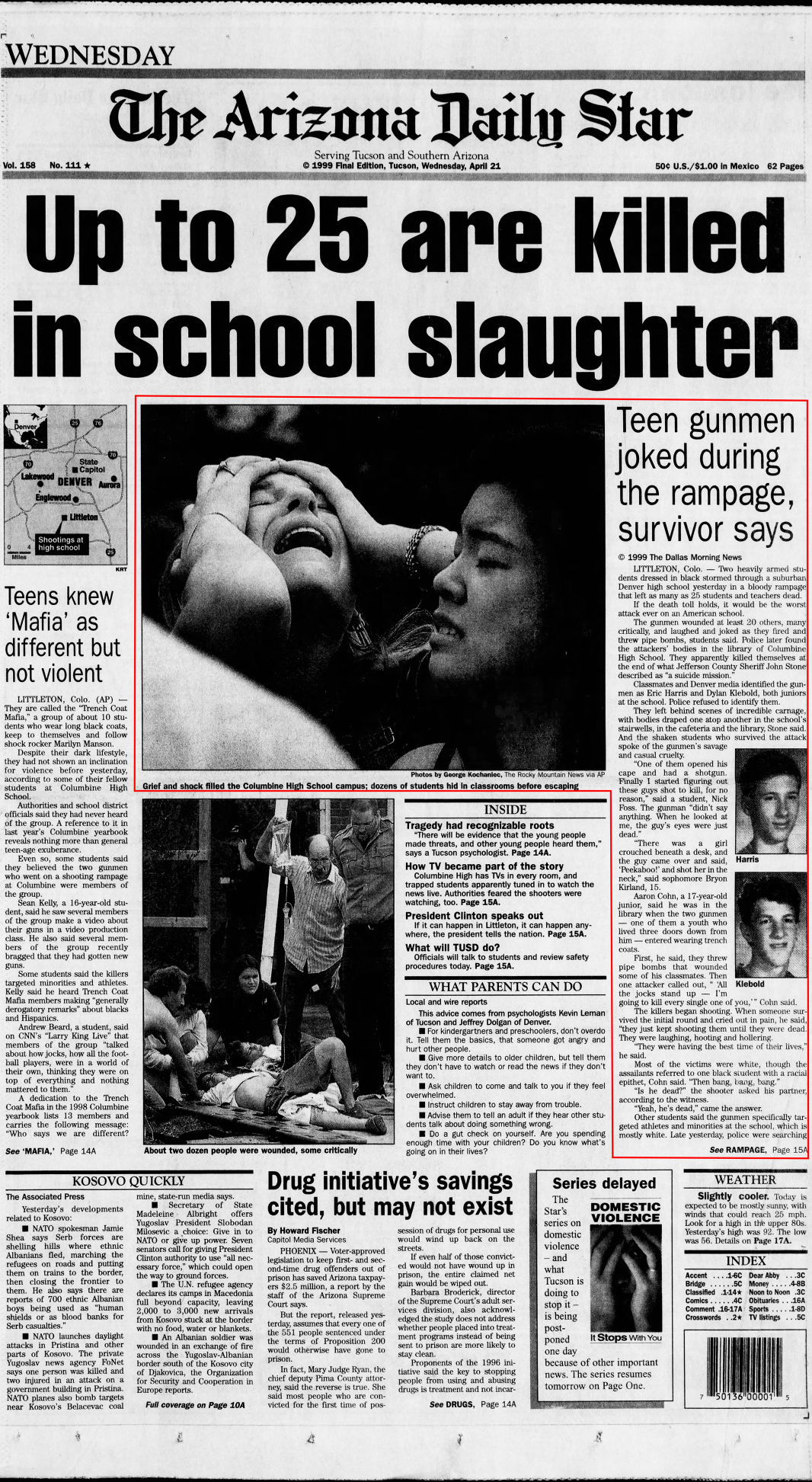
Download a PDF that you can enlarge for easier reading
Teen gunmen joked during the rampage, survivor says
© 1999 The Dallas Morning News
LITTLETON, Colo. ─ Two heavily armed students dressed in black stormed through a suburban Denver high school yesterday in a bloody rampage that left as many as 25 students and teachers dead.
If the death toll holds, it would be the worst attack ever on an American school.
The gunmen wounded at least 20 others, many critically, and laughed and joked as they fired and threw pipe bombs, students said. Police later found the attackers' bodies in the library of Columbine High School. They apparently killed themselves at the end of what Jefferson County Sheriff John Stone described as "a suicide mission."
Classmates and Denver media identified the gunmen as Eric Harris and Dylan Klebold, both juniors at the school. Police refused to identify them.
They left behind scenes of incredible carnage, with bodies draped one atop another in the school's stairwells, in the cafeteria and the library, Stone said. And the shaken students who survived the attack spoke of the gunmen's savage and casual cruelty.
"One of them opened his cape and had a shotgun. Finally I started figuring out these guys shot to kill, for no reason," said a student, Nick Foss. The gunman "didn't say anything. When he looked at me, the guy's eyes were just dead."
"There was a girl crouched beneath a desk, and the guy came over and said, 'Peekaboo!' and shot her in the neck," said sophomore Bryon Kirland, 15.
Aaron Cohn, a 17-year-old junior, said he was in the library when the two gunmen ─ one of them a youth who lived three doors down from him ─ entered wearing trench coats.
First, he said, they threw pipe bombs that wounded some of his classmates. Then one attacker called out, "All the jocks stand up ─ I'm going to kill every single one of you,'" Cohn said.
The killers began shooting. When someone survived the initial round and cried out in pain, he said, "they just kept shooting them until they were dead. They were laughing, hooting and hollering.
"They were having the time of their lives," he said.
Tuesday, April 17, 2007 front page: Mass shooting at Virginia Tech
Updated
Download a PDF that you can enlarge for easier reading
Rampage leaves 33 dead
Va. Tech gunman rages across campus in slaughter
WIRE REPORTS
Thirty-three people were killed Monday on the campus of Virginia Teach in what appears to be the deadliest shooting rampage in American history, according to federal law-enforcement officials. Many of the victims were students shot in a dorm and a classroom building
"Today, the university was struck with a tragedy that we consider of monumental proportions," said the university's president, Charles Steger.
The campus police chief said Monday evening that 15 people were wounded by the gunman, although there were other reports of higher numbers of injuries.
Witnesses described scenes of mass chaos and unimaginable horror as some students were lined up against a wall and shot. Others jumped out of windows to escape, or crouched on floors to take cover.
There were two separate shootings on the campus in Blacksburg, Va., the first at around 7:15 a.m., when two people were shot and killed at a dormitory.
More than two hours later, 31 others, including the gunman, were shot and killed across campus in a classroom building, where some of the doors had been chained from the inside. Victims were found in different locations around the building.
The first attack started as students were getting ready for classes or were on their way there. The university did not evacuate the campus or notify students of that attack until several hours later.
Johanna Eubank
Online producer
In this Series
Time machine special sections
1
Updated collection
From the Arizona Daily Star archives: Printable movie star paper dolls
2
Updated collection
Historic June front pages from the Star's archives
3