Historic July front pages from the Star's archives
From the Time machine special sections series
Big news in past Julys included the Bisbee Deportation, Amelia Earhart's disappearance, the first time men walked on the moon and an explosion at the Arizona Daily Star.
July time machine
Updated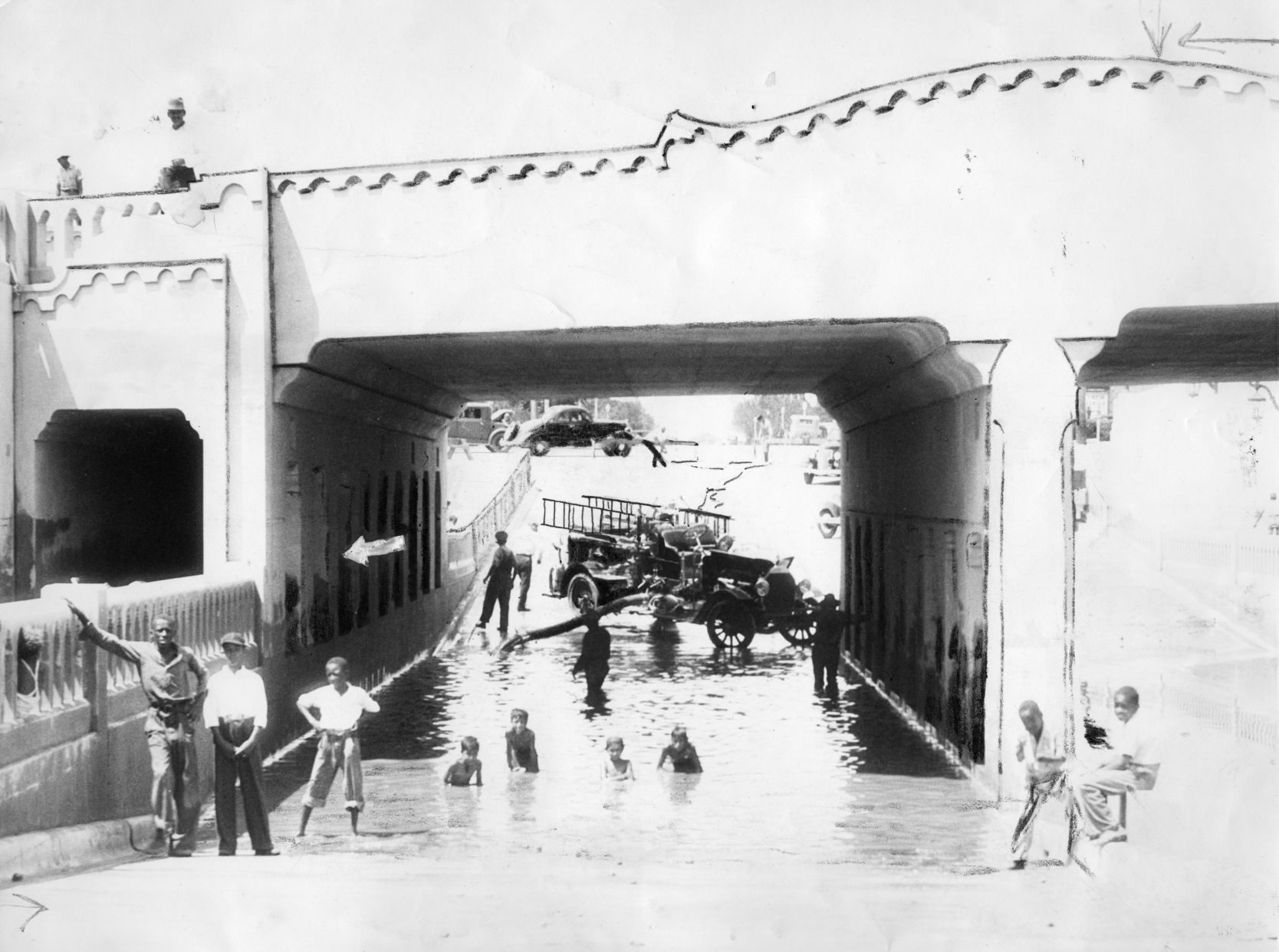
"Lake Elmira," the flooded Fourth Avenue railroad underpass in downtown Tucson, in 1940.
The Arizona Daily Star offers a look back at some front pages that appeared in July throughout the newspaper’s history.
Big news in Julys past included the Bisbee Deportation, Amelia Earhart's disappearance, the first time men walked on the moon and an explosion at the Arizona Daily Star.
The Star began publishing in 1877. Most of the Star’s editions are available beginning in 1879 on Newspapers.com. Go to tucson.com/archives to learn about subscribing to the collection of more than 2 million pages.
July 1, 1910 Coconino National Forest Divided
Updated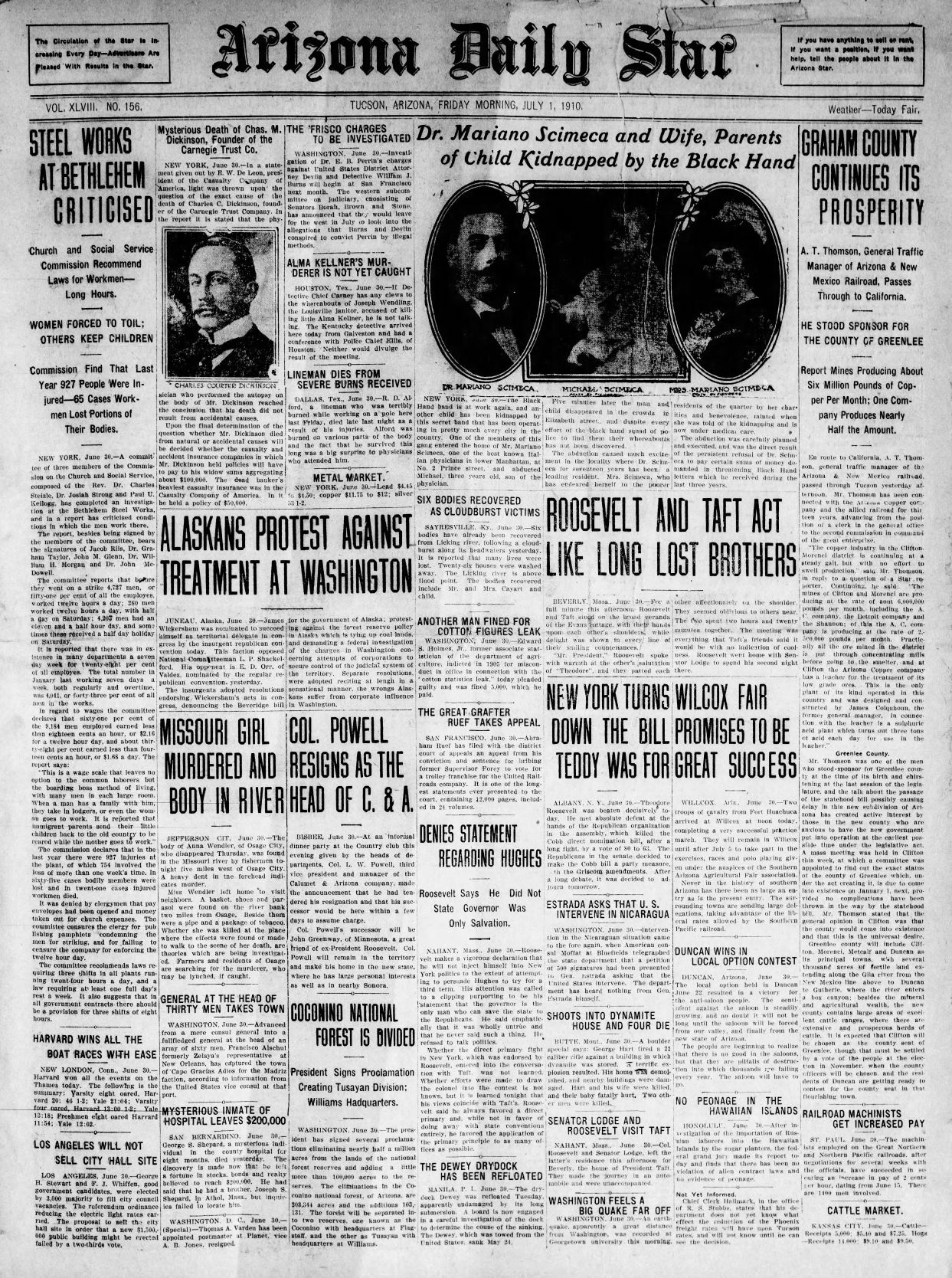
The Coconino National Forest is near Flagstaff, in Coconino County.
In 1898, the San Francisco Mountain Forest Reserve was established by President William McKinley. In 1905, the reserves were transferred to the Department of Agriculture to be administered by the new Forest Service.
The Coconino National Forest was established in 1908 from parts of the Tonto, Black Mesa, Grand Canyon and all of the San Francisco Mountains national forests.
July 5, 1913: Mexican flag hauled down by small boys
Updated
What was likely a prank by a couple of boys on the Fourth of July caused quite a furor between the city of Tucson and the Mexican government.
The article on the front page of the Arizona Daily Star said two boys who were spurred on by adults removed the Mexican flag from the Mexican Consulate and replaced it with an American flag. The identity of the boys was a mystery for years.
The ruckus died down after President Woodrow Wilson apologized to the Mexican government.
Fifty-nine years later, on July 4, 1972, the identity of the boys was finally revealed in the Arizona Daily Star. The widow of one of the boys, Murray Sowles, called the Star with the story. She said her husband told her to do so after his death because then he could no longer get in trouble.
It turned out the “small boys” were actually teenagers, the younger being 15-year-old Sowles. He and his friend Bobby Lyons did the deed, but said there were errors in the original article. Adults had not spurred them on ─ it was their idea ─ and they had not replaced the Mexican flag with an American flag.
At last the incident has been put to rest.
July 13, 1917: Bisbee deportation
Updated
In 1917, Bisbee mine workers, members of the Industrial Workers of the World, or IWW, went on strike. The group was considered a radical labor union.
Citizens of Bisbee got word that the striking miners planned to dynamite the mine shafts, so they armed themselves and rounded up the IWWs, as they called them ─ they were also referred to as “Wobblies” ─ and put them on a train to New Mexico.
This was called a deportation, although they didn’t leave the country. While the roundup of the strikers was effective, it was not without violence. There were two deaths, a striker and a deputy.
The IWWs were not welcomed in New Mexico with open arms. They were turned away.
The deputized Bisbee citizens believed the IWWs would be held in Columbus, N.M., but the commander of the Army encampment there would not accept them and ordered them all returned to Bisbee. The train headed back but stopped after several miles, the guards deserted and the IWWs were left stranded.
The army set up an emergency tent city and gave food and medication to the union men until they found new homes.
There was an investigation, but no charges came of it.
July 22, 1925: Scopes Monkey trial
Updated
John Thomas Scopes was a substitute teacher in a Tennessee high school who was accused of teaching human evolution in a public school.
The trial was staged, with the agreement of Scopes, who had purposely incriminated himself, to bring publicity to the town of Dayton, Tennessee.
Scopes was found guilty and fined $100, but the verdict was overturned on a technicality.
William Jennings Bryan argued for the prosecution and Clarence Darrow was among the attorneys for the defense in the case of evolution versus strict interpretation of the Bible.
The trial lasted eight days and ended in a guilty verdict, but the debate continues.
July 8, 1930: Boulder Dam construction begins
Updated
Boulder Dam, later known as Hoover Dam, construction began near Las Vegas in 1930. It had a budget of $165 million.
The engineering marvel was finished two years ahead of schedule and under budget. The dam was dedicated in 1935. In 1947, a joint resolution of Congress had the name changed in honor of President Herbert Hoover.
Two hundred and thirteen deaths were associated with the dam, although not all were part of the official tally of construction deaths. One of the first was that of surveyor John Gregory Tierney, who drowned on Dec. 20, 1921, while surveying sites for the dam. His son, Patrick Tierney, who died on Dec. 20, 1935, 14 years to the day after his father, was the last person to die on the project, according to official records.
The reservoir is known as Lake Mead and is a popular recreation area. The dam is on the National Register of Historic Places and was designated a National Historic Landmark in 1985.
Sources: Las Vegas Review-Journal website reviewjournal.com and Arizona Daily Star archives.
July 23, 1934: John Dillinger is killed in shootout
Updated
Earlier in the same year as his death, John Dillinger and members of his gang were captured in Tucson on Jan. 25, 1934. They had been discovered as a result of a fire at the Hotel Congress. Dillinger and three others were arrested in Tucson and later delivered to the Crown Point jail in Indiana. They escaped.
Several adventures ensued before federal agents killed Dillinger in a shootout at Chicago’s Biograph Theater on July 22, 1934.
July 3, 1937: Amelia Earhart is missing
Updated
It’s no secret that the famous aviator, Amelia Earhart, and her navigator, Fred Noonan, disappeared as they attempted to fly around the world. The mystery is what actually happened to her.
Earhart graced Southern Arizona with her presence several times. In May 1937, her Lockheed Electra 10E Special was repaired in Tucson after the plane’s left engine, a Pratt & Whitney Wasp S3H1 nine-cylinder radial, caught fire and was damaged.
Years earlier, in September 1928, she almost literally dropped in for dinner in McNeal, Arizona. She had run low on fuel while flying solo across Southern Arizona and landed on a dirt runway. While there, she dined with the Ladies Aid Society before refueling and taking off.
She was a Davis-Monthan Register pilot and landed in Tucson and signed the register at Davis-Monthan Aviation Field three times.
Sources: dmairfield.com, southernarizonaguide.com, thisdayinaviation.com and Arizona Daily Star archives.
July 29, 1945: Plane crashes into Empire State Building
Updated
Unlike the more recent tragedies of 9/11, it was an accident when an army bomber crashed into the Empire State Building in 1945. The pilot was blinded by fog.
Three pilots and 10 office workers were reported killed and an additional 24 people were injured.
There have been other aircraft crashes into buildings. Most often they are private planes crashing into houses, but other aircraft and skyscraper encounters have happened in New York and other cities around the world.
July 7, 1957: Lake Elmira traps another victim
Updated
The Stone Avenue underpass flooded so often during monsoon season that it became known as Lake Elmira. It was the scene of rescues from flooded cars from time to time.
According to local historian Jim Griffith, the name was given to the pond by Howard O. Welty, a Tucson Citizen reporter who made up a story about Elmira Doakes being the first person to swim across the pond that forms in the underpass when it rains.
Several years ago, Griffith wrote a blog for tucson.com called “Our Storied Desert Land,” in which he told the tall tale of Lake Elmira.
July 3, 1964: Civil Rights Act becomes law
Updated
The Civil Rights Act of 1964 ended segregation in public places and outlawed discrimination on the basis of race, color, religion, sex or national origin.
The act took a long time to became law and did not completely solve the problems associated with discrimination, which continue today, but it was landmark legislation and the crowning achievement of the civil rights movement.
July 15, 1965: Mariner 4 sends photos of Mars to Earth
Updated
Before the Mars Global Surveyor, Phoenix, Observer, Pathfinder and other probes that have explored the surface of Mars, there were the Mariner missions. Mariner 4 collected the first close-up photos of the surface of Mars from above the planet.
Mariner 4 was followed by Mariners 6-9 and Viking before a 17-year gap in Mars missions, which ended when the Mars Observer was launched in 1992. The Observer mission as unsuccessful, but more followed.
July 31, 1965: Medicare is signed into law
Updated
The Medicare Law was signed as part of the Social Security Act amendments. The law also established Medicaid for low-income Americans.
Medicare was meant to provide hospital insurance for older Americans. Before Medicare was created, only about 60 percent of Americans aged 65 and older had health insurance.
July 21, 1969: Americans are the first to walk on the moon
Updated
July 6, 1975: Arthur Ashe wins at Wimbledon
Updated
Arthur Ashe was the first and only black man to win the singles title at Wimbledon.
He was also the only black man to win the singles titles at the U.S. Open and the Australian Open.
Ashe died at the age of 49 in 1993 of AIDS-related pneumonia. It was believed he contracted HIV from a blood transfusion in the early 1980s.
July 26, 1978: First test-tube baby is born
Updated
Louise Brown’s birth in 1978 made headlines around the world and gave hope to couple who struggled with infertility.
In vitro fertilization, or IVF, was considered unethical by many at the time, but is now almost commonplace.
Brown married in 2004 and had a son, who was naturally conceived, in 2006. Brown’s parents are now deceased.
July 31, 1978: Tison sons break father and another out of prison
Updated
Gary Tison’s sons Ricky, Donald and Raymond broke Tison and Randy Greenawalt out of the Arizona State Prison, where both had been serving sentences for murder.
As the group eluded police, they left behind a few innocent murder victims.
Donald Tison was killed in a shootout on Aug. 11, 1978, and the other two brothers and Greenawalt were captured. Gary Tison’s body was found more than a week later, not far from the scene of the shootout in which Donald Tison died.
Randy Greenawalt was executed by lethal injection in 1997. Raymond and Ricky Tison were sentenced to death, but those sentences were overturned by the U.S. Supreme Court. They were later resentenced to life without the possibility of parole for 50 years.
Find a link to the Star’s ebook on the escape and capture, “Three-State Trail of Blood and Terror,” at tucson.com/ebooks
July 12, 1979: Skylab falls from the sky
Updated
Skylab was the first space station operated by NASA. It was only occupied for about 24 weeks, but orbited the Earth for six years.
Its decaying orbit caused it to reenter the Earth’s atmosphere. It scattered debris over the Indian Ocean and western Australia, although debris was later found in many other places.
No injuries were attributed to Skylab’s demise, but NASA was fined $400 in Australian dollars for littering by the Shire of Esperance in western Australia, according to many Internet sources.
Sources: The Esperance Express website esperanceexpress.com.au and Arizona Daily Star archives
July 8, 1981: Sandra Day O’Connor is named to Supreme Court
Updated
The first woman named to the U.S. Supreme Court was from Arizona. Sandra Day O’Connor was nominated by President Ronald Reagan.
She served until her retirement in 2006.
July 23, 1982: Explosion at Arizona Daily Star halts presses
Updated
Several people were injured in a transformer explosion that shut down power at the Star. They were Frank Johnson, executive managing editor; Frank C. Delehanty, business manager; Wayne Bean, production manager; Jack Sheaffer, chief photographer; David R. Dunn, production worker; Clifford Scott, assistant foreman of production maintenance; and Arthur Gutierrez, production machinist.
Several local and state newspapers helped the Star get the newspaper to its readers, setting competition aside during the crisis.
Of the injured, three were most affected. Delehanty died five weeks later of his injuries. Johnson was in the hospital for several weeks following the explosion but eventually returned to work. He died on Nov. 9, 1997. Jack Sheaffer was never able to return to work and never fully recovered. He died in 1999.
In this Series
Time machine special sections
1
Updated collection
From the Arizona Daily Star archives: Printable movie star paper dolls
2
Updated collection
Historic June front pages from the Star's archives
3