Historic September front pages from the Star's archives
From the Time machine special sections series
-
Johanna Eubank
Online producer
- Updated

Notable news of past Septembers include: the surrender of Geronimo, the imposing of the draft for military service in the United States, the first Black Miss America and 9/11.
Sept. 7, 1886: Geronimo surrenders
Updated
UNCONDITIONAL SURRENDER.
That is What Miles Said to Geronimo.
And What the Hostiles Were Forced to Accept.
Now Comes Peace and Prosperity to Arizona
The last of the hostile Apaches surrendered in Skeleton canyon Saturday. General Miles arrived at Fort Bowie late last night bringing with him, not only the good news of surrender, but also the persons of Geronimo and Natchez and three of their best and most trusty warriors. The remainder will reach Fort Bowie in three days, guarded by Captain Lawton's command.
The good citizens of Arizona, as one man, rise to extend congratulations to the gallant general, who less than five months ago was selected by the president to solve the difficult problem of capturing or destroying the hostile Apaches in Arizona. General Miles has done well the work assigned to him. He has not only captured the hostiles, but rounded up the Chiricahua and Warm Spring Indians on the Apache reservation, and they will soon leave that place of refuge, which has been for many years a breeding ground and base of supplies as well as a rendezvous where raiding parties are organized to overrun and blight the prospect of our fair territory.
The successful termination of the Apache troubles will lift the cloud of distrust which has been suspended over us for many years, restore confidence and set free the wheels of industry within our midst.
In a few days the subjects of thought and discussion among our people will have changed from Indian depredations in our midst to more agreeable topics. The prosperity of Arizona will occupy the attention of our citizens who in all their successes will remember to ascribe to General Miles the credit for bringing about the blessings to our country and people.
Sept. 9, 1935: Huey Long shot
Updated
HUEY LONG SHOT BY ASSASSIN
GUARDS OF SENATOR SHOOT DOWN ASSAILANT AFTER BULLET STRIKES LOUISIANA DICTATOR IN ABDOMEN
Wound Not Fatal Is Opinion of Doctor After Operation
Two Shots Fired
But Only One Enters Body of Victim, Witness Says
BATON ROUGE, La. Sept. 8 ─ (AP) ─ Senator Huey Long, Louisiana's political "dictator," was shot through the right side tonight in the state capitol with a pistol in the hands of Dr. C. A. Weiss, an eye specialist of Baton Rouge and member of an anti-Long political family.
Bodyguards of Senator Long immediately killed Dr. Weiss, puncturing his body with bullets and leaving him dead on the floor of the corridor.
Identification of Weiss was established by Dr. Thomas B. Bird, East Baton Rouge parish coroner, and Joe W. Bates, assistant superintendent of the state bureau of identification.
Senator Long had just finished directing passage of bills in one of his special legislative sessions where legislators followed his bidding without question.
As the senator stepped out of the house door, spectators said, Dr. Weiss walked up to Long and pressing the muzzle of a pistol close to his body, fired one shot. Then the bodyguards opened fire, killing the doctor, and assisting Senator Long down the stairs to an automobile.
Bleeds at Mouth
Long was staggering and bleeding at the mouth. He maintained consciousness and talked to his assistants. At the hospital he was rushed to an operating table, and Dr. Urban Maes of New Orleans, of the medical staff of Louisiana State university was summoned by airplane.
Hospital officials said the senator's condition was grave, but Dr. Arthur Virdrine, head of the New Orleans Charity hospital, in charge of the case, said the bullet had not struck any vital organs, and he did not consider the senator's condition critical.
He said the bullet passed entirely through the body, and unless complications set in, the senator had a good chance to recover.
Physicians said the bullet entered the right side of his abdomen and ranged through the body, emerging at the back.
The body of Dr. Weiss lay on the corridor for more than an hour until it could be viewed by the coroner.
Dr. Bird said two cartridges had been fired from the pistol, but Dr. Virdrine said only one bullet struck the senator.
FEAR OF DEATH FROM BULLETS TOLD IN SENATE
Attack On Long Recalls His Speech Telling About "Plot"
USED BODYGUARDS
Alarm Draws Laughter When Outlined In U. S. Congress
WASHINGTON, Sept. 8. ─ (AP) ─ News of the attempted assassination of Senator Huey Long in Baton Rouge startled the capital late tonight, with officials recalling instantly that only a month ago tomorrow he told the senate a plot to kill him was afoot.
As word spread through the city, telephone calls to newspaper offices for information increased with the minute.
Until details of the shooting and his condition were known, officials and political leaders had little to say.
Many of them at the time of the senate speech had taken Long's fears lightly. They were well aware, however, that he almost constantly took precautions of having bodyguards in the vicinity when he appeared in public.
Whether the department of justice could or would take any action in the shooting was conjectural.
In the August 9 speech, the Louisianan took the floor during a dull afternoon and said two of his supporters had sat in a hotel room in New Orleans adjoining an apartment where the reported plot was discussed. Some senators laughed while others listened closely.
Career of Long Told In Outline
NEW YORK, Sept. 8. ─ (AP) ─ The career of Senator Huey P. Long in tabloid:
Born August 30, 1893, in Winnfield, La., of humble parentage.
Admitted to Louisiana bar in 1915, age 22. Never completed formal schooling in high school or college.
Louisiana railroad commissioner 1918-21.
Governor of Louisiana 1928-31.
Defeats effort to impeach him, wins election to United States senate in 1930.
Retains governorship as "dictator" to prevent foes from taking over government.
Takes senate seat January 25, 1932.
Sept. 17, 1940: U.S. imposes the draft
Updated
Sept. 28, 1940: Axis powers sign Tripartite Pact
Updated
Sept. 16, 1959: Khrushchev visits Washington, D.C.
Updated
Host Eisenhower Glum, But Guest K Is Buoyant
By ARTHUR EDSON
WASHINGTON, Sept. 15 (AP) ─ Dwight D. Eisenhower was glum, somber. He even looked a little peeved, as if he were faced with a visit from unwelcome in-laws.
Nikita S. Khrushchev was cheerful, bouncy and impish.
Any unbiased observer of Tuesday's first meeting between the leaders of the two mightiest nations on earth would have to concede that Mr. K. stole the show. And he would also have to say that it looked as if Khrushchev had deliberately planned it that way.
Once during the exchange of pleasantries, which went on so long it seemed more like a Senate filibuster, Mr. K. appeared to wink jovially at reporters.
And while Eisenhower was reading his welcome, Khrushchev held his black hat up to shade his eyes, thereby attracting attention away from the President.
When it came time for Mr. K. to read his speech, he casually tossed his hat on one of the brass posts that held up the colored rope around the reviewing stand.
Through it all, his eyes darted around, like the eyes of an old ham actor who can't resist counting and sizing up the house.
No one knows why Eisenhower appeared so glum. As an old military man, he has always seemed willing to make the best of these formal occasions.
Possibly a foulup at the start put him in a bad mood.
As you may have guessed, the extent of preparations for these affairs is fantastic.
Everything is accounted for. Hundreds of hours go into planning.
Reporters were handed a detailed map of the area in which each object and each dignitary was plainly marked. For example, one spot on the map was marked "grass," which investigation showed was exactly right.
And what happened after all that scheming?
The Russian plane, which was shown heading south on the map, pulled up and stopped heading north. It had been planned the other way.
The big moment when Mr. K. met Mr. E. was on the far side of the plane and out of sight to almost everyone.
One curious note: When the party finally came walking along the 400 feet from the big, turbo-prop plane to the reviewing stand, it looked like any other group of Washington tourists ─ neat, clean, curious, but dowdy by Madison Ave. standards.
It's unfortunate the plane headed the wrong way; military officials had worked so hard, maybe too hard, at trying to get everything to run right.
The ceremonial detachment from Ft. Myer, for example, had been routed out of bed at 3 a.m. and by 5 a.m. they were at Andrews Air Base. By 5:15 a.m. they had rolled out the famous red carpet, a full seven hours before anyone needed it.
As a result of being so early, the soldiers had to work much harder.
Giant vacuum sweepers were going over the runways, sucking up trash that might foul the plane's engines. But they also stirred up dust, small bits of paper and a weed seed that looks like dandelion.
No sooner was the carpet swept than it was dirty again. Someone would take an old fashioned broom and start sweeping.
A soldier's work is never done.
Security preparations are always on the grand scale, but rarely do they reach the heights they reached Tuesday. Newsmen and photographers were put in bleacher seats directly in front of the reviewing stand and handy to the cafeteria.
But at 8:34 a.m. armed soldiers marched up, carefully guarded the gate to the cafeteria. Anyone who wished to refresh himself had to take a long detour, more than two clocks.
Still it's nice to know that even so early in the morning our doughnuts and coffee are safe.
Uncle Sam Foots Bill For Red Bear
WASHINGTON, Sept. 15 (AP) ─ Soviet Prime Minister Nikita S. Khrushchev and his official party ─ 63 persons altogether ─ are guests of the U.S. government during their visit in this country.
The rest, mostly newsmen covering the Khrushchev trip, pay their own expenses.
No estimate is available what the costs are, officials said. Congress allocates a certain amount every years for such purposes as state visits but the figures are not made public.
"You don't invite someone and then let him know directly or indirectly, what you spend on the dinner," a department official remarked.
Sept. 27, 1960: Nixon-Kennedy televised debate
Updated
Some Highlights Of Rival Candidates' Views
By ASSOCIATED PRESS
Here is the way Vice President Nixon and Sen. Kennedy stand on specific points at issue in the nation today:
Economic race with Russia ─
Nixon said Russian production is only 44 per cent that of the United States; Kennedy retorted that this 44 per cent was "certainly causing us a lot of trouble ─ and I want to see it stays at 44 per cent."
Kennedy argued that more must be done; Nixon agreed, but quarreled with the Democratic nominee's proposals for doing it.
Spending ─
The cost of Kennedy's program, Nixon said, would be $13.2 billion greater than that of his program; it would cause deficits, leading to inflation, he charged. Kennedy said he would not unbalance the federal budget except in a "grave national emergency"; but the nation's needs are so great, he said, that he does not see an opportunity for federal debt reduction in the next few years. Nixon chided that the Democratic platform mentions paring the national debt.
Farm policy ─
Kennedy said the administration's farm policy has failed, and Nixon's farm proposals are not "very much different from Mr. Benson's." The reduction of support has not worked, he said. Responding, Nixon said Kennedy's program to improve farm income would lead to more government control. His own farm plan, Nixon added, would rescue farmers from problems of surpluses overhanging the market and depressing prices.
Aid to education ─
Both candidates favored federal aid to school construction. Kennedy also called for federal subsidies to increase teachers' pay. Nixon rejected this on grounds it would lead to federal control of education.
Minimum wage ─
Kennedy said the threat of President Eisenhower's veto prevented enactment of a $1.25 minimum wage. Nixon replied that Congress could have overridden the veto except that, on this and some other Democratic legislation, the people supported Eisenhower's position. The bills, he said, were "too extreme."
Civil rights ─
Nixon didn't mention this. Kennedy said that: "I am not satisfied until every American enjoys his full constitutional rights." He said a Negro baby ─ and Puerto Rican and Mexican babies in some cities ─ has about one-half the chance of a white baby of getting through school, about one-third the chance of becoming a professional man, about half the chance of owning a home, about four times as much chance of being out of work during some of his lifetime.
Arbiter Of Manners Dies In N.Y.
NEW YORK, Sept. 26 (AP) ─ Mrs. Emily Post, 87, internationally famous authority on the social graces, died late Sunday night at her East Side home. She had been in poor health for several years.
Mrs. Post, author of "Etiquette; The Blue Book of Social Usage," used not only books but newspaper and radio to advise on what is socially proper.
Her first book on social usage, titled simply "Etiquette," was published in 1922. Since then, Mrs. Post has been considered the last word on good manners. Her basic rule of etiquette: Make the other person comfortable.
Sept. 14, 1971: Massacre at Attica
Updated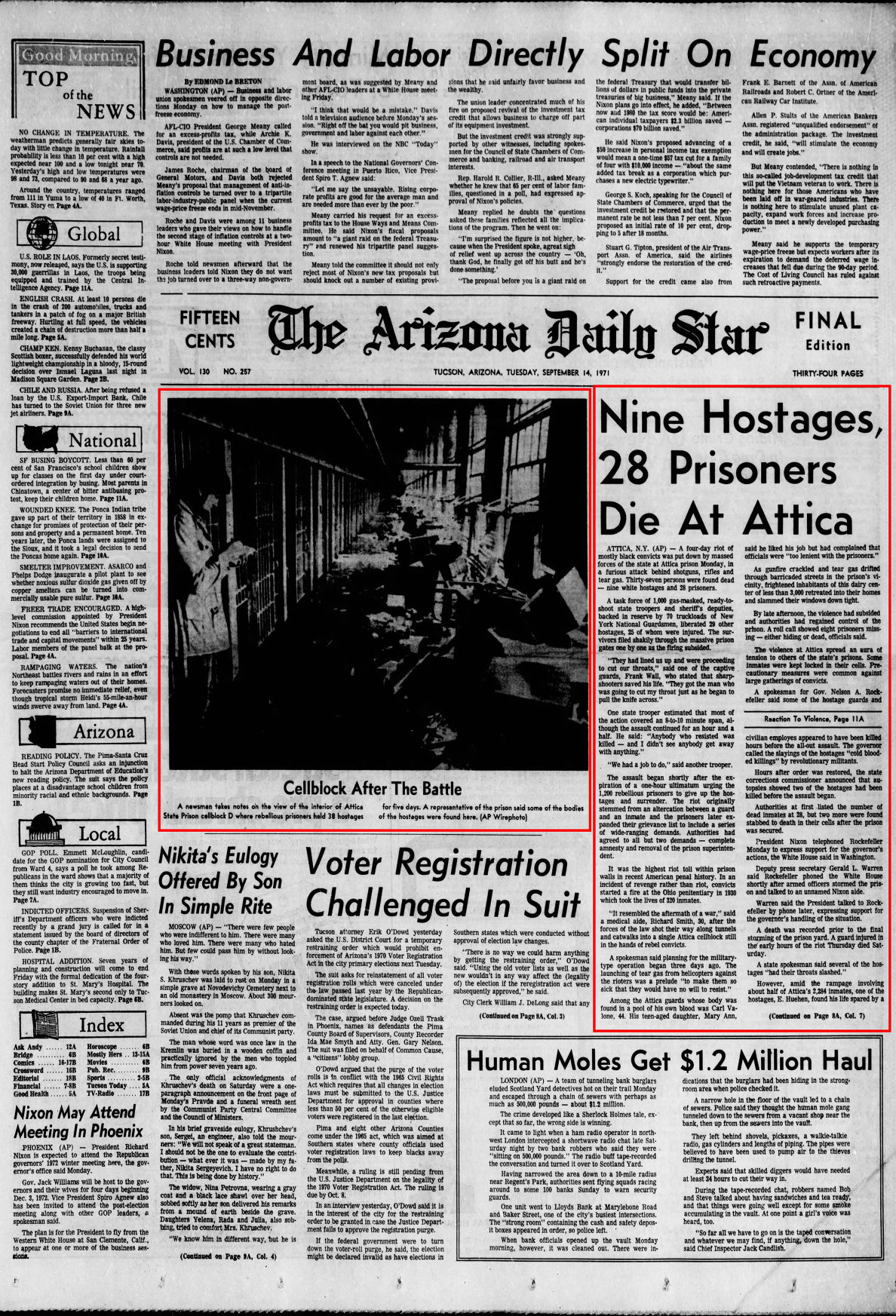
Nine Hostages, 28 Prisoners Die At Attica
ATTICA, N. Y. (AP) ─ A four-day riot of mostly black convicts was put down by massed forces of the state at Attica prison Monday, in a furious attack behind shotguns, rifles and tear gas. Thirty-seven persons were found dead ─ nine white hostages and 28 prisoners.
A task force of 1,000 gas-masked, ready-to-shoot state troopers and sheriff's deputies, backed in reserve by 70 truckloads of New York National Guardsmen, liberated 29 other hostages, 25 of whom were injured. The survivors filed shakily through the massive prison gates one by one as the firing subsided.
"They had lined us up and were proceeding to cut our throats," said one of the captive guards, Frank Wall, who stated that sharpshooters saved his life. "They got the man who was going to cut my throat just as he began to pull the knife across."
One state trooper estimated that most of the action covered an 8-to-10 minute span, though the assault continued for an hour and a half. He said: "Anybody who resisted was killed ─ and I didn't see anybody get away with anything."
"We had a job to do," said another trooper.
The assault began shortly after the expiration of a one-hour ultimatum urging the 1,200 rebellious prisoners to give up the hostages and surrender. The riot originally stemmed from an altercation between a guard and an inmate and the prisoners later expanded their grievance list to include a series of wide-ranging demands. Authorities had agreed to all but two demands ─ complete amnesty and removal of the prison superintendent.
It was the highest riot toll within prison walls in recent American penal history. In an incident of revenge rather than riot, convicts started a fire at the Ohio penitentiary in 1930 which took the lives of 320 inmates.
"It resembled the aftermath of a war," said a medical aide, Richard Smith, 30, after the forces of the law shot their way along tunnels and catwalks into a single Attica cellblock still in the hands of rebel convicts.
A spokesman said planning for the military-type operation began three days ago. The launching of tear gas from helicopters against the rioters was a prelude "to make them so sick that they would have no will to resist."
Among the Attica guards whose body was found in a pool of his own blood was Carl Valone, 44. His teen-aged daughter, Mary Ann, said he liked his job but had complained that officials were "too lenient with the prisoners."
As gunfire crackled and tear gas drifted through barricaded streets in the prison's vicinity, frightened inhabitants of this dairy center of less than 3,000 retreated into their homes and slammed their windows down tight.
By late afternoon, the violence had subsided and authorities had regained control of the prison. A roll call showed eight prisoners missing ─ either hiding or dead, officials said.
The violence at Attica spread an aura of tension to others of the state's prisons. Some inmates were kept locked in their cells. Precautionary measures were common against large gatherings of convicts.
A spokesman for Gov. Nelson A. Rockefeller said some of the hostage guards and civilian employes appeared to have been killed hours before the all-out assault. The governor called the slayings of the hostages "cold blooded killings" by revolutionary militants.
Human Moles Get $1.2 Million Haul
LONDON (AP) ─ A team of tunneling bank burglars eluded Scotland Yard detectives hot on their trail Monday and escaped through a chain of sewers with perhaps as much as 500,000 pounds ─ about $1.2 million.
The crime developed like a Sherlock Holmes tale, except that so far, the wrong side is winning.
It came to light when a ham radio operator in northwest London intercepted a shortwave radio chat late Saturday night by two bank robbers who said they were "sitting on 500,000 pounds." The radio buff tape-recorded the conversation and turned it over to Scotland Yard.
Having narrowed the area down to a 10-mile radius near Regent's Park, authorities sent flying squads racing around to some 100 banks Sunday to warn security guards.
One unit went to Lloyds Bank at Marylebone Road and Baker Street, one of the city's busiest intersections. The "strong room" containing the cash and safety deposit boxes appeared in order, so police left.
When bank officials opened up the vault Monday morning, however, it was cleaned out. There were indications that the burglars had been hiding in the strong room area when police checked it.
A narrow hole in the floor of the vault led to a chain of sewers. Police said they though the human mole gang tunneled down to the sewers from a vacant shop near the bank, then up from the sewers into the vault.
They left behind shovels, pickaxes, a walkie-talkie radio, gas cylinders and lengths of piping. The pipes were believed to have been used to pump air to the thieves drilling the tunnel.
Experts said that skilled diggers would have needed at least 24 hours to cut their way in.
During the tape-recorded chat, robbers named Bob and Steve talked about having sandwiches and tea ready, and that things were going well except for some smoke accumulating in the vault. At one point a girl's voice was heard, too.
"So far all we have to go on is the taped conversation and whatever we may find, if anything, down the hole," said Chief Inspector Jack Candlish.
Sept. 6, 1972: Terrorism at the Olympics
Updated
11 ISRAELIS KILLED AT OLYMPIC GAMES
Arab Raid Ends With Bloodbath
Compiled From Wire Services
MUNICH ─ Eleven members of the Israeli Olympic team and four Arab terrorists were killed Tuesday in a 23-hour drama that began with an invasion of the Olympic Village by the Arabs. It ended in a shootout at a military airport 15 miles away as the Arabs were preparing to fly to Cairo with nine Israeli hostages.
The first two Israelis were killed early Tuesday morning when Arab commandos, armed with automatic rifles, broke into the quarters of the Israeli team. Nine other Israelis taken prisoner were killed later in the airport shootout between the Arabs and German policemen and soldiers.
The bloodshed brought suspension of the Olympic Games, and early today there was doubt about whether the international competition would be resumed.
In addition to the slain Israelis and Arabs, a German policeman was killed and a helicopter pilot was critically wounded. Three Arabs were wounded, and one was unaccounted for, police said.
Police sharpshooters opened fire on the Arabs when the helicopters landed, but missed some in the darkness. The guerrillas who escaped the first shots turned their guns on the helicopters with the helpless Israelis inside, authorities reported.
Bavarian Interior Minister Bruno Merck said the Israeli hostages had agreed to go with the Arabs to Cairo. But the German authorities felt "this would have been a certain death sentence for them," he said. "We had to take a chance and attempt to free the hostages."
Merck said one of the guerillas had killed himself by exploding a hand grenade. It set fire to a helicopter with some of the hostages trapped inside ─ blindfolded, their hands bound, linked together with ropes. He said the other guerillas had fired on fire engines to keep them from reaching the blazing helicopter.
The terrorist action was met by horrors and condemnation in most parts of the world, and in several Arab nations. President Nixon expressed a "sense of deep outrage." Premier Golda Meir of Israel denounced the attack as "insane terror." The day that opened and closed in bloodshed injected sorrow and disgust into the atmosphere of international friendship for which the Olympic competition stands.
The terrorists were members of a Palestinian extremist group named Black September for the month in 1970 when King Hussein crushed the guerilla movement in Jordan. They had demanded that 200 Arab commandos held in Israeli prisons be freed in return for the hostages' lives.
Sept. 21, 1973: Battle of the sexes
Updated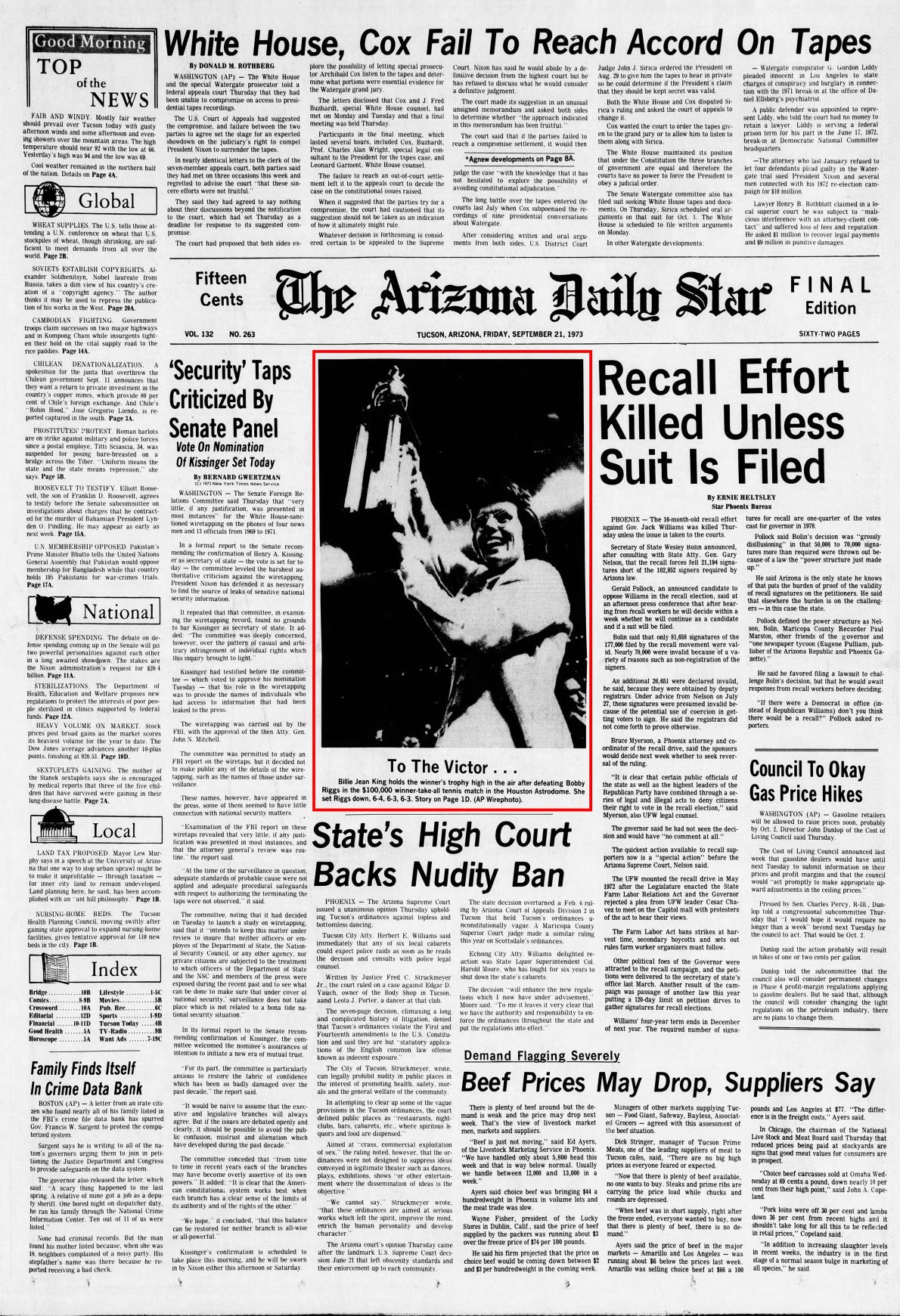
From the article on Page 1D:
Billie Jean Crushes Chauvinist Riggs
HOUSTON (AP) ─ Audacious Billie Jean King struck a blow at all male chauvinists by crushing Bobby Riggs 6-4, 6-3, 6-3 Thursday night in their circus-like, $100,000 winner-take-all tennis Battle of the Sexes at the Astrodome.
A wild roar went up from the 30,472 fans in the huge air-conditioned arena when Bobby dumped a weak forehand shot into the net for the final shot.
Billie Jean, leading 5-3 with Riggs serving, earlier blew to match points with weak shots into the net for errors.
At the end of the match, while skyrockets flared on the big Astrodome scoreboard and the University of Houston band played a marching tune, the happy Mrs. King flung her racket high in the air and hurdled the net in traditional fashion.
The 55-year-old, bespectacled Riggs was a tired, rubbery-legged old man at the finish.
"She was just too good for me," he acknowledged ungrudgingly, rubbing his chronically sore right elbow. "She was much too quick and made better shots than I did."
…..
The match was played on a green synthetic court stretched over the second and third base lines of the home of the Houston Astros baseball team in an atmosphere that more resembled a heavyweight title fight, a college football game or a circus than a tennis match.
Billie Jean was borne into the huge domed area on a litter like an Egyptian Cleopatra. The litter was carried by four muscled men with others leading the way carrying plumes on long sticks.
Riggs, not to be outdone, was a Kubla Khan as he was hauled into the stadium over a gold carpet on a ricksha pulled by eight bosomy women in red shorts.
At courtside Bobby presented Billie Jean a huge lollipop ─ which he called a sucker ─ just as he [earlier that year] handed Mrs. Court a bouquet of roses before overwhelming her in San Diego last spring.
Mrs. King was not to be upstaged, however. She promptly handed over a small pig in a box to the man who had once said, "If I am to be a chauvinist pig I have to be the No. 1 pig."
The match was nationally televised and the Trendex rating service reported that an estimated 50 million television viewers watched for the first hour. There were no figures available for the final 90 minutes.
A wild, bullring crowd in the Astrodome hooted and yelled throughout the match in a sport in which tradition has dictated deathly silence from spectators.
State's High Court Backs Nudity Ban
PHOENIX ─ The Arizona Supreme Court issued a unanimous opinion Thursday upholding Tucson's ordinances against topless and bottomless dancing.
Tucson City Atty. Herbert E. Williams said immediately that any of six local cabarets could expect police raids as soon as he reads the decision and consults with police legal counsel.
Written by Justice Fred C. Struckmeyer Jr., the court ruled on a case against Edgar D. Yauch, owner of the Body Shop in Tucson, and Leota J. Porter, a dancer at that club.
The seven-page decision, climaxing a long and complicated history of litigation, denied that Tucson's ordinances violate the First and Fourteenth amendments to the U.S. Constitution and said they are but "statutory applications of the English common law offense known as indecent exposure."
The City of Tucson, Struckmeyer wrote, can legally prohibit nudity in public places in the interest of promoting health, safety, morals and the general welfare of the community.
In attempting to clear up some of the vague provisions in the Tucson ordinances, the court defined public places as "restaurants, nightclubs, bars, cabarets, etc., where spiritous liquors and food are dispensed."
Aimed at "crass, commercial exploitation of sex," the ruling noted, however, that the ordinances were not designed to suppress ideas conveyed in legitimate theater such as dances, plays, exhibitions, shows "or other entertainment where the dissemination of ideas is the objective."
"We cannot say," Struckmeyer wrote, "that these ordinances are aimed at serious works which lift the spirit, improve the mind, enrich the human personality and develop character."
The Arizona court's opinion Thursday came after the landmark U.S. Supreme Court decision June 21 that left obscenity standards and their enforcement up to each community.
The state decision overturned a Feb. 6 ruling by Arizona Court of Appeals Division 2 in Tucson that held Tucson's ordinances unconstitutionally vague. A Maricopa County Superior Court judge made a similar ruling this year on Scottsdale's ordinances.
Echoing City Atty. Williams delighted reaction was State Liquor Superintendent Col. Harold Moore, who has fought for six years to shut down the state's cabarets.
The decision "will enhance the new regulations which I now have under advisement," Moore said. "To me it leaves it very clear that we have the authority and responsibility to enforce the ordinances throughout the state and put the regulations into effect."
Sept. 9, 1974: Ford pardons Nixon
Updated
Ford Pardons Nixon
Former President Shows Remorse
WASHINGTON (AP) ─ President Ford granted Richard Nixon "a free, full and absolute pardon" yesterday for any criminal conduct during his presidency and Nixon responded with a statement of remorse at "my mistakes over Watergate."
Announcing the pardon at a surprise appearance before newsmen and photographers, Ford said, "I feel that Richard Nixon and his loved ones have suffered enough."
The announcement touched off criticism from a number of Democratic congressmen, and the President's press secretary and close friend Jerald F. terHorst, resigned in protest.
The former President responded from his home in San Clemente, Calif., with a statement in which he admitted no criminal wrongdoing but said, "One thing I can see clearly now is that I was wrong in not acting more decisively and more forthrightly in dealing with Watergate."
Within two hours of Ford's announcement, presidential aides made public the terms of an agreement reached Saturday under which the federal government will be given custody of Nixon's public papers and controversial tape recordings.
However, the agreement specified that all the tapes will be destroyed within five to 10 years ─ or sooner ─ if Nixon dies within five years.
Philip Buchen, White House counsel, told reporters Ford granted Nixon a sweeping pardon without any strings attached. However, he acknowledged that Ford might have taken a different course, or delayed a decision, had he not been informed in advance of the gist of Nixon's planned statement of response and the agreement covering the documents of the Nixon presidency.
In announcing the pardon, Ford said any move to try the former President might have taken months or years, during which "ugly passions would again be aroused, our people would again be polarized in their opinions, and the credibility of our free institutions of government would again be challenged at home and abroad."
He said:
"My conscience tells me clearly and certainly that I cannot prolong the bad dreams that continue to reopen a chapter that is closed. My conscience tells me that only I, as President, have the constitutional power to firmly shut and seal this book."
Evel Knievel Misses In Junp Over Canyon
TWIN FALLS, Idaho (AP) ─ Evel Knievel's much-heralded attempt to rocket across the Snake River Canyon failed when a parachute deployed too early and sent him plunging into the bottom of the canyon yesterday. He suffered no serious injuries, and was plucked from the bottom of the 600-foot-deep chasm within moments.
A rescue helicopter brought him back to the canyon rim, where he saluted thousands of applauding onlookers.
The motorcycle stuntman from Butte, Mont., will receive millions, despite his failure to reach the other side of the canyon.
Four hours after his red, white and blue Sky-Cycle, twisting in the shrouds of the premature parachute, had landed on a rocky shelf on the bottom of the canyon, Knievel appeared at a news conference to declare that he did not consider himself beaten.
"To lose to a beautiful canyon and river like this to me is not a real loss," said Knievel, the right side of his tanned face cut from the impact of the crash landing.
Loud applause from the estimated 20,000 spectators ─ a far smaller crowd than had been predicted ─ greeted Knievel when he returned to the launch site from the bottom of the canyon. The daredevil stuntman embraced his father.
Knievel had been taken from the Sky-Cycle, placed in a rescue boat on the river which runs through the canyon, and then flown by helicopter back to the top of the canyon, which is almost a quarter of a mile across.
Knievel would not rule out the possibility of another attempt to clear the canyon. "I don't know what I am going to do," he said. "I gave it my best."
Promoters of the leap, probably the most publicized in history, had given Knievel a check for $6 million weeks in advance of the jump and promised him 60 per cent of the profit from closed-circuit television showings and related deals. His take was unaffected by his failure.
Sept. 6, 1975: Assassination attempt on President Ford
Updated
Manson Disciple Points .45 Pistol At President
Ford Not Harmed As Agent Reacts
Compiled From Wire Services
SACRAMENTO, Calif. ─ A young woman pointed a .45-caliber automatic pistol at President Ford at close range yesterday, but a Secret Service agent grabbed the gun and forced it from the woman's hand. The President was unharmed.
A White House spokesman said later in the day that the pistol contained a magazine with bullets in it, but that there was no bullet in the weapon's chamber when the gun was seized.
The woman was identified by the Sacramento police as Lynette Alice "Squeaky" Fromme, 26, who has been a follower of Charles M. Manson, the leader of a group convicted of murdering actress Sharon Tate and six others in 1969.
Miss Fromme was arraigned yesterday afternoon before a U.S. magistrate in the federal courthouse here on a charge of attempted assassination of the President. Bond of $1 million was set, and she was taken to the Sacramento County Jail.
The FBI said it took over the investigation and said it will cover the possibility of a conspiracy. One of Manson's prosecutors said he believes Manson masterminded the apparent assassination attempt.
"The Manson girls just don't act on their own, they act at the behest of Charles Manson," said Deputy Dist. Atty. Stephen Kay in Los Angeles. "I think Charles Manson had a hand in it. It's very easy to slip messages in and out of prison." However, he gave no indication of any evidence to substantiate his comments.
When Ford returned to Washington, he was greeted on the White House lawn by his wife and sons Jack and Steve.
Mrs. Ford and the President threw their arms around each other and kissed and the President shook hands with his sons.
Mrs. Ford, asked if she would let the President go on another campaign trip next week, said: "Of course."
It was the first time anyone has been charged with attempted assassination of the President since the federal law specifically citing assault against Presidents and other public officials went into effect in 1972, according to the FBI.
Larry M. Buendorf, 37, a Secret Service agent in the protective detail assigned to the President, grabbed the gun and forced it to the ground as Ford walked two feet away from the woman, who was in a crowd outside the California state Capitol building.
The White House said that as Buendorf seized the weapon, he cut his hand, possibly on the cocked hammer.
The President said later that as he passed the place where the woman was standing, "I saw a hand coming up behind several others in the front row, and obviously there was a gun in that hand."
Sept. 16, 1975: Tucson police, firefighters strike
Updated
Police, Firemen Stay Out; Castro Offers Guard Help
Half Of Force Away As Talks Collapse
At least 125 Tucson police and firemen ─ more than half of those scheduled for duty last night ─ claimed illness and either did not report for work or left their posts after wage negotiations collapsed in a procedural dispute at the start.
Gov. Raul Castro told City Manager Joel Valdez he would order the Arizona National Guard to protect the city, if necessary.
By midnight, 78 policemen had called in sick since late afternoon, and 50 of the 102 firemen on duty had left their stations throughout the city, claiming illness.
Matt Garry, assistant to city Fire Chief L.F. Peterson, confirmed that the city's fire defenses had been reduced by 50 per cent. Of 21 truck companies, only nine engine and two ladder companied were in operation.
Valdez said he had assurances of help from South Tucson for additional police and from Davis-Monthan AFB for additional fire protection, and was told by the governor that Dept. of Public Safety agents or National Guardsmen would be ordered into the city if requested by Mayor Lew Murphy.
"The governor said he would back up with whatever we need," said Valdez. "A call from the mayor will bring a quick response."
Capt. Peter Ronstadt said police personnel normally not on patrol duty were being pressed into service. Officers were being summoned from administration, operations and the service divisions, and others.
How long that plan would hold up remained uncertain. Some of those called reportedly responded, "I understand my new duties, but I've suddenly been taken ill."
"One hundred per cent moral support" for the police action was voiced last night at a meeting of some 150 to 200 members of the county sheriff's deputies lodge of the Fraternal Order of Police, according to lodge president Clarence "Butch" Powell. He said sheriff's deputies, who are paid less than city police and last week said they want equal salaries, are not planning any walkout, but are trying to set up a wage meeting soon with the county Board of Supervisors.
Murphy insisted yesterday ─ at the start of negotiations with representatives of the 800-plus members of Police-Fire Assn. ─ that the talks should be conducted in public. Association attorney Fred N. Belman insisted the talks be in private.
Four of the six City Council members approved the private session, and later the other two members agreed to starting the talks in private. But Murphy would not go along.
Last night, Belman said police and firemen had been afflicted with "Murphy's flu." At City Hall, the mayor told a reporter, "Everything's under control."
Asked how long the "sick-in" would last, Belman said, "We won't sit down with anything short of the mayor and all of the council." As far as could be determined, Murphy was the only one still insisting on public negotiations.
Outright strikes by municipal employes are forbidden by state law.
The Police-Fire Assn., a joint bargaining group formed just last week, is asking for a 30 per cent immediate pay increase for the police and firemen.
Valdez said last night that if he supported a raise, he would propose that it apply to all city employes. "I can't see where we can give the raise to some and not to others," he said.
The city earlier this year froze all salaries, citing economic conditions.
Meanwhile, Police Chief William J. Gilkinson and his top commanders, who had been meeting since early afternoon, began late last night to try to carry out a patchwork contingency plan.
Other city officials ─ including finance director James Kay, budget director Ruben Saurez, Asst. City Mgr. George Gray; Thomas O. Price, director of the Dept. of Operations, and City Councilman Ruben Romero ─ worked into the night to form a position paper. The paper is to tell the mayor and council the city's financial capability for any wage increases.
Sept. 19, 1975: Patricia Hearst arrested
Updated
FBI Arrests Patricia Hearst
3 Radical Friends Are Also Caught
SAN FRANCISCO (AP) ─ Fugitive newspaper heiress Patricia Hearst and three radical comrades were arrested yesterday, ending one of the longest manhunts in American history.
Miss Hearst, first the captive and then the zealous comrade-in-arms of the Symbionese Liberation Army, was arrested without resistance in a house in the city's Bernal Heights district along with fugitive Berkeley artist Wendy Yoshimura.
The FBI said a 27-year-old housepainter was also arrested at the house. Stephen F. Soliah would be charged with harboring a fugitive, agent Frank Perrone said late yesterday. The FBI said it had been watching the house for two days.
About an hour earlier, police and federal agents arrested SLA members William and Emily Harris when they spotted them jogging on a street a few miles away.
After their arraignment in a crowded federal courtroom, the Harrises and Miss Hearst were taken by car to an undisclosed location. Miss Hearst smiled and waved at reporters from the back seat of one auto, and Mrs. Harris proferred a clenched-fist salute.
Harris was taken from the federal building in another car. The three were guarded by U.S. marshals, and vehicles with law enforcement officers were at the front and rear of the caravan.
"Thank God, she's all right," Miss Hearst's mother, Catherine, said in a barely audible voice when informed. "Please call it a rescue, not a capture."
FBI special agent-in-charge Charles Bates said the arrests "effectively put an end to everyone we know who was in the SLA."
The arrest of Miss Hearst came fewer than 10 miles from the Berkeley apartment where she was kidnapped by SLA members Feb. 4, 1974.
Miss Hearst and the Harrises were arraigned before U.S. Magistrate Owen Woodruff on a variety of state and federal charges and were held on $500,000 bail each pending further hearings today.
Miss Yoshimura was released to the custody of the Alameda County Sheriff's office, where she is charged with possessing explosives.
Miss Hearst, 21, dressed in a striped shirt, brown jeans and sandals, was arraigned on federal charges of bank robbery and firearms violations.
Standing before the magistrate with her arms folded, she answered softly "yes," when asked if her name was Patricia Hearst. It was barely a year and a half ago when she proclaimed herself "Tania," the name she had adopted as a sign of her revolutionary ardor.
Appearing pale but calm, she conferred in whispers with her attorney, Terrence Hallinan.
Defense co-counsel Ted Kleiness said Miss Hearst asked to see her parents. "She was very, very interested," Kleiness said, "she was very friendly toward us."
Miss Hearst's father, San Francisco Examiner President Randolph A. Hearst, was in New York on business and said as he boarded a plane for San Francisco: "I am very pleased that things turned out the way they did."
Hearst said of the bank robbery charge against his daughter: "I don't think anything will happen on that score. After all, she was a kidnap victim, you must remember."
…..
Miss Hearst was abducted by gun-carrying members of the SLA, described by authorities as a tiny band of white ex-college students led by black prison escapee Donald DeFreeze.
She was dragged kicking and screaming from the apartment she shared with her fiance, Stephen Weed, in Berkeley, where she was a sophomore at the University of California.
The terrorist group demanded as a precondition for her release that the Hearsts feed the poor, and the family put together a $2 million "People in Need" giveaway program. But the SLA denounced the effort as a sham.
On April 3, 1974, Miss Hearst shocked the world by renouncing her family in a taped message, and declaring that she was joining her captors. To symbolize her conversion, she adopted the name "Tania," a figure from the Latin American guerilla movement.
On April 15, Miss Hearst dramatized her conversion when she and several SLA comrades allegedly staged an armed holdup of a Hibernia Bank branch in San Francisco. In a later taped message she called her father a "pig" and scornfully rejected Weed.
Sept. 18, 1983: First black Miss America crowned
Updated
57th Miss America gives pageant a first
ATLANTIC CITY, N.J. (AP) ─ Miss New York, Vanessa Williams, was crowned the 57th Miss America last night, and became the first black woman to win the title in the 62-year history of the pageant.
Williams, 20, of Millwood, N.Y., won preliminary talent and swimming suit competitions earlier in the week of the pageant, which barred minority participation during its first three decades.
Miss New Jersey, Suzette Charles, the other black finalist in the pageant, was first runner-up. Miss Alabama, Pam Battles, 21, of Muscle Shoals, was second runner-up, while the third runner-up was Miss Mississippi, Wanda Gayle Geddie, 24, of Hattiesburg. Miss Ohio, Pamela Helean Rigas, 22, of Canfield, was fourth runner-up.
The outgoing Miss America, Debra Sue Maffett, 26, of Anaheim, Calif., crowned her successor.
"This means a lot to me and I think it means a lot to America. I'm making a lot of waves," Williams said. "I'll do the best job I can as Miss America. I'll represent everybody in America, no matter what race, creed or color they are."
Black women were not permitted to enter the pageant in its early years. Blacks portrayed slaves in crowning ceremonies during early years of the pageant.
Note: After it was disclosed that Penthouse would publish nude photos of Williams that were taken a couple of years before she was crowned Miss America, she relinquished her crown on July 23, 1984. She said she had not given Penthouse permission to publish the photos. She was the first Miss America to give up her crown.

Johanna Eubank
Online producer
In this Series
Time machine special sections
1
Updated collection
From the Arizona Daily Star archives: Printable movie star paper dolls
2
Updated collection
Historic June front pages from the Star's archives
3