Historic August front pages from the Star's archives
From the Time machine special sections series
News of note from past Augusts included: the resignation of President Nixon, Social Security becoming law, an atomic bomb dropped in Japan, Marilyn Monroe's death and the Manson murders.
Aug. 9, 1974: President Nixon resigns
UpdatedToday the Arizona Daily Star offers a look back at some front pages that appeared in August throughout the newspaper’s history. Some had big national or international news on the cover. Sometimes only a small notice of an incident appeared because its importance was not yet realized, only to have it become big news, or even legend, later on. Take a look back.
The Star began publishing in 1877. Most of the Star’s editions are available beginning in 1879 on Newspapers.com. Go to tucson.com/archives to learn about subscribing to the collection of more than 2 million pages.
This first page is from Aug. 9, 1974. Download a PDF that you can enlarge to make reading easier.

Aug. 7, 1890: The first execution by electric chair
UpdatedDownload a PDF that you can enlarge to make reading easier.

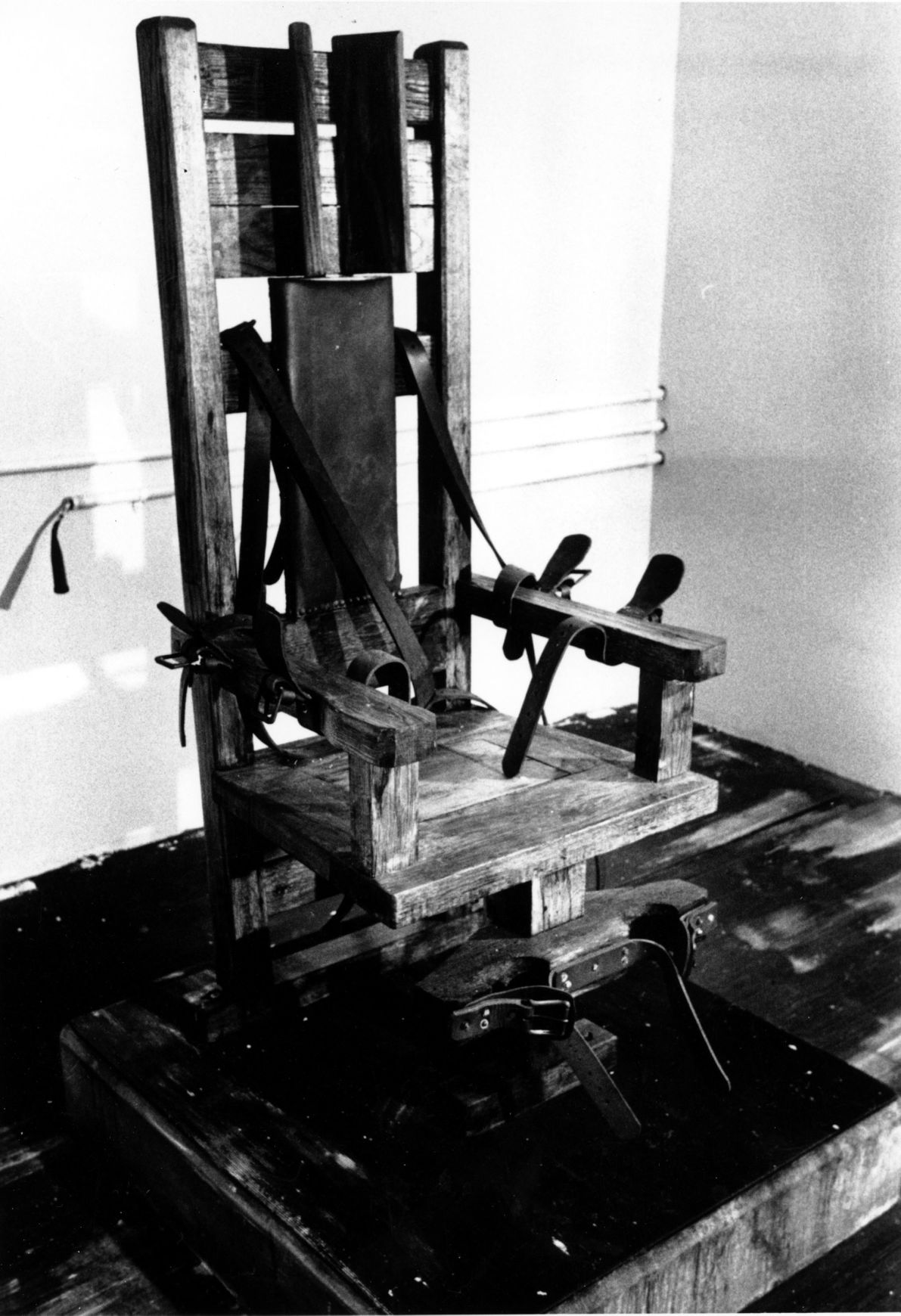
This is an undated file photo of the electric chair at the Tennessee State prison in Nashville. First used by New York State in 1890, it was used throughout the 20th century to execute hundreds and is still an option in eight states. Since 1976, 158 inmates have been executed by electrocution. It was considered humane on its introduction but resulted in many horrific executions over the years. (AP Photo, File)
William Kemmler, who had been convicted of murder and sentenced to death, was the first person executed by electric chair. The execution took place in Auburn, N.Y.
The electricity was turned on for 17 seconds, but it was not enough to kill the condemned man. Another shock lasting considerably longer was administered until witnesses could smell the body burning and there was no doubt the man was dead.
Many condemned this form of execution after witnessing it.
Aug. 5, 1892: Lizzie Borden took an axe, or did she?
UpdatedDownload a PDF that you can enlarge to make reading easier.

Andrew Borden and his second wife were found murdered in their home in Fall River, Mass. It may have been the brutality of the murders that landed the small notice on the front page of the Arizona Daily Star, more than 2,500 miles away.
Borden's daughter Lizzie was charged with the murders and went on trial. The evidence was circumstantial and the jury acquitted her after a short deliberation.
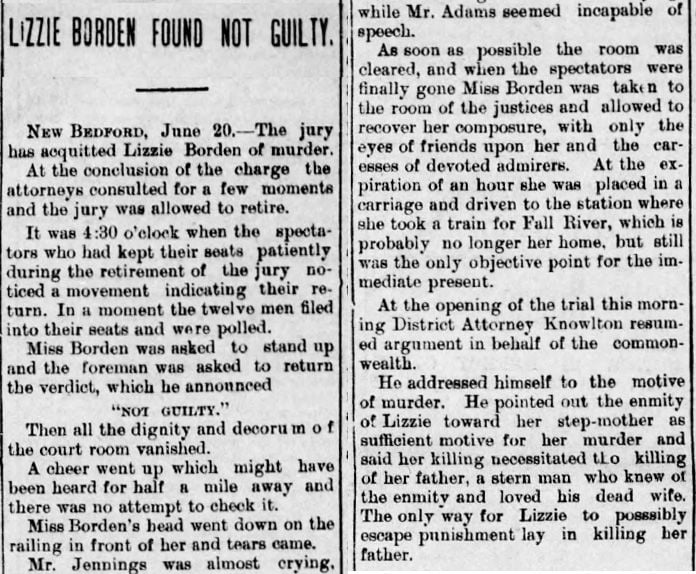
From the Arizona Daily Star June 21, 1893.
Aug. 13, 1898: Armistice declared in Spanish-American War
UpdatedDownload a PDF that you can enlarge to make reading easier.

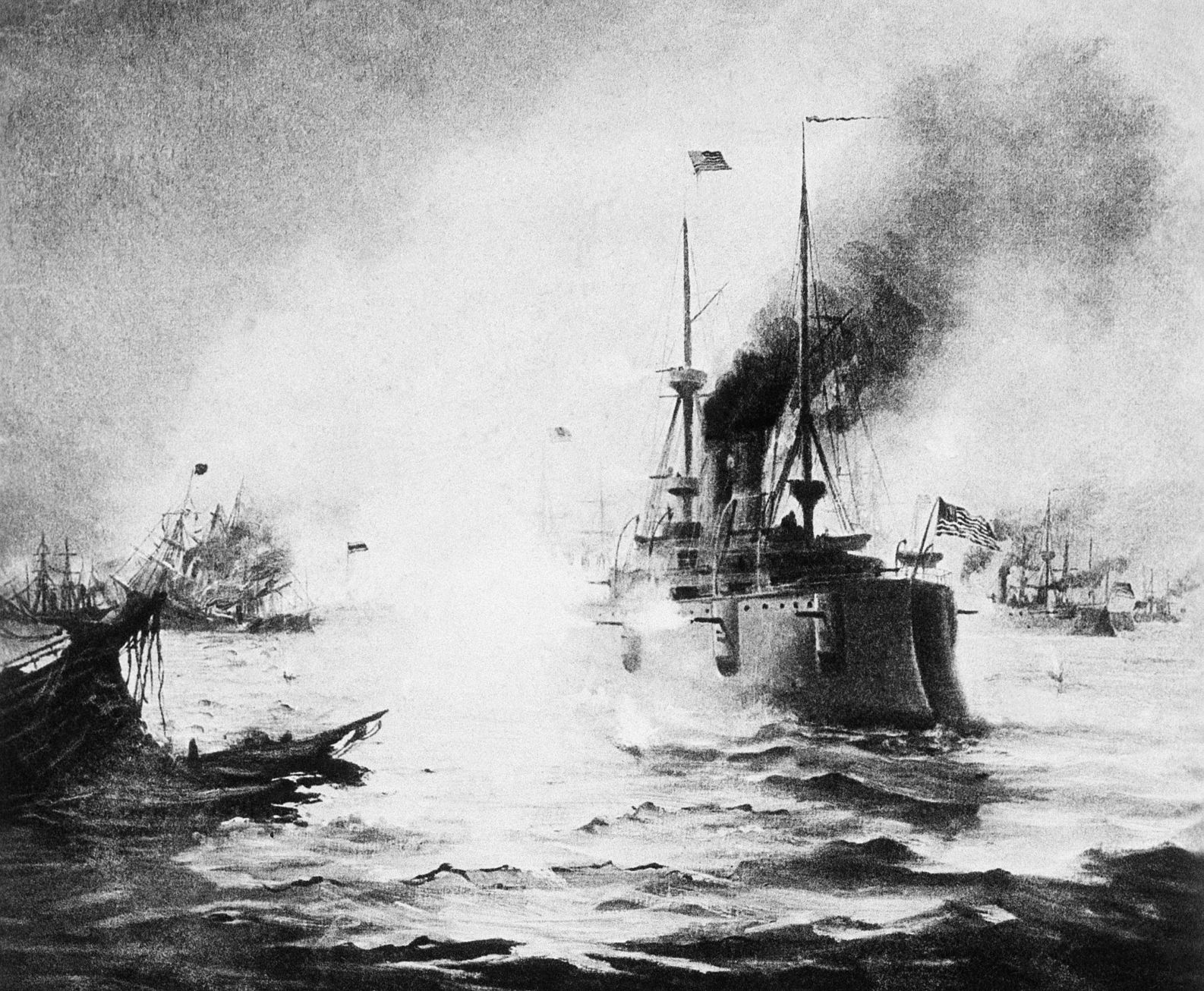
Spanish and U.S. ships battle during the Spanish American War in the waters off Manila, the Philippines, 1898. (AP Photo)
The United States declared war on Spain on April 21, 1898. While there were several reasons for the declaration of war, the main ones were that the U.S. was supporting Cubans and Filipinos who were struggling against Spanish rule, and the U.S. blamed Spain for the explosion of the battleship USS Maine in Havana Harbor.
Eleven days after the war began, the Navy defeated the Spanish Pacific fleet in Manila Bay. The war lasted less than four months.
Aug. 19, 1920: The 19th amendment is ratified by the 36th state
UpdatedDownload a PDF that you can enlarge to make reading easier.


Suffragists led by "General" Rosalie Jones march from New York on their way to the Woman Suffrage Procession in Washington D.C., on the eve of Woodrow Wilson's inaugural in March 1913. (AP Photo)
The state of Tennessee became the 36th state to ratify the 19th amendment, which gave women the right to vote in the United States. The Tennessee vote was taken a few times before the 48-48 tie was broken in state House and the bill was ratified 50-46. The state Senate had passed it easily.
Thirty-six states were required to ratify the amendment and make it part of the U.S. Constitution.
Aug. 3, 1923: President Harding dies
UpdatedDownload a PDF that you can enlarge to make reading easier.


President Warren Harding's body lying in state at the White House, Washington, Aug. 1923. (AP Photo)
Warren G. Harding, the 29th president of the United States, was born Nov. 2, 1865, in Ohio. He was a teacher for a time and a newspaper owner before entering politics.
He was elected president in 1920 and took office in 1921. He had been a popular president, but scandals that became public after his death reduced his popularity.
Aug. 3, 1934: Hitler becomes president of Germany
UpdatedDownload a PDF that you can enlarge to make reading easier.


German Chancellor Adolf Hitler, who served as a corporal during the Great War, spoke as leader of the German people at a great gathering of ex-service men at Kassel. Adolph Hitler addressing the meeting of ex-servicemen in Kassel on June 5, 1939. (AP Photo)
Upon the death of German President Paul von Hindenburg, Adolph Hitler assumed the presidency and also became chancellor. He called for oaths of allegiance from all individuals in the army and navy, essentially making himself dictator. He said he desired to be known not as president, but as "führer and reichschancellor."
Aug. 15, 1935: Social Security becomes law
UpdatedDownload a PDF that you can enlarge to make reading easier.


FILE - This Aug. 14, 1935, file photo shows President Franklin D. Roosevelt signing the Social Security Bill in Washington. (AP Photo, File)
The Social Security law included the greatest single tax burden ever appropriated by Congress up to that time.
The first person to receive benefits was Ernest Ackerman, who got a one-time, lump-sum payment of 17 cents in January 1937. Ida Mae Fuller was the first to receive monthly benefits.
Since November 1936, when they were first issued, more than 450 million Social Security numbers have been issued. Since benefits were first distributed, the program has paid out more than $11 trillion and taken in more than $13 trillion.
Sources: ssa.gov and Arizona Daily Star archives
Aug. 10, 1936: Jesse Owens wins fourth gold medal in Berlin Olympics
UpdatedDownload a PDF that you can enlarge to make reading easier.

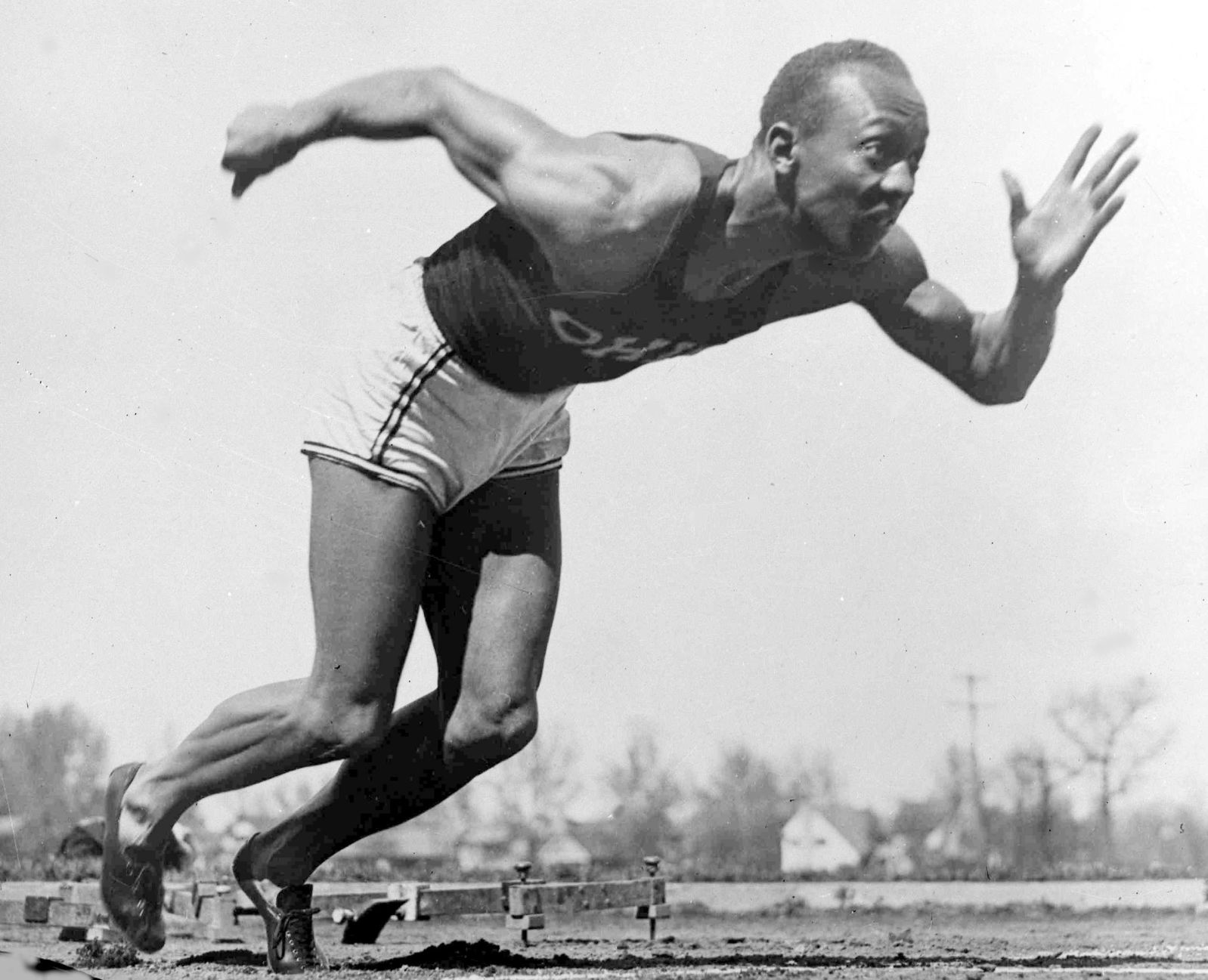
In this Aug. 5, 1936 file photo, American athlete Jesse Owens practices in the Olympic Village in Berlin. Shortly after Jesse Owens returned home from his snubbing by Adolph Hitler at the 1936 Olympics, he and America's 17 other black Olympians found a less-than-welcoming reception from their own government, as well. (AP Photo/File)
Hitler had hoped to turn the 1936 Olympics into a showcase of Aryan supremacy. Those plans were foiled when Jess Owens became the first American to win four gold medals in track and field.
After the first day of the games, rather than congratulate Owens, Hitler decided not to publicly congratulate any winners.
Sources: biography.com, time.com and Arizona Daily Star archives
Aug. 26, 1944: Paris is liberated
UpdatedDownload a PDF that you can enlarge to make reading easier.


Through streets lined with madly cheering Parisians, General Charles de Gaulle made his parade from the Arc de Triomphe to the Place de La Concorde on August 27, 1944. From every building flew the tricolor flag, the Union Jack, and the Stars and Stripes. (AP Photo/Harry Harris)
After four years of Nazi rule, Paris was liberated by French and American forces. A similar announcement had gone out two days earlier, but the Germans had resumed fighting.
This time, the German commander signed a document ordering his troops to cease fire.
Parisians had fought inside the city against the Germans for almost a week. As the French and American armies moved in, there was fighting in the streets for the better part of the day before the cease-fire was declared.
Aug. 7, 1945: Atomic bomb dropped on Hiroshima
UpdatedDownload a PDF that you can enlarge to make reading easier.


Some 35,000 gather at the peace dome in Hiroshima, Japan on August 6, 1966, to commemorate the 21st anniversary of the atom bombing of the city by the U.S. (AP Photo)
When President Truman announced that an atomic bomb had been dropped on Hiroshima 16 hours earlier, many believed this would aid in shortening the war with Japan.
However, another article in the Arizona Daily Star on the same day stated that the Japanese would likely attempt to keep the devastation a secret from others. There would be few witnesses to the explosion left alive. Thus, the Army Air Forces would drop leaflets letting civilians know what had been done.
Another bomb was dropped before the Japanese surrendered.
Aug. 17, 1948: Babe Ruth dies
UpdatedDownload a PDF that you can enlarge to make reading easier.


In this undated file photo, New York Yankees' Babe Ruth hits a home run. Ruth, also called the Sultan of Swat, began as a left-handed pitcher and became a slugging outfielder, playing for 22 major-league seasons before retiring in 1935. He died Aug.16, 1948 of cancer. (AP Photo, File)
Babe Ruth, also known as the King of Baseball or the Sultan of Swat, died of throat cancer at the age of 53 after receiving last rites.
He was born George Herman Ruth Jr. on Feb. 6, 1895, in Baltimore, Maryland. He was sent to a Catholic orphanage when he was 7 years old because he was too much for his parents to handle. At 7, he was already drinking, chewing tobacco and getting in trouble with the police.
Because he needed a legal guardian to sign his baseball contract when he was 19, the owner of the minor-league Baltimore Orioles, Jack Dunn, signed on as his legal guardian. Teammates jokingly called him "Dunn's new babe," and the name "Babe" became part of history.
Sources: biography.com and Arizona Daily Star archives
Aug. 6, 1962: Marilyn Monroe is found dead
UpdatedDownload a PDF that you can enlarge to make reading easier.
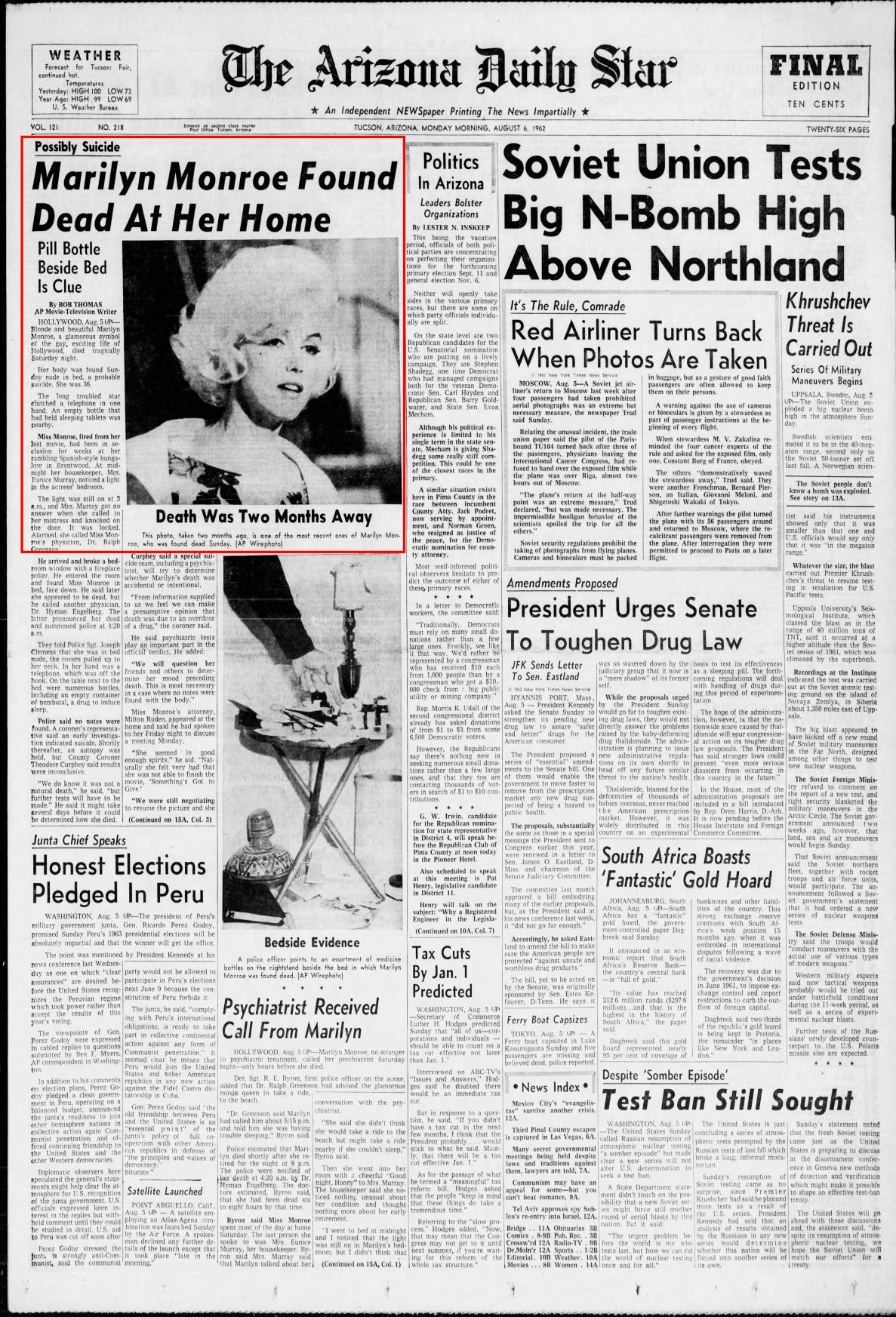

In this Sept. 9, 1954 file photo, Marilyn Monroe poses over the updraft of a New York subway grate while filming "The Seven Year Itch" New York. (AP Photo/Matty Zimmerman)
The glamorous Hollywood actress Marilyn Monroe was found dead, lying face down on her bed, by her physician. He had to break a window with a fireplace poker to gain entry to the room, as the door had been locked from the inside.
An empty bottle that had held sleeping pills was on the bedside table.
The county coroner indicated that an autopsy would be done to determine what drugs had caused her death and interviews with those who had interacted with her recently would be done to determine if she had committed suicide, since there was no note with the body.
Aug. 29, 1963: Civil rights march on Washington
UpdatedDownload a PDF that you can enlarge to make reading easier.


In this Aug. 28, 1963, file photo shows civil rights demonstrators gather at the Washington Monument grounds before noon, before marching to the Lincoln Memorial, seen in the far background at right, where the March on Washington for Jobs and Freedom will end with a speech by Rev. Martin Luther King Jr., now known as the "I Have A Dream" speech. (AP Photo, File)
William R. Mathews, editor of the Arizona Daily Star, attended the civil rights march in Washington, D.C., on Aug. 28, 1963. He described the marchers as orderly and organized.
President Kennedy said "the cause of 20 million Negroes has been advanced" by the orderly assembly.
It was called a "March for Jobs and Freedom." The marchers gathered before the Lincoln Memorial, an appropriate gathering place in front of the monument to the man who emancipated the slaves.
Perhaps the most remembered part of the event was the Rev. Martin Luther King Jr.'s famous "I Have a Dream" speech.
Aug. 31. 1963: Hotline between US and USSR is established
UpdatedDownload a PDF that you can enlarge to make reading easier.


The White House Kremlin "hot line" providing direct communication for emergency use by the Chief of Staff in Washington and Moscow, became operational August 30, 1963. Air Force Sgt. John Bretoski, left, and Army Lt. Col. Charles Fitzgerald, man the equipment in the Pentagon during a test run. The Pentagon is the U.S. operating terminal for both the land line-transocean circuit and the alternate radio circuit, with a direct relay to the White House. (AP Photo)
With very little fanfare and no ceremony, a diplomatic "hot line" between Moscow and Washington, D.C., was established.
While the two powers couldn't agree on many things, they governments of the United States and the U.S.S.R. did agree to establish this emergency line to reduce the chance of an accidental war.
Once established, it was only to be used in case of emergency.
Aug. 28, 1964: Tornado in Pima County
UpdatedDownload a PDF that you can enlarge to make reading easier.


Rubble from a destroyed building after a tornado touched down near Mission San Xavier del Bac on the Tohono O'Odham reservation on Aug. 27, 1964, and killed a mother and child. Tucson Citizen file photo
Tornadoes are far from common in Tucson or Pima County, but one appeared out of the clouds on Aug. 27, 1964, and laid a path of destruction more than 3 miles long.
The devastation was near the San Xavier Mission and several homes were destroyed or damaged.
A mother and her infant son were killed. Others in the family were injured.
Aug. 2, 1966: University of Texas shooting
UpdatedDownload a PDF that you can enlarge to make reading easier.


In this Aug. 1, 1966, file photo, smoke rises from the sniper's gun as he fired from the tower of the University of Texas administration building in Austin, Texas, on crowds below. (AP Photo/File)
Charles Joseph Whitman, a former Marine, stabbed his wife and mother to death and then went to the University of Texas and shot at students and anyone nearby from a tower. He wounded 31 and killed 14 ─ plus the unborn child of one of the victims ─ before police killed him.
A day later, it was speculated that a brain tumor had either clouded his judgment and reason or caused maddening pain.
Whitman had told a psychiatrist that he had visions of going to the tower and shooting people, but no action was taken because the psychiatrist didn't believe he would follow through with his visions.
Aug. 10, 1969: Manson cult murders
UpdatedDownload a PDF that you can enlarge to make reading easier.


This Aug. 9, 1969 file photo shows the home of actress Sharon Tate and director Roman Polanski, after Tate and four others were murdered Aug. 8-9, 1969. One body is under a sheet at upper left; another is in the car at lower right. Fifty years ago Charles Manson dispatched a group of disaffected young followers on a two-night killing rampage that terrorized Los Angeles and, in the years since, has come to represent the face of evil. (AP Photo/File)
While the big local news on Aug. 10, 1969, was that a police walkout had ended, the front page also contained the news that five people, including actress Sharon Tate, wife of Roman Polanski, were found brutally murdered in Beverly Hills, California.
Also killed that night were Wojciech Frykowski, Abigail Folger, Jay Sebring and Steven Parent.
The following night, supermarket executive Leno LaBianca and his wife, Rosemary, were killed.
Charles Manson and his followers were arrested in October 1969. Some members of the cultlike "family" confessed that they wanted to shock the world. One member was given immunity in exchange for his testimony.
The trial lasted seven months and on Jan. 15, 1971, the jury found all the defendants guilty. Charles Manson died at the age of 83 on Nov. 19, 2017.
Sources: cnn.com and Arizona Daily Star archives
Aug. 1, 1975: Jimmy Hoffa is reported missing
UpdatedDownload a PDF that you can enlarge to make reading easier.
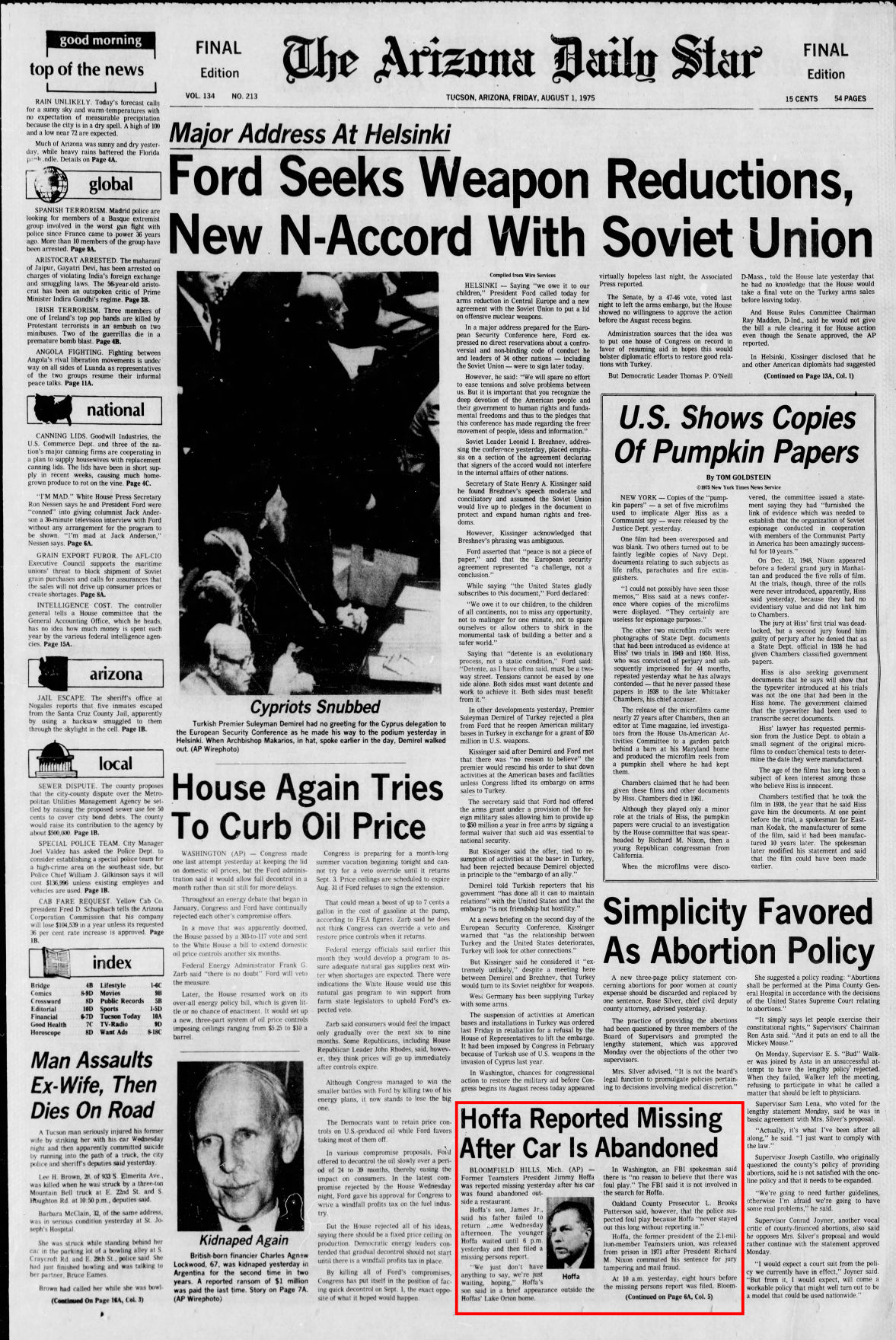

Teamster president Jimmy Hoffa, second from right, has a wide smile en route to the Federal Courthouse with his family, in Chattanooga, Tenn., Jan. 20, 1964. (AP Photo/Bill Hudson)
Former Teamsters President Jimmy Hoffa was reported missing on July 31, 1975. His family had last heard from him July 30.
Police investigated various members of mob families, but never had enough to charge anyone with the crime, which has never been solved. Hoffa's body has never been recovered.
The mystery is a popular one with TV detective shows and in movies. Martin Scorsese has made a movie called "The Irishman," due to be released soon, with a script based on the book "I Heard You Paint Houses" by Charles Brandt. The title comes from a phrase used by and for mafia hitmen. To "paint a house" means to kill someone. The book contains an account of the case by deceased mafia associate Frank Sheeran, also an associate of Hoffa.
It may have the story that is closest to the truth, but that hasn't helped police solve the mystery.
Sources: biography.com and Arizona Daily Star archives
In this Series
Time machine special sections
1
Updated collection
From the Arizona Daily Star archives: Printable movie star paper dolls
2
Updated collection
Historic June front pages from the Star's archives
3