



The pro-marijuana-legalization campaign wants you to know that its opponents are funded by the opioid industry.
Last week, the Campaign to Regulate Marijuana Like Alcohol put up a billboard in Phoenix calling the anti-legalization campaign “Reefer Madness 2.0” and “Paid for with profits from opioid sales.”
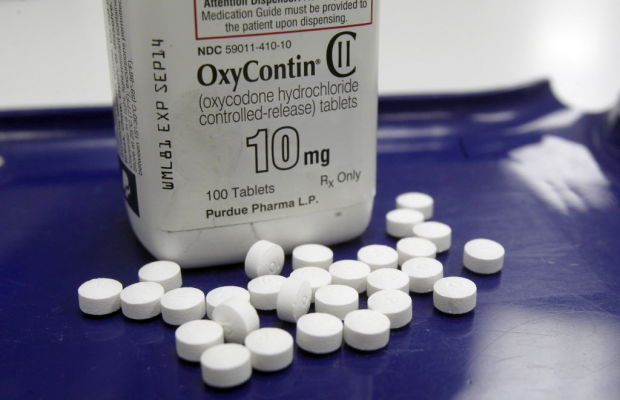
That’s true as far as it goes — as I’ve written, a Chandler-based maker of a fentanyl product donated a whopping $500,000 to the anti-legalization campaign. The specific interest of the company, though, seems to be in protecting sales of a cannabis-based drug it is developing.
It turns out both sides of the campaign have their links to opioids. And in truth, the line between legal and illegal drugs, recreational and medicinal, is hardly a line at all — more of a gray blur.
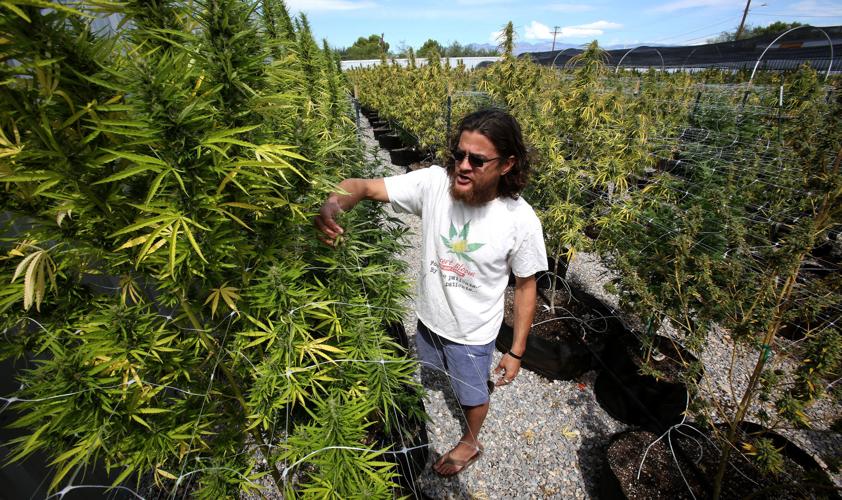
What opened my eyes to this even more recently was interviewing Aari Ruben, the owner of the Desert Bloom medical marijuana dispensary and a marijuana grow operation on Tucson’s south side. Ruben gave me a tour of his impressive cultivation site on Sept. 27.
Ruben, it turns out, worked for years in his father’s pain clinic, called Healthcare Southwest, at 2016 S. Fourth Ave. in South Tucson. Before Arizona’s medical-marijuana law passed in 2010, Ruben was the clinic’s administrator.
And off and on for years, state and federal officials have investigated his father, Dr. David Ruben, and accused him of over-prescribing oxycodone and other opioid pain-relievers. Twice his permission to prescribe opioids has been suspended, most recently in February of this year. State officials said he prescribed opioids excessively, to people who shouldn’t have been taking them, or in inappropriate dosages.
When we talked Friday, I suggested to Aari Ruben that, indirectly, opiate prescriptions made at the pain clinic financed his entry into the marijuana dispensary business. He acknowledged that was true.
“The money I invested in Desert Bloom was from my salaries from that job and money my dad allowed me to use that was generated from that business,” Aari Ruben said. “That would be correct.”
“We saw a lot of the problems of the opiate epidemic in our practice,” he went on. “People who were abusing the opiates, selling them on the street, people who tested positive for other drugs.”
So, if you take the state’s word for it in its case against Dr. Ruben, and combine it with his son’s account, what you find is that money derived from the spread of opioids is at work in favor of marijuana legalization as well.
Dr. Ruben and I spoke for an hour at his home Friday, and he defended his use of opiates in the practice while criticizing the government’s crackdown on them.
“You cannot treat pain without opioid analgesics,” he said, noting non-pharmaceutical approaches also are important. Opioids, he said, are “a vital part of treating pain.”
But now, Dr. Ruben argued, even as Drug War prohibitions on marijuana have eased and could disappear in Arizona, the crackdown is sharpening on other drugs. DEA agents raided his office in 2014 and had Dr. Ruben under criminal investigation, but eventually backed off. Pharmaceutical opioids, he said, are the latest target of the War on Drugs.
“You can’t get a Percocet, almost,” he said. “Doctors have been scared off because they want to put doctors in jail.”
Of course, this glosses over the reason why there has been a crackdown on opioids — an epidemic of addiction fueled largely by painkiller prescriptions. As described in Sam Quinones’ book, “Dreamland: The True Tale of America’s Opiate Epidemic,” pain clinics were one of the early sources of the spread of addiction in some parts of the country.
But more deeply, you could say it’s a good thing that fans of opioids are seeing a potential alternative in marijuana. As harmful as abuse of marijuana is, use of it for pain is less likely to lead to the downward spiral of addiction than the use of opioids.
On the other hand, the interest in marijuana by people who prescribed a lot of opioids also suggests that it’s just one big druggy crowd — that the legality of one drug and the illegality of another doesn’t make much difference. It’s all about the drugs.
When I spoke to Mark Kleiman, a well-known pro-legalization professor a couple of weeks ago, I asked him about the line between useful and recreational drugs.
“The fact that something can be abused doesn’t mean it can’t have a medical use,” said Kleiman, who is the director of the Crime and Justice Program at New York University’s Marron Institute of Urban Management.
The opposite, of course, is also true: The fact that something has a medical use doesn’t mean it can’t be abused.
When a person takes opioids to treat back pain and becomes addicted, does that mean their use becomes recreational? Or are they just addicted to a substance that nevertheless gives them good relief?
And if a person uses marijuana to relax and feel happy, is that recreational use, or is that medicinal? We make distinctions, but they are often hard to defend.
“We need to recognize that people like to use drugs and, in general, ought to be allowed to unless they get in trouble,” Kleiman told me. “Step back from worrying about who’s using drugs and start worrying about who’s getting hurt and who’s hurting others.”
Those seem like better ways to look at drugs than worrying about whether a drug is considered legal or illegal, recreational or medicinal.
And yet, the evening after we talked, Kleiman participated in a forum on Arizona’s Prop. 205 in Phoenix, and — to complicate matters further — he changed his mind. After reading about the provisions of 205 that would limit competition in the market, seeing there isn’t a lot to protect public health and realizing how hard it is to change the law if passed, the pro-legalization professor became anti-205.

