



This time of year, the sound of cicadas does it for me.
That droning buzz reminds me of where I am, the reality of a Tucson neighborhood in the baking summer.
It’s a good place to be.
It’s the reality outside the internet, outside the cable-news channels, a place where normal people are living, generally within the loose bounds of our society. They’re not shooting anybody. They’re not getting shot.
It’s where spadefoot toads squawk on wet nights, where kids ride bikes, where friends say hello and strangers driving by at least don’t flip you off.
Strange that this normal world feels so unusual these days. It is our reality, right around us, but it’s one that, for me at least, as someone engrossed in the news, is almost intangible at times. It feels unreal even though it’s my immediate reality.
Of course that’s because the world around us has drawn so close thanks to social media and the news media. It’s the reality of videotaped shootings by police and of police, and a political reality where those who incite get all the attention and those with insight are ignored.
We share the blame — the industry I work in, the news media. Although in newspapers we tend to be a little more staid, we still focus on what’s unusual. That makes sense: Ancient journalistic wisdom says that it’s not news when a dog bites a man, but when a man bites a dog, it’s a story: Man bites dog.
The wisdom ceases making sense when you become so saturated with extreme and agitating content from the news and social media that the whole world seems filled with men biting dogs: Police recklessly shooting citizens, citizens ambushing police, provocative protesters, violent counter-protesters.
Man-bites-dog makes sense until a newspaper shamefully declares on its front page that we are in a “Civil War,” as the New York Post did Friday after the Dallas shootings. That’s a man-bite-dog story so wild and irresponsible that it’s simply, obviously not true.
We are not in a civil war. We are not in a race war. We are not even in a war on black men or a war on police. We are in a volatile, tense period, grappling with some of our oldest problems in a new communications environment that not even the news media mediates.
This isn’t to whitewash our problems. The killings by police in Minnesota and Louisiana last week were deeply disturbing. The killing by Tucson police of a man Friday night raises issues of police violence again, though not involving possible racism.
On Friday evening, a Tucson officer killed a mentally disturbed man wielding a knife and a shard of broken mirror. No doubt the killing will be considered justified under police standards, but it is discouraging that even officers trained in responding to mentally ill people sometimes end up killing them. That outcome is still too common.
It can be a tough city and a tough country, but now, dealing with these deep-rooted problems, our news is unnecessarily dominated by inciters, dividers and extremists, instead of the wise and cool-headed people who know how to seek redress without retribution.
On Friday, a Phoenix civil-rights charlatan, the Rev. Jarrett Maupin, announced he planned to lead a protest against police brutality, but the mayor and others asked that he hold off.
Their request made some sense: Not only were five officers killed in Dallas, among the 12 shot at that protest on Thursday, but three other officers have been ambushed in separate incidents across the country since then. It’s an unsafe time for them, and the volatility now makes it less safe for protesters, too.
An example: In Portland on Thursday, before the mayhem in Dallas, a gun-rights activist known for his anti-liberal rants online showed up at a protest against police violence — a white man confronting mostly black protesters. As marchers came toward him, he drew a gun and swept it across the crowd. After his arrest, he said he’d felt threatened, but of course he showed up just to incite such a situation: He had an extended magazine in the Glock and was carrying many more.
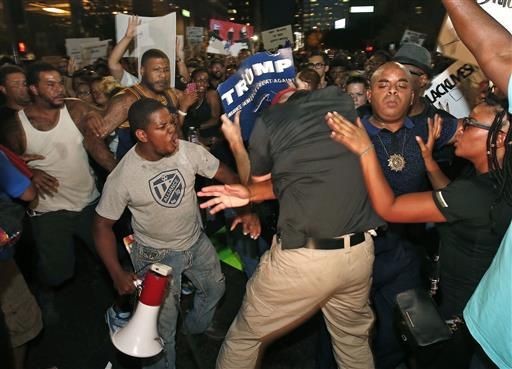
Maupin, who was convicted in 2009 of falsely reporting to police that Mayor Phil Gordon was a child molester, went ahead with the protest Friday night. Not only that, he tried to lead a blockade of Interstate 10. Thankfully, the police repelled the effort with pepper spray and tear gas.
In a time of dangerous volatility, someone needs to stand up to incitement, even if the anger is justified.
Of course, the chief inciter, who bears great responsibility for this year’s explosive political environment, is Republican presidential candidate Donald Trump.
With his appeals to hatred and grievance, he has helped split the country in a way I didn’t think was possible. So many people are drawn to his agitation against Mexicans and Muslims that I wonder at times whether there are enough Americans left willing to uphold even our society’s loose norms: basic respect and decency.
When you’re in the internet world, or the cable-news world, or at a Trump rally, you’ll feel that’s all gone. In fact, you may stoop to disrespect or even hatred yourself. I know I have at times.
But if you remove yourself from that unhealthy fray, listen to the cicadas, and deal with people around you, you’ll find respect and decency are still alive. And if you’ve lost those qualities, you may find them again. Let’s put them to work.

