


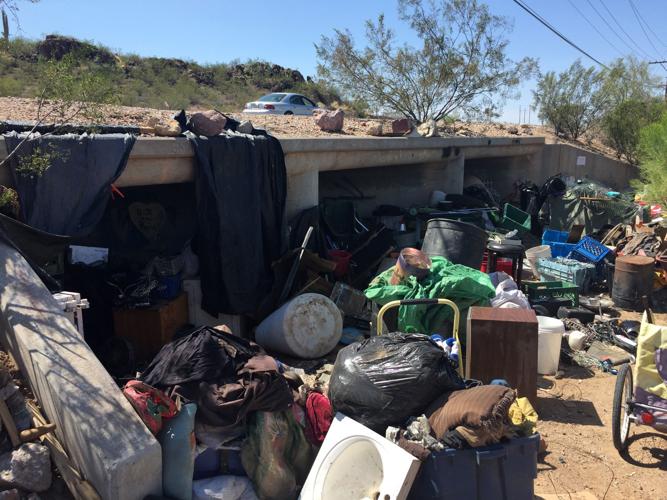


Up on South Mission Road you wouldn’t have noticed, but last week the culverts just below the surface of the road were bustling.
It wasn’t because of the rain.
The cops came on Monday, June 27 and gave notice to the residents, David Hites and Marie Hayden, that they had to clear out within 72 hours.
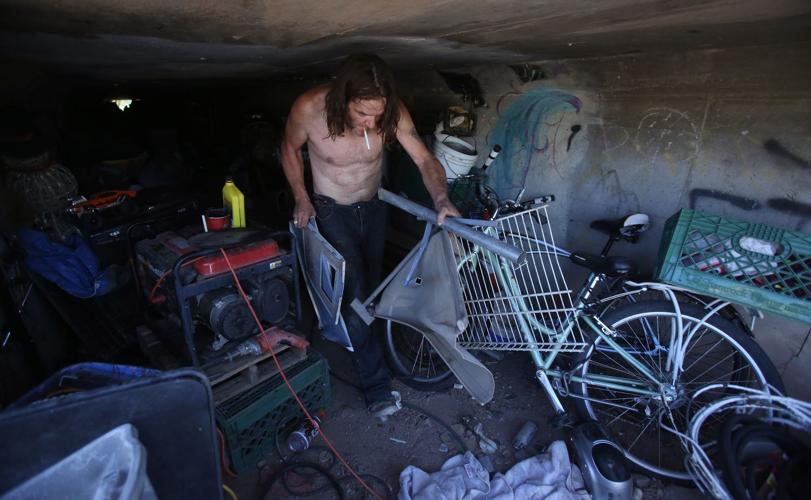
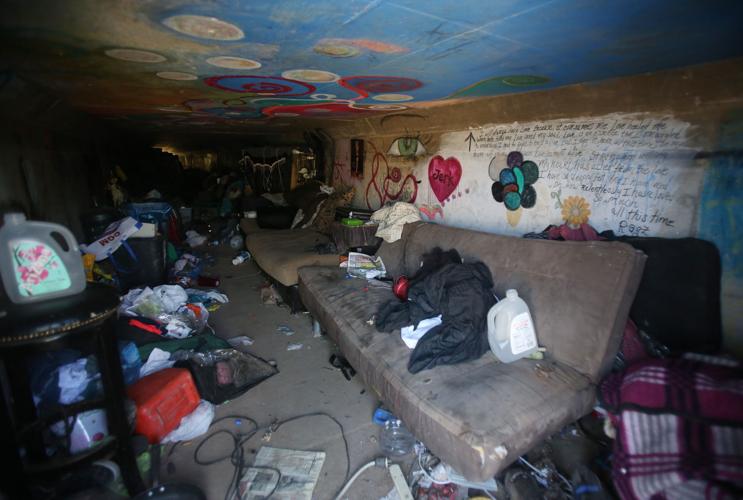
That was easier said than done. Over their three years of living in the triple box culvert below Mission, south of West Ajo Way, they had accumulated tons of belongings. Clocks, stuffed animals, gas cans, sinks, figurines.
“It just accumulates after a while,” Hites told me.
“Hey, Dave, you want to give up these gumball machines?” Hayden, 42, asked last week.
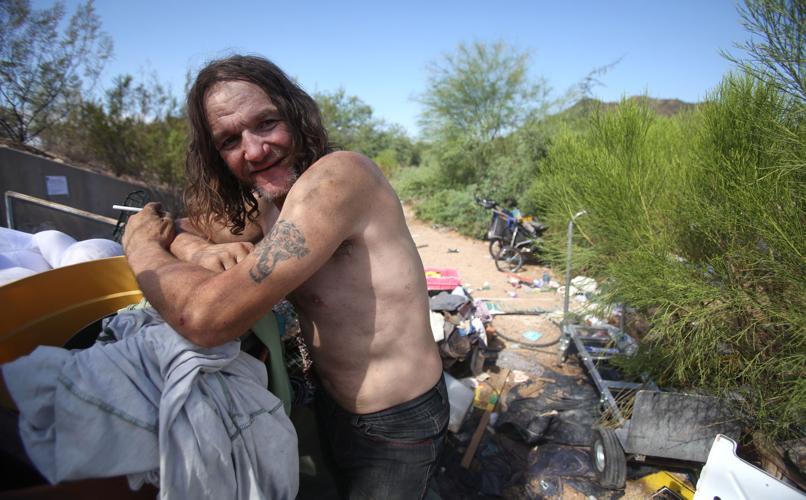
Hites, 46, smiled and shook his head.
The couple and a friend spent those days going through the painstaking process of finding what was valuable and taking it by flatbed trailer or bicycle trailer to scrap shops. This scrapping used to be enough to eke out a living, but isn’t so much anymore.
“China quit buying,” Hites explained. “I still scrap, but instead of making 500-something a month we make a couple of hundred. That’s it.”
The home Hites and Hayden have made illustrates a couple of the key problems with Tucson’s homelessness problem.
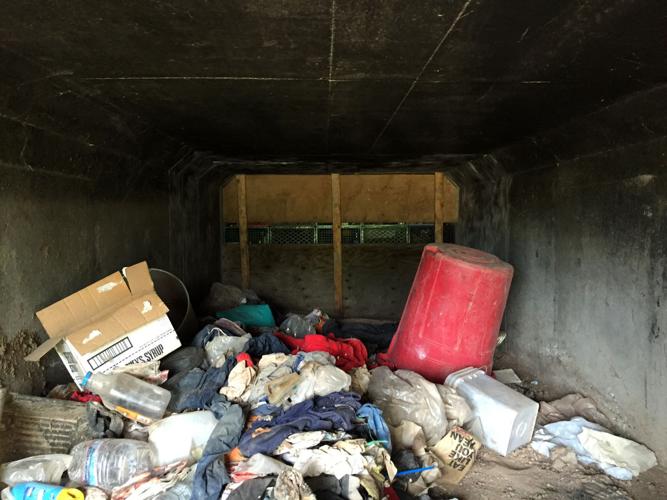
One is the sheer environmental mess of it. To make a home in one of the culverts, Hites has diverted the flow of water to the other two culverts. Hayden walled off the downstream side of that culvert so that nobody could come in. And now all three tunnels are filled with junk.
The problem here is it’s taking so long to clean the place up, something that desperately needs doing.
In years of reporting on the homeless in Tucson, though, it’s become clear to me that the authorities only sporadically follow through on threats to eject people from their camps. That, of course, would lead to the next step: bringing in a contractor to clean the place up — a pricey prospect in this overwhelmed site.
The other key problem at play: What do we do with these people?
There is a formal system in place for when the authorities want to clear out a camp. They call it the “homeless protocol.” After police post these warnings to get out, the Primavera Foundation sends representatives down to offer help to the residents.
There are shelters people can go to. Transitional housing is available for some people with an income.
But for people like Hites and Hayden, there’s not much.
“You can offer them shelter, but people who have been outside often can’t make that transition, separated from their partner,” said Michele Ream, the Primavera worker who was sent to offer services to Hayden and Hites.
Most shelters separate men and women, and none of them allow dogs, which are indispensable to many people living on the streets. Hayden and Hites have three dogs they do not want to part with.
In Tucson, there are around 380 people living in similar situations, according to a count carried out earlier this year. That’s probably an undercount, but it’s what local officials and volunteers could come up with to report to the federal government.
The number of dysfunctional people — some combination of homeless, transient, addicted, jobless and mentally ill — has surprised even new Tucson Police Chief Chris Magnus, who arrived from the East Bay city of Richmond, near San Francisco. That city could be considered the capital of homelessness in America, as a new project by the San Francisco Chronicle attests.
“It’s unclear to me as a newcomer why the problem is at such a significant scale,” Magnus told me Tuesday. “Unlike some cities, you see examples of this in numerous locations throughout the city. You see it in the washes and the culverts, you see it in multiple parks.”
It’s not because of the generosity of our social services, contrary to perception. In Tucson, we don’t have a whole lot to offer Hayden and Hites. They get food stamps and say that’s the extent of regular services they receive. Of course, they cost taxpayers in other ways — if they get sick or are jailed, for example.
In San Francisco and elsewhere, studies have repeatedly shown that not housing homeless people costs taxpayers more than housing them does, but providing housing is a more politically difficult sale.
It has taken far too long for our local leaders to find their way toward solutions. As Tom Litwicki, the outgoing chair of the Pima Coalition to End Homelessness, told me, even now the kind of housing we can offer is unsuitable for many chronically homeless people like Hayden and Hites.
Originally from Iowa, they’ve lived in Tucson since 2002. They’ve had a couple of permanent homes but mostly have lived in culverts. When I asked Hites where they lived before this culvert, he said they’d “moved from up the street in the box culvert up there. Lived there for like seven years.”
“The sheriff came down and had us move,” he said.
There is some movement in local government toward more appropriate solutions for people like them and the problems they sometimes have or cause. Council members Richard Fimbres and Karin Uhlich are planning to put on an agenda for next month the ideas of allowing tiny houses and small-scale camping at dispersed, permitted sites in the city.
The idea is modeled after a program in Eugene, Oregon, under which up to 10 sites in the city can have up to five people camping. Ream herself has been pioneering the “homeless hut” model, as well, through the group Community Supported Shelters Tucson.
“That seems like a very interesting idea and a nice interim step,” Litwicki said. “It’s better than what we’re doing now.”
The key, he said, is understanding that getting people into housing is the first step toward helping the homeless, not the end goal. Being housed helps solve people’s other problems.
Hayden and Hites both were reticent when I asked them separately what they would hope for if they could have a permanent home. At some point, entertaining these dreams becomes painful or pointless, it seems.
“A small mobile home would be OK,” Hayden told me. Due to arthritis, she said, “I don’t know if I could hold a steady job any more.”
“A truck and a piece of property would be pretty cool,” Hites said. “Where the cops can’t come and tell you you got to move.”
As of Tuesday, though, the cops hadn’t come again — Hayden and Hites hadn’t moved.

