

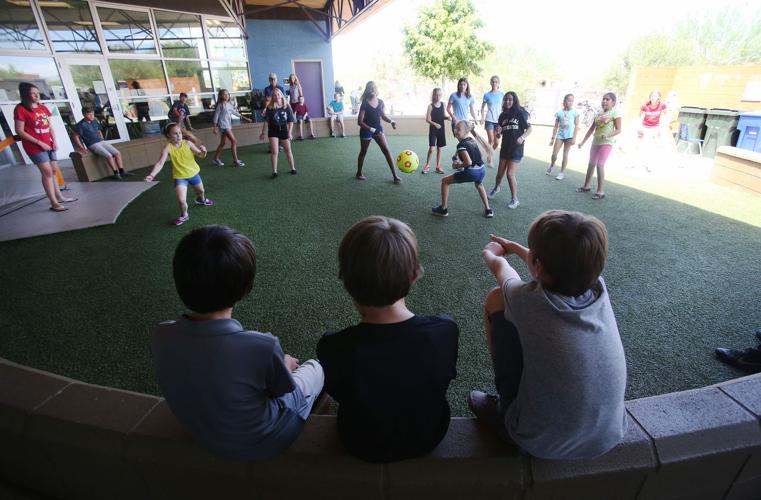
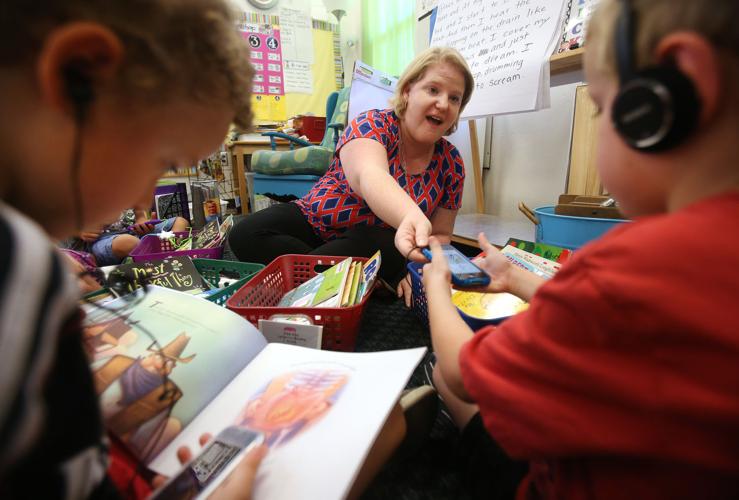
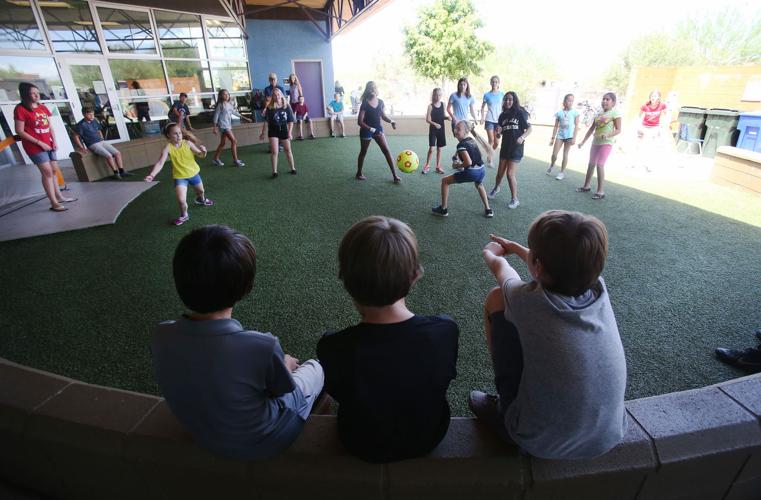

A post-World War II trend in classroom design is making a comeback as more parents seek creative learning environments for their children.
“Open concept” or “open classroom” incorporates homelike settings for schools that encourage informal learning rather than a teacher standing in front of the classroom and following structured lessons. For some schools, it means altering the physical space by creating large open spaces instead of divided classrooms.
Some Tucson-area schools tried and failed with the concept in the 1970s and ’80s, but some newer schools — both district and charter — are making it work.
The open-classroom movement began in Britain after World War II, said Larry Cuban, a Stanford professor emeritus who studies school reform and classroom practice. It found its way to the United States, where it became wildly popular, he wrote in a 2004 report in Education Next. Thousands of elementary schools adopted the concept.
During that time, U.S. schools were criticized for “not developing enough engineers and scientists; for being racially segregated and hostile to disadvantaged children; and for producing uncreative graduates who seldom questioned authority,” Cuban wrote.
But the trend disappeared almost as quickly as it came. Many schools and parents failed to figure out how to make that kind of learning space work, and by 1980s, “open classrooms had already become a footnote in doctoral dissertations,” he said.
Now, some Tucson-area schools are embracing the idea again, including a new elementary school in Marana that is set to open for the 2016-2017 school year. The new school’s design uses hallways as flexible learning space and features a media center instead of a traditional library.
“This is kind of new for us,” said Brett Kramer, chief improvement officer at the Marana district. “We’ve always just followed plans from before.”
Open classroom concept’s previous failure had some Marana parents worried. In voicing concerns about the design, parents cited failures, including in a district in Omaha, Nebraska, that spent about $14 million to renovate an open-concept school to a traditional one.
Locally, Cholla, Pistor Middle School and Santa Clara Elementary traded their formerly open-concept design for traditional classrooms separated by walls.
However, a few schools in the Tucson area are using the open classroom design to their advantage, including the Civano Community School in Vail and Mary Belle McCorkle Academy of Excellence on Tucson’s south side. Administrators from both schools said the key to working with a nontraditional design is to have a school culture and instructional model that complement it.
OPEN-CONCEPT SCHOOLS
NEW ELEMENTARY IN GLADDEN FARMS COMMUNITY
District: Marana Unified School District
Built: To be completed 2016
Features: partitions, hallways as learning space, media center
Marana was faced with shortage of space for its new school, so district officials were forced to think outside of the box, Kramer said. In thinking of ways to maximize space, along came an opportunity to build an instructional model to one that encourages collaborative learning and team-teaching, he said.
Hallways won’t just be for foot traffic, he said. Dubbed “flex space,” they will have boards and furniture so students can come out during class to work freely.
Earlier versions of the design featured three walls for classrooms, which would open to the hallway. After parents voiced concerns about not being able to lock down classrooms in emergencies, the district agreed to install partitions for each classroom.
CIVANO COMMUNITY K-8 SCHOOL
District: Vail Unified School District
Year built: 2005
Features: space utility, adjoining classrooms, mixed grades
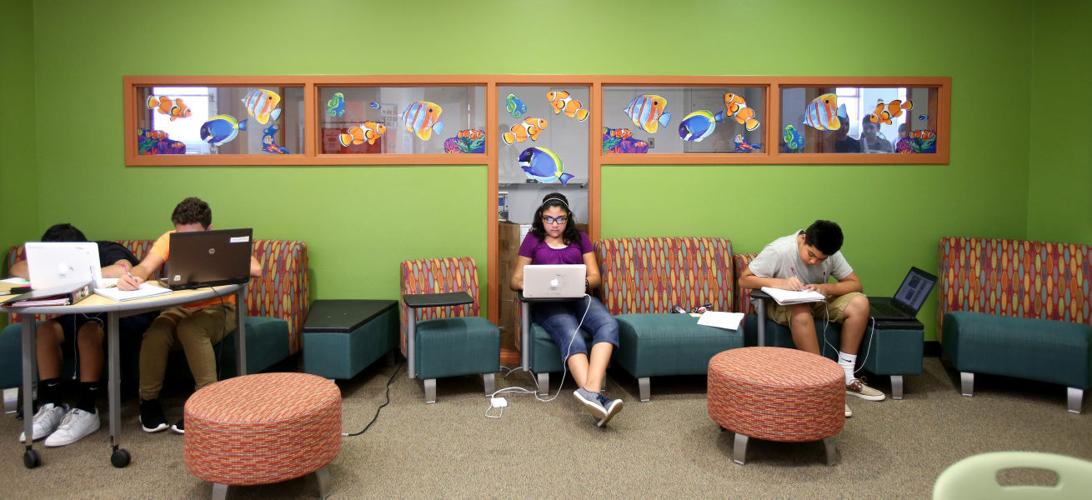
It doesn’t have a big open hallway, but this small school of about 100 students looks more like a large house than a school with its multicolor exterior. Each room is interconnected with other areas of the school, allowing teachers to more easily collaborate.
The campus features a creative play area, an outdoor theater, a garden and rainwater cisterns. Classrooms have elements that are homelike, especially to younger students. For example, the kindergarten and first-grade classroom has a fort, which students can climb into during reading time to cozy up on a cushion.
“The room doesn’t do the job itself,” said Bridget Uzzelle, director of the school.
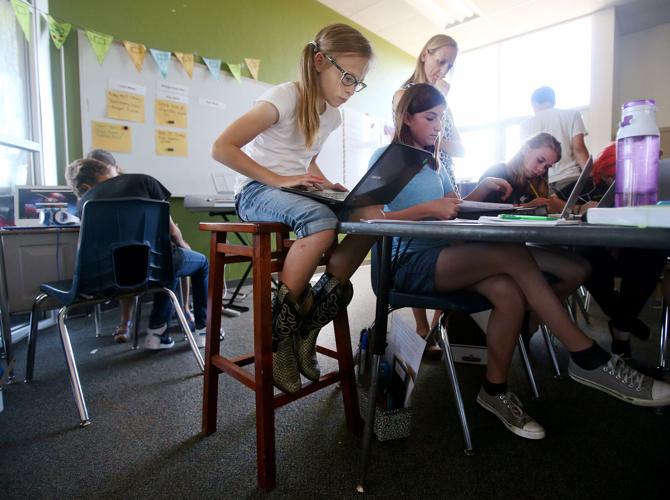
Teachers often aren’t standing in front of the classroom and lecturing to the students. Many elementary students work in groups, rotating from one station to another.
The middle school classrooms have a more mature atmosphere. Two adjoining classrooms have big glass windows and doors and students use their school-issued laptops.
Sixth-, seventh- and eighth-grade students are blended at Civano’s middle school, but the mix of grades works because of the school’s use of technology in its curriculum, Uzzelle said. For instance, during a math class, students learn through an online platform appropriate for their grade level.
MARY BELLE MCCORKLE ACADEMY OF EXCELLENCE K-8
District: Tucson Unified School District
Year built: 2011
Features: shared courtyard, large glass doors, learning space between classrooms
The first bell rang at 9:10 a.m. at Mary Belle McCorkle Academy of Excellence on a recent Thursday.
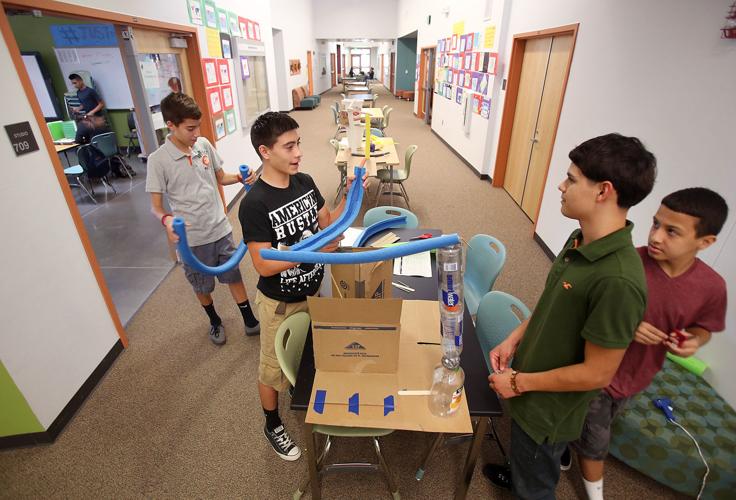
After brief instructions from teachers and schoolwide announcements, children trickled out from classrooms to a common area with couches, bean bags, desks and whiteboards.
The common area might look like a very large hallway with furniture, but it isn’t meant for getting from point A to B — students get to other parts of the school through classroom doors that lead outside. The space is an extension of the classrooms.
Eighth-grader Oscar Gonzalez was part of a group in the common area that was trying to build a model roller coaster out of recyclable material as part of their science class.
Not everyone can just freely roam the campus without restriction. Students earn a “trust card,” which can be revoked if they abuse the privileges.
“We need to be respectful and responsible with everyone, not just the teachers,” Gonzalez said.
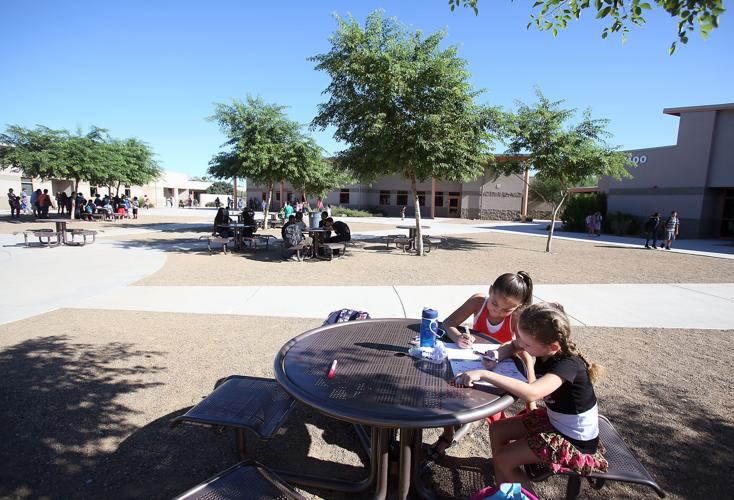
Privileges vary depending on grade, said McCorke Principal Sandra Thiffault. Older children can take their work to a courtyard that all grades share.
The school does not separate middle and primary students. The younger children learn from the older ones and the older students learn how to take care of the younger ones, she said.
The only disadvantage? Weather, Thiffault said. Since students and staff commute from one part of the campus to another outside instead of using indoor hallways, “When it rains, we all get wet,” she said.
FORMER OPEN SCHOOLS
SANTA CLARA ELEMENTARY SCHOOL
District: Sunnyside Unified School District
Year built: 1979
Year retrofitted: 1998, 2002
Features: big open hall, partitions
Santa Clara Elementary School was built near the end of the open-concept trend.
It had a big open hallway where multiple classes mixed together. There were rolling cabinets and shelves, said Eddie Islas, the current principal of the school.
The school underwent renovations first in 1998, then again in 2002, said Mary Veres, Sunnyside’s spokeswoman. Walls and hallways were added.
But since Santa Clara wasn’t designed to be a traditional school, the new walls were too short, Islas said. In some areas, there are 2-foot gaps between the top of the walls and the ceiling.
“You either want to be open all the way or not open at all,” he said. “This is kind of halfway.”
Noise travels through gaps. That can be challenging if one classroom is trying to do a quiet activity and another class is talking loudly.
There are also issues with how the building is wired, he said. A teacher might send a student two hallways down to turn the lights off for a movie. But that could affect the lights of another classroom.
“It’s not ideal,” he said.
CHOLLA HIGH SCHOOL
District: Tucson Unified School District
Year built: 1968
Retrofitted: 1980s and again in 1990s
Features: center locker area, partially open classrooms, hexagonal shape
Cholla was built in a hexagonal with a center common area for lockers, said Marcus Jones, TUSD’s architecture and engineering program manager. Classrooms were partially open to one another.
Team-teaching and collaborative learning — two main goals of open concept — were celebrated, he said. But not being able to control the environment became problematic.
“Sound was a problem, lighting was a problem and temperature control was a problem,” he said.
There was excessive noise between classes, he said. Cholla underwent two renovations to be converted to a traditional school.
PISTOR MIDDLE SCHOOL
District: Tucson Unified School District
Year built: 1969
Retrofitted: 1993
Features: center work areas, large open classrooms
Pistor Middle School lasted more than 20 years as an open classroom concept school.
Like Cholla, it had a center area that connected other parts of the building and was divided into two spaces for teachers’ offices and conference spaces.
In 1993, Pistor was retrofitted to a more traditional environment.
School districts were attracted to the idea of open concept not only because it encouraged collaboration, but because it was less expensive to build, said Marcus Jones, TUSD’s architecture and engineering program manager.
“The lack of walls and all the other elements that went along with it made the construction considerably cheaper,” he said.
The movement also had something to do with the ideals of the 1960s, he said. “Things in general were happy in the world and people were getting along.”

