

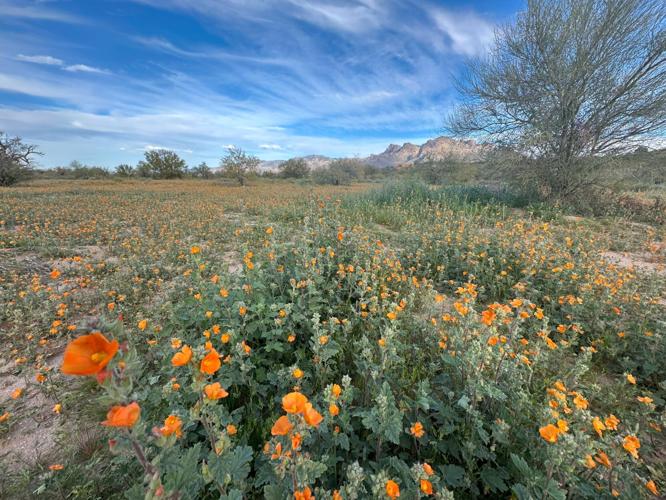
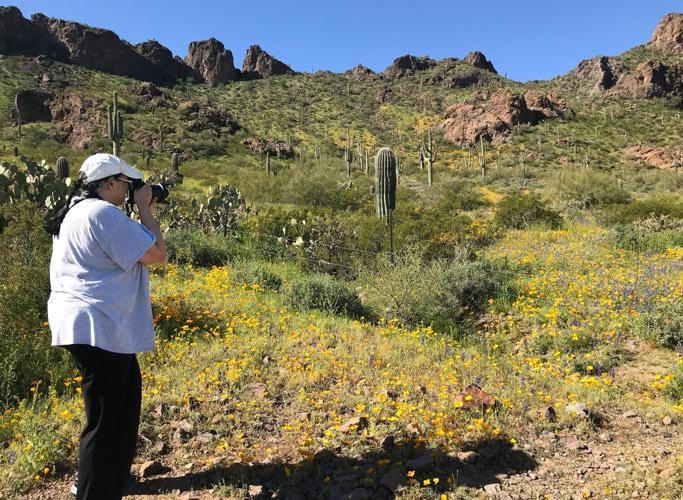

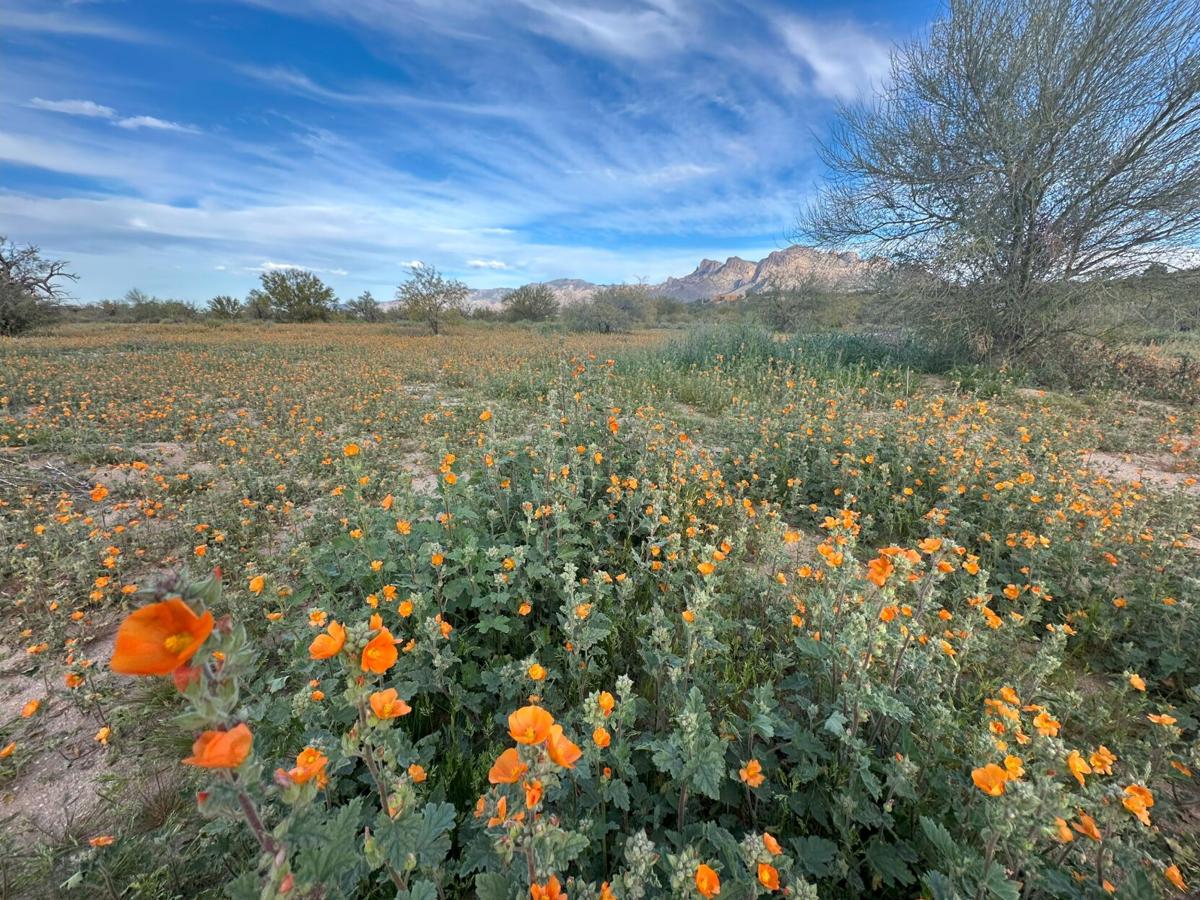
If the 3-foot wall of weeds in your neighbor’s yard wasn’t enough of a clue, experts are predicting an early and impressive wildflower display across parts of Southern Arizona.
Unusually warm and wet conditions through the fall and winter have prompted annual plants to sprout and blossom weeks ahead of time in some places, while the usual hotspots for flowers are bracing for a coming surge of bloom chasers.
Picacho Peak State Park is already calling in reinforcements to help with the expected crowds.
“Right now we are anticipating a good wildflower season, and when it is good, Picacho Peak does need additional volunteers to help out,” said Michelle Thompson, spokeswoman for Arizona State Parks and Trails. “We have put out an internal call for rangers from other parks who have the capacity to travel and be away from their home park to come help at Picacho.”
The park on Interstate 10, about 40 miles northwest of Tucson, is also providing regular wildflower updates on its website, complete with a new meter called “Bloomdar” that was pegged on “Starting to bloom” as of Tuesday.
Past wildflower events at Picacho have led to parking problems and long lines at the entrance station.
Catalina State Park at the northern edge of Tucson is also expecting a colorful display this year. Park manager Steve Haas said he began noticing wildflowers in January, which is the earliest he can remember seeing them in his 15 years there.
“It’s so green. I think the grass and the flowers are confused,” Haas said. “It’s shaping up to be something else. I wouldn’t call it fields yet, but there’s definitely patches of poppies and lupine.”
Arizona State Parks and Trails issued a news release about wildflower season on Wednesday, with tips on which blossoms to see when and a reminder to always follow park rules, stay on designated trails and “never pick flowers.”
“Desert blooms typically appear in this order: bladderpods, brittlebush, Mexican poppies, chuparosa, globemallow and then other various cacti species,” the release from the agency said. “Flowers in the desert bloom based on the elevations, rainfall, and the temperature. Parks at higher elevations, like Oracle State Park north of Tucson and Red Rock State Park in Sedona, will see flowers later in the year, around May, and the blooms last well into the summer.”
Variable bouquet
Jim Malusa is a retired research scientist from the University of Arizona School of Natural Resources and the Environment.

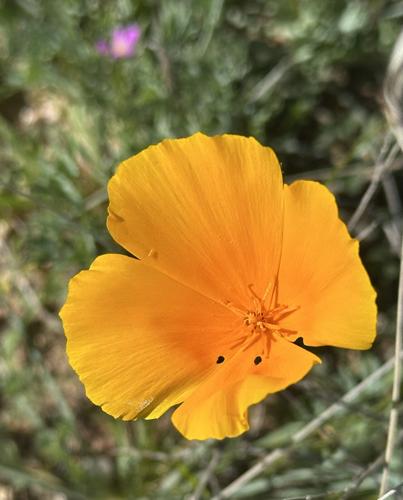
A Mexican poppy soaks up the sun along a trail at Catalina State Park on Feb. 8.
He said the past six months or so have been “particularly confusing for our annual plants, because the seasonality of the rainfall was not what it typically is.”
Malusa recorded just 2.5 inches of rain at his midtown Tucson home through mid-September of last year, then got hit with 5.2 inches over the last 3½ months of 2025.
“I saw summer and winter annuals coming up together in October. They weren't sure if it was the monsoon or the beginning of the winter,” he said.
That initial confusion seems to have faded since then, giving way to what Malusa described as “some very good shows of flowers” wherever the seasonal rains continued to fall.
“I think it's more variable this year than others,” he said.
Malusa hasn’t done too much exploring around Tucson yet, but he said Tumamoc Hill and "A" Mountain are “excellent right now.”
“They're covered with tons of bladderpods and blue dicks. Perhaps they should be called the urinary hills,” he said with a laugh.
You can also find silver bells and fiddlenecks now blooming on the two peaks west of downtown. For yellow-orange, Mexican poppies, Malusa suggests the Sutherland Trail at Catalina State Park.
The showy seasonal display is not limited to the desert surrounding Tucson, either.
Malusa spent several days late last month driving around the southwestern corner of the state for a new project he has taken up in retirement: to track and stop the spread of a nasty invasive plant called stinknet that has already overrun the Phoenix area. While scouting for the noxious weed along highways and frontage roads from Organ Pipe Cactus National Monument to Gila Bend and west to Yuma, he said he encountered large patches of poppies and lupine coming up in areas that saw significant autumn rains.
He also saw lilies and verbena and other sand-loving plants starting to pop in the dunes along Interstate 8 near Mohawk, about 50 miles east of Yuma.
There’s not much happening at Organ Pipe, Malusa said, but a big bloom seems likely in the remote Cabeza Prieta Mountains, where an eye-popping 6 inches of rain fell last fall on the notoriously dry range along the U.S.-Mexico border. And he said his son recently reported seeing lots of green groundcover — but not a lot of flowers just yet — between Lake Havasu City and Wickenburg, along a wide swath of west-central Arizona that saw significant precipitation.
Meanwhile, in the neighboring Mojave Desert of California, there are recent reports and photos circulating that show a sizable bloom now underway in Anza Borrego State Park and Death Valley National Park.

Anu Condon photographed wildflowers at Picacho Peak State Park in March of 2023, when a major bloom caused a dramatic spike in visitation.
Warm colors
Of course, no self-respecting scientist relies on eyewitness accounts alone. Malusa also employs a U of A website called DroughtView (droughtview.arizona.edu) to tap into the latest vegetation and climate measurements for the region. The tool uses satellite data to map the entire country in 16-acre pixels and chart plant growth by comparing how green it is now to how green it was two weeks ago, last year or averaged out over the past decade.
“There aren’t rain gauges everywhere, but there are plants, and the satellites can see them,” he explained. “So that's how I go and find the blooms, usually.”
Based on the data, for example, Malusa expects the wildflowers to be better in the Rincon Mountains foothills on the east side of Saguaro National Park than in the Tucson Mountains on the west side of the park.
DroughtView readings from late last month also show patches of above-average plant cover to the southwest of San Xavier Mission, along Rincon Creek east of Old Spanish Trail, on the west side of Avra Valley near Manville Road and on Arizona Highway 79 north of Oracle Junction and west of SaddleBrooke Ranch.
Back at Catalina State Park, Haas credits the early green-up to a combination of relatively warm and wet conditions with no serious freeze events.
According to the National Weather Service, Tucson didn’t fall below freezing even once in January or December. In fact, the Old Pueblo is in the midst of its longest streak on record without a freeze, according to Weather Service meteorologist Kiera "Kei" Malarkey.
Tucson averages 14 days below freezing a year, she said, but the official weather station at Tucson International Airport hasn’t recorded a low of 32 degrees or less since Jan. 23, 2025.
And that streak shows no signs of stopping anytime soon. Haas said it looks like spring has already sprung, at least in his corner of the desert. As of a week ago, he was already seeing patches of flowers along the park’s popular Alamo, Sutherland and Birding trails.
“I’m just blown away. I think it’s going to be a really, really good season for us,” Haas said.
Just watch the weather and don’t wait too long. If it gets “too hot too quickly,” he said, the colorful desert display at Catalina State Park and elsewhere might not linger.

