

If only she had time, the executive director at Make Way for Books might ponder the whereabouts of those first children touched by the program in 1998.
Are any of them teachers now? Parents? Do they read to their kids as their teachers and parents once read to them?
Since those first, early days at Pio Decimo Preschool on the city’s south side, tens of thousands of Tucson children received their first books through Make Way programs.
A single-file, keep-your-hands-to-yourself line of “graduates” would extend from here to … well, Yissel Salafsky wishes she knew, but right now there are just too many meetings, too many Zoom calls, too many people to talk to.
“SO many people to talk to,” Salafsky laughed, but Make Way has a great story to tell, and she wants to tell everyone.
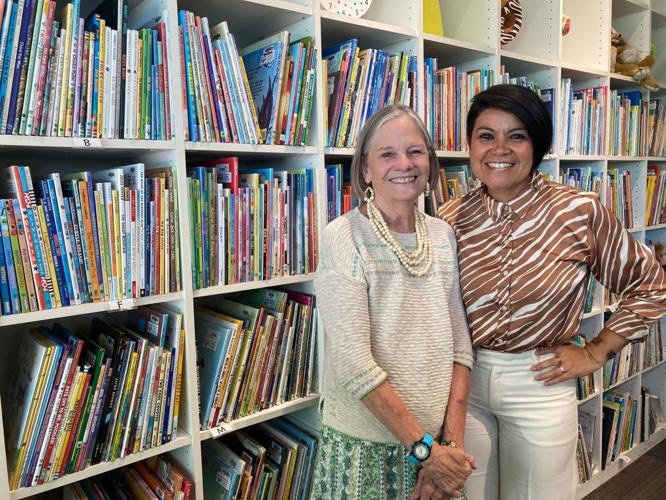
Salafsky moved into the director’s office in January, just before Make Way for Books began celebrating its 25th anniversary year. On the face of it, the mission looked like child’s play. No, really. Since its inception, Make Way has provided more than 750,000 books to Pima County preschools and preschoolers.
Scratch the surface, though, and we learn Make Way for Books will soon be widening its lens to the entire state of Arizona. That is why the days just aren’t long enough for the new executive director.
“It started with a grant request to the Pima County Office of Education two or three years ago,” Salafsky explained. “They suggested we talk to the statewide office, too. The state was placing new emphasis on early childhood education. Not a lot of organizations do what we do, and they wondered if we might be able to expand.”
Already, Make Way for Books has opened satellite locations in Chandler and Avondale. An office in Phoenix is scheduled to open later this year. New initiatives are also being explored in Flagstaff and Chinle.
“It’s an exciting time,” Salafsky said. “Our mission is to help every child read and succeed. If we can help more kids, that’s great, but we need to do it in a thoughtful way.”

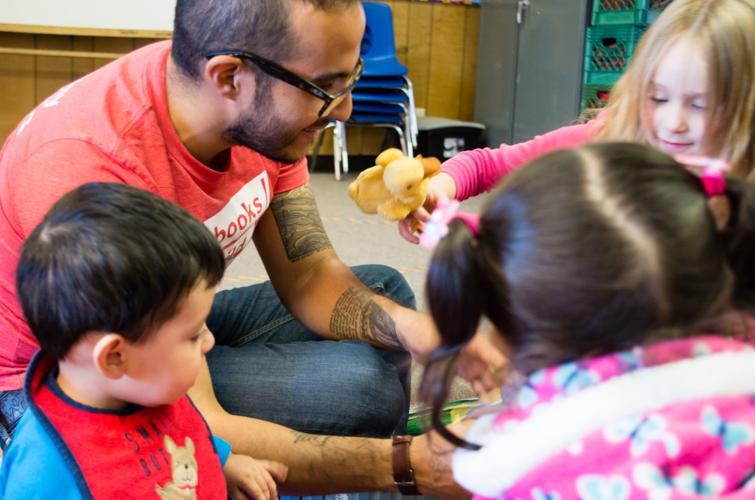
Children and parents learn together and build community at Make Way for Books programming.
One priority: tailoring each local program to the specific needs of that community.
“We can’t just assume that the program we’ve developed here in Pima County will be what’s needed in Maricopa County or the Navajo nation north of Flagstaff. We want to craft every program to fit for those areas. So right now, we’re spending a lot of time getting to know those communities, trying to learn just what they need and how we can help.”
Here in Tucson, Make Way for Books offers two bedrock programs, both sufficiently nuanced to help children whose families speak languages other than English at home.
“The Story Project” provides books and teacher assistance to certified preschools and daycare centers.
The other Make Way program, called “Story School,” supports home care and child care providers, even if they’re grandparents or friends.
“We’ve known for a long time that our preschools touch less than half the kids in Pima County,” Salafsky said. “A majority of our 3- and 4-year-olds stay at home with their parents, with friends or with relatives. We want to help those kids, too.”
Both programs were buoyed during the pandemic by a newly developed app, and it proved to be a winning combination. The Library of Congress named Make Way for Books the winner of its 2022 American Prize “for significant and measurable contributions to increasing literacy levels in the United States.”

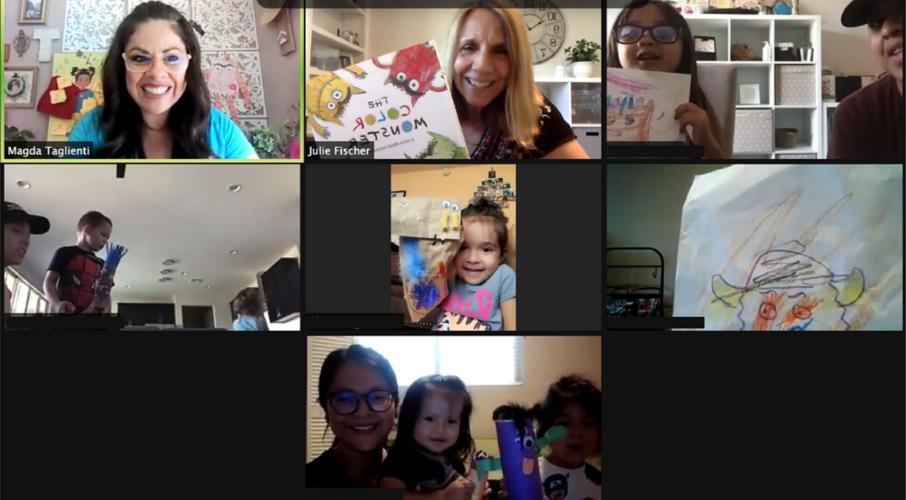
Make Way For Books has a program called Story School, which helps train parents in teaching literacy skills to their children. The program switched to virtual meetings during the pandemic.
Much to be done
Make Way for Books was launched in 1998 by Mary Jan and Paul Bancroft from his law office, the name a loving nod to the classic picture book, “Make Way for Ducklings.”
Their first project was the establishment of a library and reading program at Pio Decimo Preschool.
In the 25 years since, Make Way has helped dozens of preschools, thousands of families and a generation of young readers discover the joy of reading.
It has matured into an organization with 32 staff members and an operating budget of $2.5 million, but expanding statewide will be a major undertaking.
Salafsky, a first-in-family college graduate who attended all three of Arizona’s public universities, brings a unique skillset to the challenge. She holds degrees in communications, public administration and nonprofit management.
A young mom herself, Salafsky came to Make Way from the University of Arizona, where she helped develop the school’s online degree program.
She is hoping the combination of these experiences will serve her well as her organization expands.
“When people ask what we will need to expand, the easy answer is ‘everything.’” she said, “We’ll need more people, more grants, more donors ... First, though, we need to put systems in place that will help us grow. Those are the kind of things we’re thinking about and working on this summer. We have a lot to do.”

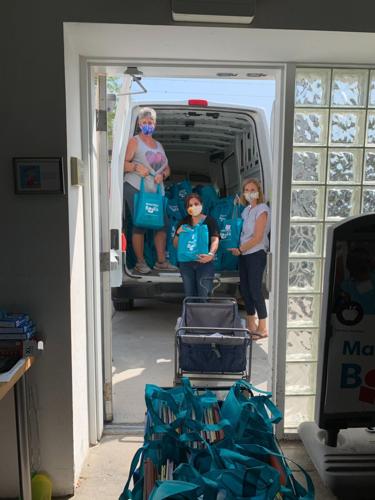
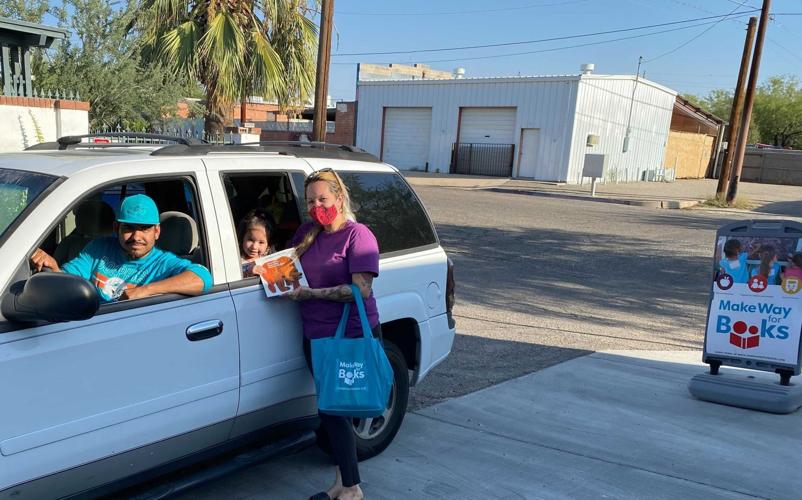
A family picks up books from the Make Way for Books office in Tucson during the pandemic.
FOOTNOTES
If you are interested in becoming a Make Way for Books volunteer or would like to learn more about the program, visitors are welcome to tour the main office on the last Friday of each month. Tours are offered on the hour each morning. To schedule a visit, call 520-398-6451.
As if she doesn’t have enough on her plate, Salafsky is pondering the viability of a new program for teachers of children in kindergarten through second grade. “Kids are coming into grade school now who lost a year or both years of preschool because of the pandemic. We know there won’t be a big increase in funding from the state. Could we help?”
The UA Poetry Center, 1508 E. Helen Street, will be open from 10 a.m. to 5 p.m. Tuesdays through Fridays until students return for the fall semester in August.
A recent study has found that children understand more when reading on paper rather than on a digital screen.

