


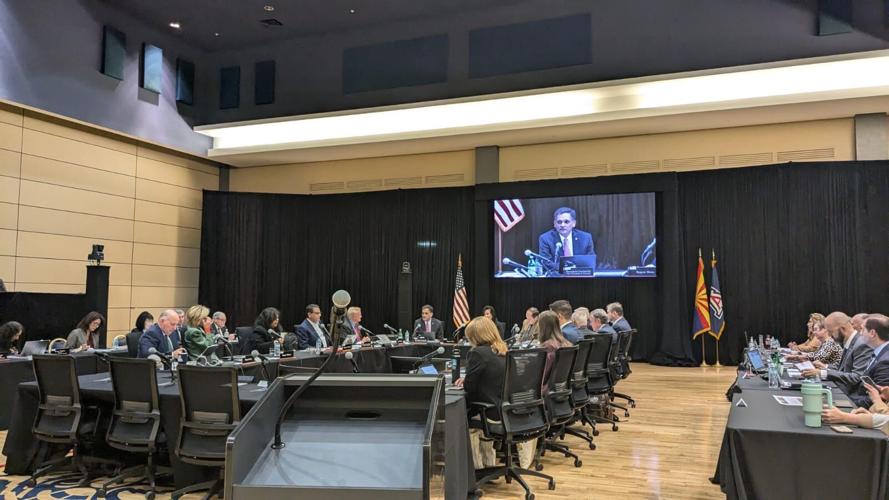


Arizona’s regents were to meet in private session with University of Arizona President Suresh Garimella to discuss the White House compact, while Garimella said he was “working together” with faculty, students, state lawmakers, university presidents across the country and Gov. Katie Hobbs’ office on a decision.
The Board of Regents, which oversees the state’s three public universities, including the UA, scheduled a virtual executive session for late Friday to discuss “possible legal advice” and “federal matters” and to review assignments with Garimella.

Garimella
The executive session comes two days before the White House’s Monday, Oct. 20 deadline for nine universities, including the UA — the first invited to sign its higher education compact — to give “limited, targeted feedback,” although the White House has said the document is “largely in final form.” There is a Nov. 21 deadline to sign the compact.
In an interview with the Arizona Daily Star on Thursday, Garimella said he was unsure what the White House wants by the Monday deadline, and he was trying to figure that out.
“We are grateful for all the feedback we’re getting,” Garimella said. He said UA administrators are engaged in “many, many conversations with faculty, staff, students, etc.” and are tracking all the feedback coming in, but no decisions have been made.

Adriana Grijalva, president of the Associated Students of the University of Arizona, holds a sign protesting the White House “Compact for Academic Excellence” during a press conference held by student government leaders outside of Old Main on Tuesday.
UA spokesperson Mitch Zak declined to answer the Star’s follow-up questions on whether the UA was considering a conversation in person or over the phone to give feedback to the White House, since Garimella said they were unsure about the need for a written response.
Nationally, four of the nine universities had rejected the White House deal, as the University of Pennsylvania and the University of Southern California announced Thursday they will not sign it, joining previous rejections by Brown University and the Massachusetts Institute of Technology. The president of a fifth university, Dartmouth, has said she cannot support the compact but hasn’t formally rejected it. Regents in Texas have expressed enthusiasm about the compact, while presidents of the other universities have said they’re still deciding.
According to the compact, universities may gain priority access to federal money if they commit to 10 pages of rules proposed by the White House, including: banning the use of race or gender in hiring and admissions, freezing tuition for five years, capping international undergrad enrollment at 15%, changing or abolishing units that criticize “conservative” ideologies, and banning university employees from speaking about any societal or political event unless it directly impacts the university.
There is strong opposition to the compact from faculty and student government leaders at the UA and from the Tucson City Council and the Pima County Board of Supervisors, who have passed resolutions urging Garimella not to sign. Opponents say signing would sacrifice academic freedom, that the compact is risky because any violation would result in a loss of all federal funding for a year, and cite other concerns.

University of Arizona President Suresh Garimella addresses an Arizona Board of Regents meeting last November.
Most recently, the Associated Students of the University of Arizona’s senate passed a resolution Wednesday in opposition to signing the compact, with 17 votes in favor, one against and one in abstention. This was done in solidarity with more than 18 student organizations, several student groups said in social media posts.
Penn’s president, J. Larry Jameson, and USC’s interim president, Beong-Soo Kim, told their university committees in separate announcements Thursday that they informed the White House they won’t sign the compact, the New York Times reported.
“We are concerned that even though the compact would be voluntary, tying research benefits to it would, over time, undermine the same values of free inquiry and academic excellence that the compact seeks to promote,” Kim wrote in a notice to USC’s campus.
Jameson said he told White House officials that for Penn, the compact has areas of “existing alignment as well as substantive concerns.”

