


LONDON — Scientists searching for the origins of COVID-19 have zeroed in on a short list of animals that possibly helped spread it to people, an effort they hope could allow them to trace the outbreak back to its source.
Researchers analyzed genetic material gathered from the Chinese market where the first outbreak was detected and found that the most likely animals were racoon dogs, civet cats and bamboo rats. The scientists suspect infected animals were first brought to the Wuhan market in late November 2019, which then triggered the pandemic.
Michael Worobey, an evolutionary biologist and head of the University of Arizona’s Department of Ecology and Evolutionary Biology, is one of the new study’s authors. He said researchers found which sub-populations of animals might have transmitted the coronavirus to humans.
That may help researchers pinpoint where the virus commonly circulates in animals, known as its natural reservoir.

Michael Worobey, head of the University of Arizona's Department of Ecology and Evolutionary Biology, helped lead a study searching for the origins of COVID-19.
“For example, with the racoon dogs, we can show that the racoon dogs that were (at the market) … were from a sub-species that circulates more in southern parts of China,” said Worobey. “Knowing that might help researchers understand where those animals came from and where they were sold. Scientists might then start sampling bats in the area, which are known to be the natural reservoirs of related coronaviruses like SARS.”
While the research bolsters the case that COVID-19 emerged from animals, it does not resolve the polarized and political debate over whether the virus instead emerged from a research lab in China.
“This may be the last big, new set of data directly from the market, and in a way, it’s like finishing the last piece of a puzzle showing a picture that has been pretty clear already,” Worobey says in a UA news release about the study. “We present a thorough and rigorous analysis of the data and how it fits in with the rest of the huge body of evidence we have about how the pandemic started.”
“We need to start putting the evidence of how this pandemic started into action by taking serious, concrete action to stop the perilous practice of bringing live animals with potential pandemic pathogens into densely populated urban areas,” he said in the UA release.
Mark Woolhouse, a professor of infectious diseases at the University of Edinburgh, said the new genetic analysis suggested that the pandemic “had its evolutionary roots in the market” and that it was very unlikely COVID-19 was infecting people before it was identified at the Huanan market.
“It’s a significant finding and this does shift the dial more in favor of an animal origin,” Woolhouse, who was not connected to the research, said. “But it is not conclusive.”
An expert group led by the World Health Organization concluded in 2021 that the virus probably spread to humans from animals and that a lab leak was “extremely unlikely.” WHO chief Tedros Adhanom Ghebreyesus later said it was “premature” to rule out a lab leak.
An AP investigation in April found the search for the COVID origins in China has gone dark after political infighting and missed opportunities by local and global health officials to narrow the possibilities.
Scientists say they may never know for sure where exactly the virus came from.

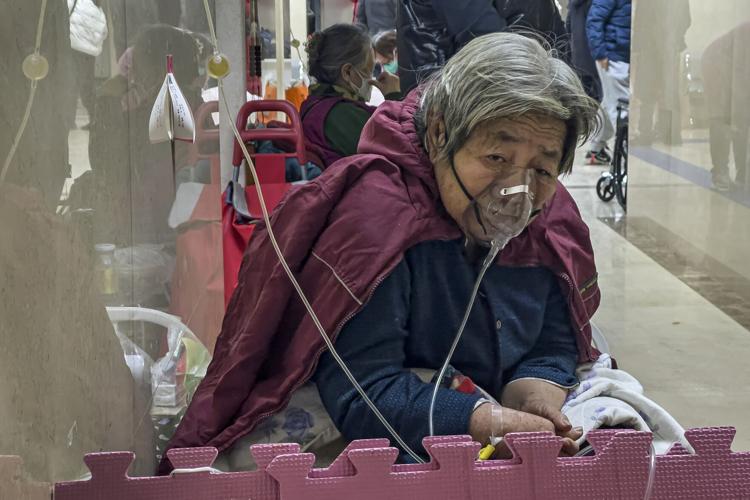
An elderly patient receives an intravenous drip while using a ventilator in the hallway of the emergency ward in Beijing. A new international study co-authored by a University of Arizona scientist provides a shortlist of the wildlife species present at the Chinese market where the virus responsible for the COVID-19 pandemic was present.
In the new study, published Thursday in the journal Cell, scientists from Europe, the U.S. and Australia analyzed data previously released by experts at the Chinese Center for Disease Control and Prevention. It included 800 samples of genetic material Chinese workers collected on Jan. 1, 2020 from the Huanan seafood market, the day after Wuhan municipal authorities first raised the alarm about an unknown respiratory virus.
Chinese scientists published the genetic sequences they found last year, but did not identify any of the animals possibly infected with the coronavirus. In the new analysis, researchers used a technique that can identify specific organisms from any mixture of genetic material collected in the environment.
Worobey said the information provides “a snapshot of what was (at the market) before the pandemic began” and that genetic analyses like theirs “helps to fill in the blanks of how the virus might have first started spreading.”
Woolhouse said the new study, while significant, left some critical issues unanswered.
“There is no question COVID was circulating at that market, which was full of animals,” he said. “The question that still remains is how it got there in the first place.”
The top stories of the week from longtime Star columnist Greg Hansen for September 15-21.

