

Despite a barrage of national headlines this past week, experts at the University of Arizona say the theory that the COVID-19 virus originated from a Chinese lab leak isn’t credible at this point.
“There has been no evidence released that anyone could make a reasonable conclusion from,” Felicia Goodrum, a professor of immunobiology at the UA, told the Arizona Daily Star. “In the absence of that evidence, what we are left with is very strong evidence that it was a zoonosis,” meaning the virus first appeared in an animal and organically spread to humans, she said.
The Wall Street Journal was first to report in late February that the U.S. Department of Energy says it now believes, with “low confidence,” that a lab leak is to blame for unleashing the pandemic that has killed roughly 6.8 million people in the past three years. However, the intelligence within that report remains classified, so it is unclear what kind of evidence the department has to corroborate a lab leak.
Additionally, on Tuesday, FBI Director Christopher Wray told Fox News that “the FBI has for quite some time now assessed that the origins of the pandemic are most likely a potential lab incident in Wuhan, (China).”
This Wednesday, March 8, a U.S. House subcommittee, the Select Subcommittee on the Coronavirus Pandemic, will hold a hearing to further investigate the pandemic’s origins. It is slated to hear testimony from Dr. Robert Redfield, a former director of the U.S. Centers for Disease Control and Prevention and a proponent of the lab leak theory.
At the same time, numerous other federal intelligence agencies have favored a zoonotic theory, which experts like Goodrum say is the only theory rooted in available data.
‘Possible, but not plausible’
Last summer, Michael Worobey, a virus evolution expert at the UA, co-authored two peer-reviewed papers published in the journal Science. The research concluded, based on the data available to the international team of scientists Worobey worked with, that the virus was first transmitted from animals and spread to humans once it made its way to a market in Wuhan, China.
Worobey, who could not be reached for comment in the last week, addressed the lab leak theory last year, when his findings supporting zoonosis made national headlines.
In 2021, Worobey joined other experts in calling on the scientific community to take seriously both the lab leak theory and zoonosis. But by 2022, after spending a year analyzing all available information about the behavior of the first COVID-19 cases in late 2019, Worobey told reporters those new insights — which revealed the likelihood of two separate viral transmissions from an animal to a human — “moved me to the point where I also think it’s just not plausible that this virus was introduced any other way than through the wildlife trade at the Huanan market.”
Worobey presented highlights of that research Wednesday in Tucson during a public lecture entitled “Origins of the COVID-19 Pandemic: Facts and Fallacies.”
“When you put all of the pieces together it becomes extremely difficult to explain how this virus — two times — if it escaped from a lab would have emerged in a lab worker (and) left no trace at that particular workplace,” he said, speaking after the Energy Department news was reported but not specifically addressing it.
“That person (would have had to make) a B-line to the western side of the market, only one of four locations in this huge city that sold these sorts of animals, and established” the first lineage of the virus, Worobey said.
Since scientists have concluded there were two separate viral lineages, Worobey said this exact and unlikely scenario would have had to of happened a second time, with a different lab worker, a couple weeks later to result in the pandemic we’ve all experienced.
“Possible,” he said. “But not plausible, in my view.”
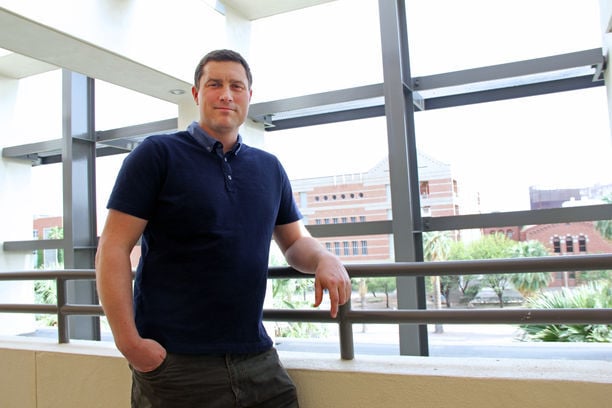
Michael Worobey, a virus evolution expert at the University of Arizona, was among an international team of scientists to conclude, based on extensive data, that the covid-19 virus spread from animals to humans. This video is a clip from his public lecture entitled “Origins of the Covid-19 Pandemic: Facts and Fallacies" he delivered on March 1, 2023 in Tucson. Watch the full talk here, https://www.youtube.com/watch?v=jTJG4GFYSbQ.
There is no consensus yet among American government officials on how or where the virus started. The Chinese government, however, has roundly dismissed the lab leak theory buzz of the past week.
The scientific community largely stands behind the zoonotic theory. In January, Goodrum and 155 of her colleagues in the scientific community signed their names to a widely published article stating there is “no credible evidence” to support the lab leak theory.
Neither statements from the Energy Department nor the FBI director last week have changed her mind, Goodrum said.

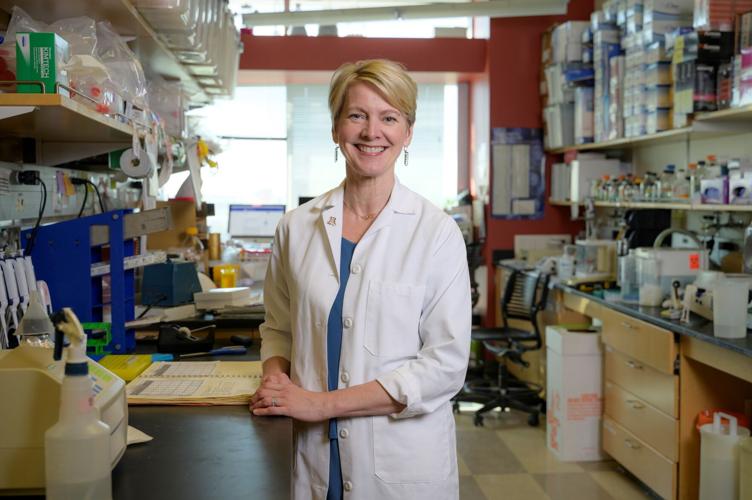
Felicia Goodrum is a professor of immunobiology at the University of Arizona.
Giving credibility to the lab leak theory without any scientific evidence, she said, is harmful.
“Most of us see science as our best defense against future pandemics,” Goodrum said, noting that for the last century a virus with “pandemic potential” has emerged every 10 years — and that rate is only increasing as humans continue to push the boundaries of nature through urban development. “Are we going to cripple science and sow public distrust in science, when that’s where we need to have trust?” she asked.
‘Blame’ nature
Longstanding public trust in the scientific process, Goodrum said, is part of the reason why scientists were able to develop rapid COVID tests and vaccines so quickly — they’d been laying the groundwork for years before the pandemic.
Moreover, the lab leak theory has also fueled the idea that laboratories are not well-regulated, which Goodrum said is simply not true.
Until the intelligence officials leaning toward a lab leak origin make public scientific evidence to support that theory, Goodrum said entertaining it is fruitless. “It’s much more satisfying to have a person or a country to blame,” she said, “but nature is generally the culprit for all viruses that emerge.”
Science is ever-evolving, however, and if there were compelling, data-driven support of a lab leak, Goodrum said she’d welcome an examination of new information.
“If evidence emerges to the contrary (of the zoonosis theory), we will remain open and receptive to it,” she said. “But at this point, there isn’t evidence that can justify the driving of the fervor that exists in the public press around the lab leak. That’s dangerous.”

