

Sometime after June 2014, NASA will launch a telescope more than twice as far into space as the Hubble Space Telescope, on a mission to record the infant universe.
The $2.4 billion James Webb Space Telescope, being developed by NASA in conjunction with the European and Canadian space agencies, is expected to record events that took place 13.5 billion years ago - shortly after the Big Bang that created our universe.
That's if everything on board works as planned, and part of that responsibility lies with a husband-and-wife team of researchers at the University of Arizona's Steward Observatory who are busy this week grading 250 students in Natural Sciences 102, an introductory class they co-teach.
They face a more daunting dual deadline this time next year.
That's when Marcia Rieke must deliver a finished version of the near-infrared camera for the Webb telescope and George Rieke must produce a camera and spectrograph in the mid-infrared range that will complement discoveries made by his wife's instrument.
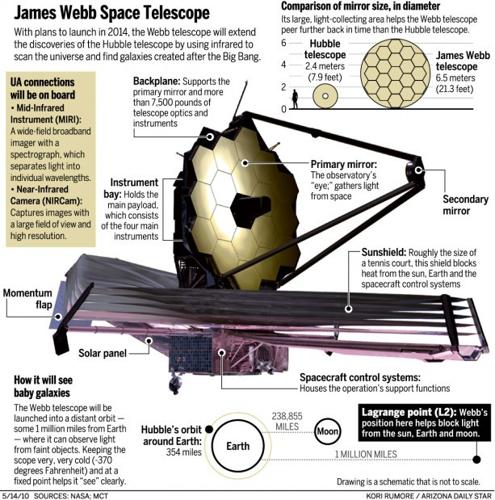
Marcia Rieke is principal investigator for NIRcam, the Near Infrared Camera that will collect light in wavelengths ranging from the just visible to the near infrared, measured in microns, or millionths of a meter, from 0.6 to 5.0 microns.
Rieke's design, which she calls a "sweet little package," is smaller than NASA envisioned when it called for proposals to build it.
"Their version was huge," said Rieke, mainly because it relied on reflector mirrors while Rieke's design accomplishes the same work with lenses.
Downsizing made room for a fourth instrument that will see in larger infrared wavelengths - 5 to 27 microns.
The Mid-Infrared Instrument, or MIRI, a camera and spectrograph, is being built by teams in Europe and at the Jet Propulsion Laboratory in Pasadena, Calif. George Rieke and Gillian Wright of the Royal Observatory in Edinburgh are the science leads for that instrument.
George Rieke said he initially proposed working on the MIRI camera as a backup plan in case the couple's NIRcam proposal was not selected. NASA chose both.
The Riekes have done this sort of thing before.
Marcia Rieke was deputy principal investigator for NICMOS, a UA-designed near-infrared camera and spectrometer aboard Hubble.
George Rieke developed mid-infrared instruments for NASA's Spitzer Space Telescope.
Marcia Rieke said she has been "tantalized" by near-infrared images from Hubble and can't wait to see what a telescope designed exclusively for infrared viewing will reveal.
Hubble was designed to provide visible light images, she said. Her instrument is better suited to pursue even more distant objects, whose light waves have "red-shifted" into infrared as they accelerate.
Infrared also allows the telescope to look past the dust clouds that obscure view in the visible range, revealing early galaxies and other sources of light from an infant universe.
Webb will be parked 1.5 million kilometers (937,500 miles) from Earth, where it can shield itself from light sources and keep its instruments and primary mirror as cool as deep space (under 370 degrees Fahrenheit), which turns out to be pretty ideal temperature for observing in near infrared.
Webb can also provide precise views of our own Milky Way galaxy, joining the quest to find Earth-like planets orbiting near and distant stars and determine their physical and chemical characteristics.
Webb has a much larger primary mirror - 6.5 meters (21.3 feet) in diameter, in comparison to Hubble's 2.4 meters.
Of course, being parked that far out means the potential for a rescue or repair mission is slim. "It's do-or-die time," said Marcia Rieke.
Work on NIRcam is on schedule, she said, even with some setbacks like the filter wheel that broke off during a shake test and the million-dollar collector that was scratched when a technician's glasses went flying in a clean-room accident.
"We are chugging right along," she said.
The actual instrument will be built by Lockheed-Martin in San Diego, but the collectors and prototypes are being assembled in the basement of Steward Observatory's building on the UA campus, where Rieke's team has set up a clean room.
While the design of the camera is unique, its components are not, Rieke said. She did not want unproven technology on a camera that couldn't be serviced. The design also provides redundancy. Rieke's camera assembly, which splits the light into two paths along which collectors will record short or long wave lengths, is actually two identical systems.
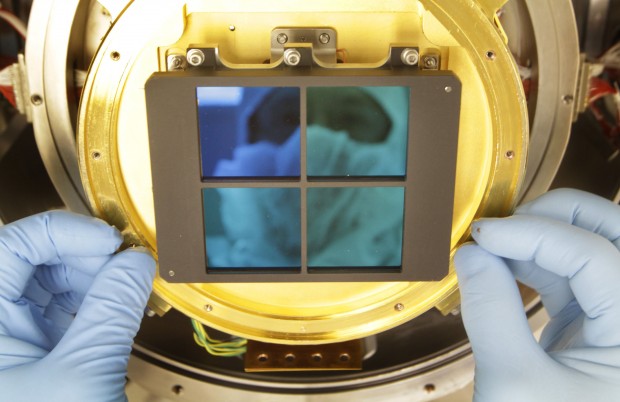
The collectors are similar to the technology used in the most advanced single-lens reflex digital cameras, though much larger. The instrument will carry 10 four-megapixel (4 million pixels) arrays. Rieke and her team have customized them for infrared collection.
Every part of Rieke's instrument will be fixed into place along the main mirror's light path. "The fewer things that move, the better," she said.
Webb already has plenty of moving parts to deploy. Its primary mirror and sun shield are far too large to fit into a rocket's payload, so both will be folded up for launch and deployed in space. "A lot of this has not been done before," said Rieke.
George Rieke said he and his wife are rivals in some areas - mainly about allegiances to different sports teams and universities. "My degree is from Harvard and hers is from MIT, that trade school down the road," he jibed.
In their instrument building for NASA, however, there is no competition. "This is far too important for that," said George.
On StarNet: Find more science, technology and health stories at azstarnet.com/news/science
Contact reporter Tom Beal at 573-4158 or tbeal@azstarnet.com

