




As it turns out, designing the main camera for NASA’s new $10 billion space telescope is a little like that Tom Petty song. The waiting is the hardest part.
University of Arizona astronomer and regents’ professor Marcia Rieke first began working on the James Webb Space Telescope in 1998, when the project was in its infancy.
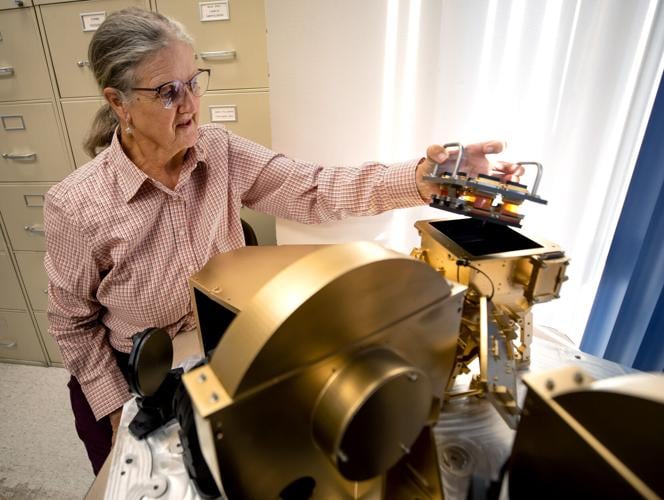
Since 2002, she has led the development team for the Near InfraRed Camera — NIRCam for short — which will allow Webb to peer into the deepest reaches of the universe in search of light made by galaxies more than 13.5 billion years ago.
Rieke and company handed over the finished camera to NASA in 2013. They’ve been waiting for it to be sent into space ever since.
“We knew we would deliver well before the project launched, but there were a few extra launch delays that none of us had counted on,” Rieke said recently from her office at UA’s Steward Observatory. “You just have to be patient.”
Her long wait may finally end on Christmas morning.

Artist conception of the James Webb Space Telescope.
An Ariane 5 rocket carrying the Webb telescope had been scheduled to blast off from a South American spaceport on Dec. 24. But NASA announced Tuesday that another last-minute delay, this time due to weather, has bumped the launch back to 5:20 a.m. Tucson time Dec. 25 at the earliest.
Rieke said she feels “enormous relief that we’re finally getting there,” but she isn’t exactly holding her breath.
About a month ago, a digital display was installed in the lobby of Steward Observatory so people could follow along with the countdown to liftoff. The clock had been reset twice before the new delay announced Tuesday.
“Bah humbug!” Rieke said with a grin.
Crafted on campus
The successor to the 31-year-old Hubble Space Telescope has a much bigger primary mirror — 6.5 meters (21.3 feet) in diameter, versus 2.4 meters (7.9 feet) for Hubble.
It is the largest telescope mirror ever flown into space, so it has to be folded up to fit inside the launch vehicle.
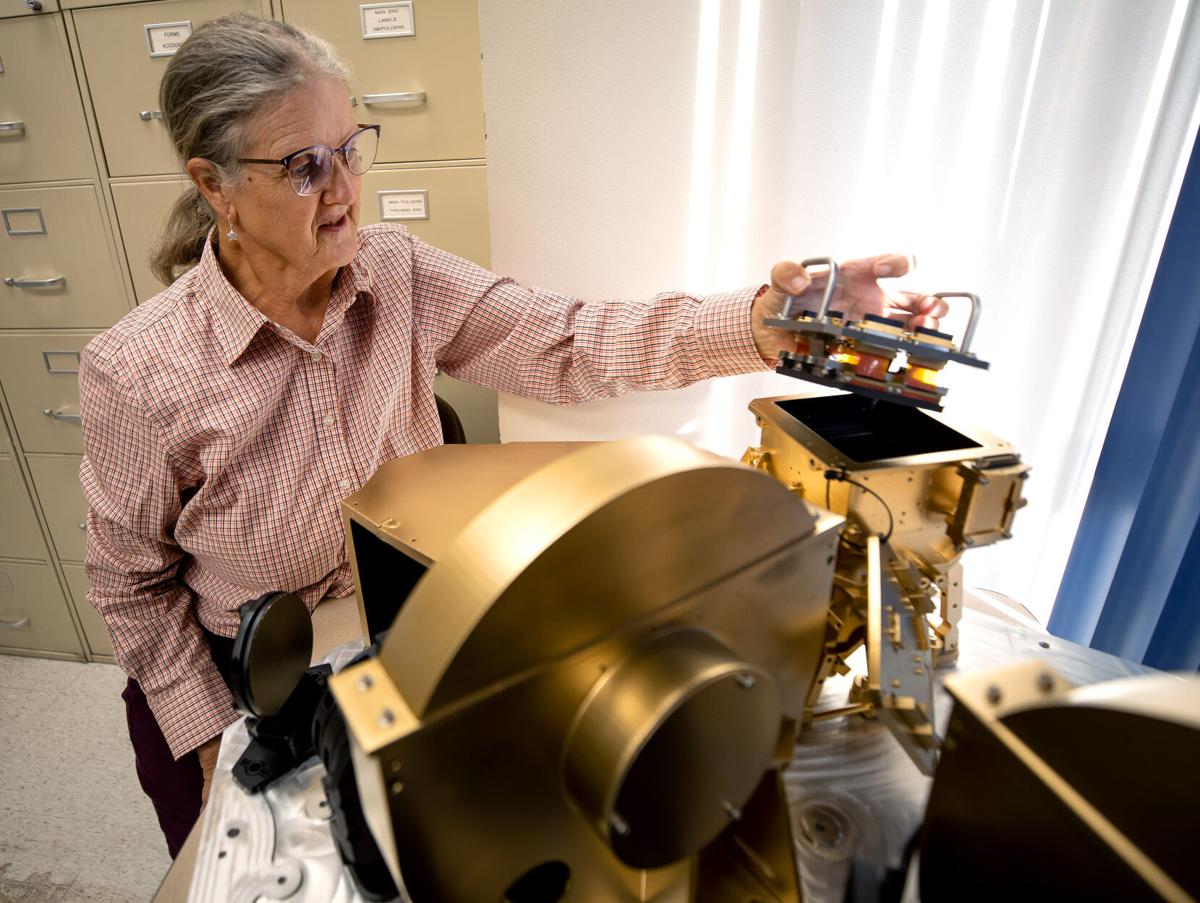
Then there is NIRCam, a $460 million package featuring two identical imaging systems that can scan different areas of space at the same time.
The light sensors at the heart of the camera were designed and largely fabricated, assembled and tested on the UA campus. They are made from titanium, molybdenum, silicone and a thin layer of the chemical compound mercury cadmium telluride.
The Astronomy Department has a machine shop downstairs that’s certified by NASA to work with exotic metals and a clean room with a special vacuum chamber where parts can be tested in the simulated cold of space.
When the development process required work by one of the UA’s design partners in California, the sensors would be packed into special shipping containers and sent via “FedEx white glove service,” Rieke said.
Occasionally, she would book a Southwest Airlines flight so she could hand deliver the sensors — each weighing between 5 and 8 pounds — to Lockheed Martin’s Advanced Technology Center in Palo Alto or Teledyne Imaging in Camarillo.
“It was always a little bit of an exercise going through security, because we didn’t want them X-rayed,” she said. “I got to know some of the TSA people.”
All told, Rieke estimates about 50 people at the UA had a hand in the development of NIRCam.
Today, she said, the team includes about 20 professional scientists and “a fair number” of students and postdoctoral researchers — all of them eager to start using the roughly 900 hours of observing time they are guaranteed from Webb through 2025.

Inside the world’s largest clean room at NASA’s Goddard Space Flight Center in Greenbelt, Maryland, engineers installed the Near InfraRed Camera into the heart of the James Webb Space Telescope. To complete this installation, the engineers needed to carefully move NIRCam inside the heart or ISIM, or Integrated Science Instrument Module that will house all of the science instruments.
Most of the team is still in Tucson, though a few moved on to other universities while they waited for Webb to launch.
“When people get faculty offers, they go,” Rieke explained. “But they’re still members of the team, and we’ve gotten very good at Zooming.”
Designer pair
Webb also carries a camera and spectrograph designed by Rieke’s husband, fellow UA astronomy professor George Rieke.
The Mid-Infrared Instrument, or MIRI, is designed to complement discoveries made by NIRCam and study the formation of stars and galaxies and the atmospheres of planets beyond our solar system, among other things.
George Rieke and Gillian Wright from the Royal Observatory in Scotland are the science leads for that instrument. The entire space telescope is a joint project of NASA, the European Space Agency and the Canadian Space Agency.
“The original rationale for the whole project was to discover the light from the first galaxies to form after the Big Bang,” Marcia Rieke said.
“If you had told me when I was a graduate student that I would be studying galaxies that are so far away that we’re seeing them only about a hundred million years after the Big Bang, I would say, ‘I’m not going to live that long.’”
But the new space telescope is anything but a one-trick pony.
“It’s going to get used for lots of things,” she said. “Webb is designed to be quite general purpose, which it better be if it costs $10 billion.”

Professor of Astronomy and NIRCam Principal Investigator Marcia Rieke talks about the two sensors, which are replicas of the sensors on NASA’s new James Webb Space Telescope, inside her office at the UA’s Steward Observatory.
Rieke has been searching the universe for the most distant galaxies since the early 1980s, back when she had to manually scan the sky to find things without the aid of today’s advanced sensors.
“That was really hard work, and the galaxies that we studied then are ones that we will view as weeds in the (Webb) pictures,” she said with a laugh. “They are too close to be interesting now.”
Rieke grew up reading science fiction in Michigan and majored in physics at MIT, before coming to Tucson to use a telescope on Mount Lemmon for her graduate thesis. That’s where she met George, who was the keeper of that telescope.
He hired her as a postdoctoral researcher in 1976 and they married in 1982. The UA has been home to infrared astronomy’s biggest power couple ever since.
Flight delays
Back when NASA was soliciting design proposals for NIRCam in 2001, the Webb mission had a preliminary launch date of 2009, though “we all knew that was a joke, because it didn’t seem feasible to build everything that quickly,” Rieke said.
Since then, the project has been slowed by cost overruns, design changes, manufacturing flaws and a few mishaps during assembly.
The first “believable” launch date to come and go was in 2014, she said. “And then that became something like 2016, and that became 2018, and that became 2020 and that became 2021.”

On Dec. 11, NASA’s James Webb Space Telescope was secured on top of the Ariane 5 rocket that will launch it to space from Europe’s Spaceport in French Guiana.
Rieke previously worked on NASA’s Hubble and Spitzer telescopes, so she was used to the occasional setbacks that come with space flight. Other members of the team were not.
“The last two-year launch delay was really a psychological blow to the younger people on the project,” the 70-year-old said.
“In around 2014, I started hiring postdocs to work on the data that we’re going to get (from Webb). Most of those people are still here. For them, a two-year launch delay is like half of their professional careers so far.”
Luckily, they’ve had plenty of work to do while they waited.
NIRCam has undergone a barrage of preflight tests over the past eight years to make sure it will survive the shaking during blastoff and the unforgiving conditions in space.
In 2017, Rieke and company hooked their instrument up to the rest of the telescope and tested it at Johnson Space Flight Center in Houston as Hurricane Harvey raged outside.
More recently, telescope team members have been rehearsing what they will need to do during the six-month commissioning stage that will follow Webb’s launch and deployment.
“We’ve also been preparing for our own science program. So we’ve actually ended up being quite busy in spite of the delays,” Rieke said.
Whenever the launch finally happens, students and faculty from the Department of Astronomy are slated to gather in the main lecture hall at Steward to watch NASA’s live stream of the big event.
For Rieke, it will be a moment of excitement and resignation.
“A rocket launch is always scary, because it’s a controlled explosion, but there’s nothing I can do about it. I just have to hope that everyone’s done everything right,” she said. “If it blows up, we’ll all go home crying.”

The Ariane 5 launch vehicle which will launch the James Webb Space Telescope was moved to the final assembly building at Europe’s Spaceport in French Guiana in November.
Very cool camera
The waiting won’t end at liftoff, of course. Once in space, it will take Webb about a month to reach its final destination roughly 1 million miles from Earth, where it will enter a parallel orbit around the sun.
Assuming it unfurls as designed, a heat shield made from five layers of delicate film, each as thin as a human hair, will protect the spacecraft and allow the instruments inside to cool down to about minus 370 degrees Fahrenheit, the optimal temperature for observing in infrared.
Rieke said they won’t even be able to activate NIRCam until it’s nearly as cold as the vacuum of space, a process that’s expected to take about 33 days. It will take several days more after that before the instrument can begin collecting test images.
“We’ll get reports on how all the different unfoldings and so on are going,” she said, “but it won’t be until roughly the third week in January before we really spring into action.”
Rieke said switching NIRCam on for the first time will be the scariest moment for her. By then, Webb will be parked in space roughly three times farther away than the moon is from the Earth, well beyond the reach of any potential repair mission from home.
If anything goes wrong out there, it is very likely to stay that way. That’s the reason for all the preflight testing, the redundancies, the checks on top of checks and, yes, even the delays.
“You can’t go fix it,” Rieke said, “so you’ve got to be sure everything’s right.”
She won’t know that for sure until NIRCam is up and running sometime next year. For now, all she can do is wait.
“I probably will withhold the celebrations until we get some light through (the telescope). Once we start getting some star images, I’ll feel much better,” Rieke said.
“Then we’ll uncork the champagne bottles.”
Photos: Kitt Peak National Observatory - crown jewel of U.S. observatories
Kitt Peak National Observatory
Updated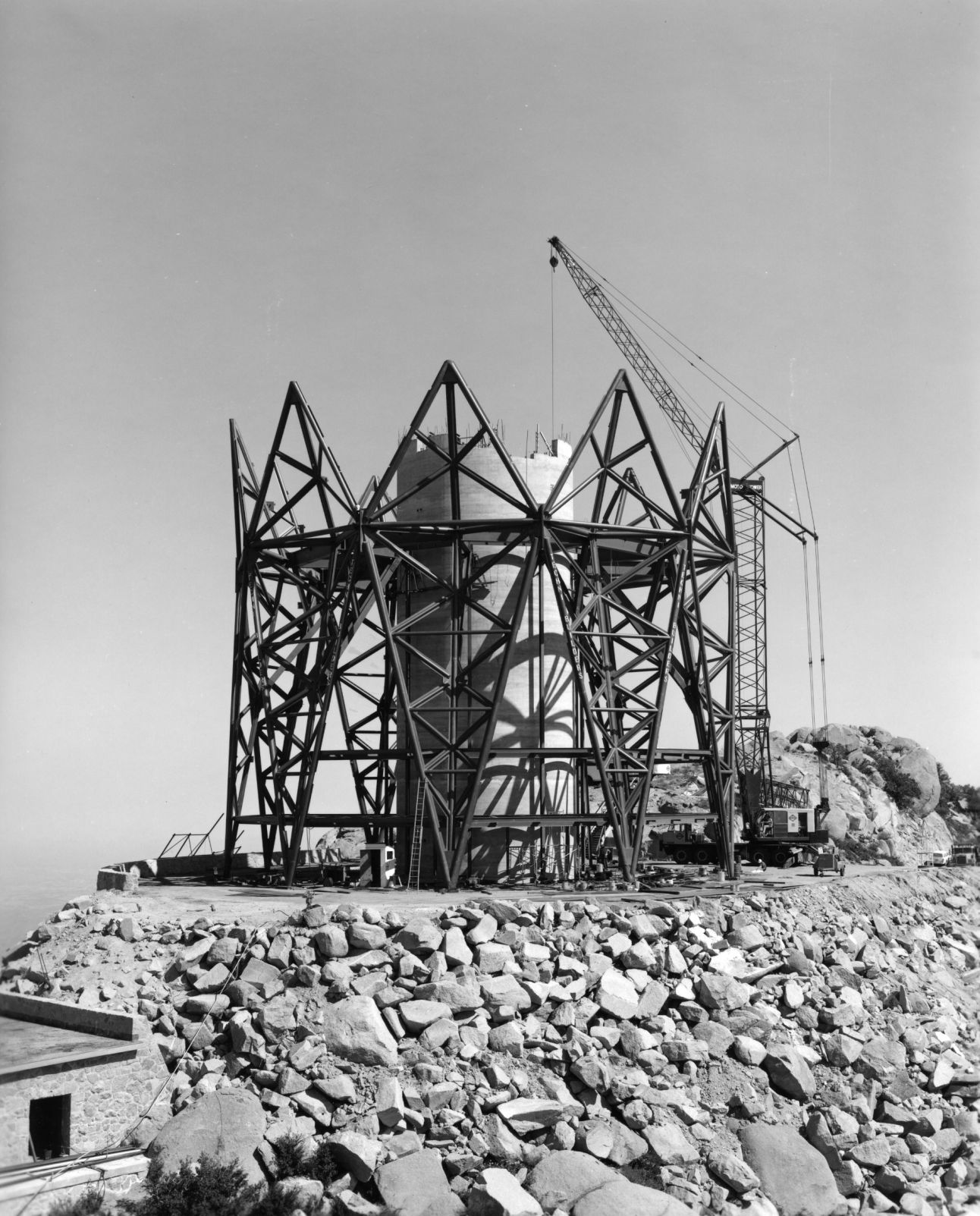
The 4-Meter Mayall optical telescope under construction at Kitt Peak National Observatory in September, 1967.
Nicholas U. Mayall 4-meter Telescope, KPNO, 1969
Updated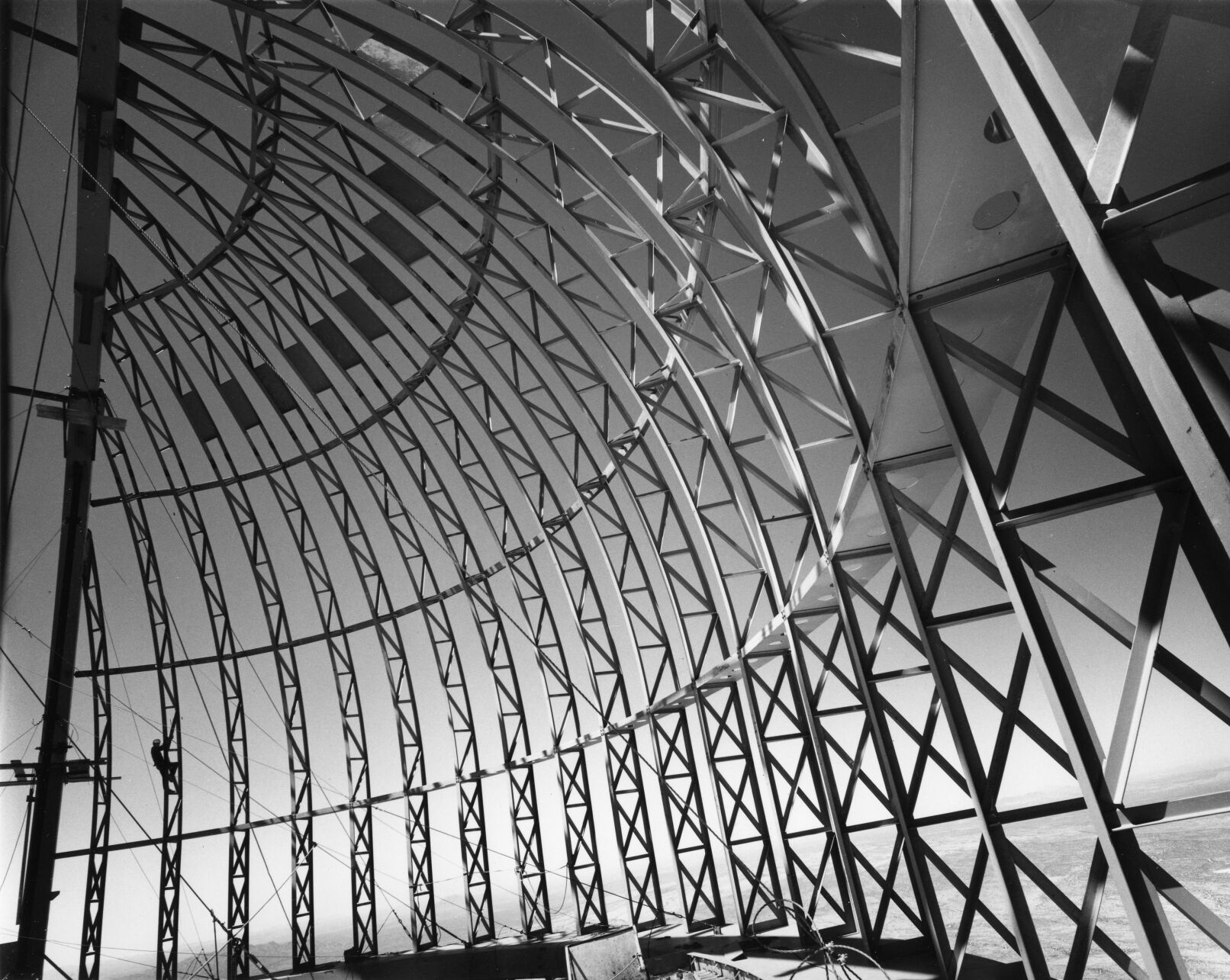
Nicholas U. Mayall 4-meter Telescope under construction at Kitt Peak National Observatory in 1969.
Kitt Peak National Observatory
Updated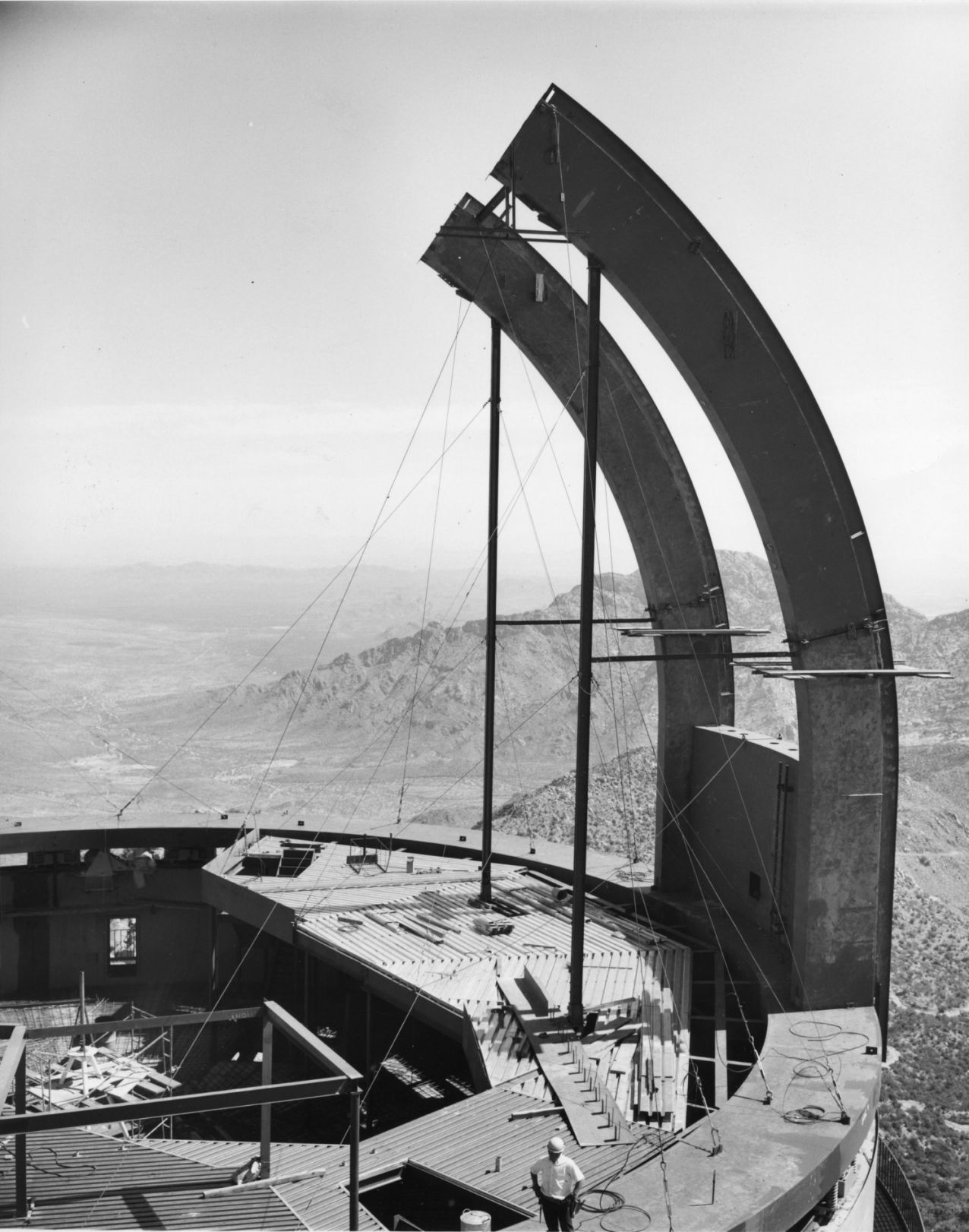
Construction of the 500-ton dome the 4-meter (158 inch) Nicholas U. Mayall Telescope at Kitt Peak National Observatory in 1968.
Nicholas U. Mayall 4-meter Telescope, KPNO, 1969
Updated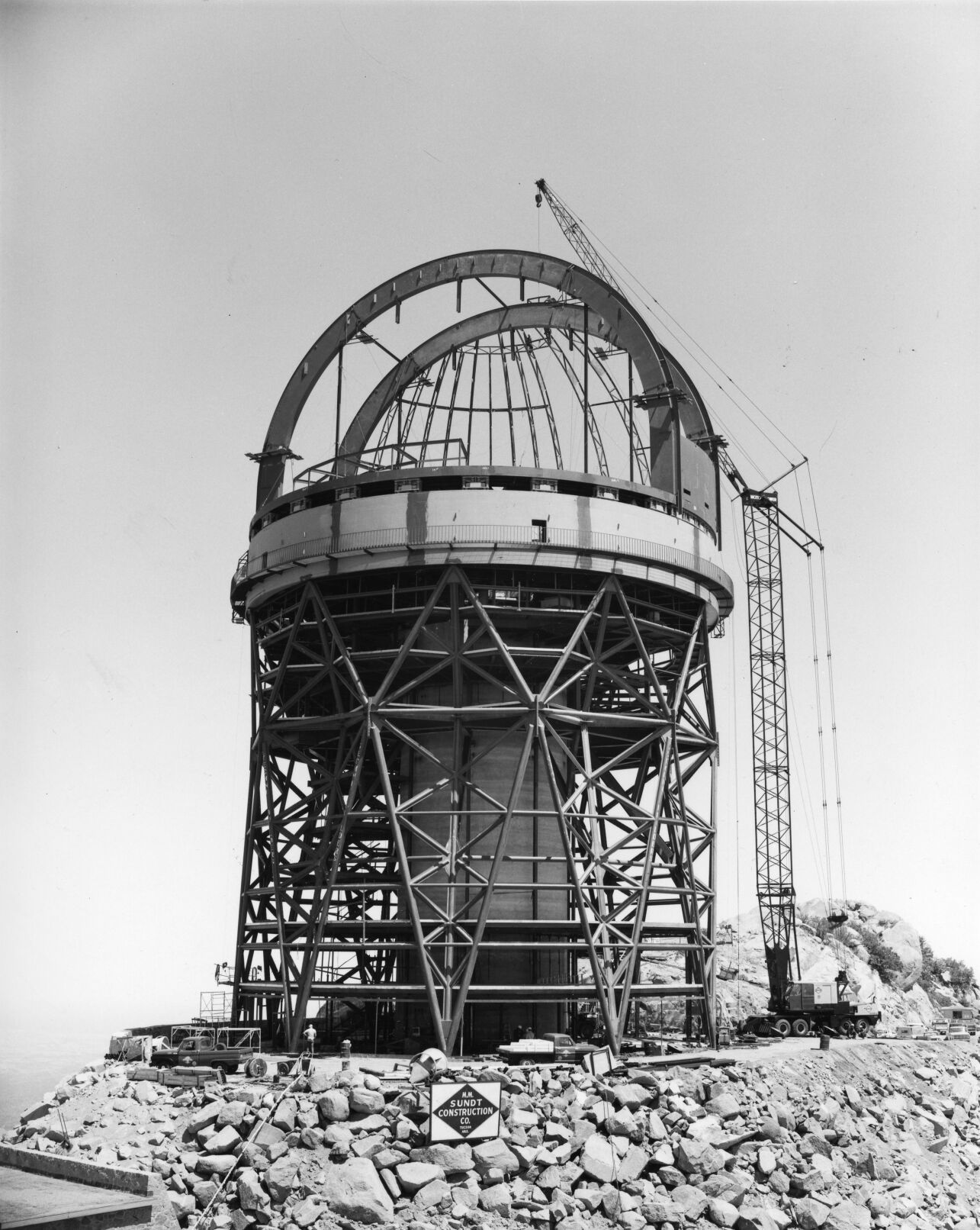
Nicholas U. Mayall 4-meter Telescope under construction at Kitt Peak National Observatory in 1969.
Nicholas U. Mayall 4-meter Telescope, KPNO, 1969
Updated
Nicholas U. Mayall 4-meter Telescope under construction at Kitt Peak National Observatory in 1969.
Mayall Telescope
Updated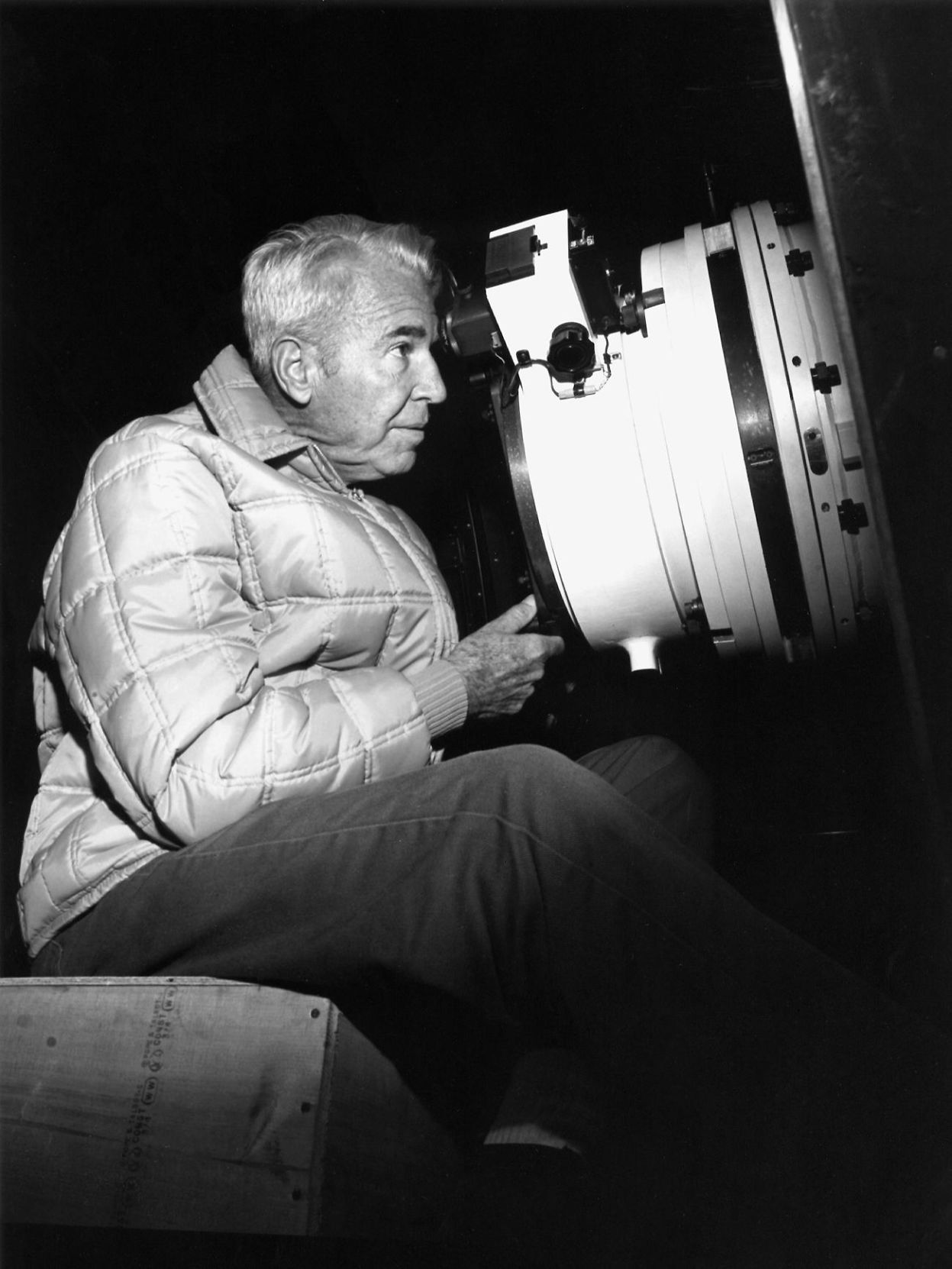
Dr. Nicholas U. Mayall, Director of the Kitt Peak National Observatory from 1960 to 1971, is seen here observing at the prime focus of the 4-meter telescope on 2 March, 1973. After Dr Mayall’s retirement, the telescope was rededicated on 20 June, 1973, as the Nicholas U. Mayall telescope.
Kitt Peak National Observatory
Updated
Technicians at Kitt Peak National Observatory's Cherry Ave. shops on the University of Arizona campus, look over the steel cell upon which the 80-inch mirror will be mounted. The Pyrex mirror "blank" from Corning, N.Y., took more than two years to polish.
Kitt Peak National Observatory
Updated
The massive 4-Meter Mayall telescope during dedication at Kitt Peak National Observatory in June, 1973. At the time, it was the world's second-largest optical telescope.
KPNO, lightning, 1998
Updated
Lightning atop Kitt Peak, looking to the north-west, with the Mayall 4-meter telescope silhouetted against the stormy sky. Taken by Adam Block in July 1998. This picture was a twenty second exposure using Fuji 800 film with a 50mm camera lens.
Mayall Telescope
Updated
Star trails over the Mayall 4-meter Telescope, Kitt Peak National Observatory.
Bok Telescope, KPNO, 1969
Updated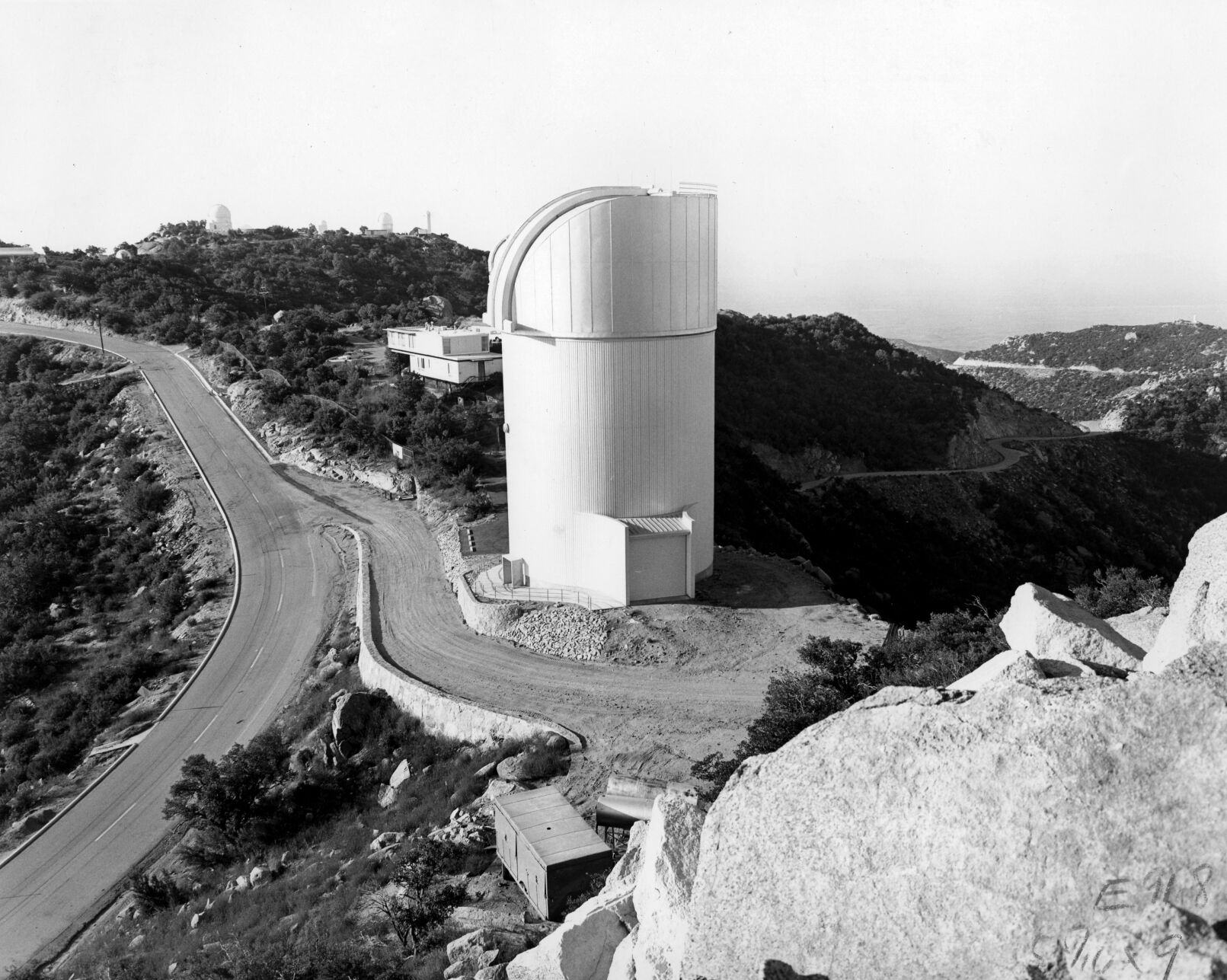
The 2.3 M Bok Telescope operated by the University of Arizona Steward Observatory at Kitt Peak National Observatory, shown after completion in 1969.
Bok Telescope on Kitt Peak National Observatory
Updated
The Bok Telescope (front) on Kitt Peak National Observatory, AZ..
Southwest view of McMath-Pierce Solar Telescope during construction
Updated
Southwest view of the McMath-Pierce Solar Telescope during construction, 27 February 1961.
Kitt Peak National Observatory
Updated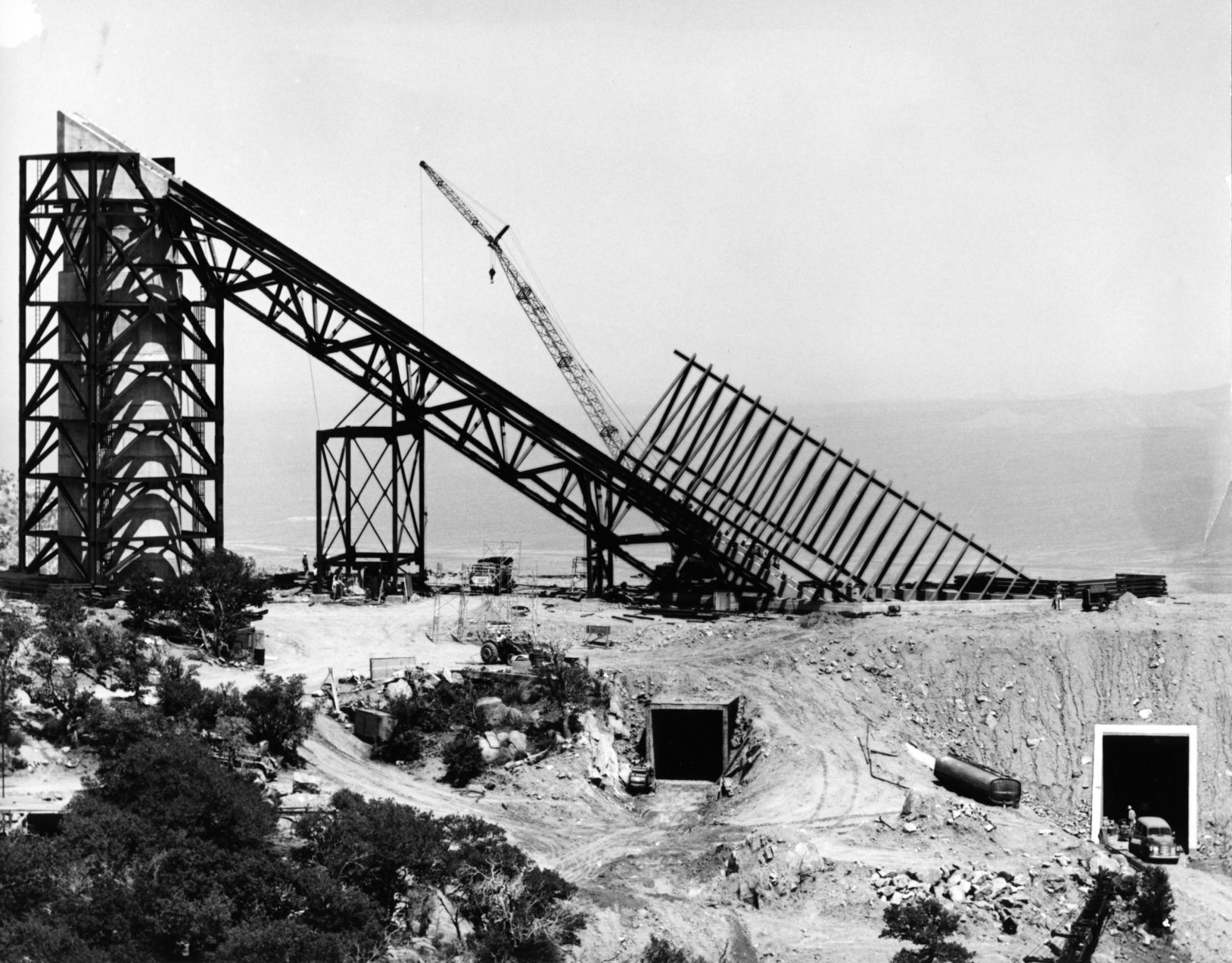
The McMath Solar Telescope under construction at Kitt Peak National Observatory in 1957.
Kitt Peak National Observatory
Updated
The McMath Solar Telescope under construction at Kitt Peak National Observatory in 1957.
Kitt Peak National Observatory
Updated
A 1972 architectural rendering of the vertical housing of the Synoptic Optical Long-term Investigations of the Sun at Kitt Peak National Observatory
Kitt Peak National Observatory
Updated
The McMath-Pierce Solar Telescope at Kitt Peak National Observatory nearing completion in 1962.
Kitt Peak National Observatory
Updated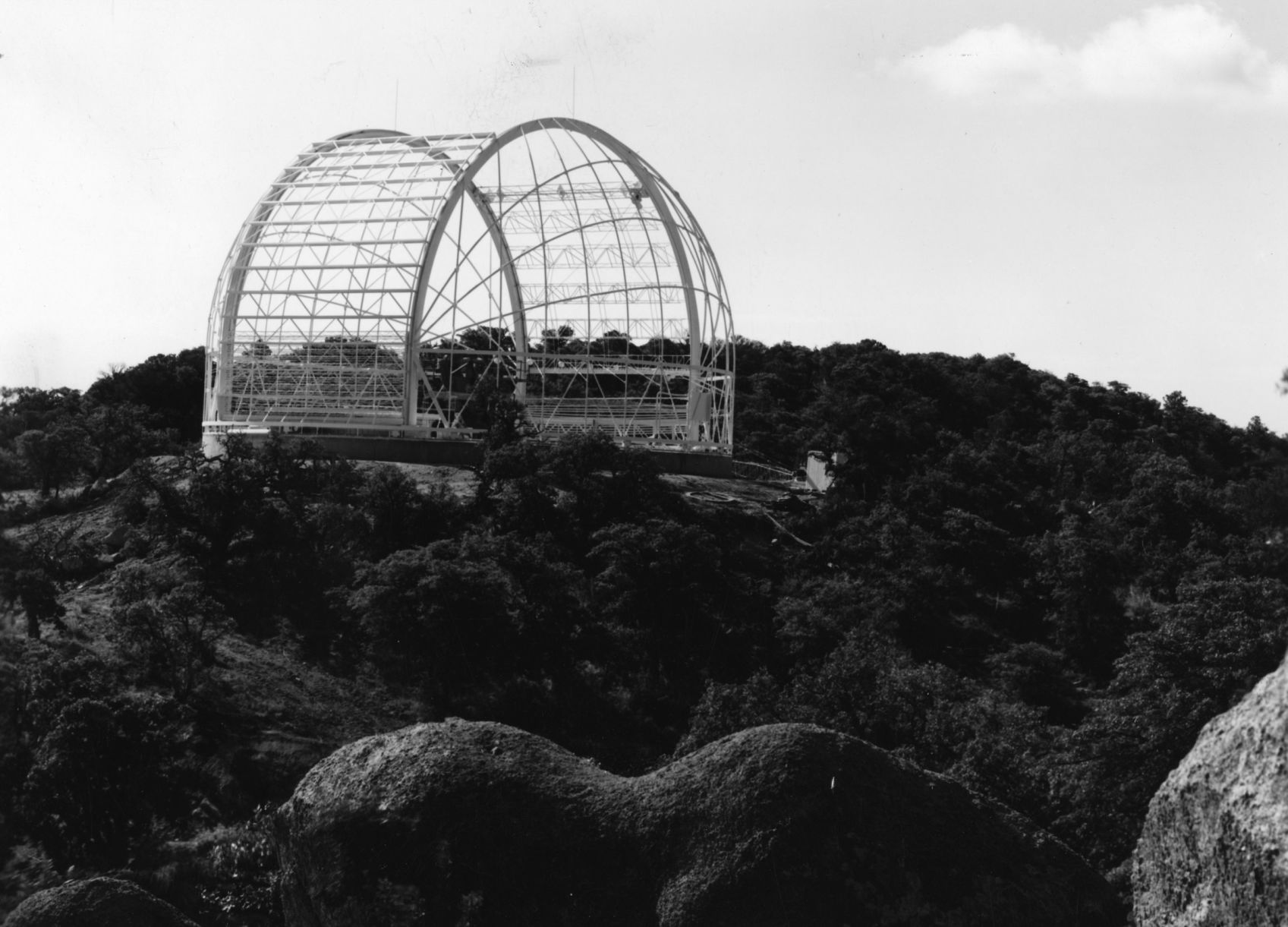
The skeleton for the 55-foot-tall dome of the 36-foot radio telescope under construction at Kitt Peak National Observatory in 1966.
Kitt Peak National Observatory
Updated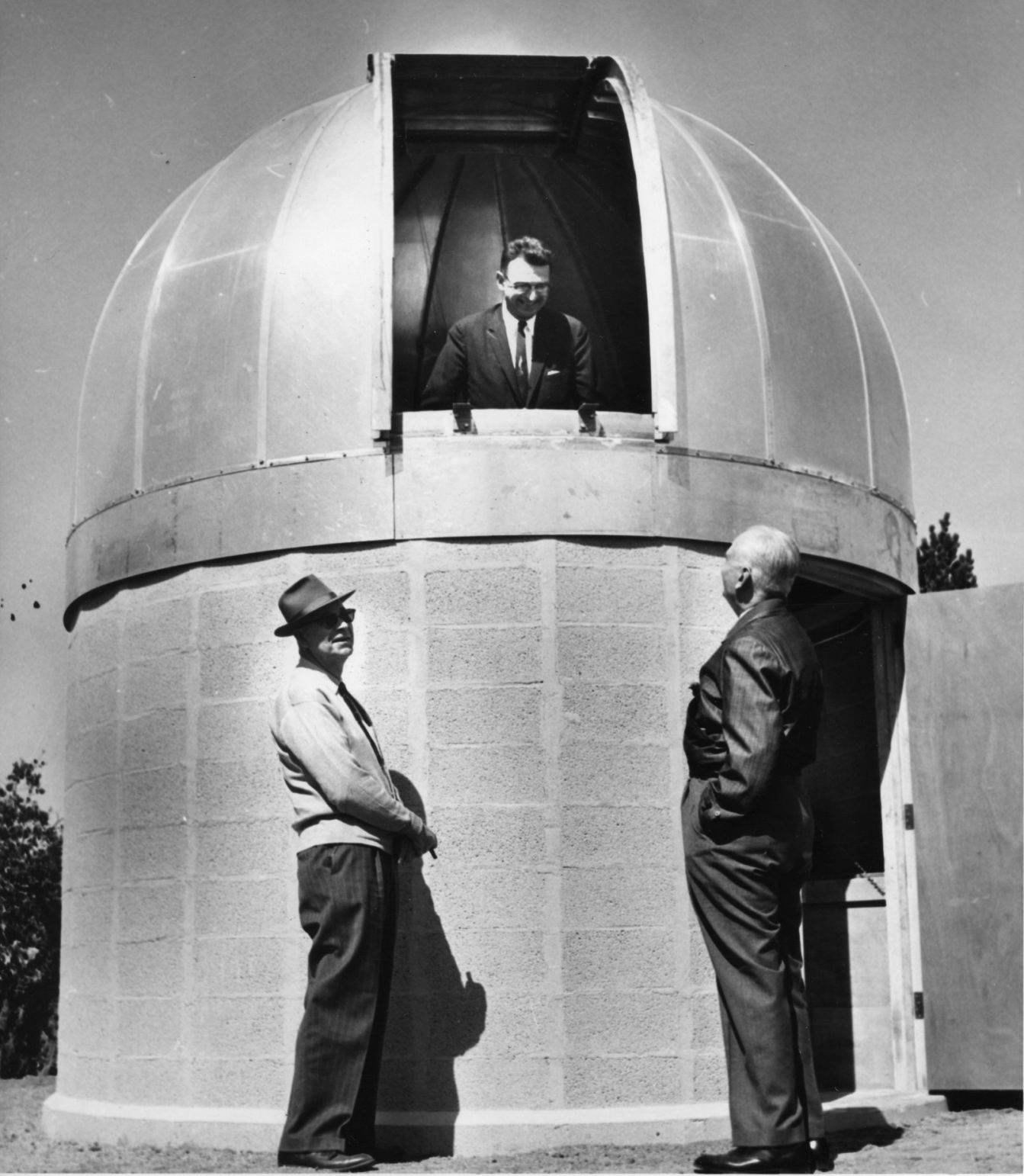
The smallest telescope – a 16-inch – at Kitt Peak National Observatory, ca. 1960.
Kitt Peak National Observatory
Updated
The 36-foot National Radio Astronomy Observatory telescope inside side its vinyl-coated nylon dome at Kitt Peak National Observatory in 1969.
Kitt Peak National Observatory
Updated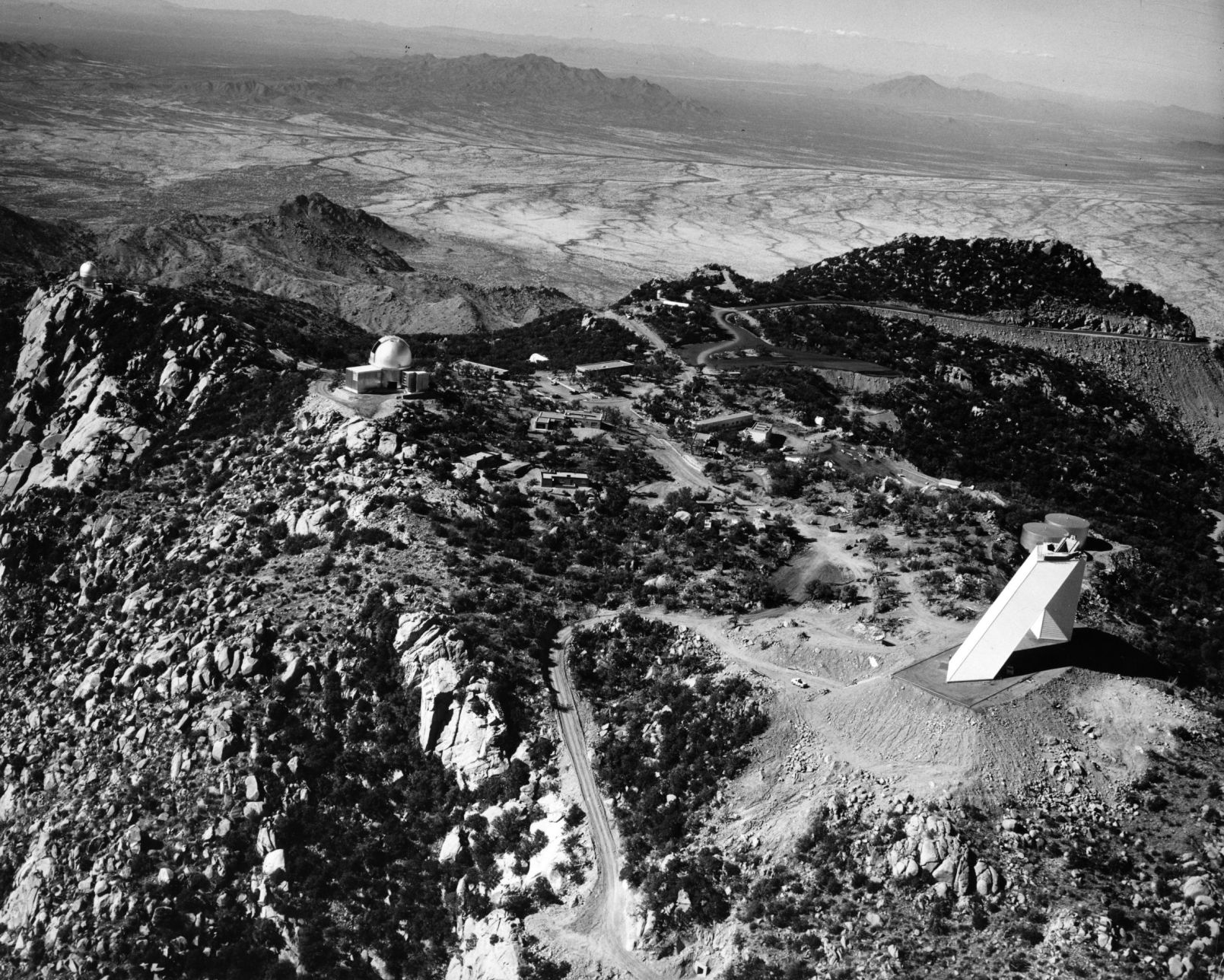
The McMath Solar telescope on its perch at Kitt Peak National Observatory, ca. 1962.
Kitt Peak National Observatory
Updated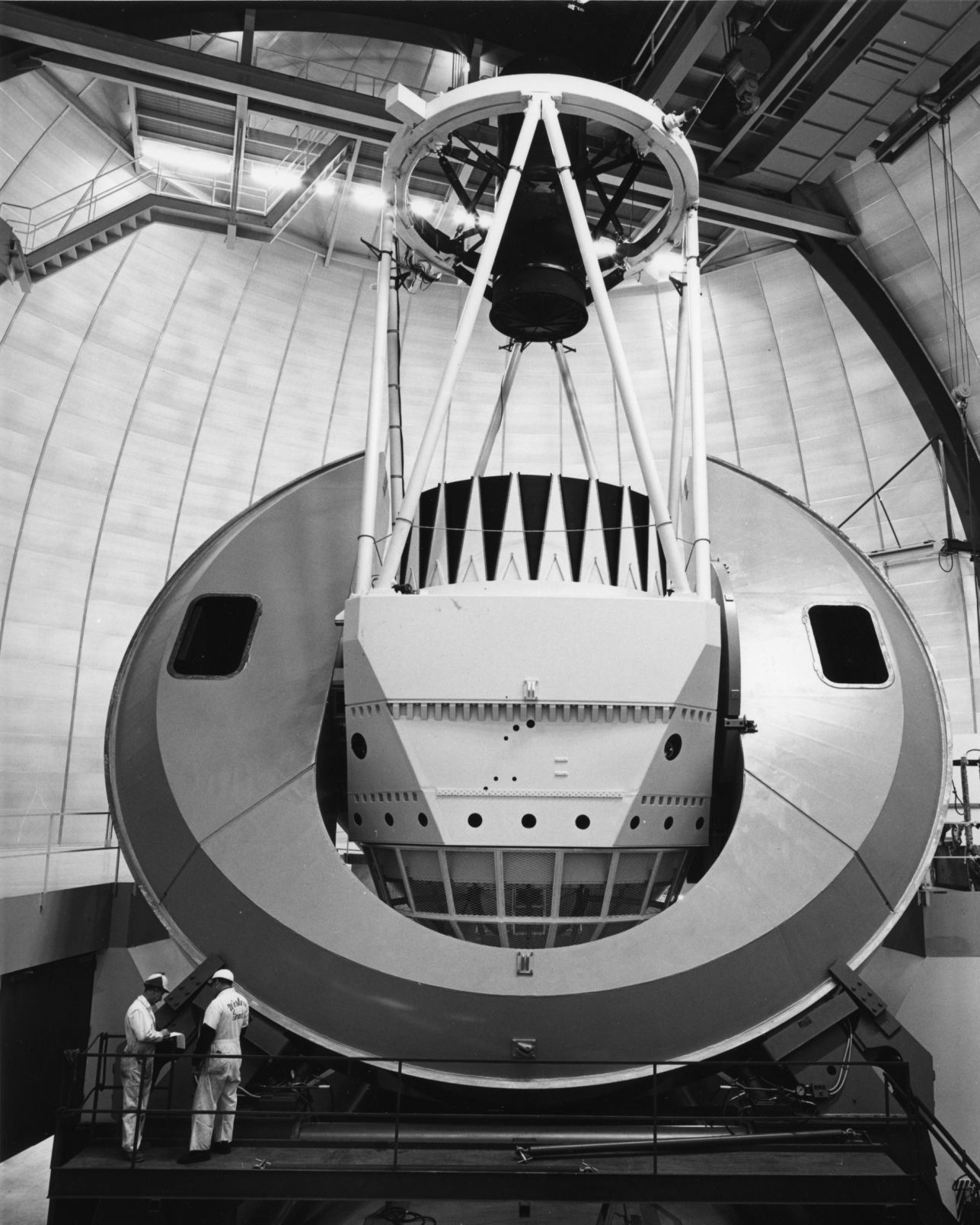
The horseshoe-shaped yolk housing in the 4-Meter Mayall Telescope at Kitt Peak National Observatory in 1973.
Kitt Peak National Observatory
Updated
Dr. Bart Bok stands beneath the 90-inch, 100-ton telescope destined for Kitt Peak National Observatory in 1968. Bok was the head of the department of astronomy at the University of Arizona and director of Steward Observatory.
Kitt Peak National Observatory
Updated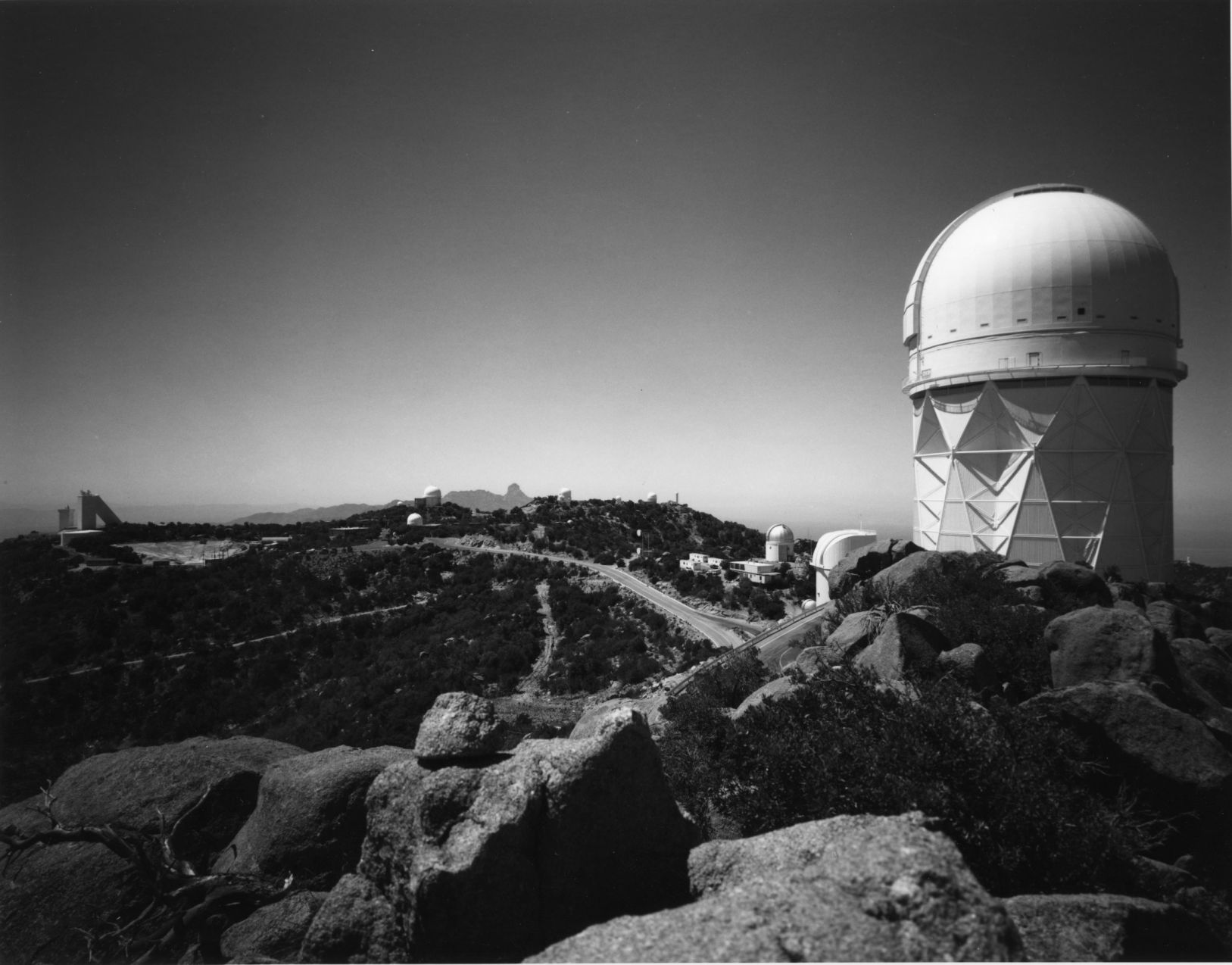
The 4-meter Mayall Telescope, left, at Kitt Peak National Observatory in 1975.
Kitt Peak National Observatory
Updated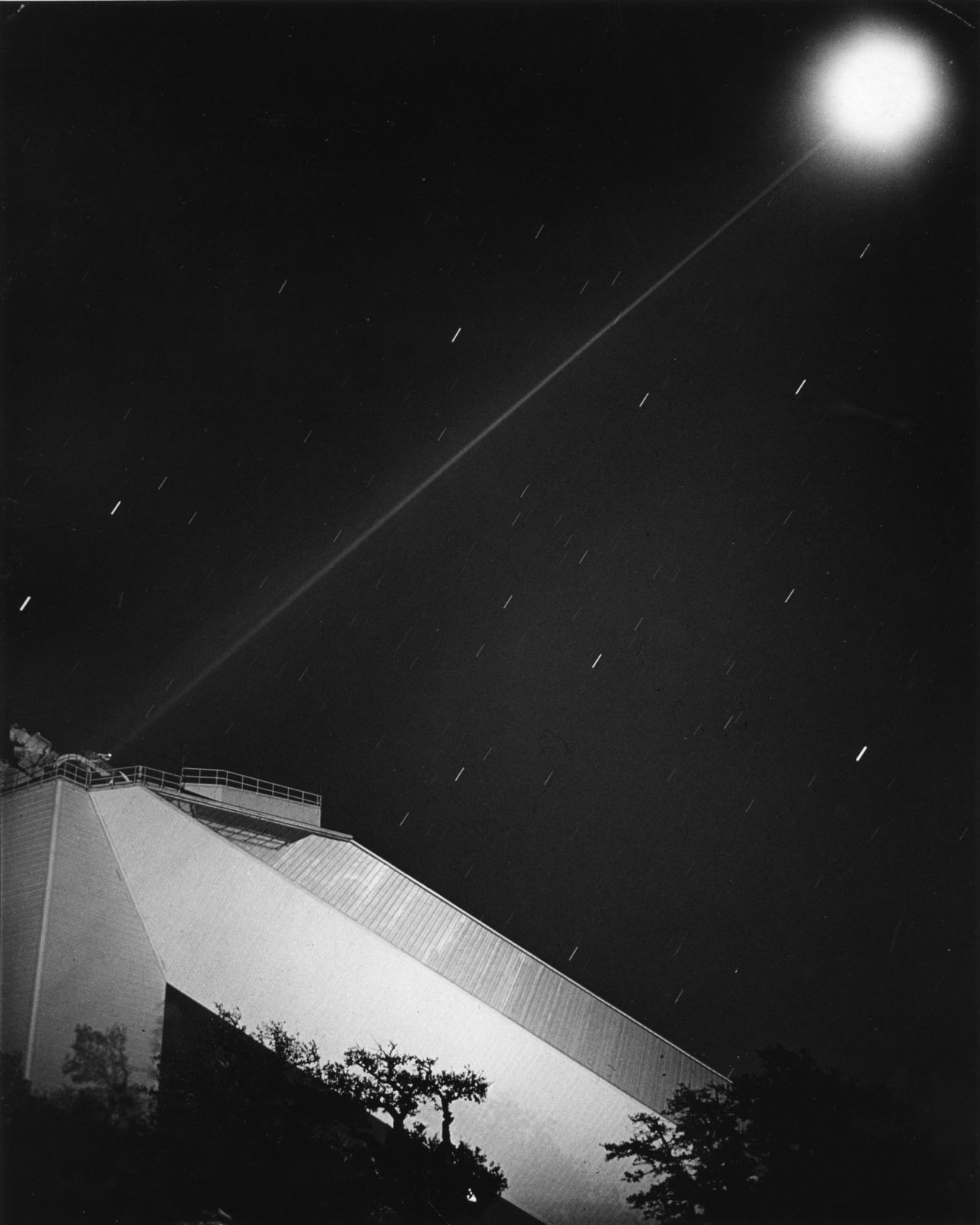
A laser beam from the McMath Solar Telescope at Kitt Peak National Observatory targets the moon in July, 1971.
Kitt Peak National Observatory
Updated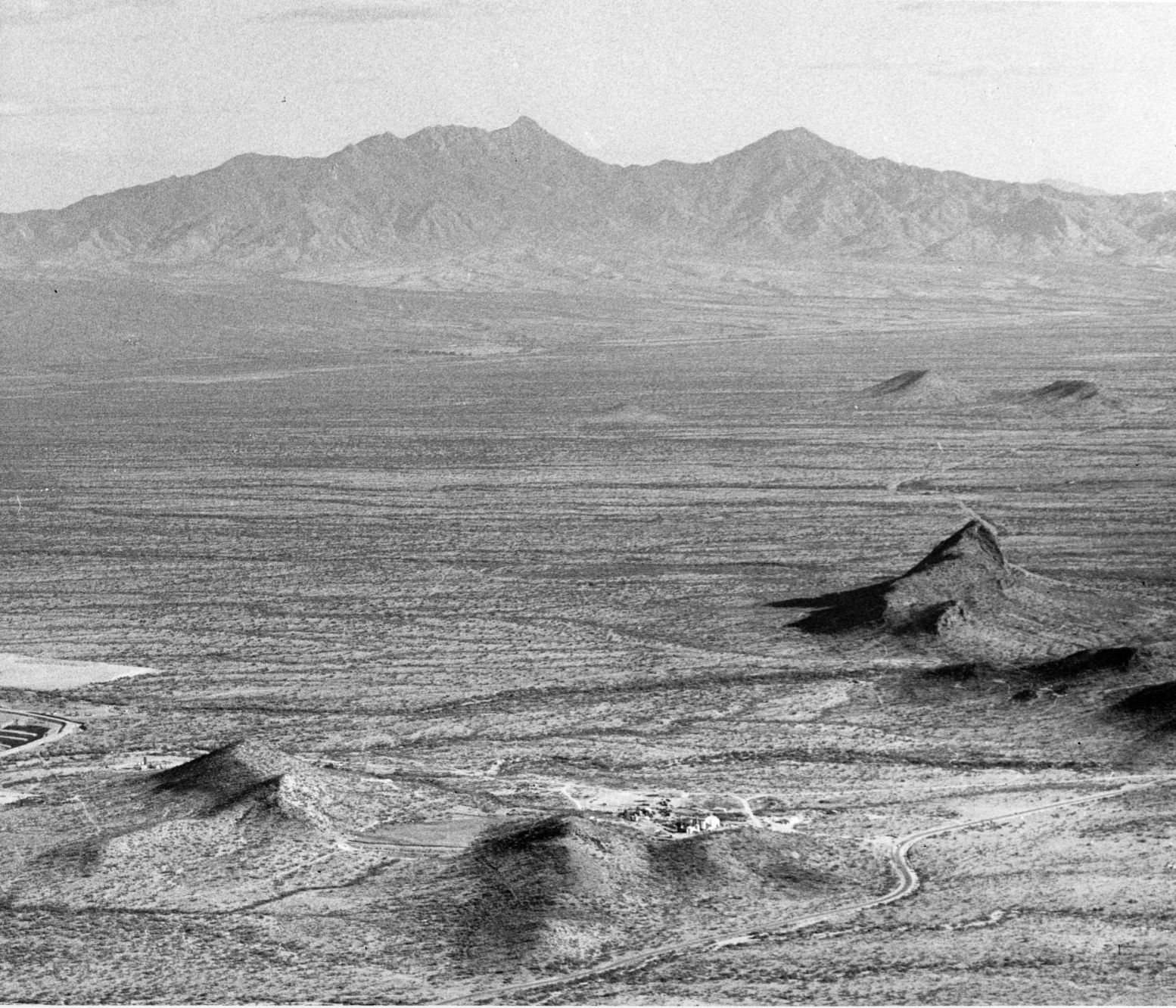
The valley floor below Kitt Peak National Observatory, ca. 1960
Kitt Peak National Observatory
Updated
The McMath Solar Telescope flanked by snow that fell on Kitt Peak National Observatory in February, 1966,
Kitt Peak National Observatory
Updated
A 10.5-ton fork is lifted into place at the 3.5 Meter WIYN telescope at Kitt Peak National Observatory in May, 1992. The fork holds a center section that includes the mirror, which was added later that year.
Kitt Peak National Observatory
Updated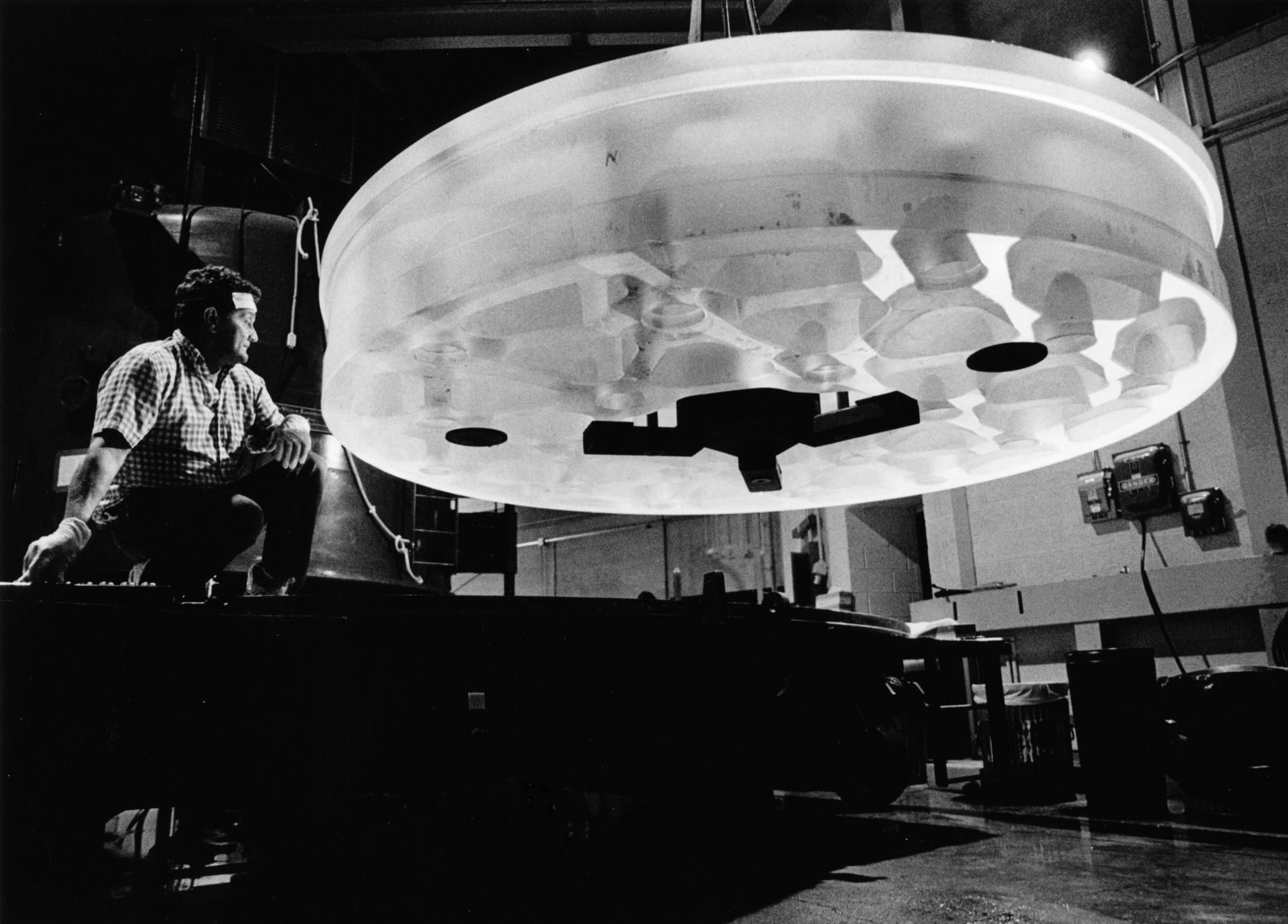
Jon Settlemyre watches the quart mirror from the 2.1 Meter telescope lowered onto a platform on an realuminizing chamber at Kitt Peak National Observatory in 1992. It was transferred to the Mayall Telescope building where the old coatings were stripped off and new ones reapplied.
Kitt Peak National Observatory
Updated
The lights of Tucson as seen from Kitt Peak National Observatory in 1959 (top) and 1980 (bottom).
Kitt Peak National Observatory
Updated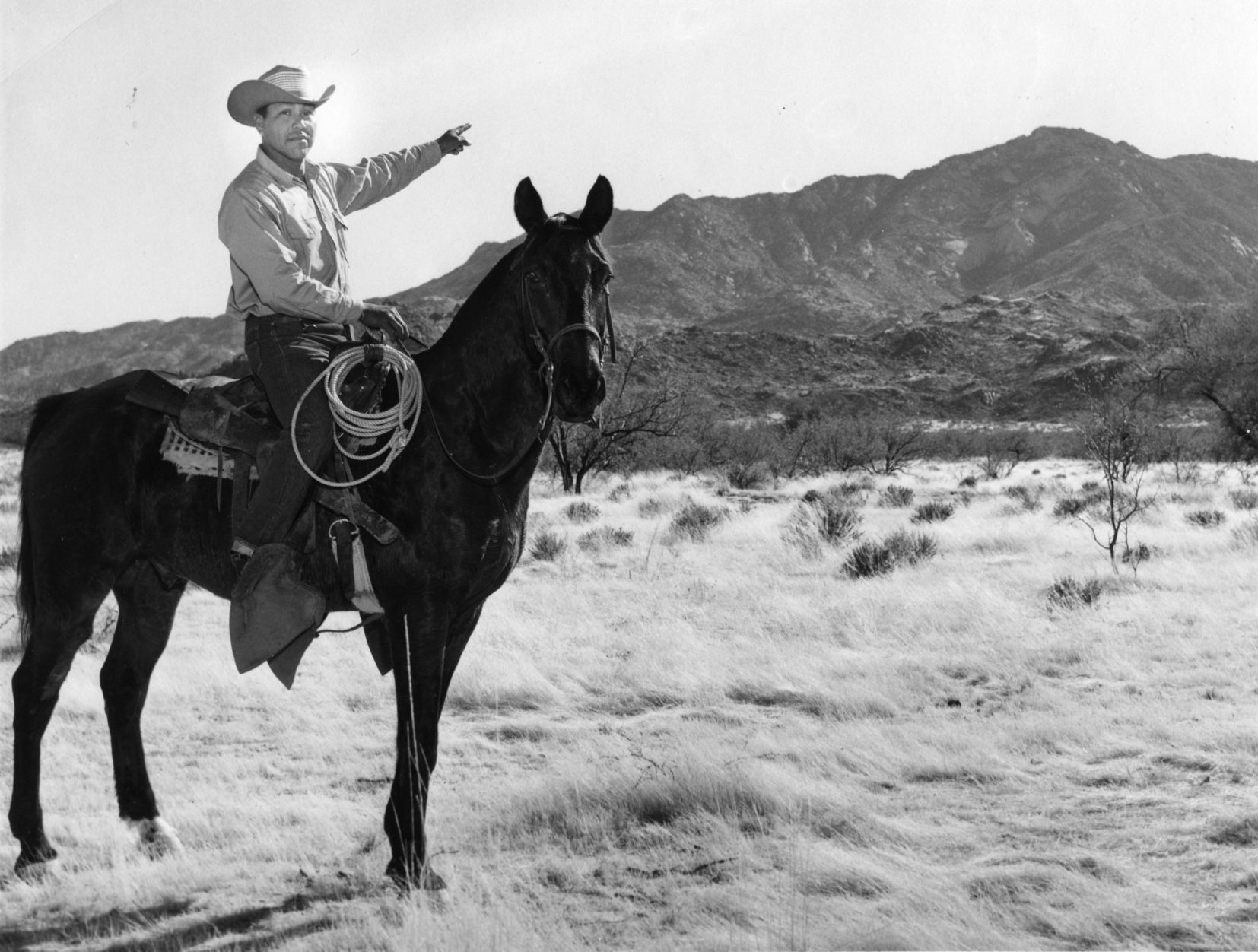
Roman Chavez, vice-chairman of the Papago (now Tohono O'Odham) Tribal Council, points at Kitt Peak in the Quinlan Mountains west of Tucson in 1956, during site and lease discussions for the observatory.
Kitt Peak National Observatory, 1959
Updated
Aerial photo of Kitt Peak on Jan 31, 1959. looking west solar telescope pad at bottom center of the picture.
Building the road to Kitt Peak National Observatory
Updated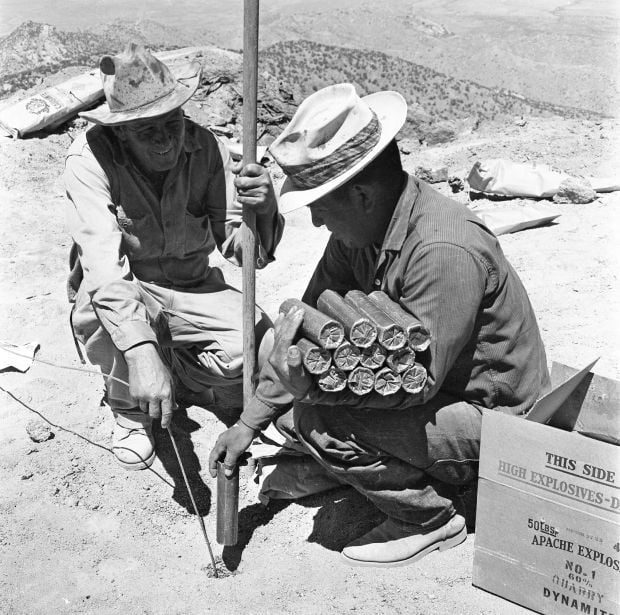
Building the road to Kitt Peak National Observatory in May, 1960: Workers slip explosives into holes to blast away rock.
Building the road to Kitt Peak National Observatory
Updated
Building the road to Kitt Peak National Observatory in May, 1960: A jackhammer operator pounds away at the rock face.
Building the road to Kitt Peak National Observatory
Updated
Building the road to Kitt Peak National Observatory in May, 1960: Bulldozers operate on treacherous, unstable material blasted from the the face of the mountain.
Building the road to Kitt Peak National Observatory
Updated
Building the road to Kitt Peak National Observatory in May, 1960: A truck eases down the early primitive road from near the top. The first telescope on the mountain, the 36-inch, can be seen in the background.
Building the road to Kitt Peak National Observatory
Updated
Building the road to Kitt Peak National Observatory in May, 1960: A dozer operator tackles tree stumps and rock.
Snow in Tucson
Updated
Snow and ice clinging to the telescope structure at Kitt Peak National Observatory west of Tucson on March 3, 1964.
Snow in Tucson
Updated
Snow and ice at Kitt Peak National Observatory on March 3, 1964.
Kitt Peak National Observatory
Updated
Actuators on the back of the telescope can make minute adjustments in the shape of the mirror surface of the WIYN Telescope, a 3.5 m meter telescope operated by a consortium of University of Wisconsin-Madison, Indiana University, Yale University and the National Astronomy Observatory. It is located west of Tucson, AZ.Photo taken Wednesday, October 23, 2013.
Kitt Peak National Observatory
Updated
A view from the Nicholas U. Mayall Telescope of some of the other telescopes at Kitt Peak National Observatory west of Tucson, AZ. The tall telescope at left is The McMath-Pierce Solar Telescope. Top center is The 2.1-meter Telescope and at right is The WIYN Telescope. Photo taken Wednesday, October 23, 2013.
Kitt Peak National Observatory
Updated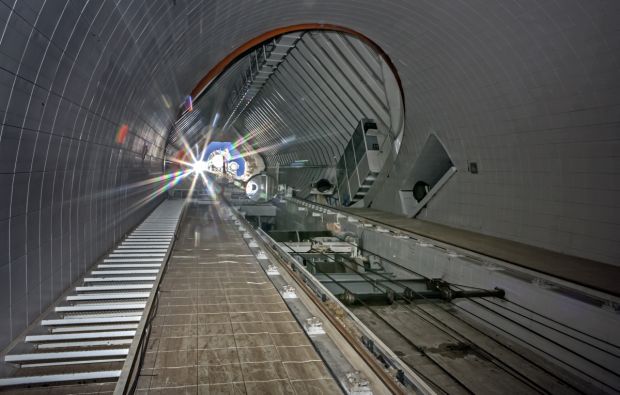
Seen from inside the 780 ft. linear optical tunnel of Kitt Peak National Observatory's McMath-Pierce Solar Telescope, sunlight is reflected from the three mirror heliostat, through a series of mirrors in the tunnel to the observation room where is it analyzed with spectrographs. McMath-Pierce Solar Telescope, built in 1962, west of Tucson, AZ., is the largest solar telescope in the world. Photo taken Wednesday, October 23, 2013.
Kitt Peak National Observatory
Updated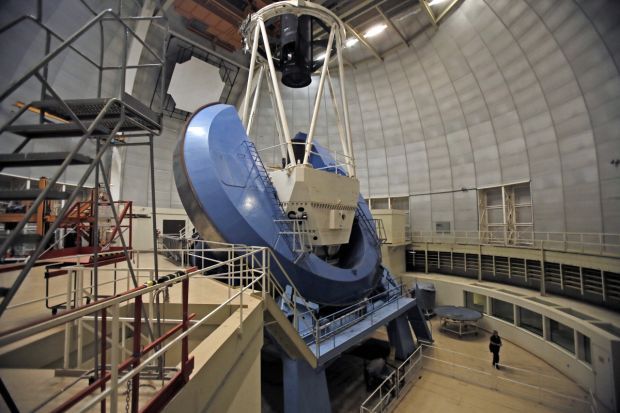
Lori Allen, left, Director of Kitt Peak National Observatory, is dwarfed by the Nicholas U. Mayhall 4-meter Telescope at Kitt Peak National Observatory west of Tucson, AZ. . Photo taken Wednesday, October 23, 2013.
Kitt Peak National Observatory
Updated
Matt Penn, Solar Astronomer with National Solar Observatory, discusses telescopes in the observation room of Kitt Peak National Observatory's McMath-Pierce Solar Telescope, built in 1962, the largest solar telescope in the world west of Tucson, AZ. Photo taken Wednesday, October 23, 2013.
Kitt Peak National Observatory
Updated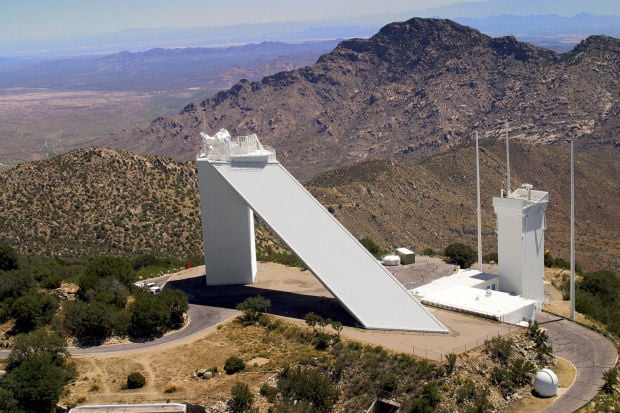
The McMath-Pierce Telescope on Kitt Peak since 1962, LEFT, and the SOLIS (Synoptic Optical Long-term Investigations of the Sun) at right..
Kitt Peak National Observatory
Updated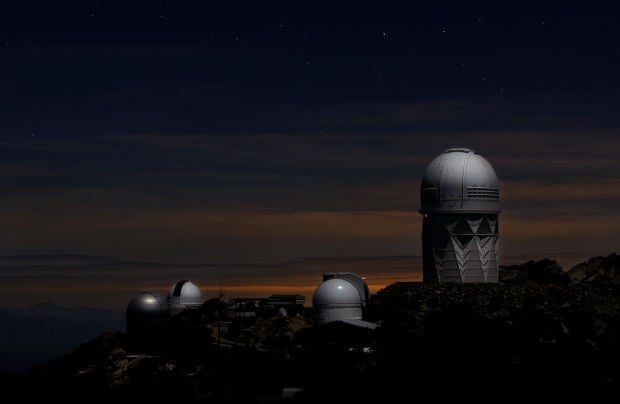
The orange glow of light pollution from Phoenix and Casa Grande lights the skies north of the SARA 0.9 meter, left, the Spacewatch 0.9 meter, the CWRU Burrel Schmidt 0.6 meter, the Steward Observatory's Bok 2.3 meter and the KPNO Mayall 4 meter telescopes at Kitt Peak National Observatory in 2010.
Kitt Peak National Observatory
Updated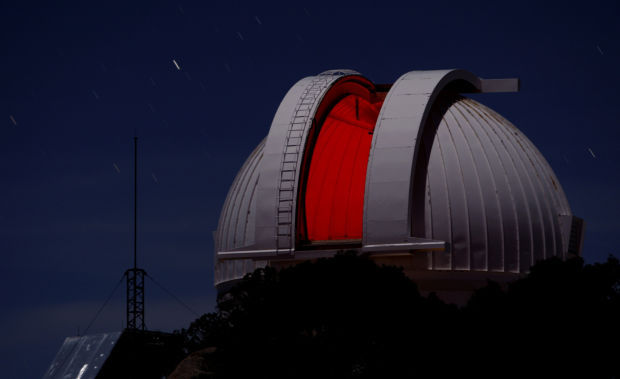
The dim glow of saftey lights shines out of the door of the WIYN 0.9 meter telescope where a tour group is using the instrument at Kitt Peak National Observatory in 2010.
Kitt Peak National Observatory
Updated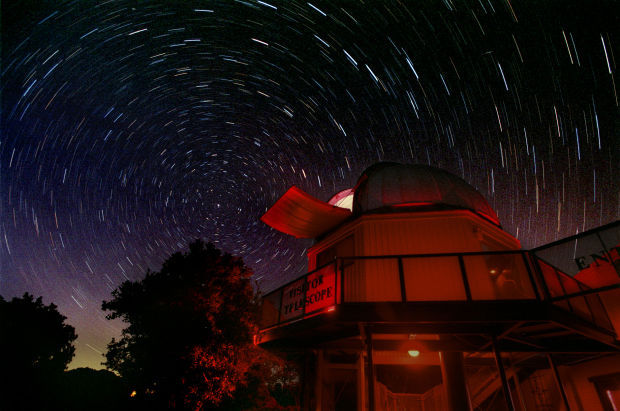
Stars swirl around the North Star, just to the left of the Kitt Peak observatory, in a 40-minute exposure.
Kitt Peak National Observatory
Updated
Bob Martino, standing at left, talks to astronomy enthusiasts about some of the stars that are visible at sunset as they listen to him at the 16 inch telescope with its roll-off roof at the top of Kitt Peak National Observatory in 2009. At upper left is the 4-meter Mayall telescope with the city lights of Three Points, AZ at the upper right.
Kitt Peak National Observatory
Updated
Some of the many observatories at Kitt Peak National Observatory.
Kitt Peak National Observatory
Updated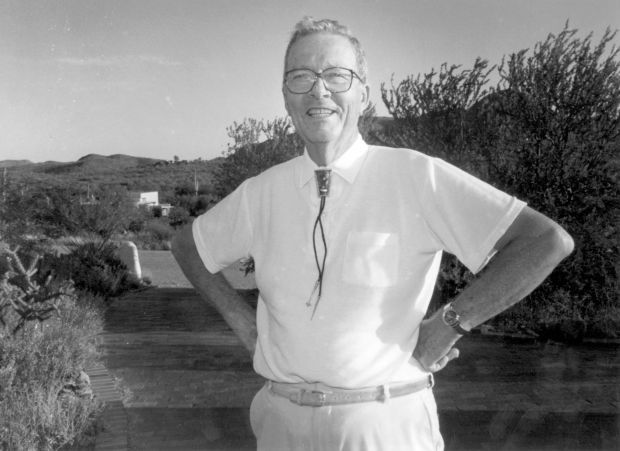
Aden B. Meinel, First director of Kitt Peak Observatory, photographed in 1993.
Kitt Peak National Observatory
Updated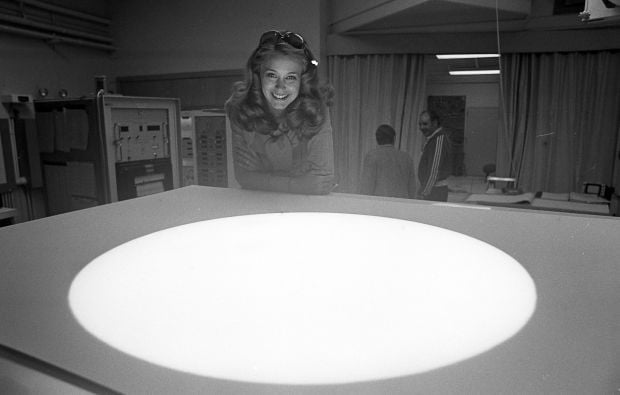
Jane Pauley surveys Kitt Peak's solar telescope in 1978.
Contreras Fire, Kitt Peak National Observatory, 2022
Updated
Kitt Peak National Observatory after the Contreras Fire.
Contreras Fire, Kitt Peak National Observatory, 2022
Updated
Kitt Peak National Observatory after the Contreras Fire. The Nicholas U. Mayall 4-meter Telescope is visible on the ridge on the left hand side of the image.