


The final frontier is becoming a more powerful force in the classroom.
Astronomy and space science has been part of curriculums for decades. Shiloe Fontes can remember her first trip to the planetarium, as a second grader at St. Peter and Paul Catholic School in Tucson.
“There is something so humbling and so fascinating about seeing the sky in a way you’ve never seen it before,” she said. “I fell in love.”
Fast-forward to today, and Fontes is the design manager at Flandrau Science Center & Planetarium on the University of Arizona campus.
Fontes indicated there is a lack of knowledge about career paths related to astronomy and space science.
“The economic opportunity in space is making it imperative for schools to teach it more than they have historically. There’s a reason we teach chemistry and biology right now. The same is happening in space, and it’s exciting to make everybody feel like they can get in on it,” said Michael Paolucci, CEO and founder of online space and Earth science learning platform Slooh.
Slooh is an online space and Earth science learning platform, which links to live telescope and satellite access, in an effort to foster hands-on space and Earth science education.
In early December of 2024, the company was approved as an educational savings account (ESA) vendor in Arizona. Paolucci said the company is approved for use at Los Angeles Unified School District, Chicago Public Schools and New York City Public Schools, among others.
Classroom teachers like Jack Erickson have found ways to use astronomy and space science as learning tools in classes other than astronomy. Erickson is a teacher at Vail Unified School District’s Cienega High School.

Classroom teachers like Jack Erickson, of Cienega High School in Vail, have found ways to use astronomy and space science as classroom learning tools.
“Since astronomy is not required to graduate, we also try and incorporate some of the earth and space science standards into our physics and biology classes, which all kids are taking, basically.”
Erickson has students explore kinematics — the science of moving objects — by looking towards the stars, bringing out students’ curiosity.
“It is kind of fun to say, If we follow Elon to Mars, and you know the rocket ship is landing, how much force is going to stop it? I’m not opposed to letting the conversation steer, and let them think they’re being off task, but really just having them right where I want.”
Fontes’s background is in scientific illustrations — science isn’t her strongest suit, she said.
Fontes said, “The idea of STEM is it’s great because everyone gets interested in science, math, astronomy … but a lot of it is worded or aimed at that ultimate career path, which I think makes it difficult to just have a passion for something. I think we forget that scientists have a passion.”
Fontes also said that the biggest barrier for educators – particularly those educating their students at home – is often lack of foundational knowledge.
“This has been a pretty big topic for many of us in the planetarium community. It’s a big issue, from what we’ve gathered, of not being comfortable speaking into the subject matter. No one wants to start talking about a subject where you might get questions, and then you can’t answer them.”

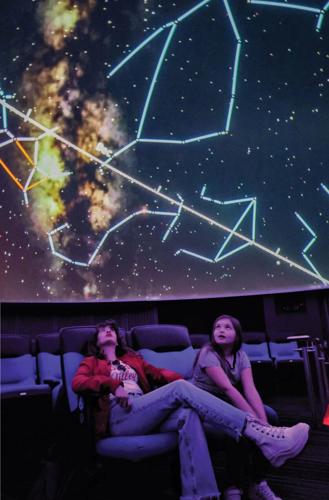
Hanah Klein and her daughter Lois Letson take in a program at Flandrau Science Center and Planetarium. During the 2023-2024 school year, 14,057 K-12 students participated in a the planetarium’s programming.
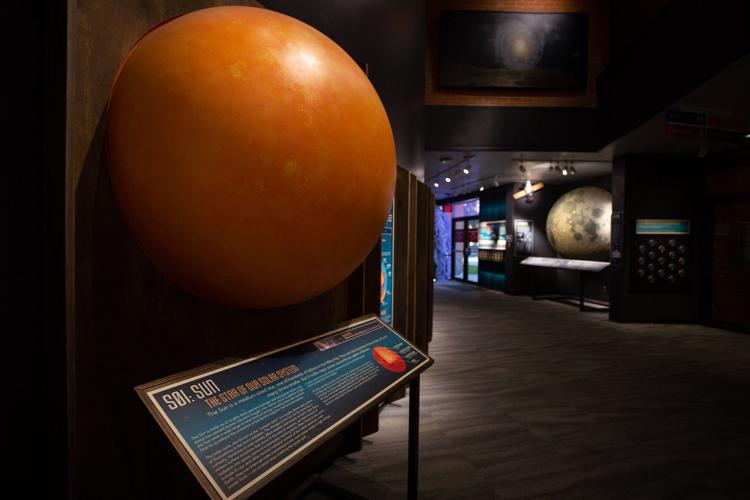
Institutions like the Flandrau Planetarium also help fill that knowledge void. During the 2023-2024 school year, Flandrau Planetarium hosted more than 24,000 children at its exhibits, planetarium presentations and specialty programs, according to a release by the University of Arizona facility.
“We primarily see public schools; then, private, and then we see homeschool and other non-traditional types of schools come through,” Fontes said. “For home schools, I think it’s a little tricky, because I think – again – that’s an area that may feel they don’t have the background to talk about the subject.”
For the Fall 2023 and Spring 2024 academic year, 14,057 K-12 students participated in a Flandrau Planetarium’s programming, with more than half of those coming from low-income, Title I public schools – many receiving a free or reduced registration rate.
The most popular astronomy-related ESA expense are telescopes, according to the Arizona Department of Education. Since July , the department has approved more than one thousand telescopes and nearly 800 books, including workbooks solely on astronomy.
Paolucci said the availability of space science resources has developed over time. “The fact that there’s now this digital ecosystem enabling students to interact with (astronomy) instruments all over the world and up in space is a game changer.”
Paolucci said that he’s noticed society has become disconnected from Earth’s place in the universe.
“We’re just not in tune with the reality that we’re sitting on this rock, floating through space. Anybody who goes to a dark sky park or goes out into the ocean like just see how majestic The Milky Way is.
There’s a tremendous benefit to getting all the people of the world looking up into space together in a social way – just think of ourselves for a little sliver of our day, as Earthlings.”

