





Four Cienega High School students and their teacher are part of a North American network of citizen scientists collecting data about a rarely-studied part of the sun during Monday’s total solar eclipse. The project was started by Tucson solar astronomist Matt Penn.
Using telescopes, computers and specialized software, the group — under the tutelage of Cienega science teacher Jack Erickson — will gather data about the sun’s inner corona in an effort to help scientists better understand a rarely-seen part of the sun.
Matt Penn, an electro-optical engineer and 33-year veteran solar astronomer based in Tucson, founded the project in 2015.
“I thought, how cool would it be to get a network of telescopes set up and take real imaging data during the eclipse?”
NASA studies have looked at the corona — the atmosphere of the sun — but the inner region of the corona has gone largely unstudied, Penn said.
“They don’t look at the inner region of the corona for technical reasons,” Penn explained. “The eclipse opens that window for the inner corona, something from the surface of the sun, up to about one solar radius above the surface.
“That’s where all the exciting stuff happens.”

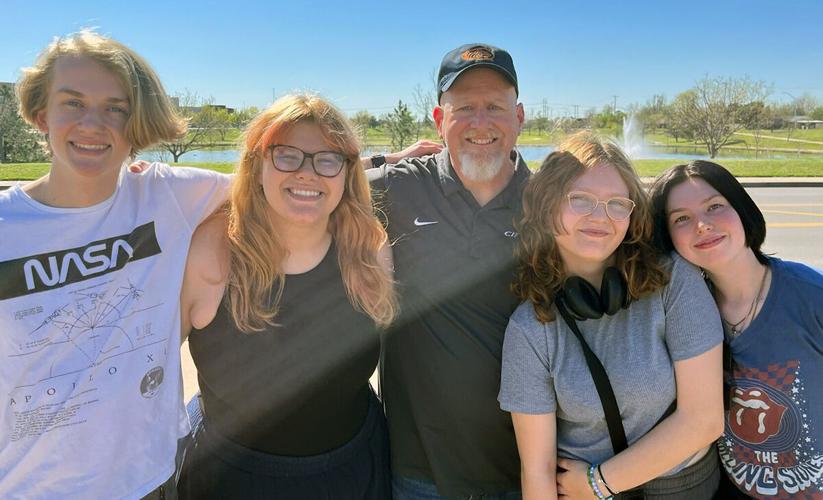
Four Cienega High School students - Hayden Tanksley (twelfth grade), Makayal Kroeger (eleventh grade), Ana Sofia Moran (tenth grade) and Grace Stubbins (tenth grade), along with their teacher, Jack Erickson (third from left) arrived in Oklahoma Thursday. They will participate in a North American citizen-scientist endeavor recording data from the upcoming total solar eclipse. The group will be set up in Idabel, Oklahoma, along the path of totality.
The corona is host to solar storms that are accelerated off the sun and travel through space. The storms can “cause havoc with our magnetic field and our power systems,” Penn said.
“We don’t know how those are accelerated. All that acceleration happens in the region where NASA can’t observe currently.”
An eclipse lasts about four minutes — not much time to collect data.
But with dozens of teams studying across the path of totality?
“If we can get eclipse data for the whole time that the moon’s shadow is on the earth, then there’s a lot more robust science that can be done with that,” said Erickson, the Cienega teacher.
A group of Cienega students traveled to record observations about the 2017 total solar eclipse.
Erickson said his students received a lot of scholarship money from that experience. A few gave an eclipse presentation at Comic Con, Erickson said.
“This is a whole new level of nerdy right here,” he said, laughing.

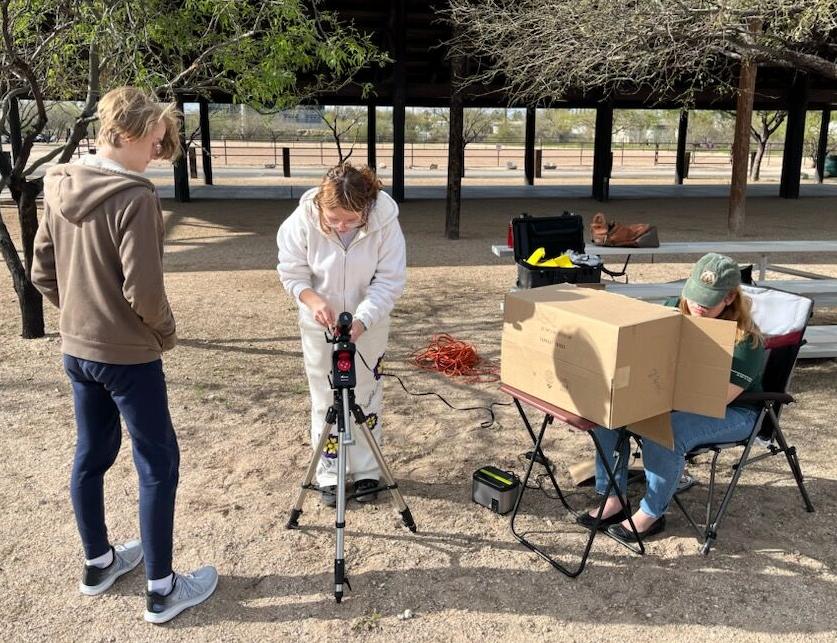
Vail Unified School District Cienega High School students Makayla Kroeger and Callie Erickson steady their telescope and tripod in the Utah sand to record data from the annular eclipse. That 2023 trip preceded a journey to Oklahoma to study Monday’s total solar eclipse. Four Cienega students will be stationed in Oklahoma Monday, along the path of totality.
As a result of the 2017 endeavor, in 2020 a 283-co-author white paper was published using the combined data.
It was the first of its kind, and only the third to make a similar measurement, Penn said.
Dozens of teams are taking part in Monday’s eclipse study, including college students, retired astronomers, Girl Scouts — and high school students.
“The project has groups like ours, going all the way from the Gulf of Mexico along the path of totality of the eclipse … and we have telescopes all the way up to where it leaves land and goes out to sea in Canada,” Erickson said.
Four Cienega students, a chaperone and Erickson arrived in Oklahoma on Thursday. The group will contribute to the project, dubbed “DEBI” (Dynamic Eclipse Broadcast Initiative) from Idabel, Oklahoma.
The group had a practice run at Tucson’s Brandi Fenton Memorial Park last Saturday.
There were a few hiccups — students had to reconfigure some software code to make sure the telescope remained focused on its target.
“If we’re not precise in our setup, when we try and automatically have it look at the sun, it’ll be off, and then then we’ll have to manually set it,” said Hayden Tanksley, a senior at Cienega. “That’s pretty difficult.”
Cienega’s efforts are being funded by Cienega’s astronomy club, the Vail Unified School District and tax credit donations, totaling a bit less than $10,000 Erickson said. That includes equipment and travel.
“Because we have to make the science more valid, all of the groups have the same telescope, the same camera running the same computer with the same software, the same filters — everything has to be the same,” he said.
Some of the equipment has been donated and will be kept by participants after the eclipse, Penn said.
Penn said that whether the students go on to pursue careers in science or otherwise, what is important is that they can make an educated decision about their futures.
“Some of the best students that we’ve had decided that science just isn’t for them. At least they’ve made that decision based on facts.”

