PHOENIX — Gov. Katie Hobbs expressed optimism about reaching a seven-state deal to cut Colorado River water use, while sticking to her stance that unless Upper Basin states offer up some firm commitments to conserve water she won't agree to any deal for Arizona to cut its own withdrawals from the river.
Without such a commitment, either U.S. Interior Secretary Doug Burgum would impose his own solution on the seven states that draw water from the river — or the impasse would be hashed out in court.
But Burgum has so far refused to do more than bring the states' governors together, as he did on Friday in Washington, D.C.

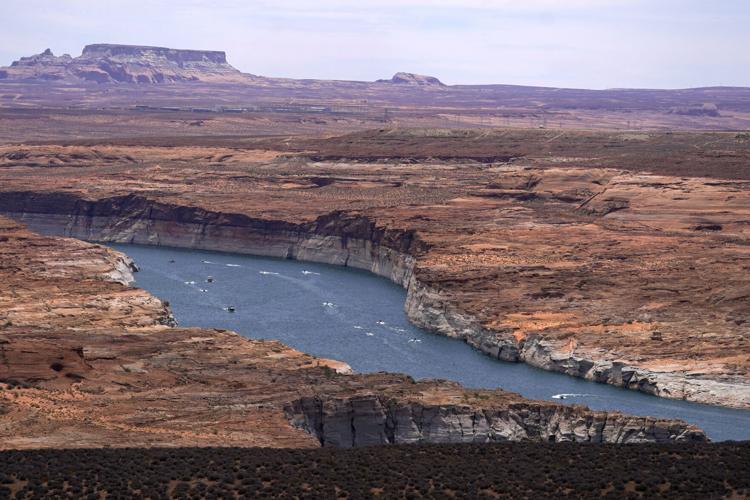
Boats move along Lake Powell along the Upper Colorado River Basin in Wahweap, Arizona, in this 2021 file photo.
Hobbs told reporters Monday that while she doesn’t expect a seven-state agreement will be reached by Interior’s Feb. 14 deadline, she thinks a 5-year deal for water use cuts is possible among the states. That would be in lieu of the 20-year arrangement the states have been seeking. She spoke three days after she and five of the basin’s other six governors met with Burgum.
"What we heard from everyone Friday, even the feds, is that they don’t want another 5-year deal to put us back in the same place in 5 years that we’re in now. They want a bridge to get us to that 20-year deal,” Hobbs said.
“The details are going to be left to negotiations, but a shorter term deal sounds like it is on the table,” she said.
Also speaking Monday, Terry Goddard, president of the Central Arizona Water Conservation District, which oversees the state's Colorado River supply, said the options put forward by the Interior Department in its recent draft environmental impact statement "are not palatable to Arizona or California.''
"All Burgum's done is set us up for litigation,'' he told Capitol Media Services. "And I think that's sad.”

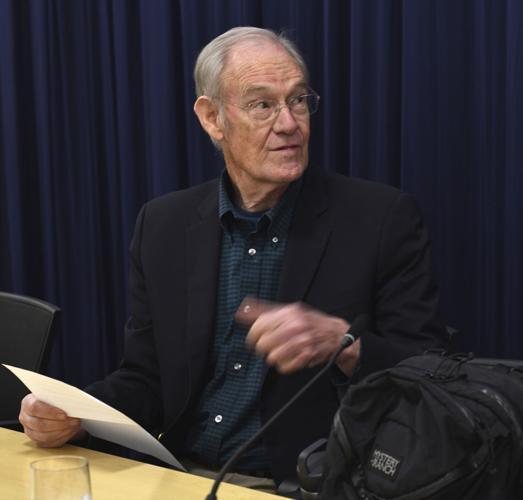
Terry Goddard
Hobbs, however, said she thought the basin states made better progress in Friday's meeting than they have in a long time.
“Certainly for me, the governor with the most skin in the game, the most water on the table, we heard more from the Upper Basin than in the negotiations so far,” Hobbs said.
She had asked Burgum in November to get involved and develop a plan designed to protect Arizona water users, specifically by requiring conservation in the Upper Basin states of Colorado, New Mexico, Wyoming and Utah. But on Monday she did not dispute that so far — even during Friday's session — all he has done is encourage states to work together.
Still, the governor said she thinks it doesn't necessarily have to wind up in court, even though Arizona already set aside $3 million for the potential litigation.
"While we didn't leave with a lot of specifics — the details are to be worked out through negotiation — I think that we came away with hearing that nobody wants to end up in litigation,'' Hobbs said. "We want to find a way to get to a deal.''
Hobbs said that means recognizing that Arizona, which already agreed to give up 27% of the water it has been getting from the Colorado River, won't give up a drop more unless there are firm and enforceable promises that the Upper Basin states will share in the burden.
That theme was echoed by Tom Buschatzke, director of the Arizona Department of Water Resources.
"We need certainty there are reductions in Upper Basin usage because that is one of two tools that we have,'' he said, as historic drought conditions mean less water is going into the river upstream.
"You can't make it snow or rain,'' Buschatzke said. "But you can reduce your demand. So that has to be a tool that's in play at some level.''
Some estimates show that consumption of Colorado River water needs to be cut by up to 3 million to 4 million acre-feet a year. Three million acre-feet is enough to serve the equivalent of more than 9 million homes in the Phoenix area. More homes could be watered than that in the Tucson area with 3 million acre-feet because Tucson homeowners typically use less water per household than those in Phoenix.
The Lower Basin states of California, Nevada and Arizona have agreed to trim usage by 1.5 million acre-feet, enough to serve about 4.5 million homes a year. And Arizona, which contractually and legally has the lowest priority claims to the river's water, has already had to cut its own withdrawals from what it's been allowed by 27%.
Upper Basin states have said they're willing to voluntarily conserve water, meaning more would flow down the river to the Bower Basin states. But Hobbs noted that has yet to be put into an actual commitment.
"I shared this with Secretary Burgum and the other basin states,'' the governor said. "For a successful negotiated outcome, Arizona and the Lower Basin cannot and will not be balancing the Colorado River on our own.''
She said the Lower Basin states are willing to do more only "if our partners in the Upper Basin states come to the table with reductions of their own.''
That, in turn, leads to the prospect of having it all decided in court.
"The stonewalling from the Upper Basin has made it very hard to see a non-litigation course in the future,'' Goddard said. "If the Upper Basin continues to say 'In a time of shortage, we're not going to save and contribute to the shortage one drop of water,' I don't see we can have a settlement.''
How much Arizona can demand could depend, at least in part, on the other Lower Basin states all hanging together.
Cooperation has not always been the rule, with California at times exercising the fact it holds more senior water rights. And even now, the amount of water that Arizona has offered up — about 760,000 acre-feet — is on a per-capita basis more than California has.
But Hobbs said she believes that despite California's senior rights to the water, the state's western neighbor won't sell Arizona down the river, so to speak, to protect its own water interests. She said all three Lower Basin states have been united since they came to an agreement among them in 2023.
“We have worked from Day One of my administration to bring California to the table in the negotiations,” Hobbs said. “I feel very confident that we are continuing on a united path.”
Goddard, however, said "I think we always have to be cautious.” A former Arizona attorney general, he acknowledged that, compared to California, "Arizona has a slightly lower pecking order” when it comes to having legal priority for Colorado River water rights.
Actually, California has more than a slightly higher priority for river water than Arizona. Under the 1968 law that authorized construction of the Central Arizona Project canal system, Arizona must legally give up all of its CAP water before California would lose any of its share. California officials, however, have agreed to take some cuts along with CAP as part of a compromise deal among the Lower Basin states.
Goddard acknowledged the history between the two states.
"Keep your friends close,'' he said.
"But we've had some very good discussions with the major water users in California,'' he continued. "They have a joint interest with us. We're all part of a growing economy in the West that gets its water from the Colorado River.''
That hasn't stopped Hobbs from making what she says is the case for why Arizona, despite its lower priority rights to river water, should have its needs met — and why the Trump administration should pay special attention.
"The most important computer chip manufacturing facilities in the Western Hemisphere are here in Arizona, critical to winning our struggle against China in the AI arms race and at the center of the president's recent trade deal in Taiwan,'' Hobbs said.
She also emphasized that the majority of the nation's winter crops are grown in Arizona.