


Arizona and Colorado officials are building war chests for possible future litigation over Colorado River water rights even as the states try to negotiate an agreement on river management to keep the dispute out of court.
The Central Arizona Project now plans to spend up to $6 million a year for two years on possible litigation to protect its imperiled Colorado River supplies that serve residents of the Tucson and Phoenix areas as well as farmers.
Colorado officials have already started hiring additional lawyers to prepare for future lawsuits that the state's attorney general says are likely inevitable.
On Friday, Jan. 30, U.S. Interior Secretary Doug Burgum is scheduled to meet with governors or their representatives from all seven Colorado River Basin states, in a last-ditch effort to secure an agreement to curb longstanding overuse of river water. The hope of Arizona Gov. Katie Hobbs and others who will attend is to at least move closer to a deal and thereby avoid expensive, time-consuming litigation that all parties say they don't want.

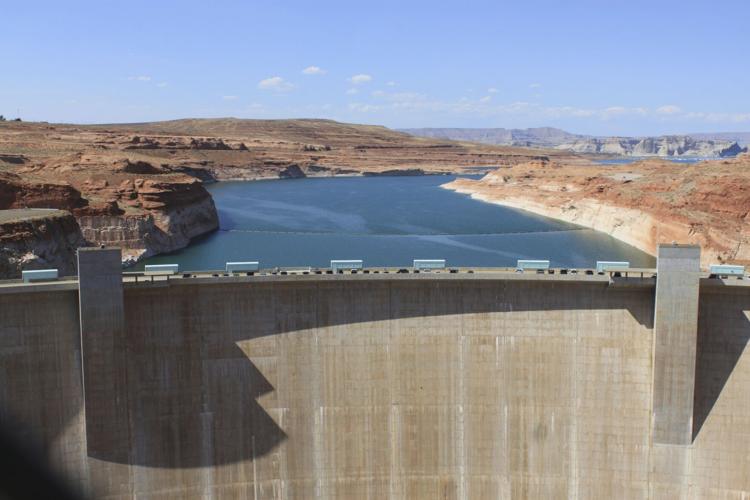
Glen Canyon Dam on the Colorado River in Page, Arizona. Arizona and Colorado officials are building war chests for possible future litigation over Colorado River water rights even as the states try to negotiate an agreement on river management to keep the dispute out of court.
The chances of the states reaching consensus on a 20-year deal to replace current river operating guidelines that expire at the end of 2026 are considered very slim. But some officials and outside experts have held out hopes for a slimmed-down, 5-year agreement that would give states breathing room to negotiate a longer-term deal later.
Already, however, Arizona and Colorado, whose officials have been the most vocal combatants on this issue, are mobilizing to fight in court over river water rights, litigation that experts say could stretch out for many years.
That battle would almost certainly be over the meaning of the century-old Colorado River Compact and how its rules govern the Upper and Lower basins' water use today. Arguments over the compact have long been seen as a side issue in the inter-basin conflicts. But one longtime river expert says the compact is now the "elephant in the room," at the heart of any future court battles.
The CAP board agreed last November to authorize spending $6 million in both 2026 and 2027 on legal expenses, as part of the project's approved budget.
While the budget doesn't specifically earmark that money for Colorado River litigation, "obviously the thing on our mind is to protect our position on the Colorado River," CAP board president Terry Goddard told the Star Wednesday.
The Arizona Legislature appropriated another $1 million last year for Colorado River litigation and legislation is pending this year to appropriate more.
Goddard is still hopeful the seven states can work something out, but the recently released federal draft environmental impact statement on the river did nothing to help, he said. The draft report offered five alternative approaches to substantially shaving river water use, but one called for no action and the other four saddle the Lower Basin states of Arizona, Nevada and California with the overwhelming majority of cuts.
And in that report, the U.S. Bureau of Reclamation said its authority to impose cuts on the Upper Basin states hasn't been legally tested, whereas its authority over the Lower Basin states river water use is undisputed by all parties involved. The Upper Basin states are Colorado, New Mexico, Utah and Wyoming.
"It did virtually nothing to get the Upper Basin to come to the table and talk seriously," said Goddard, a former Arizona attorney general. "Every day puts us closer to litigation.
"It's a higher litigation budget than we’ve had before. The reason the board felt that was necessary is that they wanted to do everything in their power to make sure Arizona’s rights are respected," Goddard said. "It hasn't been expended — any draw on the money would have to be approved separately by the board."

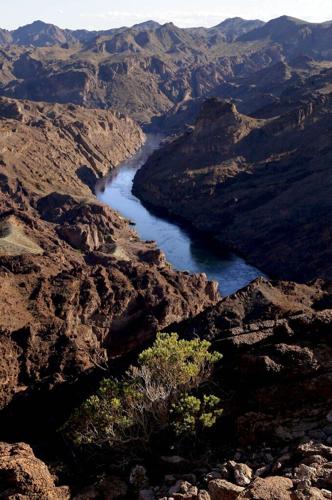
The Colorado River flows through Black Canyon just south of Hoover Dam. "No amount of legal posturing will create more water," says Colorado River Commissioner Becky Mitchell, as both Colorado and Arizona dig in on their disputes over water rights.
The compact puts the Lower Basin in a very strong position, he said, saying it's very clear on the Upper Basin's delivery obligations. To underscore that, the federal government's authorization for Glen Canyon Dam and other units authorized at the same time was made specifically to let the Upper Basin states have some water to expand their economies while still meeting their obligations under the compact, he said.
This week, CAP posted on its website a statement blasting all the alternatives, saying the draft environmental report "places all the risk of a dwindling Colorado River on the Lower Basin and all the alternatives proposed are harmful to Arizona."
The draft report "ignores the obligations of the Upper Basin states to deliver water under the Colorado River Compact and the federal government to release water from the Colorado River Storage Pojrect dams," the CAP said, referring to Glen Canyon Dam and several other Upper Basin dams lying upstream of Glen Canyon.
But at a Colorado state legislative hearing last week, that state's attorney general, Phil Weiser, said the state has invested in hiring more water law attorneys on staff and that his office is preparing for a fight he increasingly sees as inevitable.
“The reason it’s hard to get a deal is because you need two parties living in reality, and if one party is living in la-la land, you’re not going to get a deal,” said Weiser, an announced candidate for Colorado's Democratic nomination for governor. “Arizona has continued to ship alfalfa to Saudi Arabia, which is a classic example of what we should not be doing with water from the Colorado River.”
(The publicity about Arizona farmers shipping alfalfa to Saudi Arabia has actually been about crops grown by a Saudi firm using groundwater, not river water, although it's not publicly known if any Arizona farmers using river water are also growing alfalfa for shipment to Saudi Arabia.)
In remarks first reported by the Las Vegas Review-Journal, Weiser said he’s “committed to not getting a bad deal,” and that, in a likely court case, Colorado would stand by its water rights detailed in the original 1922 Colorado River Compact.
In a statement to the Star, Colorado River Commissioner Becky Mitchell added, "No amount of legal posturing will create more water. The 1922 compact is flexible enough to accommodate highly variable hydrology if all within the Basin are willing to live within the means of what the river supplies.
"For the last 25 years of record drought, the Upper Basin has used millions of acre-feet less than its apportionment and has met its compact obligations," Mitchell wrote. "Colorado is committed to protecting our state’s significant rights and interests in the Colorado River. We will continue to work towards a consensus-based, supply-driven solution for the Post-2026 operations of Lake Powell and Mead."
But when asked more directly about Colorado's legal position on the river, Mitchell's spokeswoman Michael Sakas took a more nuanced stance.
"While Colorado will defend its significant interests in the Colorado River if needed, we are fully focused on negotiating a seven state solution without positioning behind legal arguments," Sakas said Thursday.
For a long time, the basins' states have most publicly argued over who should bear the brunt of whatever cuts are needed to bring the river's dwindling supply in line with demand.
But beneath those arguments, "the Colorado River Compact is the elephant in the room, that everyone involved knows is the elephant in the room," said Eric Kuhn, a longtime water researcher and author in Colorado.
The compact, in dividing up the river's reputed supply between the states, set minimum requirements for how much water the Upper Basin states are supposed to release over 10 years to the Lower Basin states.
While the lawyers for both basins' states continue to argue over the specifics of the compact's meaning, there's a real chance that this year's river flows will offer the first real legal test of this longstanding debate.
If the basin's weather stays dry and river flows continue falling as they have for at least the past 18 months, the river may for the first time carry little enough water that the 10-year flow through 2026 will fall below the amount the Lower Basin states say the Upper Basin states need to release to meet their compact obligations, Kuhn said.
That total — 82.5 million acre-feet — is called the "tripwire," the spot where the adequacy of the river releases to the Lower Basin would first come into question.
"If they don’t have an agreement and the hydrology is the same (as it is now), the Lower Basin states will say the Upper Basin states are not meeting their compact obligations and the Upper Basin states will say 'No, we are,'" Kuhn said.
"How will they deal with this in a short-term fashion?" he asked.
The Lower Basin states say the compact legally obligates the Upper Basin states to deliver a minimum amount of river water downstream over a decade. The Upper Basin states say the compact merely requires them to not "deplete" the river flow below that minimum, and they say climate change, not their states, are to blame for that depletion.
This argument has never been tested in court, and Kuhn said he has no idea which side would prevail if that argument is the deciding factor. But should the Upper Basin states prevail, it could set a precedent upending numerous other river compact agreements, Kuhn said.
What the 1922 compact means is the "crux" of the ongoing fight over the river, said Kathryn Sorensen, a researcher for Arizona State University's Kyl Center for Water Policy.
The Lower Basin states interpret the compact to mean the Upper Basin states must deliver the 82.5 million acre-feet over a decade, even if the Upper Basin states have to curtail their water uses to meet that target, she said.
The Upper Basin states believe that because they're not using their total 7.5 million acre-foot allocation of river water every year, it's not their responsibility to ensure that much water reaches the Lower Basin, Sorensen said.
The Upper Basin states have also rejected an argument from the Lower Basin states that they must deliver some of that 82.5 million acre-feet just to help meet the U.S.' obligation to deliver water to Mexico under its 1944 treaty with that country. That's their position, although a 1968 law said meeting the Mexican treaty requirement is a national obligation that Lower Basin states say should apply to both U.S. basins.
"The prize goes to whose interpretation is correct. Are we going to manage the river so the Lower Basin continues to use its full allocation and the Upper Basin uses are curtailed? Or will the Lower Basin cut its use so the Upper Basin can continue to develop?" Sorensen said. "There isn't enough to go around.""
"Everyone is now focused on the short term deal. It's important and there's a good reason for that. But there are bigger long-term issues at play — those are the ones at the end of the day that really matter," she said.
For some time, some Upper Basin water officials have conditioned their willingness to make a deal on receiving a commitment from Lower Basin states to promise not to enforce any compact requirements. Just last week, Amy Haas, executive director of the Colorado River Authority of Utah, reaffirmed that position in discussing the five alternatives proposed in the new river environmental impact statement.
“None of the five can provide what for Utah is really the central consideration for the deal, and that is a waiver of compact litigation,” Haas was quoted as saying.
Arizona Department of Water Resources Director Tom Buschatzke, however, has said repeatedly that he would never even want to ask the state Legislature to waive Arizona's right to enforce the contract without written, firm legal commitments by Upper Basin states to reduce their water use.
In a recent briefing, Buschatzke told reporters that Arizona’s decision about whether to sue may depend on how close the states are to reaching a deal.
“We may say, ‘Tough luck, we’re going to sue, enforce the compact,’” he said. “We may say, ‘You know something, this is an unforeseen circumstance, this is an emergency, we want to be good neighbors and participate in fixing the problem.’
“I can’t tell you what we’re going to do," he said, "and 10 lawyers will probably advise me to do 10 different things.”

