


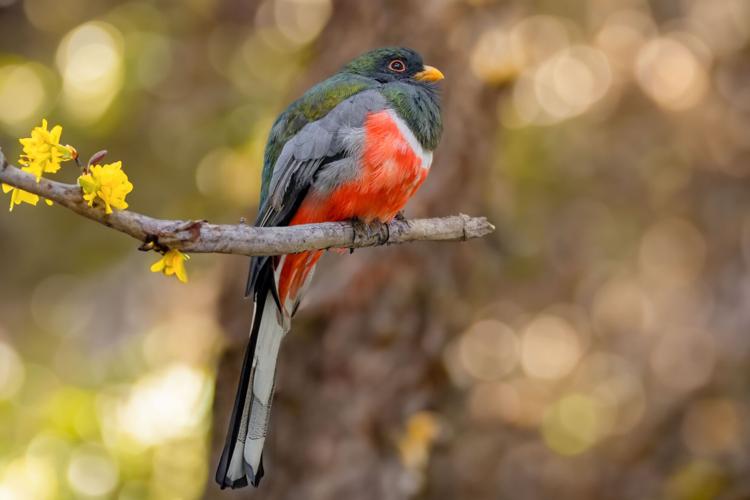
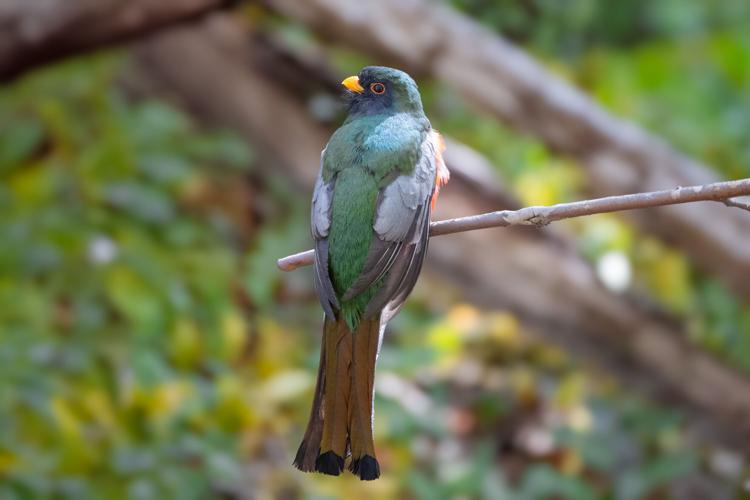
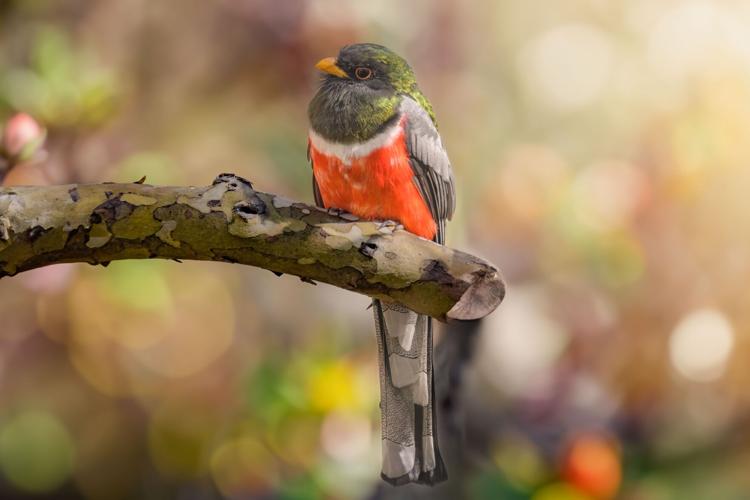

A rare species prized by birders in Southern Arizona has been unceremoniously stripped of its elegance, and at least one local expert isn’t happy about the change.
A leading panel of taxonomists recently announced a species split and a name change for the elegant trogon, a brightly colored red and green bird sometimes spotted in Madera Canyon and elsewhere in the sky island mountain ranges south of Tucson.
The trogons in Central America will retain the elegant name while the ones found across Mexico and occasionally Southern Arizona will henceforth be known as coppery-tailed trogons.
The Cornell Lab of Ornithology, operators of the popular eBird online database for bird observations, posted a notice about the change last month as part of its annual taxonomic update.
The move is part of a broader push to compile a single global checklist of bird species that reconciles the various names and classifications found in multiple lists produced by an alphabet soup of different ornithological organizations.
Jennie MacFarland can’t help but feel betrayed.
“I was definitely surprised. I didn’t even know it was up for a split,” she said. “I find it kind of irritating. Why didn’t they leave ours as the elegant one?”
MacFarland is director of bird conservation for the Tucson Bird Alliance. Since 2013, she has led the nonprofit environmental group’s annual population survey of elegant trogons in the mountains south and east of Tucson.
Only now it turns out that the large and exotic-looking bird she has been counting all these years is actually a slightly different kind of large and exotic-looking bird.
“I don’t love it,” MacFarland said of the new name. “I don’t think it’s as romantic. It’s kind of clunky, and it doesn’t sound as cool.”
Even the scientific name for the coppery-tailed variety seems like a slight: Trogon ambiguus, literally Latin for ambiguous or uncertain trogon.
The coppery-tailed moniker has actually been around for a while. For decades, it was used to distinguish the northern variety of elegant trogon from the ones in Central America – two distinct populations that are separated by geography but also feature subtle differences in plumage and in the cadence of their calls.
Some taxonomists over the years have classified them as entirely separate species, while others opted to treat them as subspecies.
MacFarland said the trogons we see up here do have a metallic, yellow-orange hue on the back of their tails, but the decision to declare it as a separate species is not the result of some new research or genetic analysis. “It’s the exact same bird. Nothing else has changed.”
She said revisions like this are common in the avian taxonomy world. Bird classification groups seem to go through “phases of style” when it comes to naming and classifying bird species, MacFarland said, with “an era of lumping” followed by “an era of splitting” like the one we’re in now.
“It’s entirely possible that this bird could get relumped someday” and go back to being elegant, she said.
It’s worth noting that the Tucson Bird Alliance underwent a name change of its own in 2024. After 75 years as the Tucson Audubon Society, board members for the local conservation group decided they no longer wished to be lumped in with John James Audubon, the 19th century slave owner and white supremecist famous for his colorful illustration of birds.
Southern Arizona lies at the northern edge of the trogons’ range, and it serves as a nesting ground for birds from northern Mexico. They generally arrive in mid-April and fly south again with their chicks in September or October.
Trogons are cavity nesters, drawn to natural hollows in sycamore trees or the holes left in oaks and pines by flickers and other birds. MacFarland said they seem to prefer wooded canyons with ample “large-bodied insects” such as grasshoppers and walking sticks, which the omnivores rely on through the summer to feed themselves and their hatchlings.
One way to spot them is by zeroing in on their distinctive call, which is easily the least elegant thing about them. The sound has been compared to the bark of an angry chihuahua, but it also reminds MacFarland of the croaking noise a frog might make.
She and her fellow surveyors generally go out looking for the birds in mid-May to avoid disturbing them when they’re trying to nest.
The population count is conducted in five mountain ranges: the Santa Ritas, Chiricahuas, Huachucas, Patagonias and Atascosas.
MacFarland said she also hears about occasional trogon nests in the Rincons and Galiuros, but those mountains are not included because they require too much hiking for too few sightings.
Interestingly, the birds do not seem to favor the Catalinas. She said the handful of reports she has gotten in that range have come in late summer or early fall, leading her to suspect that the Galiuro trogons might occasionally use the Catalinas for a brief stopover on their way back to Mexico.
The overall population in Arizona never amounts to much. The highest number on record came in 2020, when MacFarland and company counted 201 trogons across the entire survey area. Just 31 birds were sighted last year, the lowest total by far.
“It seems highly variable and tied to habitat conditions,” MacFarland said.
Ultimately, she doesn’t expect the name change to diminish overall interest in the bird. As long as Southern Arizona is the only place in the U.S. to reliably find the once-elegant species, people will continue to come looking for it. “The trogon is going to be a headliner for visiting birders or bird enthusiasts,” no matter what it’s called, she said.
But it could take a while for the new name to catch on, especially with people who have devoted so much time to the bird.
“It’s going to be kind of rough for me,” MacFarland said. “I know I’m going to still be calling it elegant for years.”

