

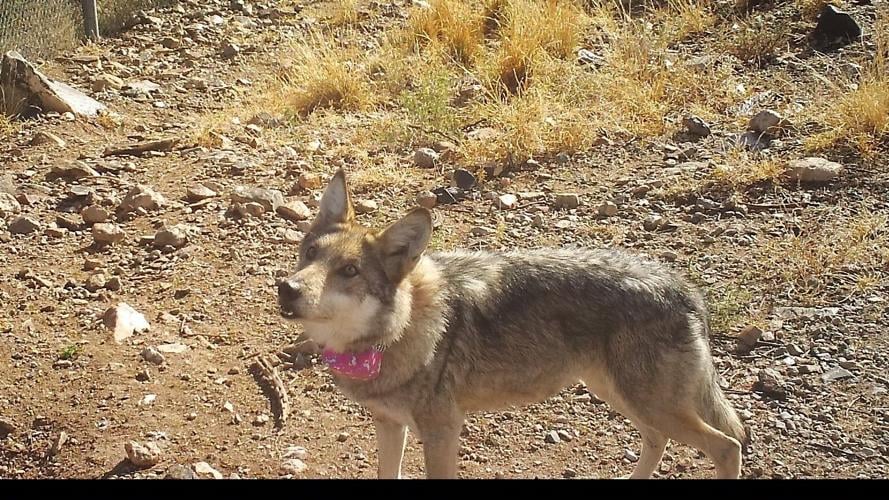


A well-traveled wolf, her mate and some of their pups were removed from the mountains east of Douglas on Tuesday, after the endangered animals came into conflict with ranchers in the area.
A team from the Arizona Game and Fish Department subdued the adult Mexican gray wolves with tranquilizer darts fired from the door of a helicopter, then collected two roughly 3-week-old male pups from a nearby den. A third pup that was "barely responsive" was euthanized and left in the den, said Jim deVos, wolf recovery coordinator for the Game and Fish Department.
"It's not uncommon, but it's unfortunate," deVos said.
He added that the adult female and the two surviving pups were underweight and in "relatively poor condition" at the time of their capture. He said the wildlife veterinarians at the scene later told him that the pups "likely would not have survived to den emergence."
The animals are now being cared for at the same wolf management facility in central New Mexico where the two adults were paired up by wildlife officials a little over a year ago, before being fitted with tracking collars and released into the Peloncillo Mountains at the southeastern corner of Arizona.

A male Mexican gray wolf nicknamed Wonder, but known officially as No. 2774, as photographed in captivity prior to his release into the Peloncillo Mountains in southeastern Arizona on April 29, 2024.
DeVos blamed ongoing drought, poor range conditions and a lack of natural prey for what happened next: a recent string of attacks on cattle that prompted the decision to relocate the wolves.
Since February, five cows have been killed and a sixth injured in cases officially documented as wolf attacks by federal investigators, he said. The most recent confirmed case happened about two weeks ago.
“We felt that these wolves were not in the best of (habitat) conditions, and we anticipated continued depredation of livestock,” deVos said. “If we’re hungry, we’re going to go to the refrigerator, whether we get yelled at for doing it or not. It’s the same with wolves.”
The captured animals comprised the entirety of the Mañada del Arroyo pack, one of about 60 distinct groups of Mexican wolves that wildlife managers are tracking across eastern Arizona and western New Mexico as part of the reintroduction effort launched in 1998.
Mañada del Arroyo was the only known pack in Cochise County. “We don’t know of any other wolves there,” deVos said.
Caught again
The Mexican subspecies of gray wolf was once found across the southwestern U.S. and Mexico, but government-sponsored predator-eradication efforts had all but wiped it out by the time it was added to the federal endangered species list in 1976.
In recent decades, captive-bred animals have been gradually reintroduced to the federally designated Mexican Wolf Experimental Population Area that covers almost all of eastern Arizona and western New Mexico south of Interstate 40.
Tuesday marked the fourth time the female, officially designated as wolf No. 1828, has been captured since she was born in the wilds of eastern Arizona more than 7 years ago.
She was first caught and fitted with a tracking collar in 2018, only to be trapped again three years later after straying onto the San Carlos Indian Reservation east of Globe.
he 2024 Mexican wolf census documented a minimum of 286 wolves living in recovery areas Arizona and New Mexico. The Mexican wolf population has grown for a record nine consecutive years! See how biologists capture and collar wolves to manage the growing population. Video courtesy of Arizona Game and Fish Department.
She was returned to the wild with a mate in early 2022, this time in northern Mexico, but the pair moved freely back and forth across the border before settling in the Peloncillo Range on the U.S. side of the line.
After her partner was killed in southwestern New Mexico in the spring of 2023, she wandered across I-10 to Mount Graham and then back to the Peloncillos, where wildlife officials captured her again that November to pair her up with her current mate, officially known as male No. 2774.
The two were set free in southeastern Cochise County on April 29, 2024, in what was hailed as a triumph by wolf advocates, who nicknamed him Wonder and her Llave, the Spanish word for key.
Those same advocates condemned Tuesday’s recapture operation, even as it was hailed by ranchers and others who oppose the reintroduction program.
In a Facebook post featuring photos of the operation, including close-up pictures of the captured wolves and their pups, Tammy Smith wrote, “We thank those who played a role in the removal of our killing pack. Today is a very good day!”

Female Mexican gray wolf No. 1828, nicknamed Llave by wolf advocates, as photographed in captivity on Nov. 18, 2023.
Previous posts on the same page show graphic images of dead livestock mixed in with appeals for the Trump administration to delist the Mexican wolf, defund the recovery effort and rewrite the Endangered Species Act.
Meanwhile, a coalition of eight conservation groups issued a press release accusing wildlife officials of caving to livestock operators who they say have exaggerated the damage caused by wolves and made little effort to coexist with an endangered species once native to the area.
“This action perpetuates ineffective and unethical management of these highly endangered animals — management that caters to the interests of the livestock industry rather than focuses on the mandate of the Endangered Species Act: to promote recovery of our Arizona wolves,” said Sandy Bahr, director of the Sierra Club’s Grand Canyon Chapter. “Keeping these bonded wolf families in the wild and contributing is essential to recovery of wolves. Removal of this pack is a big setback to that effort.”
Between sides
But DeVos insists politics had nothing to do with the relocation. The Mexican Wolf Interagency Field Team bases its actions on “the best available science,” he said. “That’s wildlife science, but we listen to social science as well. We listen to both sides of the story. We don’t make decisions based on one side or the other.”
He went on to characterize Tuesday’s operation as a routine management practice. “We move wolves all the time,” he said, though he acknowledged that it is rare for an entire wolf pack to be relocated all at once.
The move made sense in this case, because the pack was so small, range conditions were so poor and their attacks on livestock were likely to continue, despite efforts to stop them, deVos said. “The department did quite a bit to try to reduce the impact of these wolves,” he said, including sending down a team of range riders to haze the animals away from livestock in the area.
DeVos said all indications are that the pup that did not survive Tuesday's capture was already in bad shape before the operation, but he couldn't rule out "handling stress" as a contributing factor. He said the team spent roughly five hours trying to get the pup out of the den before the decision was made to euthanize the animal using what he called a "jab stick," basically a pole with a syringe at the end of it.
DeVos called Mexican wolves “the most difficult and controversial animals I have ever worked on,” but he thinks the results of the recovery program so far speak for themselves.
According to the most recent population survey, announced earlier this year, there are at least 286 of the endangered animals now living in the wild in Arizona and New Mexico. That’s “up from zero” when the reintroduction effort began 27 years ago, deVos said.
No decision has yet been made about what to do with the captured wolves and their pups, but he said the goal is to return them to the wild someday. When and exactly where that might happen remains unclear.
“We are evaluating all of the options that we have,” he said. “If I could tell the future accurately, I’d go buy a lottery ticket with the right numbers on it.”
As for the future of Mexican wolves in Cochise County, deVos noted that the Experimental Population Area does still include that part of Arizona, as does the subspecies’ historic range.
Though some ranchers in the county might prefer it if wolves are never seen there again, he said, “I can’t say never.”

