


The Colorado River’s reservoirs contain their third lowest amount of water for this time of year since the current drought period started in 2000, a sign that “the Colorado River crisis endures,” said a blog post from five river researchers.
Whether the low reservoir storage will lead to a situation in which the reservoirs fall still lower, requiring major short-term cutbacks in water use, will depend on what the weather is like in the basin for the next year or two.
Right now, the immediate outlook isn’t good, with spring-summer river runoff forecast to be significantly below normal. Water use in the Lower Basin states of Arizona, California and Nevada is projected to be higher this year than last, although the states will still use less than they’re legally allowed to use.
Despite that, the level of public and official concern about the region’s declining reservoirs isn’t approaching that of July 2021, when the reservoirs held the same amount of water as they did this month and a top federal official declared the situation “serious,” said the blog post.
The U.S. Bureau of Reclamation operates and monitors a system of 46 reservoirs in the seven-state river basin, most notably Lake Mead at the Arizona-Nevada border and Lake Powell at the Arizona-Utah border. The entire reservoir system held 60 million acre-feet of water back in 2000, when those two biggest reservoirs were nearly full.
On March 15 of this year, however, the reservoirs held only 26.9 million acre-feet. That’s about the same amount of water they all held in July 2021, when worries about the river began to escalate. That summer, Mead and Powell both fell to their lowest levels since the reservoirs started to fill in the 1930s and 1960s, respectively.
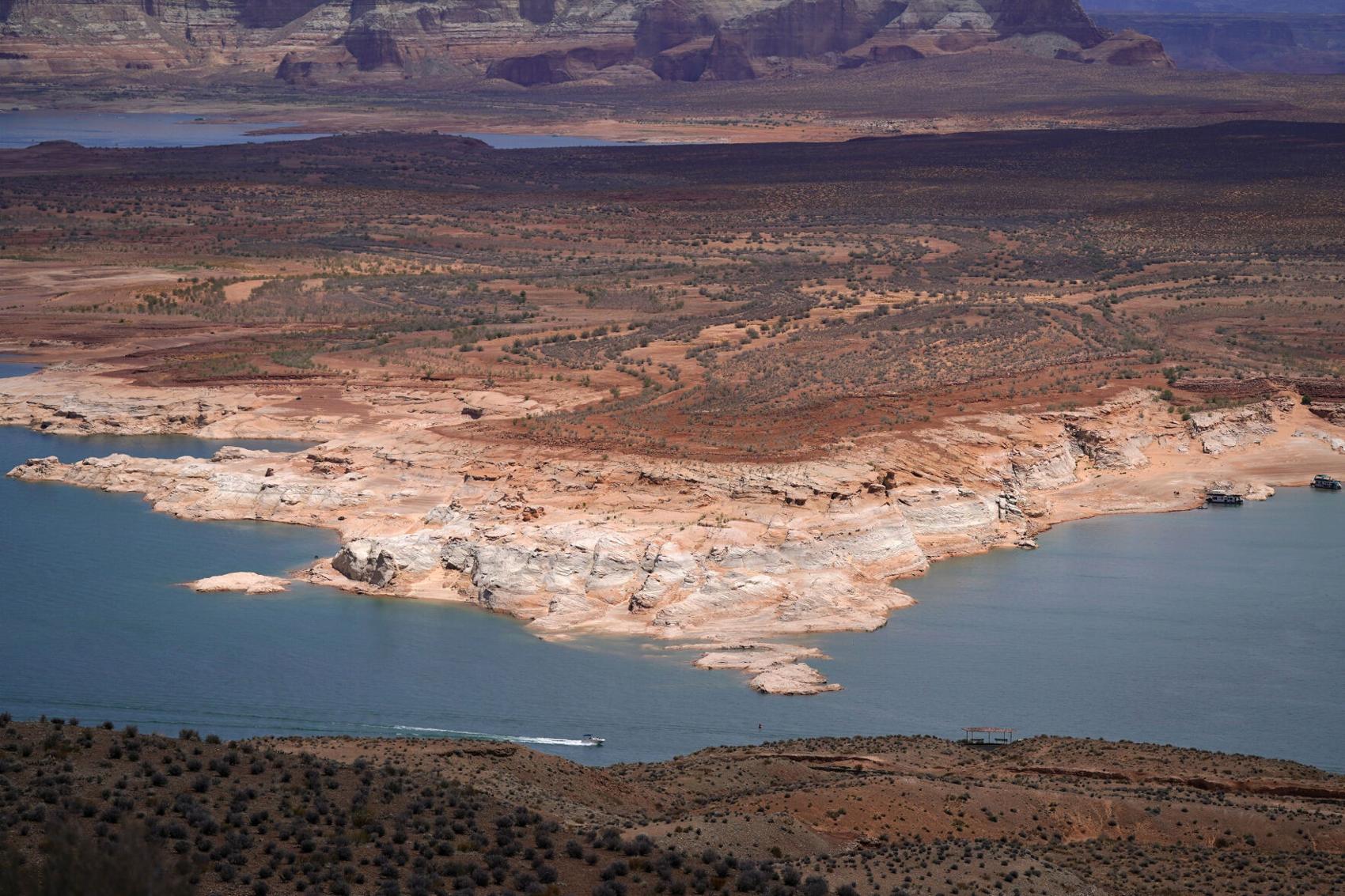
The U.S. Bureau of Reclamation operates and monitors a system of 46 reservoirs in the seven-state river basin, most notably Lake Mead at the Arizona-Nevada border and Lake Powell at the Arizona-Utah border. The river’s reservoirs this month contained their third lowest amount of water for this time of year since the current drought period started in 2000, researchers say.
After that time, the reservoirs continued falling, and by March 2023, the system contained only 21.6 million acre-feet, their lowest total storage for this century. Authorities were seriously concerned that Lakes Mead and Powell could within a reasonable period fall so low that the turbines at their dams wouldn’t be able to generate power.
But right after that, the reservoirs recovered rapidly due to very high snowfall and rainfall that spring and summer, and extensive conservation in the three Lower Basin states of Arizona, California and Nevada starting last year.
But now the reservoirs are losing ground again, and stand a good chance to lose more this year because the three Lower Basin states are projected by the bureau to use 8.3% more water in 2025 than they did in 2024, the researchers said.
“The continued decline and lack of recovery of water in reservoir storage conveys the clear message that our efforts to balance use with supply and to recover storage have not succeeded. The Colorado River water crisis endures,” the researchers wrote in their March 20 post.
The researchers are Jack Schmidt of Utah State University’s Center for Colorado River Studies, Kathryn Sorensen of Arizona State University’s Kyl Center for Water Policy, John Fleck and Katherine Tara of the University of New Mexico’s Utton Transboundary and Eric Kuhn, a longtime Colorado River historian and author. The post appeared in Fleck’s Inkstain blog.
The blog post used today’s lower reservoir storage to make the point that while the region has made significant strides in conserving water this decade, more reductions are needed should the West experience another streak of extreme dry years such as those of 2020 through 2022.
The ongoing negotiations among the seven river basin states to rewrite the rules for managing the river are focused on finding solutions to lower water use to match the river’s current low supply. The states’ goal is to find a compromise solution to take effect by the end of 2026.
“But today’s small amount of storage reminds us that it is critically important to also develop policies to recover reservoir storage to ensure security and reliability of the system,” the blog post said.
Since the reservoir’s water levels started tumbling in recent years, water managers for the basin have made no progress in rebuilding reservoir levels except for parts of 2023 and 2024, thanks to unusually wet weather in that time, the researchers wrote. That’s despite the major efforts officials have made for reservoir “system conservation” and the huge payments the bureau has made to farmers and cities to conserve river water, they said.
From mid-July 2023 to mid-April 2024, the reservoirs only lost 2.2 million acre-feet, the smallest one-year drawdown of reservoir storage in the past 15 years. But since mid-July 2024, the reservoirs have lost all that and more – a total of 3.1 million acre-feet. Until the spring-summer runoff into Lake Powell begins next month, the reservoirs will continue to be depleted, and the prospects for recovery aren’t great.
“This winter’s snowpack if merely average and the basin’s soils are very dry,” and the most likely forecast for runoff into Lake Powell is only for 70% of the 30-year average, the blog post said.
Looking back, the blog post recalled that in July 2021, The New York Times posted the headline, “Two of America’s largest reservoirs reach record lows amid lasting drought.” That story led with these words, “The water level in Lake Powell has dropped to the lowest level since the U.S. government started filling the enormous reservoir on the Colorado River in the 1960s — another sign of the ravages of the Western drought.”
In the Times article, Wayne Pullan, Reclamation’s Upper Colorado Basin Regional Director, said, “This is a serious situation,” the blog post noted. Brad Udall. a Colorado State University water researcher, told the Times, “I’m struggling to come up with words to describe what we’re seeing here.” In mid-August 2021, Interior formally announced a water shortage in Lake Mead, triggering cuts on water deliveries to Arizona farmers.
But today, there is less discussion about whether this small amount of reservoir storage represents a crisis, the blog post said.
“In part, that may be because the season of snowmelt is ahead of us rather than behind us, as was the case in late July 2021. We hope that inflow this coming spring will recover some storage, but, this winter’s snowpack is merely average, and the basin’s soils are very dry.,” the post said.
“Additionally, there may be little sense of concern, because we survived these conditions between July 2021 and March 2023. In fact, total basin storage plunged to only 21.3 million af in mid-March 2023. Perhaps, we are distracted by the engineering, legal, and political intricacies of the negotiations concerning post-2026 consumptive use and the seeming dysfunction of those negotiations.
“Perhaps, we are resigned to low reservoir storage as the new normal. Perhaps, we are the frog in the pot of water whose temperature is gradually rising, and we do not realize the water is about to boil.”
The Star sought comment on this post from top water officials in five states including Arizona. But only J.B. Hamby, California's Colorado River Commissioner, responded with a comment.
"I think the most concerning thing for the public should be the potential for any impasse on the Colorado River,," said Hamby, who chairs the Colorado River Board of California. "Without consensus, there is conflict. We need action and compromise from every user, state, and basin to prevent the simultaneous crash of the system due to drought and no way to act on it without an agreement."
Hamby added, "That would be disastrous — and completely avoidable. The best way to manage the system sustainably and resiliently is to develop the tools and reductions necessary to keep us away from dead pool and the courts."
Shauna Evans, an Arizona Department of Water Resources spokeswoman, said, "We have no comment."
Officials of the Southern Nevada Water Authority, Colorado's Colorado River Commissioner Becky Mitchell and Amy Haas, executive director of the Colorado River Authority of Utah, didn't respond with comments to requests from the Star to comment.

