




Not much has changed at Ironwood Forest National Monument since President Clinton set aside the remote swath of mountains and desert west of Tucson in 2000.
Only a few paved roads lead into the almost 190,000-acre preserve, and even those quickly dissolve into gravel and dirt, sometimes requiring a high-clearance vehicle or 4-wheel drive. There is no visitor center to visit or parking lots to park in or much in the way of road signs to guide your way.
“That’s by design,” said Tom Hannagan, board president for the volunteer group Friends of Ironwood Forest. “It’s meant to be pristine out there. The mandate for this area was to keep it pretty much the way it is.”
The Friends will celebrate Ironwood’s 25th anniversary with an all-day “Meet the Monument” gathering on March 22 at the El Tiro Gliderport in Marana, just inside the monument’s eastern boundary.
The free event at the west end of El Tiro Road will last from 9 a.m. to 3 p.m. and feature four guest speakers, about a dozen informational booths, a taco truck and an activity area for kids.
Ironwood Forest National Monument skirts the west side of the Avra Valley and wraps around the Silver Bell Mine, taking in the iconic Ragged Top Mountain and portions of the Roskruge, Sawtooth, Silver Bell and Waterman ranges. It borders the northeastern edge of the Tohono O’odham Nation and includes historical and cultural resources dating back thousands of years, including rock art, Hohokam-era archaeological sites, Spanish colonial ruins and the cemetery left behind by an early 20th-century ghost town.

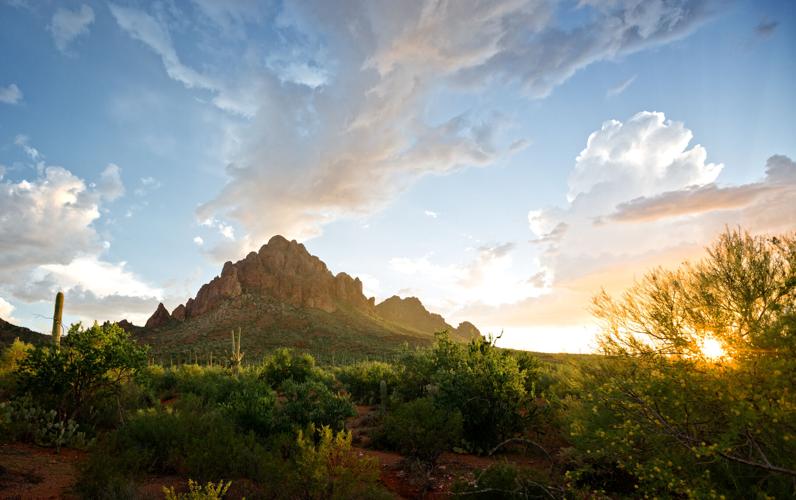
The sun goes down at Ragged Top in Ironwood Forest National Monument. The desert preserve west of Tucson celebrates its 25th anniversary this year.
The preserve is also home to hundreds of different species of plants and animals, including dense stands of saguaros and ironwoods, scattered endangered turk’s head cactus, and a herd of desert bighorn sheep that is widely considered to be the only remaining indigenous population in Pima County. The other bighorn herds in the region have been reintroduced by wildlife managers.
“It’s really like an outdoor museum that’s pretty representative of the entire Sonoran Desert,” Hannagan said.
The federal Bureau of Land Management oversees the monument as part of the National Landscape Conservation System.
Since 2007, the Friends of Ironwood Forest have supported the BLM by providing information to visitors, leading hikes and organizing volunteer cleanups and educational outreach events at the monument.
Hannagan said the group has about 1,500 people on its mailing list, most of them in the Tucson area.

The late afternoon sun shines on a petroglyph at Ironwood Forest National Monument.
Over the past four years, the Friends have teamed up with other nonprofits and government agencies to remove more than 60 miles of abandoned barbed wire fencing in Avra Valley that posed a threat to wildlife.
BLM spokeswoman June Lowery said the monument still contains all or part of 12 active federal grazing allotments, 10 of which are approved for year-round use by up to 892 cattle. That’s the same amount that was authorized 25 years ago, she said.
Hannagan doesn’t know what the future might hold for grazing in the Ironwood Forest. “There is still some going on,” he said. “I’m not sure that ranching in the desert is a really cost-effective way to raise cattle these days.”
Fast action
If conservationists like Carolyn Campbell had their way, the monument would be at least twice the size it is now.
The long-time executive director of the nonprofit Coalition for Sonoran Desert Protection said her organization originally pushed for almost 500,000 acres to be set aside, including much of the Tortolita Mountains and large tracts of desert extending to the southern edge of the Superstitions in Pinal County.
They even offered to name their monument after Mo Udall, the late congressman from Arizona, in hopes that might help get it approved, Campbell said with a laugh.
The proposal from environmentalists covered virtually the entire known habitat in Arizona for the cactus ferruginous pygmy owl, a 6-inch-tall bird of prey currently listed as threatened under the federal Endangered Species Act. “It was all about the pygmy owl, and the pygmy owl is dependent on ironwood habitat,” Campbell said.
Those monument plans ended up being scaled back amid concerns about the amount of state-owned land in the Tortolitas and the prospect of creating another federal preserve that was split into separate pieces like the east and west districts of Saguaro National Park.
But Campbell said conservationists were able to secure one thing that not even Clinton Interior secretary and former Arizona Gov. Bruce Babbitt thought they could get: support for a monument from the conservative, development-friendly Pinal County Board of Supervisors.

Desert bighorn sheep at Ironwood Forest National Monument, which is home to what some consider to be the only remaining indigenous herd in the Tucson basin. Other bighorn populations in the area have been reintroduced by wildlife managers.
“There’s not that much (of Ironwood) in Pinal County, but there’s some,” Campbell said. “They gave us a resolution, and it was unanimous. It was pretty exciting.”
A lucky confluence of events ultimately led to the monument’s creation, she said.
Just two years earlier, Pima County began drafting its landmark Sonoran Desert Conservation Plan to balance economic development with protections for the region’s natural and cultural heritage.
Then in early 2000, renowned ethnobotanist Gary Paul Nabhan and other researchers from the Arizona-Sonora Desert Museum authored “The Desert Ironwood Primer,” a paper highlighting the tree’s role as what the scientists called “a habitat modifying keystone species.”
Once the ball got rolling, the new preserve was approved with dizzying speed.
Using his authority under the Antiquities Act, Clinton designated the Ironwood Forest on June 9, 2000, just three months after the Pima County Board of Supervisors began pushing for it and barely a week after Babbitt formally proposed it.
The boundaries drawn up by the president’s proclamation took in roughly 129,000 acres of federal land, 60,000 acres of state land and almost 7,000 acres of private property. It was one of the first monuments established as part of the National Landscape Conservation System, another Clinton-era program promoted by Babbitt to protect special places managed by the BLM.
And though it wasn’t as large as environmentalists had hoped, securing Ironwood Forest National Monument was a huge success nonetheless.
“How is it 25 years already?” said Campbell, who still serves on the board of the Coalition for Sonoran Desert Protection but retired as its executive director in October after 26 years on the job.
“I think it was kind of foresight to create the monument,” she said. “Eventually it would have been ripe for development out there, based on how Tucson continues to grow.”
Still in danger
According to the latest traffic counts available from the BLM, Ironwood recorded more than 125,000 visits in 2023, almost double what it saw in 2021.
Though the area has been protected since 2000, advocates insist it remains at risk from nearby development, including plans to build a segment of the proposed Mexico-to-Canada Interstate 11 project along the monument’s eastern edge.
In response to a lawsuit from environmental groups, the Federal Highway Administration agreed in January to reevaluate its environmental impact statement for I-11’s proposed route west of Tucson. If the highway is built, Hannagan said, it will “bifurcate the Avra Valley” and “just about destroy wildlife in the Tucson Mountains.”
At the moment, though, the biggest threat currently facing the monument “is in the White House right now,” he said.
Specifically, Hannagan is worried about ongoing funding and staff cuts at the BLM and a possible push by the Trump Administration to scale back national monuments or sell off public land to private interests.

A close-up of ironwood blossoms photographed in 2019. The national monument west of Tucson named for this keystone species of desert tree will mark its 25th anniversary this year.
He said the monument is also threatened by some of the same things now looming over the entire Sonoran Desert, namely drought and other extreme weather events made worse by human-caused climate change and the spread of invasive plants such as buffelgrass and stinknet.
The celebration on March 22 will be the first “Meet the Monument” that the Friends have held since COVID-19. It used to be an annual event before the pandemic, and it might be again, Hannagan said.
You can probably guess why the group decided to mark the monument’s 25th anniversary now instead of waiting until the actual date in June, when temperatures typically top 100 degrees and human activity drops to a minimum in the Ironwood Forest.
“No way,” Hannagan said. “What’s the saying? I may be dumb, but I’m not stupid.”

