


The Mount Graham red squirrel continues its climb back from the brink, seven years after a wildfire nearly wiped it out.
The endangered rodent’s numbers have jumped by more than 61% over the past year, according to the latest estimates released by wildlife officials on Tuesday.
The annual population survey counted 233 squirrels, up from 144 in 2023 and just 35 in 2017, a few months after the Frye Fire burned 48,000 acres in the Pinaleño Mountains, 150 miles east of Tucson.
More than 40% of the survey locations used to count the squirrels were destroyed by the lightning-sparked blaze. At the time, experts said they were “not optimistic at all” about the future of the red squirrel subspecies found only in the high conifer forest on Mount Graham.
“We were all extremely concerned for the subspecies after the 2017 Frye Fire caused the squirrel’s population to drop drastically, so seeing a number now over 200 is really fantastic news,” said Marit Alanen, lead Mount Graham red squirrel biologist for the U.S. Fish and Wildlife Service.
The annual population survey by the Fish and Wildlife Service, the Coronado National Forest and the Arizona Game and Fish Department doesn’t count the actual critters. Instead, biologists add up the number of active red squirrel food caches, known as middens, within designated census plots and use that to estimate the overall population.
“We all knew that we were seeing a lot of squirrels and middens during this last survey, but I don’t think any of us expected such a dramatic increase,” said Holly Hicks, small mammal project coordinator for Arizona Game and Fish.

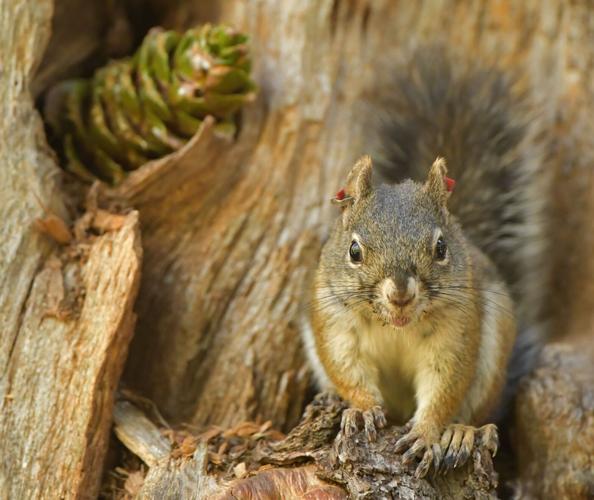
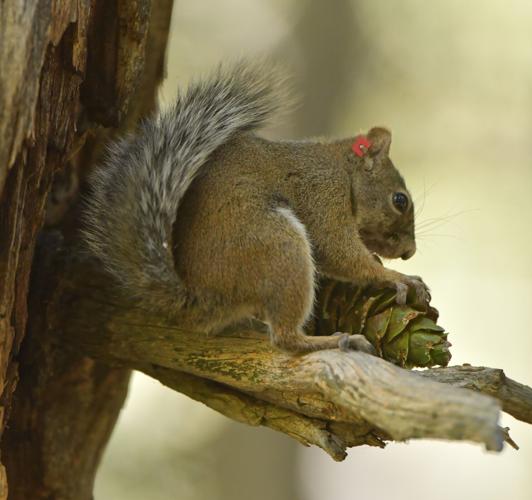
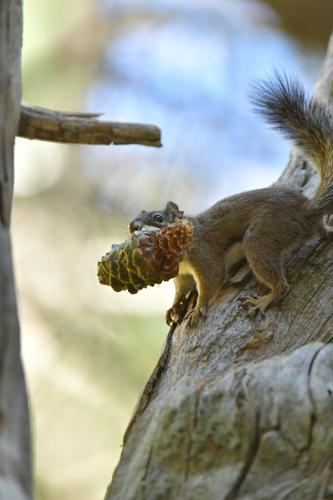
A Mount Graham red squirrel carries a pine cone in an undated photo. The endangered subspecies has seen its numbers rebound since a wildfire in 2017.
Typically, each squirrel maintains a single midden, where it stockpiles its food for the winter. A midden is considered active if census takers find stored pine cones or evidence of feeding there.
According to a history from the University of Arizona, the Mount Graham red squirrel was thought to be extinct in the 1950s, but the subspecies was found in small numbers on Mount Graham in the 1970s.
When it was listed as endangered in 1987, the estimated population was less than 400.
Its numbers peaked at about 550 in the late 1990s, but had shrunk back to its typical range of between 200 and 300 by 2016, the year before the Frye Fire.
The squirrels are grayish-brown with yellow and orange markings along their backs. They weigh in at about 8 ounces and 8 inches in length, with a fluffy, 6-inch tail that lacks the white fringe most other squirrels have.

Threats to the Mount Graham red squirrel include wildfires, tree-damaging insect infestations, competition from non-native Abert’s squirrels and droughts that reduce the availability of pine cone seeds, its primary food source.
Aside from wildfires, threats to the subspecies include tree-damaging insect infestations, competition from non-native Abert’s squirrels and droughts that reduce the availability of pine cone seeds, its primary food source.
The animals are highly territorial and reproduce at lower rates than other varieties of red squirrel.
Since 2014, the Arizona Center for Nature Conservation — better known as the Phoenix Zoo — has kept and studied a handful of Mount Graham red squirrels in hopes of establishing a captive breeding program.

An undated photo shows a Mount Graham red squirrel and a pine cone, the subspecies' main source of food.
Beth Ullenberg, spokeswoman for the U.S. Fish and Wildlife Service’s Southwest Region, said the zoo’s pilot breeding program has not yet produced any offspring, but it has provided biologists with important and previously undocumented insights into the behavior and reproductive cycle of red squirrels.
“That information will be used to inform the captive breeding pilot program as it moves forward and should help in successful breeding in the future,” Ullenberg said in an email.
The Phoenix Zoo is the only place in the world where Mount Graham red squirrels are kept in captivity.
“We’ve literally had to write the book on how to care for them,” said Tara Harris, the zoo’s director of conservation and science.
A lot of progress has been made over the past 10 years, Harris said, especially considering how little was known about the squirrels — and how much of what was known turned out to be wrong.
For example, the females were thought to be only open to breeding one day a year and that mixing them with males at the wrong time could result in violent territorial fights. Zoo officials have since discovered that the squirrels seem perfectly happy to be kept together in the same enclosure.
“They sleep together in nest boxes. They groom each other like primates,” said Harris, who co-authored a 2022 study on the reproductive biology of the subspecies. “It’s been astonishing to see.”
The zoo is currently home to three wild-caught Mount Graham red squirrels — two males and a female — that have lived in Phoenix for a couple of years now. Harris said squirrels in the wild might only survive for a year or two, but in captivity, safe from predators, they can live for as long as 8 years.
Zoo officials are now making small adjustments to the animals’ diets and other environmental factors in hopes of encouraging some reproductive behavior, Harris said. They are hoping to see their first successful breeding season finally arrive sometime in the spring or early summer of 2025.
“We’d really like to have some baby squirrels,” she said.

