

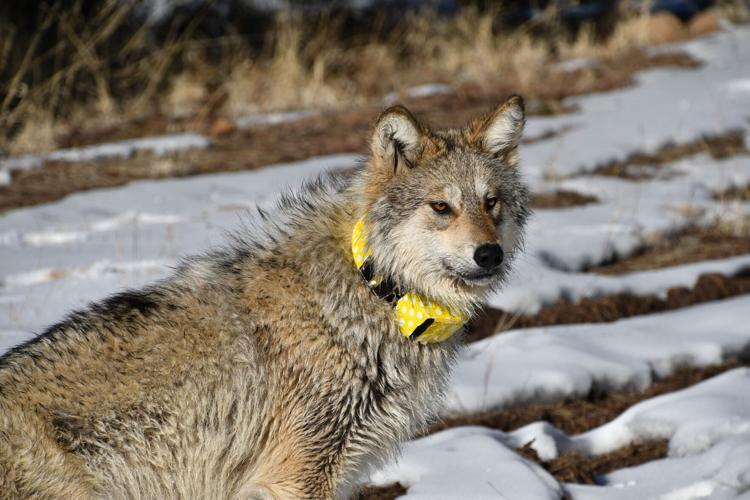



A government hunter accidentally killed an endangered wolf that was wearing a tracking collar and may have been expecting pups, according to federal records from the April 14 incident along the Arizona-New Mexico border.
Early this month, the U.S. Fish and Wildlife Service authorized the “removal” of one uncollared Mexican gray wolf from a pack of seven animals that had been blamed for a series of attacks on cattle over the past year.
Instead, documents show that a collared female known as AF1823 was “mistakenly lethally removed” from the Bear Canyon pack by Wildlife Services, a branch of the U.S. Department of Agriculture that investigates livestock deaths and removes wolves when necessary.
The killing has sparked outrage among wolf advocates.
“I’ve never seen them screw up a removal. This is really unprecedented and really bad,” said Greta Anderson, the Tucson-based deputy director for Western Watersheds Project. “It calls into question how these agents are trained if they don’t know what they’re shooting at.”
he 2024 Mexican wolf census documented a minimum of 286 wolves living in recovery areas Arizona and New Mexico. The Mexican wolf population has grown for a record nine consecutive years! See how biologists capture and collar wolves to manage the growing population. Video courtesy of Arizona Game and Fish Department.
Wildlife Services did not respond to a request for comment. A spokeswoman for the Fish and Wildlife Service said the agency had no additional information to share beyond what was in its original removal order and two-sentence, follow-up report.
Brady McGee, Mexican wolf recovery coordinator for the Fish and Wildlife Service, issued the removal order on April 4, after seven cows were killed and six others injured on public and private rangeland in eastern Arizona since March of last year.
His order only authorized the killing of a single uncollared wolf, while specifically calling for AF1823 to be spared.
“It is our intent not to remove the breeding female ... who will likely whelp a new litter of pups soon,” McGee wrote.

A Mexican wolf is released back into the wild with a radio collar on April 12, 2022.
Wildlife managers initially tried to haze the Bear Canyon pack away from cattle grazing areas or lure the wolves elsewhere with food, but those efforts were hampered by the remote, rugged terrain.
“I am concerned with the numerous depredations in this area over a short period of time and the toll these depredations have caused the livestock producer,” McGee said in his order.
Anderson thinks a broader livestock management problem ultimately led to the wolf’s killing.
She said all of the recent attacks on young cows occurred in springtime, before wild elk in the area started having their own calves, which serve as the primary natural source of prey for the pack.
“It’s not the wolves’ fault for eating baby cows. You can’t put vulnerable prey in predator territory and not expect predators to eat them,” Anderson said. “It’s a set-up for depredation.”
Under a federal grant program established in 2009, ranchers can seek reimbursement for cows, sheep, goats, pigs, horses and even working dogs that are injured or killed by Mexican wolves.
McGee has previously described lethal removal as a measure of “last resort” for dealing with livestock conflicts.

Wearing a new radio collar, a Mexican gray wolf is released back into its home range in New Mexico after being captured by wildlife officials in January 2022.
As far as Anderson is concerned, no predator should ever be punished for behaving like a predator. “It’s outrageous that our government is authorizing wolves to be killed for preying on livestock on public lands, full stop,” she said.
Conservation groups challenged the targeted killing of wolves as part of a 2022 lawsuit over the government’s current recovery plan for the Mexican gray wolf, but a federal judge in Tucson decided the case in favor of federal and state wildlife officials late last month.
Once found across the Southwest, the Mexican wolf was driven to extinction in the U.S. in the latter half of the 20th century by a government-sponsored predator-eradication campaign.
The subspecies of the gray wolf was added to the federal endangered species list in 1976 and reintroduced to Arizona and New Mexico starting in 1998 with the captive-bred descendants of animals taken from the wild in Mexico.
According to wildlife officials, there are now at least 286 Mexican wolves in some 60 distinct packs scattered across eastern Arizona and western New Mexico, where the overall population has increased annually for the past nine years in a row.
But advocates say the survival of the subspecies remains very much in doubt, and the loss of even one individual could have unforeseen consequences.
“All Mexican wolves are precious due to their small numbers, but a breeding female is especially precious and important,” said Sandy Bahr, director for Sierra Club’s Grand Canyon Chapter in Arizona. “This is no way to treat endangered wildlife.”
AF1823 was less than 12 months old when the Mexican Wolf Interagency Field Team first captured her and fitted her with a tracking collar in October 2018.
At the time, the wild-born wolf was a member of the Prime Canyon pack, which lives along U.S. Highway 191 northeast of Hannagan Meadow. She left that group in early 2020 and joined the Bear Canyon pack roughly 15 miles away.
As part of an educational program by conservationists, a group of school children gave AF1823 the nickname Asiza, which means “Forest Spirit.”

A child's drawing of the Mexican gray wolf known to wildlife officials as AF1823. Before it was mistakenly killed by a government hunter, the wolf was nicknamed Asiza, or “Forest Spirit,” by a group of schoolchildren as part of an educational campaign by conservationists.
Though the 7-year-old wolf was still wearing a tracking collar when she was killed last week, the device was no longer functioning.
Even so, Anderson said, it should have been obvious that the animal was not one of the uncollared members of the pack.
“They wear brightly colored collars for a reason,” she said. “I get that mistakes happen, but this is a really big mistake.”

