


A critical minerals mine in the Patagonia Mountains is upgrading its water treatment process and answering questions from concerned residents after a discharge exceeded its permitted level of a potentially toxic heavy metal.
According to the Arizona Department of Environmental Quality, a compliance sampling report submitted in late November by the South32 Hermosa mine showed the company released water from the site containing antimony levels above the limit of 6 micrograms per liter allowed by its state Aquifer Protection Program permit.
The mine’s treatment plant discharged the water into Harshaw Creek, a mostly dry wash that runs downhill to the town of Patagonia, about 9 miles away.
In a mandatory report to state regulators, company officials said the antimony “exceedance” of 6.23 micrograms per liter showed up in a single monthly permitting sample collected on Oct. 3, but other samples from earlier that day and in the weeks since contained levels safely below the discharge limit.
“The exact duration of the exceedance is unknown but is believed to be limited in nature,” said Brent Musslewhite, director of environment and permitting for the Hermosa project, in the report to the state. “There have been no prior (discharge-limit) exceedances for antimony.”

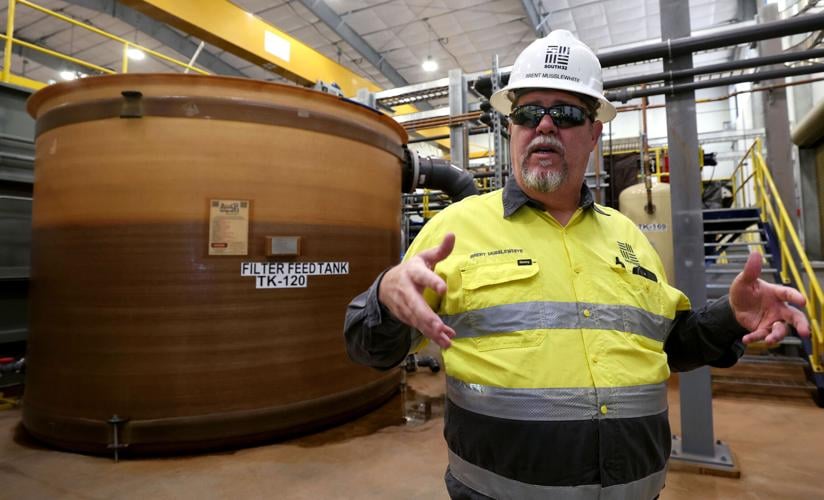
Brent Musselwhite, project director for environment and permitting for the South32 Hermosa project, gives a tour of the mine’s water treatment plant in the Patagonia Mountains in 2024.
ADEQ did not issue a public health advisory in response to the discharge.
"A permit exceedance is a regulatory trigger that requires investigation and corrective action, but it doesn’t by itself quantify a health risk," said department spokeswoman Alma Suarez. "The discharge to Harshaw Creek was significantly below the applicable surface water quality standards, which are established to protect human and wildlife interactions with the creek."
According to Suarez, ADEQ has reviewed the mine's reporting and determined that it is taking the necessary steps to prevent future exceedances. "We will continue to monitor discharge data to ensure corrective actions are effective," she said.
Suarez added that the mine’s latest compliance sampling results, received by the department on Dec. 29, showed antimony levels in November “down to 4.7 micrograms per liter, below the permit’s alert level.”
Heavy in metals
Australia-based mining giant South32 is building its roughly $2.5 billion underground zinc and manganese mine on about 750 acres of private land 75 miles southeast of Tucson. Federal regulators are expected to issue a final decision on the project later this year, and the company hopes to begin production in 2027.
South32 Hermosa president Pat Risner gave a detailed briefing on the antimony discharge and the mine’s response to it during Wednesday’s meeting of the Santa Cruz County Board of Supervisors in Nogales.
He also responded to questions and concerns voiced by local residents and conservationists.
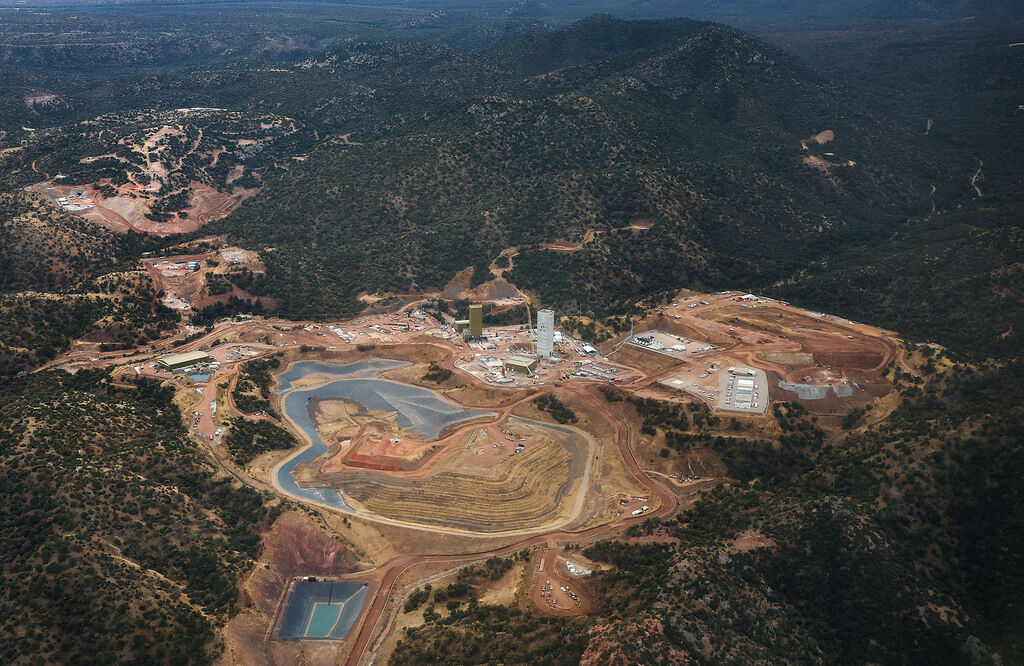
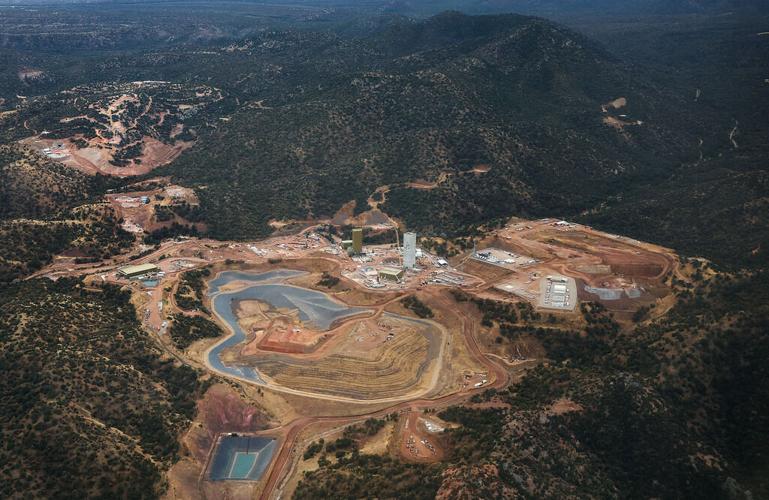
The South32 Hermosa mine site in the Patagonia Mountains, as seen from the air during an EcoFlight tour in 2025.
Risner said antimony is one of several naturally occurring metals suspended in the groundwater that Hermosa is pumping from below the surface to keep it from flooding the mine shafts workers are excavating.
The Patagonia Mountains are rich in metals, he said, which is why mines have operated in the range for more than a century and why South32 is now investing billions of dollars there.
The company spent $55 million on its on-site water treatment plant, which went into operation in August 2023. At the time, mine officials did not expect to find high enough antimony concentrations to require treatment for that contaminant, but the plant was designed with “the flexibility to adapt to treat higher levels of metals,” Risner said. “We’re dealing with Mother Nature.”

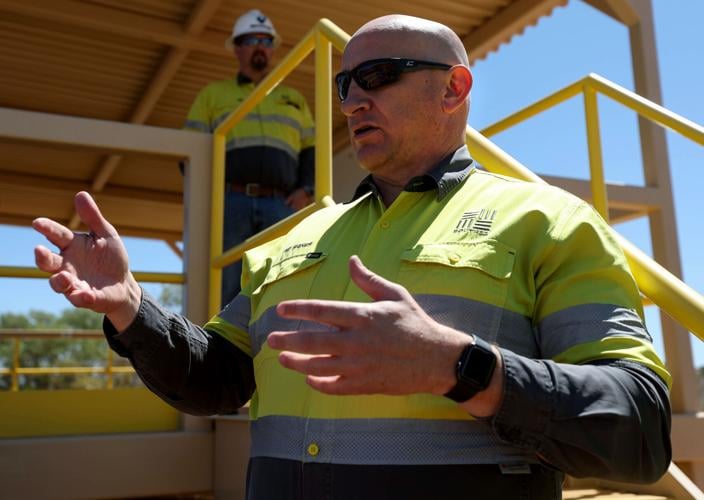
South32 Hermosa president Pat Risner talks about the mining project during a media tour in 2024.
Risner said Hermosa officials first noticed rising antimony levels in the groundwater from one of the deepest wells on site in late 2024. That well was shut down from February through August, as the company implemented several additional treatment and filtration methods to address the problem, he said.
The well was started back up again in September, and antimony levels spiked in early October.
As soon as the exceedance was confirmed, Risner said, the problem well was shut down again along with another deep well, and both of them are being kept offline until further upgrades to the treatment plant are completed in February or March.
In all, South32 is spending more than $280,000 to enhance its antimony treatment, he said.
Risner also presented findings from an outside environmental health consulting firm that determined the antimony discharge last year did not pose a risk to human health.
He said the state Aquifer Protection Program uses the same limit on antimony as the federal safe drinking water standard, which is based on the health risks to someone who consumes 2 liters of contaminated water every day for years at a time. “It’s not based on something like one sample at one point in time on one day.”
Risner added that six micrograms per liter equates to a concentration of 6 parts per billion or 0.000006%.
“This is an important issue. We understand the concerns,” he said. “We do think there’s a lot of context and information that’s either missing or is not being provided or in some cases been misconstrued.”
Water worries
ADEQ is scheduled to address the supervisors at the next Santa Cruz County meeting on Jan. 21.
According to the U.S. Environmental Protection Agency, unsafe levels of antimony in drinking water can cause acute gastrointestinal issues, with long-term exposure leading to altered levels of glucose and cholesterol in the blood and decreased lifespans.
County residents and environmental advocates living downstream from the Hermosa mine are calling for improved monitoring, regulation and communication in the wake of the antimony discharge.
Harshaw Creek is part of a watershed that provides drinking water to residents in and around Patagonia, and people are worried that the mine’s groundwater pumping could cause some domestic wells to run dry while contaminating others, either directly or by saturating mineral deposits in the dry creekbed and sending them downstream.
Chris Gardner is a retired hydrogeology consultant and Patagonia land owner who now serves on the board of the nonprofit Friends of Sonoita Creek and as a scientific advisor to local residents.
If Hermosa is already exceeding its discharge permit limits during construction, he wonders what will happen once the mine is in full production, with the treatment plant operating at close to its capacity of 6.7 million gallons a day.

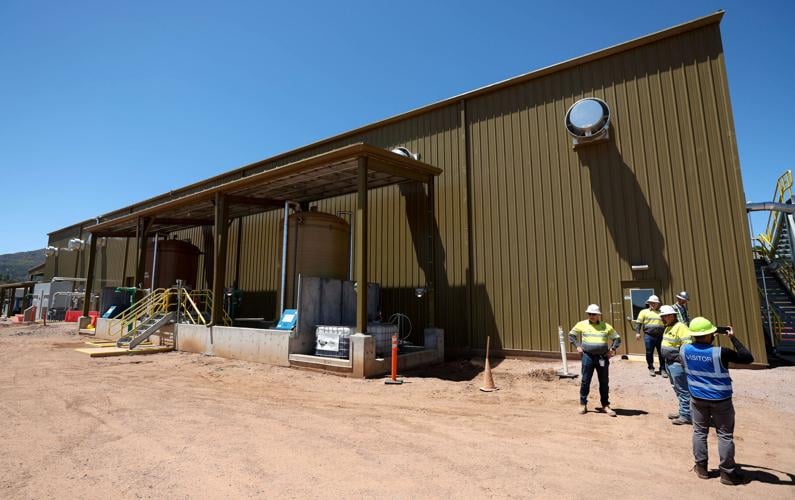
An outside view of the water treatment plant at the South32 Hermosa project site in the Patagonia Mountains.
"The antimony in the discharge issue is likely the first example of deficiencies by the mine and regulators to protect human health and the environment. Even with assurances from South32 and regulators, will the air treatment system be as deficient as the water treatment plant? Will the town aquifer be contaminated?” said Gardner, who has been invited to give his own briefing to the Santa Cruz County supervisors on Feb. 4. “Environmental monitoring by the public is key to better understand the issues, respond to these issues, and hold South32 and regulators accountable.”
Rio Rico conservationist Robin Lucky agreed.
“The people of Patagonia and Lake Patagonia have lived for nearly a decade with deep uncertainty about how this project may affect our shared water resources. All we are asking for is clear information, timely reporting and an honest accounting of what the data show,” said Lucky, president of Calabasas Alliance, an environmental advocacy group formed in response to the Hermosa project. “This is a crucial moment for trust building in our community. When reported concentrations exceed state thresholds, the citizens of Santa Cruz County deserve to know promptly and understand what steps are being taken to protect them.”

