


Tucson’s fire and police departments would get the biggest cut of the $800 million projected to come from Prop. 414.
The measure, called “Safe & Vibrant City,” is currently before city voters. It would add a half-cent to the city’s current 8.7% sales tax over the next 10 years.
The proposition is split into five categories, with “Capital Investments for First Responders” accounting for nearly 31% of the total funding. It would send about $24.6 million a year to the fire and police departments to pay for things like equipment, maintenance and expansion of facilities.
“There’s no more to give you … There’s no more tricks, there’s no more rabbits to pull out of this hat. Now, it’s time to figure out: We’re either going to invest in this police department, or we talk about what it looks like to not have our own police department,” said Police Chief Chad Kasmar, who says he was one of the proposition’s “co-architects.”
“I’ve lost police department sizes of people. In 2021, we lost I think over 150 officers. That’s bigger than Marana Police Department, that’s bigger than Oro Valley (Police) ... There are no evidence-based strategies out there, there are no further ways to restructure and lean out this department,” Kasmar said. “We’ve scaled all of the alternative response … on developing programs that peels off work, off of the traditional public safety response plan and puts it in other places.”

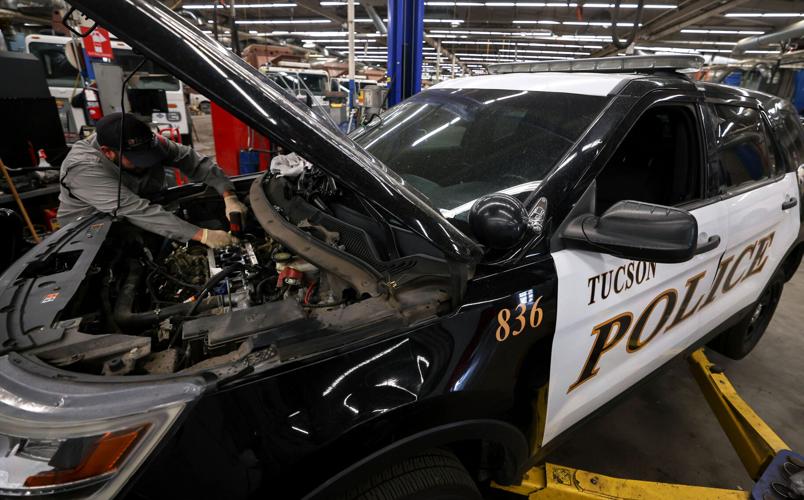
Gabriel Leon makes repairs to a Tucson police squad car. If passed, Proposition 414 would send about $24.6 million a year to Tucson’s police and fire departments to pay for things like equipment, maintenance and expansion of facilities.
Tucson is the 33rd-largest city in the United States. Its police department, headed by Kasmar since late 2021, has an operating budget of about $200 million, with an additional $30 million or so in grant money. The department peaked in staffing 12 years ago, he said, with 1,163 officers. It now has about 750.
With fewer officers, the Tucson Police Department made over 5,000 narcotics arrests last year and 473 through Feb. 10 this year, a roughly 10% year-to-date increase and about a 35% rise over a five-year period, Kasmar said, adding that he “cannot, and will not, ask more out of my staff.”
Prop. 414 has been met with a number of criticisms since it was announced late last year, including its reliance on sales tax funding and claims the city needs to better prioritize its budget. Some critics also call for the department to pull back from traditional policing methods if non-traditional efforts have helped to address homelessness and street drug use.
“We’re at a point where we have to recognize, ‘I can’t give you the level of service that we had a decade ago’,” Kasmar said.
Opponents, including April Putney of the grassroots No Prop. 414 Tucson coalition, say the city has other needs that are bigger than new police equipment.

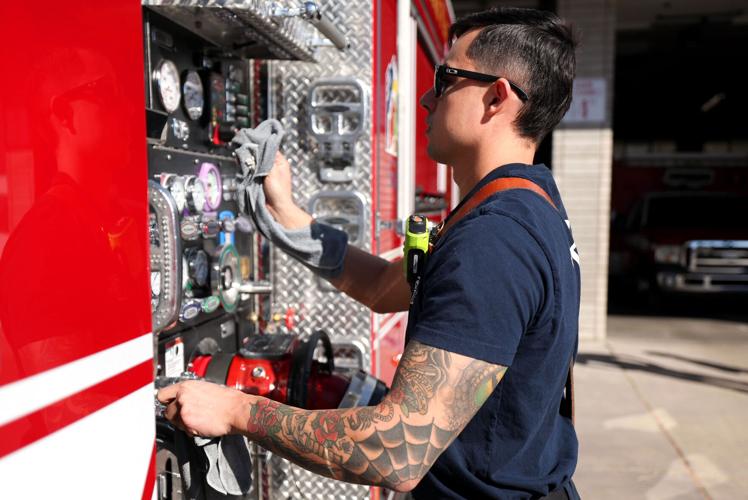
Randy Mozingo, a firefighter at Tucson Fire Department’s Station 5, 2835 E. Grant Road, cleans the exterior of a firetruck. About 70% of the department’s fleet is used to handle more than 3,000 calls each year.
Millions of dollars on items like a new SWAT vehicle, “how is that going to solve our housing crisis?” Putney asked.
“Tucson’s main priorities aren’t added policing. The coalition has a different vision of what community safety means, and it does not include expanded policing or incarceration,” Putney said. “When people are shown images of police that have things like shields or other military equipment, compared to when they’re shown images of police that do not have that militarized equipment, they trust the police less and they like them less. Investing in these things might actually be harming public trust in the institution of policing, counterintuitively. It might actually alienate our police force even further.”
“When it comes to looking at a budget, and conceptualizing a budget as our society’s priorities, of course we should be keeping everybody safe,” Putney said. “More people need to be included in that, and the people who are the least safe, and the most vulnerable and marginalized, need immediate help now.”
Investing in police, fire upgrades
The proposition funding is expected to send about $10 million each to the police and fire departments to address upgrades at their stations.
There are two big-ticket items: $15 million to address infrastructure improvements, technology upgrades and “modernization” of the training grounds at the Public Safety Training Academy, a 158-acre facility that is used by both departments, as well as other agencies across Southern Arizona; and $44 million to build a new combined police and fire center on the city’s southeast side. The city says the center will improve response times and help prepare the city to serve a growing area.
About $6 million a year will go toward Tucson police patrol vehicles and another $2.7 million a year for “non-patrol” vehicles in the department.
TPD said it currently has 1,234 vehicles. Prop. 414 would be about enough to replace every vehicle in the fleet twice over the 10-year life of the proposition, Kasmar said.
Some of these vehicles have in excess of a decade on the road and are not sustainable for much longer.
Darrel Hussman, president of the Tucson Police Officers Association, described a Ford Crown Victoria he once drove with 180,000 miles on it.
“It still had the lightbulb-overhead emergency lights, and sometimes you had to be like Fonzie, and punch, or slam your first on the roof, to break the light free so it spins more,” he said. “The last thing that officers should be worried about is their visibility and their basic safety from the equipment. They should be able to focus on their job at hand … it’s just amazing that we still have vehicles this old in our fleet.”
About $4 million per year would be spent on the fire department, which has 22 fire engines, eight ladder trucks, and 17 ambulances, and several specialty units for things like technical rescues, wildland fires and handling hazardous materials calls, the city says.
Those investments would allow the department to have its fleet replaced at “appropriate intervals for both reliability and cost effectiveness.” About 70% of the department’s fleet is used to handle more than 3,000 calls annually, the Star has reported.
A $2 million one-time investment would be made so the department can purchase an additional ladder engine, whose staff would be funded by a separate category of the sales tax. Additionally, a $12 million one-time investment would be for a new fire station on the city’s northwest side, equipped with “two apparatus bays, dormitories, and all of the modern health and safety features for a modern fire station,” according to the city. Staffing for this fire station would also be covered through another proposition category.
About $1.7 million for police and $870,000 for fire annually would be for personal protective equipment, called PPE.
For the police, PPE includes things like ballistics vests, shields, Tasers, batons, uniforms and weapons. For the fire department, it includes things like firefighter gear.

