

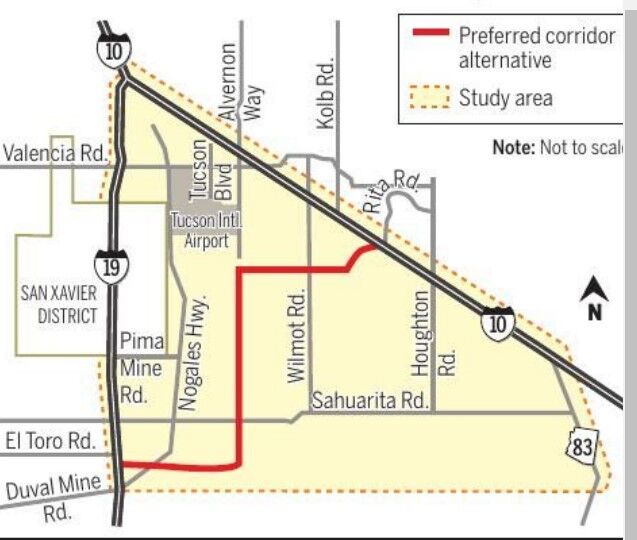

The Arizona Department of Transportation has selected the route for the proposed new Sonoran Corridor, marking one of the first “major milestones” toward completing a project that city officials said is critical for economic growth.
The corridor will include 20 miles of highway connecting Interstate 19 and Interstate 10. It’s designed to “improve regional mobility” by increasing traffic flow in an area with mostly two-lane roads, and “integrate the region’s transportation networks.”
It will also be key to developing the surrounding area, which Tucson officials said is uniquely positioned to be a hot spot for commerce and the creation of high-paying jobs in Arizona.
“There’s not another region in the state that brings to the table the combination that this Sonoran Corridor does,” said Councilman Steve Kozachik. “That includes Tucson International Airport for air cargo, it includes the Port of Tucson for rail cargo, it includes I-10 and I-19 for both over-the-road and international commerce.”
Kozachik added that the location is also ideal for large manufacturing and logistics employers to set up shop. Such companies could bring hundreds of high-skilled jobs to the region.
ADOT and the Federal Highway Administration on Friday released the Final Tier 1 Environmental Impact Statement and Record of Decision on the project that identified the selected corridor. The report and other documentation can be viewed at azdot.gov/sonorancorridor.
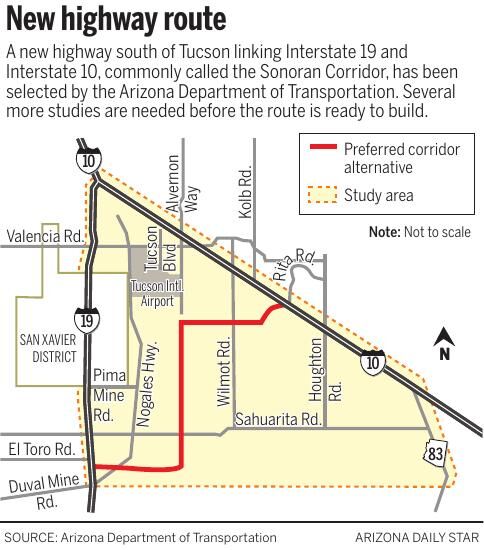
Under the proposal, the Sonoran Corridor will begin at I-19 between El Toro Road and Duval Mine Road, extend east until Alvernon Way and then go directly north to the airport. It will then extend farther east until hitting I-10 near Rita Road on Tucson’s southeast-side.
The route was one of many considered during a yearslong process designed to assess the viability of each design through public outreach and an evaluation of environmental factors.
Still, the project is far from being completed: it could be decades until the corridor is actually finished, and none of the next steps are funded.
“This is a fairly long-term process that we’re looking at and those funding sources have not yet been identified,” said Doug Nick, an ADOT spokesman. “We’ll continue to move along here, but people should understand this is a long-term outlook for this project.”
Another “robust” assessment needs to be done before any more progress can be made. It will be similar to the $3.6 million evaluation that was just finished, but is expected to be more expensive.
Kozachik said the long timeline and lack of identified funding sources is unacceptable, adding that the project should be completed within three to five years given its importance and previous progress made at the local level.
“When I hear somebody from the state say this could take decades, that doesn’t show me a real sense of understanding the importance of this location from an economic development standpoint,” he said. “This is a time when the economy is still kind of struggling along, we ought to be working together on this thing.”
The Arizona State Transportation Board will have to approve the project before construction can begin. The corridor’s design is subject to change anytime during the evaluation or review process.
Money could become an issue once again during the construction phase because those funding sources haven’t been identified either. Nick said the money is likely to come from a “mixture” of federal, state, county and city dollars.
Construction is also likely to be many times more expensive than the currently unfunded environmental evaluation, further adding to the uncertainty surrounding the Sonoran Corridor’s future.
“Shame on them. Find the sources,” Kozachik said about ADOT’s failure to identify funding for the next steps. “This is not just somebody putting a swimming pool in their backyard and benefiting themselves and their two adjacent neighbors. Everybody benefits from this.”

