


Council members recently approved Move Tucson, the city’s “transportation master plan” that outlines every roadway improvement needed in Tucson over the next two decades.
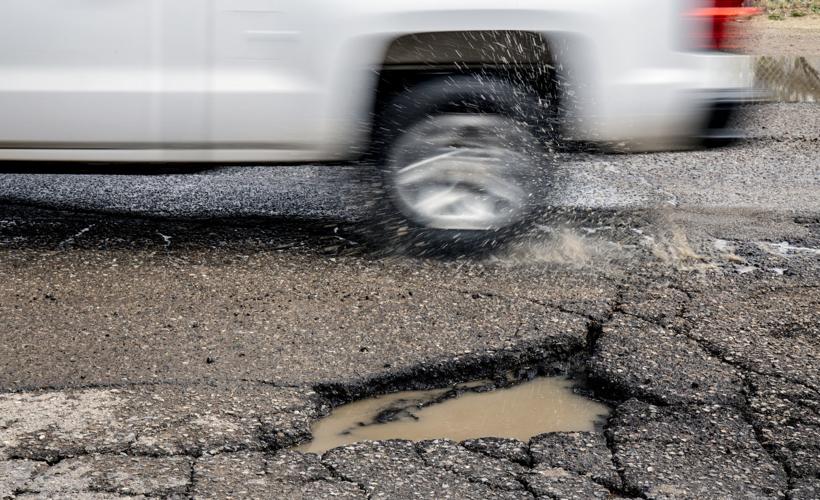
It shows Tucson needs about $13 billion in transportation projects, including 640 miles of road and pathway upgrades and over a billion dollars in pavement repair such as filling potholes.
Officials won’t be able to complete all of those projects in 20 years, however. It would eat up a third of the city’s budget each year and require a $390 million bump in annual spending.
“We wanted to understand the magnitude and the totality of the needs of the transportation system,” said Patrick Hartley, Tucson’s Complete Streets Program coordinator. “We never wanted to set up this exercise thinking we’re going to address all of this over the next 20 years, it was more about what are we looking at and how much can we take on over the horizon of this plan?”
The city has instead targeted a smaller increase in funding, from about $260 million to $388 million annually, and has created a list of projects that can realistically be completed before 2041 if officials secure the extra cash.
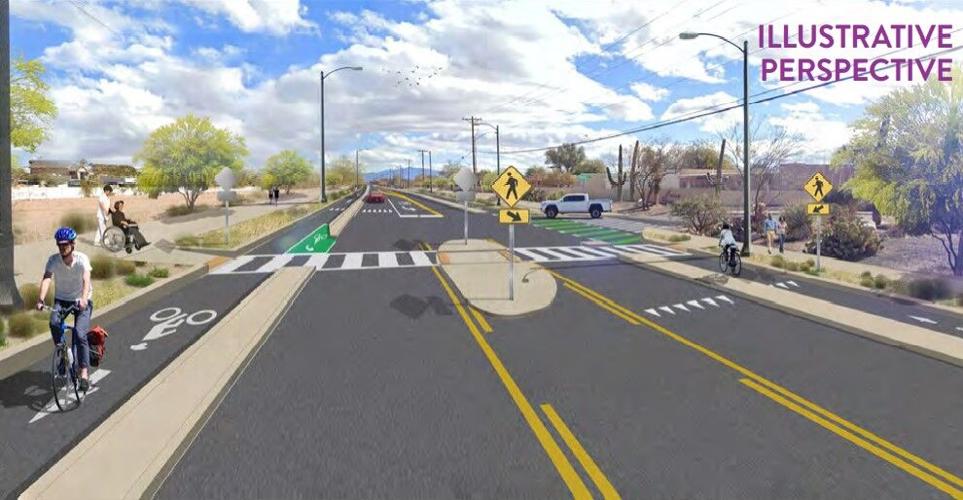
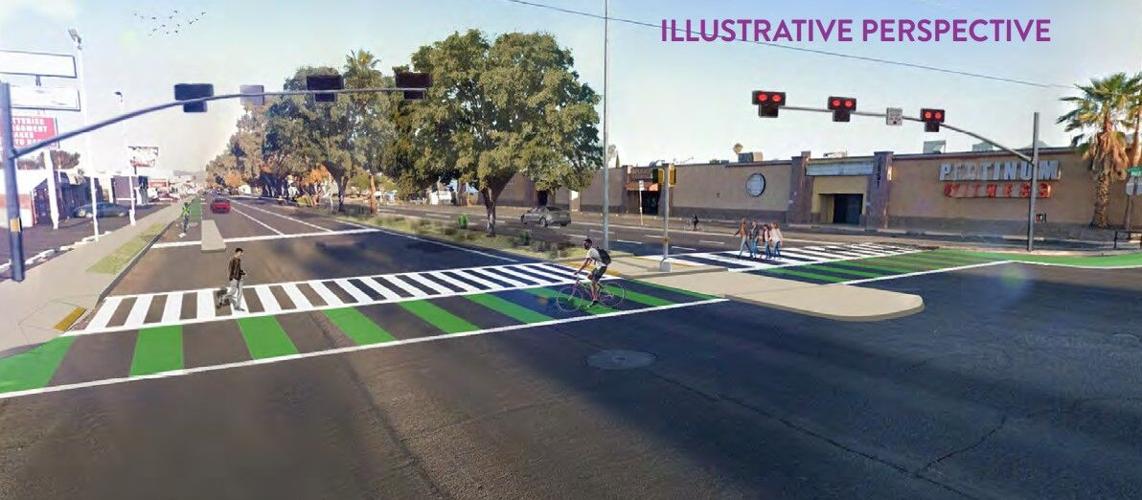
The highest-priority Move Tucson projects, which range from new bike lanes to sidewalk upgrades to pedestrian crossings, were included in that list based on resident feedback.
It also includes the repaving of about 100 miles of road within the 20-year timeframe, something that could reduce the countless potholes that have plagued Tucson drivers for years.
“The vast majority of the city of Tucson is looking at residential road repair. Fix the roads, fix the roads,” Councilman Steve Kozachik said. “That’s what’s the most important thing for the taxpayers to see out of this.”
Hartley said pavement preservation will also be conducted to keep Tucson’s roads from getting any worse in areas where total re-pavement is not happening. Those efforts are critically important because if it is not done now, the roads here will continue to break down.
But it all hinges on whether officials can secure an additional $128 million in transportation funds each year to make it happen.
“At our current funding levels the expectation is that the overall condition of the pavement citywide is looking to decrease,” said Patrick Hartley, Tucson’s Complete Streets Program Coordinator. “This investment level would stabilize that.”
Move Tucson does not generate its own revenue because it’s a “planning document” rather than a full-fledged transportation program, so it will depend on dollars from other sources and transportation initiatives.
For example, Proposition 101 and the Regional Transportation Authority could be major sources of funding for the “master plan.” The voter-approved initiatives have provided hundreds of millions of dollars for Tucson’s transportation projects for years.
Both will expire soon if they are not renewed by voters. The situation has created some uncertainty around how Tucson will even maintain its current funding level, which needs to be raised by nearly 50%.
“We’re juggling three balls at the same time — RTA, Prop. 101 and Move Tucson,” Kozachik said. “They’re not independent of one another.”
Some elements of Move Tucson are already underway. The implementation of other parts of the plan such as the new re-pavement efforts will be a “continual process” for the foreseeable future, according to officials.
Read the report at tucne.ws/1j8k
Street Smarts: The stories behind 14 popular Tucson roads
Craycroft Road
Updated
Traffic trudges along through the rain near the intersection of North Craycroft Road and East Sunrise Drive on Friday, Nov. 22, 2013, in Tucson, Ariz.
Frank Craycroft, a mechanical and mining engineer, built one of the most impressive houses of the day on the road that now bears his name.
Craycroft was born in Louisville, Ky., in 1872, to Elkanah and Louise Craycroft. He graduated from the University of Kentucky and then, following in the tradition of men in his family, enrolled in the University of Edinburgh in Scotland. On graduation day in 1889, he received his degree in mining engineering and also became a CPA.
He spent the next four years working with his father on water works projects. After his father died, he lived in Boulder, Colo., Bisbee, Globe and Los Angeles. He also served in the Spanish-American War in 1898.
In 1904, Craycroft came to Tucson, working mostly in heating and power plant construction. He also was chief engineer for the J. Knox Corbett Co., and later went into business for himself. The 1925 Tucson City Directory lists his business, Frank Craycroft Plumbing and Heating, at 40 Toole Ave., downtown. He was also an important promoter of the El Conquistador Hotel, where El Con Mall is now.
Craycroft was married twice, first to Mary L. Norman, of Texas, who died in 1917, and again in 1925 to Edna E. Huckabee (some sources site her last name as Greene). He had three children.
In 1925, he built a house in the desert, just off a dirt road that was then called Kenyon. A Tucson Citizen article in May of that year described the house as "of Spanish architecture and is built in the shape of an 'H.' " The article said it "contains nine rooms and three baths . . . two large sleeping porches, and a porch built on the roof, which is gained by means of a spiral stairway."
The house, at 5524 E. Fourth St., off Craycroft Road, has been remodeled and changed hands several times. In the 1990s, it was the headquarters of the Tucson chapter of the American Cancer Society. It is now a private business.
Roughly 15 years after the house was built, Kenyon Road was renamed Craycroft Road.
Frank Craycroft died suddenly on May 10, 1929, at his home. He was 56 years old.
Sources:
Thanks to reader Carl Hendley for suggesting this street.
Special thanks to Alexa N. Tulk of the Arizona Historical Society
Richard E. Sloan, "History of Arizona," Record Publishing Company, 1930
William G. Clemens, "Craycroft building is both central and historic," Tucson Citizen, Dec. 1995
"Craycroft Brings Home Bride To Grace Palatial Residence Now Going Up On Speedway," Tucson Citizen, May 1925
"Frank Craycroft Claimed By Death," Arizona Daily Star, May 1929
Tucson City Directory, 1925
If you have streets to suggest or stories to share, contact writer David Leighton at streetsmarts@azstarnet.com.
Congress Street
Updated
Pedestrians walk along East Congress Street where Herbert Avenue once crossed the intersection in downtown Tucson on May 21, 2018. A.E. Araiza / Arizona Daily Star
Actually, the street is named after the Congress Hall Saloon, built in 1868 at Congress and Meyer Avenue.
The saloon hosted informal meetings of the Arizona Territorial Legislature when Tucson was the capital of the territory. In 1871, a meeting of prominent townsmen was held there, during which the municipality of Tucson was organized and officers elected. The saloon's builder, and owner for more than 30 years, Tucson pioneer Charles O. Brown, was chosen as one of the councilmen.
Brown was born in Essex County, New York in 1829, and his family moved to Illinois when he was about 12 years old. Sometime later he ran away and headed to the California Gold Rush, where he made his fortune.
In 1860, he came to Tucson and soon after married Clara Borvean, a Mexican woman from a respected family.
He built the Congress Hall Saloon on Calle de la Alegria (Happiness Street) and Meyer Avenue. In 1870, the Tucson map shows that Calle de la Alegria had been renamed Congress Street in honor of the important saloon, where the legislators met.
It was a gambling house and saloon when owning a bar was a perfectly honorable profession and also served as a place where miners and cattlemen could meet, write letters or read. The floors were made of fine wood from Sante Fe, the locks were of the best quality, and there was a large safe in the back.
Newspapers from throughout the country were available, and many of the fanciest dances of the day were held in the large, L-shaped building.
The saloon's operation passed to Brown's sons in the early 1900s. It's unknown when the hall closed but, it was knocked down in 1912, the year Arizona became a state.
Brown died in 1908.
Sources:
* Special thanks to the library staff of the Arizona Historical Society and Postal History Foundation.
* Interview with Josephine Brown Macteague, Oral History Transcript (Arizona Historical Society).
* Charles O. Brown biography by J. del Castillo (Arizona Historical Society).
* Wallace E. Clayton, "Charlie Brown's Saloon," The National Tombstone Epitaph, Oct. 1989.
* Star archives.
If you have streets to suggest or stories to share, contact writer David Leighton at streetsmarts@azstarnet.com
Stone Avenue
Updated
N. Stone Ave. between Pennington Street and Alameda, Tucson, in 1903. Church at the far right is now the site of the Pioneer Hotel. Dark building at upper right is the San Xavier Hotel, now the historic Southern Pacific train depot.
Stone Avenue is one of Tucson's oldest streets and is the dividing line between east and west.
The street is named for John Finkle Stone, who was born in New York in 1836 and left home at age 15. He spent the next 14 years in the Southwest and served in the Civil War.
Stone moved to Tucson in the mid-1860s, and in 1868 he helped organize the Apache Pass Mining Co., near Fort Bowie, and was elected president and superintendent.
On Oct. 5, 1869, while traveling in a mail stagecoach from the Apache Pass Mine to Tucson, he was attacked by Apaches. The deceased - four soldiers, the driver and Stone - were found by a wagon train headed to Tucson and buried at the site of the attack. His body was reportedly moved later to the Fort Bowie Cemetery.
The Weekly Arizonian, Arizona's first newspaper, reported on Oct. 16, 1869: "The Eastern mail arrived on Wednesday carried by the coach on which Col. John F. Stone and party were murdered. The sides of the coach are splintered and perforated from the action of lances and bullets, and in many places bespattered with blood."
In the early 1900s, The Tucson Post newspaper, published from 1901 to 1917, printed the following:
"Stone Avenue was named for John F. Stone. Just how or why he came to the country no one now living seems to know. He was a man of considerable means and of magnificent physique. Of powerful build and wearing a heavy black beard he stood distinguished among his fellow men. ... Sometime in the early sixties, he built the first house on Stone Avenue. It was situated on the southwest corner of Stone Avenue and McCormick Street, and is still standing.''
Sources: Chiracahua National Monument Visitors Guide and history: www.wnpa.org/freepubs/CHIR/Chiricahua_News.pdf
Thomas Edwin Farish, "History of Arizona - Filmer Brothers Electrotype Company," 1915
Dan L. Thrapp, "Encyclopedia of Frontier Biography - The Arthur Clark Company," 1988
Weekly Arizonian newspaper, Oct. 16, 1869
Oral history of an (unknown) Stone descendent, Arizona Historical Society
Marvin Alisky, April 1959, New Mexico Historical Review, Arizona's First Newspaper, The Weekly Arizonan 1859, Vol. 36, pp. 134-143
Probate court records of Pima County filed by George Stone (brother) on Dec. 9, 1869
If you have streets to suggest or stories to share, contact writer David Leighton at streetsmarts@azstarnet.com. Stone Avenue was suggested by Star reader Konnor W. Drennen.
Kolb Road
Updated
Northbound traffic on Kolb Road merges into a right-turn lane toward Sabino Canyon Road. Cyclists have the option of continuing straight by riding between this turn lane and the northbound lane. A cyclist, claiming flawed intersection design at this junction, is suing Pima County for $13.5 million after he was hit by a motorist. Photo taken Thursday, July 30, 2015. Mike Christy / Arizona Daily Star
In 1957, the residents of El Encanto Estates asked that Camino Miramonte be renamed.
Another street with the same name ran through the center of their tony neighborhood, and they worried that the duplication was confusing. Several names were suggested, and the decision was made to rename the street after Richard Earl Kolb, who had died the year before.
Kolb was born on July 20, 1890, in Brookston, Ind., to Richard and Sabra (Penner) Kolb. His family's arrival in the United States dates back to 1770, when a large group from Bavaria, Germany, settled in Pennsylvania. Many of the men in his family fought in the Revolutionary War.
His father, also named Richard, served in the Civil War and was wounded. The younger arrived in Arizona in February 1913 after a short stint in California. He homesteaded in the San Pedro Valley, near Hereford, with his father and one sister. The homesteading didn't last long - despite government advertising to the contrary, the land wasn't good for dry farming or growing beans, according to a letter by Kolb's wife, Harriet.
Kolb worked at the Tombstone City Courthouse until the beginning of World War I, when he entered the Army for 22 months.
During the Great Depression, he moved to Tucson and worked at a gas station for $60 per month. He was a deputy in charge of voter registration in the Pima County Recorder's Office; and then worked for the County Assessor's Office for 11 years. In 1947, he became clerk of the Pima County Board of Supervisors.
He married Harriet O'Connor in Tombstone in 1928 and honeymooned at the Grand Canyon. His wife had come to Arizona in 1910 with her family; her father had been an agent for the Southern Pacific Railroad.
The couple had one son, John Richard Kolb, in 1936. He went on to work for the Pima County Assessor's Office for 34 years. Richard Kolb died in 1956 at the Veterans Hospital.
Harriet Kolb wrote in a Nov. 29, 1982, letter to Chuck Huckelberry, then Pima County director of transportation, that Kolb "is an honorable name and worthy of a little space in Arizona history."
Mrs. Kolb, here is that little bit of space you requested.
Sources:
A special thank you to Alexandria Caster of the Arizona Historical Society
"Death Claims Richard Kolb," Arizona Daily Star, June 1956
"Road Named in Honor of Richard Kolb," Tucson Citizen, Jan. 25, 1957
Sylvia Strauss-Kolb (Richard Kolb's daughter-in-law)
Spencer Kolb (Richard Kolb's grandson)
If you have streets to suggest or stories to share, contact writer David Leighton at streetsmarts@azstarnet.com
Wetmore Road
Updated
The Wetmore family arrived in Tucson well before statehood and left its mark on local education, entertainment and shopping.
How involved were the Wetmores in early Tucson? The road that bears their name is one they graded themselves with a team of horses.
Edward L. Wetmore Sr. was Tucson's first meteorologist. He arrived in Tucson in 1878 from San Francisco and tracked weather for the government until his death in 1912.
He also established the first school in what is now the Amphitheater Public Schools district.
His son, Edward Wetmore Jr., was born in 1883 in an adobe house in Plaza de Armas Park, where Tucson City Hall now sits. He was one of the first students to enter the school. He farmed and was in the cattle and dairy business.
His farm was part of his father's land, homesteaded in 1880 near the site of the former Wetmore Pool, a bit west of the current Walmart at 455 E. Wetmore Road.
In 1887, the homestead was attacked by an Apache raiding party and defended by two military companies from Fort Lowell.
After World War I, Edward Jr., along with his brother Ralph's wife, Helen, opened an amusement park with a pool, roller skating rink and outdoor dance floor. In 1919, he began to show the first outdoor motion pictures in Tucson and possibly the Southwest.
In 1922, he added a dance pavilion that was said to be the biggest in the Southwest and drew big names like the "King of Jazz" Paul Whiteman and others.
Later that decade, Edward Jr. and Ralph graded Wetmore Road with a team of horses and lined it with shade trees and rosebushes, then turned it over to Pima County.
Helen Wetmore came up with the idea for Tucson Mall. On a trip to Chicago in the 1930s, she saw a shopping center on the Skokie Highway and thought, "That's what I am going to have on my land," the Tucson Citizen reported decades later. She kept the parcel together until 1978, when plans for the Tucson Mall began with Forest City Enterprises.
Occasionally she visited her former homestead using a wheelchair to navigate the huge mall.
There have been two Wetmore roads in Tucson's history. The original Wetmore Road is now Limberlost Drive, and the current one, built by Edward and Ralph Wetmore, is the one that borders the Tucson Mall.
After Dorothy Wetmore, the daughter of Ralph and Helen, married Harry Neffson, the road just south of the mall became Neffson Drive.
Sources:
Interview with Dorothy Wetmore Neffson and Diane Neffson (daughter and granddaughter of Ralph and Helen Wetmore).
Vicki Thompson and Sue Barnhizer-Anderson, "Across the Dry Rillito," Territorial Publishers, 1986.
"Ralph A. Wetmore, 78, Dies At Tucson Home," Arizona Daily Star, May 5, 1963.
Judy Carlock, "Helen Wetmore called a doer," Tucson Citizen, Dec. 1, 1995.
Bonnie Henry, "Helen Wetmore dies; foresaw Tucson Mall," Arizona Daily star, Nov. 30, 1995.
Unknown Author, "E.L. Wetmore Dies, Pioneer of Old Pueblo," Arizona Daily Star, May 30, 1954.
If you have streets to suggest or stories to share, contact writer David Leighton at streetsmarts@azstarnet.com
Ruthrauff Road
Updated
A driver manages to get his truck through the backed up traffic and barricades to get out and eastbound on Ruthrauff Rd. just east of Davis, Thursday, Oct. 20, 2016, Tucson, Ariz. Kelly Presnell / Arizona Daily Star
Ruthrauff Road, which runs east from Interstate 10, is named after a man who is credited with turning Tucson from a sleepy village with dirt streets into a modern city.
John Mosheim Ruthrauff Jr., known to those who knew him as "Mos," was born on Dec. 6, 1886, in Dixon, Ill.
He attended public schools in Illinois but in 1904 he came to Tucson with his older brother, mother and sister. William Ruthrauff, Mos' brother, came here in hopes of curing his wife's tuberculosis.
Mos Ruthrauff earned a bachelor's degree in metallurgy in 1909 from the University of Arizona. He was captain of the football team.
In 1910, he became superintendent of Oxide Calumet Copper Co. in Silverbell, Ariz. In August of the same year, he wed Nellie L. Kellum. They had four children, but only two survived: Virginia and Mary Elizabeth.
From 1912 to 1917, Ruthrauff was chief engineer for the city of Tucson. He guided all public works related to the first paving and lighting of city streets. He designed and constructed the Fourth Avenue underpass under the Southern Pacific Railroad tracks.
He also planned and built the old City Hall, which bore his name on the cornerstone, and the original Congress Street bridge above the Santa Cruz River.
During World War I, Ruthrauff served in the Army Corps of Engineering from 1917 to 1919 and reached the rank of captain. He was charged with maintaining the water supply on the front lines in France from Verdun to the Swiss border.
After the war he returned home and worked as a consulting engineer and paving contractor, and spent two years as the county engineer.
Ruthrauff was influential in acquiring land for the city's airport, which later became Davis-Monthan Air Force Base. He was also vice president of the University of Arizona Alumni Association.
He died in 1926 at 39 years old. On the day of his funeral, schools and government offices were closed, and as his coffin was being lowered into the ground, a plane circled overhead and thousands of flowers were dropped to the ground.
Sources: Judith Williams, "Plaza of Pioneers," Tucson Museum of Art, 1982.
Arizona Historical Society.
Interview with Shirley Beaham Moore (granddaughter of John "Mos" Ruthrauff).
If you have streets to suggest or stories to share, contact writer David Leighton at streetsmarts@azstarnet.com.
Anklam Road
Updated
09 bike classic cc-p4 The main pack of riders in the men's pro senior I division climbs one of the many hills on West Anklam Road during the annual Tucson Bike Classic, Sunday March 8 2009 (cq SUN MAR 8 2009) in Tucson, Ariz. Photo by Chris Coduto/For the Arizona Daily Star; assignment #144284; no mags, no sales, mandatory credit
Anklam Road was named in honor of the man who homesteaded the area that the road runs through.
George H. Anklam was born on Nov. 1, 1890, in Pigeon, Mich., to August and Lena (Fettig) Anklam.
After attending public school in his hometown, George Anklam was appointed Pigeon's postmaster in 1913 by Woodrow Wilson. He stayed in the position until after the election of President Warren G. Harding in 1921.
In 1917, he entered the First World War, spending half of his 18 months in the American Expeditionary Forces. He was under the command of John J. Pershing, who just a year earlier, in 1916, was pursuing Pancho Villa. Anklam's wife, Perle, filled in as postmaster during his time in the service.
In about 1918, after George's brother Joe and his wife died in a flu epidemic, their son Ralph came to live with George and Perle, who didn't have children.
In 1925, George Anklam moved to Tucson, hoping the dry climate would relieve some of the health problems that had plagued him since the war. His family soon followed. He homesteaded property a few miles west of Tucson, built a cabin and had a shallow well drilled by Ed Wetmore Jr.
In order for the homesteading contract to be fulfilled, a road was built into Tucson. It was named Anklam because Perle walked into the Pima County Board of Supervisors office and asked that it be named after her husband.
Anklam Road went right through the middle of the homestead, and through land that Ralph owned, where the Starr Pass Marriott Resort and Spa sits.
George at one point owned the old Pioneer Taxi Co. He was chairman of the Pima County Board of Supervisors in 1933 and '34. He was a member of several Masonic organizations throughout his life and was active in the American Legion.
Perle was a teacher who ran for county clerk in Huron County, Mich., in 1924 and later was president of the Arizona Federation of the Democratic Women's Club.
Ralph served in the Second World War and later did some work with Comstock Children's Hospital in Tucson.
George Anklam died in 1939 at the U.S. Veterans Hospital.
Sources:
Interview with Richard and Markie Anklam
Unknown author, "George Anklam taken by death," Arizona Daily Star, Jan. 24, 1939
Unknown author, "Perle Anklam, Tucson pioneer, dies," Arizona Daily Star, Nov. 27, 1979
Ruth Wallace, "Tribute to Perle Anklam, a worthy Tucson pioneer," Tucson Citizen, Dec. 27, 1979
Office of Vital Records, death certificate
Ed Smith file (Arizona Historical Society)
If you have streets to suggest or stories to share, contact writer David Leighton at streetsmarts@azstarnet.com
Ina Road
Updated
Drivers wanting to turn left onto Oracle Rd. from eastbound Ina Rd. are met with visual chaos in Tucson, AZ. on June 10, 2016. This eastbound view directs drivers to cross Oracle Rd, drive into the turn lane, make a u-turn at the top of the hill and come back westbound for a right turn onto Oracle. The Ina/Oracle intersection was the first in Pima County to have a so-called Michigan-left style intersection (also known as indirect left turns). Some motorists have complained of confusion, but officials say they speed travel and reduce accidents. Two more will likely come on line in the coming year along Grant. Photo by Ron Medvescek / Arizona Daily Star.
Ina Road (which should be pronounced Eena) is named in honor of the woman who homesteaded the area and was the first director of physical education for women at the University of Arizona.
Ina Gittings was born to Curtis and Emma (Thompson) Gittings in Wilber, Neb., in 1885. She earned a bachelor's degree in physical education from the University of Nebraska in 1906.
From graduation until 1916 she held various roles at the university, including physical education instructor, director of the women's gymnasium and chairwoman of the physical education department for women.
With World War I in full swing, she - like many other women - joined the U.S. Army medical department. She served as a physical therapist at Walter Reed Hospital.
In 1919, in the middle of Turkey's bloody crackdown on Armenia, called genocide by many, Gittings volunteered as a relief worker with the U.S. Near East Relief Organization, helping Armenian refugees.
She arrived in Tucson on Oct. 3, 1920, and five years later she received a master's degree from the University of Arizona, where she was elected to Phi Beta Kappa. She joined the faculty as the university's first director of physical education for women, a post she held until her retirement in the early 1950s.
During her stint at the UA, she introduced female students to such sports as horseback riding, swimming, archery and track, as well as team sports. In her career she served on many academic and civic committees, including the Women's Overseas League, Red Cross and the Arizona Education Society, and belonged to the Tucson Writers Club.
Gittings homesteaded about 480 acres of land between 1928 to 1932, about a mile and a half west of North Oracle on what is now West Ina Road. But she spent very little time there.
She lived for a while at 1204 E. Helen St., near the university. Gittings died at St. Mary's Hospital in 1966. In 1985, the Ina Gittings Building at the UA was named in her honor.
Special thanks to Bruce Dinges of the Journal of Arizona History.
Thanks to reader James Passannanti for suggesting Ina Road.
Sources:
Biographical Sketch written by Ina Gittings March 21, 1960 (Arizona Historical Society
University of Arizona bio on Ina Gittings: womensplaza.arizona.edu/honor/view.php?id=293
"UA to Rename Building for Ina Gittings," Arizona Daily Star, April 1985
"UA Physical Ed Pioneer Dies," Arizona Daily Star, 1966
If you have streets to suggest or stories to share, contact writer David Leighton at streetsmarts@azstarnet.com
Pennington Street
Updated
This is a view of the Pioneer Building, right, on East Pennington and Scott Avenue looking west on Tuesday, November 5, 2013 in Tucson, Ariz. Photo by A.E. Araiza/ Arizona Daily Star
Pennington Street is named for an early family that made its permanent home in what is today Arizona.
Elias G. Pennington and Julia Hood married in 1832 and left the Carolinas for Tennessee, later moving to Texas.
Julia died in 1852 in Texas, leaving behind 12 children - eight girls and four boys.
In 1857, Pennington and his children joined a wagon train headed for California. When they reached Fort Buchanan near present-day Sonoita, one daughter, Larcena, fell ill, and the family was forced to drop out of the train.
For the next two years, they lived near the fort, and they grew hay for the military.
In 1858, Larcena Pennington wed John H. Page in Tucson. A year later, the Penningtons lived in Calabasas, and in 1860 they lived in a stone house two miles north of the border.
That same year, Larcena was kidnapped by a small band of Apaches, who after spearing her and knocking her unconscious with a rock left her for dead. After about 14 days of near-starvation and incredible pain, she found her way back to camp.
In 1861, Page was ambushed and killed. Larcena remarried a decade later to William F. Scott, a leading citizen in Tucson.
In 1863 the family was in Tucson; in 1864, it was in Tubac. In both places family members hauled logs from the mountains and whipsawed them, selling the lumber to the military. The Sopori Ranch was their home in 1867 and '68. Between 1868 and 1869, Elias and his two sons - Jim and Green - were killed by Apaches.
What was left of the family, mostly women and children, moved to Tucson and stayed for some years. Jack, the only remaining brother, took his unmarried sisters back to Texas.
Pennington Street, on the south side of the old presidio wall, was originally called Calle del Arroyo and was used by Elias Pennington as a saw pit.
Special thanks to Richard "Tub" Troyer of Nippon Motors Service.
Special thanks to Kim Etherington and Shaw Kinsley of the Tubac Historical Society.
Sources:
Robert H. Forbes, "The Penningtons: Pioneers of Early Arizona," Arizona Archaeological and Historical Society, 1919
Frank C. Lockwood, "Pioneer Days in Arizona," The Macmillian Co., 1932
Pennington Footbridge marker: hmdb.org/marker.asp?marker=26431
If you have streets to suggest or stories to share, contact writer David Leighton at streetsmarts@azstarnet.com
Campbell Avenue
Updated
George Timson walks his hound dog "Bella" on the southbound side of North Campbell Avenue where most defined sidewalks exist. Stretches of aging sidewalks are intermittent along the street, between East Grant and Glenn streets. Summer construction will bring new sidewalks and landscaping to the popular business corridor. Photo taken Thursday, April 23, 2015, in Tucson, Ariz. Photo by Mike Christy / Arizona Daily Star
Running north and south along the eastern edge of the University of Arizona, Campbell Avenue was named in honor of a judge whose influence reached from a local to a national stage.
John H. Campbell was born in Tuscola, Ill., on Sept. 19, 1868. He attended schools there until he was 20 years old.
In 1887, he went to Washington, D.C., where he became a clerk in the U.S. Department of Treasury. He studied law at Columbia University and earned his master of laws degree in 1891. (He also earned a bachelor's degree from Columbia.)
The following year he was admitted to the bar of the District of Columbia, where he rose to prominence in the legal profession. In 1894, he was reassigned to the law department of the Department of Justice.
Campbell held that post until 1901, when he arrived in Tucson. He formed a partnership with Roscoe Dale, and the two worked together until Campbell was appointed assistant U.S. attorney for the Arizona Territory. When his time in office had ended, he formed a partnership with former Supreme Court Justice Frederick S. Nave of the law firm Nave & Campbell, and once again opened an office in Tucson.
In 1905 he was chosen associate justice of the Supreme Court of Arizona, and he served in that role until 1912 with a distinguished record. He was one of the final associate justices in Arizona's territorial government.
Campbell married Estelle Freet of Pennsylvania on April 15, 1890. She endured tuberculosis for most of their 20-year marriage and died in 1910. This left three biological children - William, Helen and Ruth - and an adopted son, Frederic G. Nave.
Judge Campbell went on to marry Elise Gill in 1916, and she died in Tucson in 1958.
Campbell was a Republican and was a member of the Arizona Board of Regents. He resigned in 1927 in a dispute over the firing of Cloyd Heck Marvin as university president.
He died on June 10, 1928, in Loma Linda, Calif.
Sources:
"Plaza of the Pioneers," Tucson Museum of Art, 1982
Jo Conners, "Who's Who in Arizona," Arizona Daily Star Press, 1913
James H. McClintock, "Arizona Prehistoric - Aboriginal Pioneer Modern. The Nation's Youngest Commonwealth," SJ Clarke Publishing, 1916.
"Helen Campbell Land, museum curator, dies at 92," Arizona Daily Star, Oct. 18, 1987
If you have streets to suggest or stories to share, contact writer David Leighton at streetsmarts@azstarnet.com.
Miles Street
Updated
Running through the middle of the Miles Neighborhood is East Miles Street, named in honor of the man credited with getting Geronimo to surrender.
Nelson A. Miles was born in 1839 on a family farm near Westminster, Mass. He learned to ride horses at an early age and was given his first steed at age 6.
In 1861, when the Civil War began, he took up arms for the Union. Brave and ambitious, he climbed the ranks from lieutenant to major general in the volunteer army. He was wounded four times and was awarded the Civil War Medal of Honor.
After Gen. George Custer was defeated at the Battle of Little Bighorn in 1876, Mile's regiment was sent in as reinforcement to the Northern Plains. During the winter of 1876-77, after the other soldiers had returned to their bases, Miles stayed on. His fur-clad troops kept Crazy Horse, Sitting Bull and the other chiefs on the move and exhausted, so much so that by spring the majority of Indian forces had surrendered.
In 1886, Miles was again called to duty, this time against the Chiricahua Apaches in Arizona. Gen. George Crook had pursued Geronimo for four years. In spite of his comparative success in limiting Geronimo's wanderings, the Apaches' second escape led to Crook's stepping down. Miles used many of Crook's unorthodox methods of pursuit to track Geronimo into the Sierra Madre Mountains in northern Mexico. He dispatched Lt. Charles Gatewood, who negotiated surrender with Geronimo.
This was the end of a generation of fighting with the Apaches. In 1887, Miles was awarded a sword from the people of Arizona and honored in a parade that included 400 Tohono O'odham Indians under Chief Huilz, and the important clubs and societies of the town. However, many historians believe Crook or Gatewood may have been more deserving of the accolades than Miles.
Miles became head of the U.S. Army, which he led into the Spanish-American War. He was forced to retire when he reached the mandatory retirement age of 64 in 1903, and lived for another 22 years.
He died in 1925 at the Ringling Brothers Circus in Washington D.C., where he had gone with his grandchildren. He suffered a heart attack as the national anthem played.
Sources: Special thanks to Cynthia Lancaster of Pima Community College.
- Nelson A. Miles, "Personal recollections and observations of General Nelson A. Miles," Chicago Publishing, 1896
- Robert M. Utley, "The American West: A Multicultural Encyclopedia," Grolier Educational Corp., 1995
- Dan Thrapp, "Encyclopedia of Frontier Biography," The Arthur C. Clark Co., 1988
- C.L. Sonnichsen, "Tucson: The Life and Times of an American City," University of Oklahoma Press, 1987
- 1881 Tucson City Directory
- 1883-1884 Tucson-Tombstone Directory
- Bureau of Land Management -General Land Office Records (Manlove Homestead)
If you have streets to suggest or stories to share, contact writer David Leighton at streetsmarts@azstarnet.com
Cushing Street
Updated
Just south of the Tucson Convention Center downtown are three streets named in 1872 in honor of men killed by the Apaches.
Lt. Howard B. Cushing was born to Dr. Milton B. Cushing Sr. and Mary (Smith) Cushing on Aug. 22, 1838, in Milwaukee.
In 1862, Cushing enlisted in the 1st Illinois Light Artillery and saw action at the Battle of Shiloh and the siege of Vicksburg. After his younger brother, Alonzo, was killed at Gettysburg in 1863, he took his place in the 4th U.S. Artillery, and stayed there for the duration of the war.
Cushing had two other brothers, Milton Jr. and William, who served in the U.S. Navy during the Civil War. William's heroism in the war was documented in the book "Lincoln's Commando" by Ralph J. Roske.
After the Civil War, Howard was stationed at Fort Washington, Md., drilling recruits. In late 1867, he transferred to the 3rd Cavalry and within a few months became a first lieutenant, commanding Troop F. In late 1869, he was in the Guadalupe Mountains of southwest Texas, where he attacked Mescalero Apaches who had stolen livestock.
On March 2, 1870, Troop F left Fort Craig, New Mexico Territory, for the Arizona Territory, where Cushing continued his pursuit of Indians. On May 26, 1870, a wagon freight train traveling from Tucson to Camp Grant was attacked by Indians, resulting in many deaths, including that of Hugh Kennedy, part owner of a ranch and store on the San Pedro River. After a long and difficult scouting mission, Cushing located the attackers and reported killing 30 of them.
On May 5, 1871, in the Whetstone Mountains of Cochise County, Cushing was ambushed by Apache warriors. He and his friend William H. Simpson, a mining engineer from San Francisco, were killed in the Battle of Bear Springs. The rest of the command retreated to Fort Crittenden.
Both Cushing Street and Simpson Street got their names in 1872, when S.W. Foreman did the town site survey and named the streets in their honor.
Kennedy Street was likely named that same year after Hugh Kennedy.
Sources:
Special thanks to Donald Rollings and Doug Kluge of the The Cushing Street Bar
Interview with Rusty Cushing
Dan L. Thrapp, "Encyclopedia of Frontier Biography," Arthur H. Clark Co., 1988
Dan L. Thrapp, "The Conquest of Apacheria," University of Oklahoma Press, 1975
Kenneth A. Randall, "Only the Echoes: The Life of Howard Bass Cushing," Yucca Tree Press, 1996
"Cushing: Indian Fighter Without Peer," Tucson Daily Citizen, Aug. 19, 1975
Donald N. Bentz, "Sword of Revenge," Golden West, Vol. 1, No. 6 (Sept. 1965)
"Preserve the Old Landmarks," Arizona Daily Star, Dec. 29, 1910
J.C. Martin, "First it was Calle de la Guardia, then it was Cemetery (or Campo Santo) and now it's called Alameda Street," Arizona Daily Star, Sept. 3, 1972
Notice to Creditors in The Weekly Arizonan, July 30, 1870 (Estate of Hugh Kennedy)
If you have streets to suggest or stories to share, contact writer David Leighton at streetsmarts@azstarnet.com
Magee Road
Updated
Motorists travel along West Magee Road (WEST MAGEE ROAD), as seen looking east from North La Canada Drive (NORTH LA CANADA DRIVE) on Saturday, June 8, 2013, in Tucson, Ariz. Construction to widen the road to a four-lane divided road is set to begin in a few weeks. Photo by Mike Christy / Arizona Daily Star *NO MAGS NO SALES, MANDATORY CREDIT*
Homesteading - or claiming federal land with the intent of living on it and improving it - gave a prominent northwest-side street its name.
Lt. Col. John Arthur Magee homesteaded some land on Tucson's northwest side. In an interview with his granddaughter, Catherine Euler, a few years before his death, Magee said: "Homesteading was the interest of many in 1929. We homesteaded 640 acres, 10 miles northwest of Tucson. I had learned that a homesteader wished to relinquish his claim on this land, so I bought his little frame house a mile west of Oracle Road at the northwest corner of what became Magee Road and La Cañada (Drive). We lived there four or five years and got a patent deed to the section."
Magee was born in 1899 in the New York City borough of Queens to John W. Magee, a lawyer, and Florence (Hull) Magee. He came to Tucson in 1919 and earned his degree from the University of Arizona in 1924.
While at the university, he played for the first university polo team, which competed in the U.S. Polo Championship against Princeton in 1924.
At college he also met his future wife, Catherine Fowler. They married in 1925.
After graduation, Magee entered the U.S. Forest Service and was stationed in the Santa Rita Mountains at the Southwest Experimental Station.
Magee was chairman of the Chamber of Commerce's New Industries Committee, which began the city of Tucson's acquisition of the land now occupied by Davis-Monthan Air Force Base. He served in World War I in the Navy, and spent two years after World War II, 1947 to 1949, in Japan with the 24th Infantry Division and 8th Army. While there, his wife taught English to Japanese teachers.
In 1950, Magee returned to the U.S. Forest Service, this time in California. He retired eight years later and returned to Tucson. He remained active through the Southern Arizona Hiking Club.
Catherine Magee spent several years as director of the Beacon Foundation. She also authored two novels, "The Crystal Horse" and "One of the Family."
John and Catherine had four children: Jack, Betty and Bob, who were born in Tucson, and Sally, who was born in San Diego.
Jack died in 1990 and Catherine in 1987.
Magee Road was officially recorded with Pima County in 1931 and is named in honor of John and Catherine.
Sources:
Special thanks to Jane Eppinga, author of the book "Saguaro National Park";
Yvonne Magee and Sarah "Sally" Magee Moffett;
Catherine A. Euler, "The Life of John Arthur Magee, Sr.: Early Arizona Homesteader," self-published, 1985 (In private collection);
John A. Magee obituary, Arizona Daily Star, May 20, 1990;
"Services are set for John Magee; teacher, soldier," Arizona Daily Star, May 20, 1990;
"Catherine Magee dies; ran agency," Arizona Daily Star, March 15, 1987;
Office of Vital Records;
Homestead Records - U.S. Bureau of Land Management
If you have streets to suggest or stories to share, contact writer David Leighton at streetsmarts@azstarnet.com
Limberlost Drive
Updated
Tech Trek four minle bike ride participants head west on Limberlost Road near Melpomene Saturday, Jan. 29, 2011 morning. The proceeds benefitted the technology needs in the Tanque Verde Schools. According to director Elizabeth Spilotro (cq-ELIZABETH SPILOTRO) over 250 people took part in the Saturday morning event, Jan. 29, 2011. Photo by David Sanders/Arizona Daily Star. #151741.
A north-side street gets its name not from a local person but from a children's novel published in 1909.
"A Girl of the Limberlost," by writer and naturalist Gene Stratton-Porter, was the sequel to her earlier book, "Freckles."
The book tells the story of an impoverished teenage girl named Elnora Comstock, who is intelligent and compassionate and lives on the edge of the Limberlost Swamp in eastern Indiana, near the fictional town of Onabasha.
Elnora's most passionate desire is to attend high school, but her emotionally distant and widowed mother, Katharine, wants her to stay and help on the farm since Elnora's father, Robert, had died. Elnora bears the brunt of Katharine's anger for the loss of her beloved husband, since she was giving birth to her when Robert drowned in the Limberlost Swamp, and Katharine was unable to come to his rescue.
Elnora's neighbors, Wesley and Margaret Sinton, are a constant source of support and aid in her goal of attending high school. Elnora finds a means of paying for her tuition and books through the collection and sale of moths from the Limberlost Swamp to the Bird Woman, a character likely based on the author herself. During her time in school she takes up the violin, like her father had done, hiding it from her mother, who she fears wouldn't approve.
Later on, Katharine learns of her husband's courting of another woman and changes her attitude toward her daughter, and their relationship begins to change into a loving one. She even begins helping her daughter in the collection of moths.
After graduation, Elnora is offered the position of lecturer of natural history by the Onabasha School Board and Philip Ammon, a young Chicago lawyer, comes to stay with the Comstocks to recover from illness. Ammon, who is engaged to wealthy socialite Edith Carr, eventually falls in love with Elnora, and it's implied at the end that they will marry.
Several movies were made from the book: a 1924 silent film; 1934 and 1945 talkies; and a 1990 made-for-TV movie.
A local road ended up with the Limberlost name because, around 1941, there were two Wetmore Roads, said Dorothy Wetmore-Neffson. University of Arizona professor Harry Behn, who lived at 411 E. Old Wetmore Road, successfully petitioned the local government for the name change to Limberlost Drive in honor of the book.
Behn, who died in 1973, founded the University of Arizona Press in 1960 and wrote many children's books, including "The Faraway Lurs."
Sources:
Special thanks to reader Bob Capetta for suggesting Limberlost and to University of Arizona librarian Ginger Cullen.
Gene Stratton-Porter, "A Girl of the Limberlost," Indiana University Press, 1984 (Reprint)
Mary D. Obuchowski, "A Girl of the Limberlost," The Great Lakes Review, Spring, 1985
Tanya Benbow-Pfalzgraf, "American Women Writers," St. James Press, 2000
Gene Stratton-Porter Web page: http://landandlit.iweb.bsu.edu/Literature/Authors/portergs.htm#girl
Harry Behn webpage: http://socialarchive.iath.virginia.edu/xtf/view?docId=behn-harry-cr.xml
Limberlost Swamp Web page: http://www.stateparks.com/limberlost.html
Internet Movie Database
Phone interview with Dorothy Wetmore-Neffson, Jan. 22, 2013
Ed Smith interview with Dorothy Wetmore-Neffson, Oct. 8, 1975
If you have streets to suggest or stories to share, contact writer David Leighton at streetsmarts@azstarnet.com

