


The first time I came to Tucson, for a job interview in September 1996, I took out a map of the city when the day was over.
I thought I’d go someplace interesting before driving home to Flagstaff. On the map I saw two busy streets intersecting next to the University of Arizona, Speedway and Campbell.
So I drove there, just after dark, hoping for some sort of excitement. I was disappointed to find fast-food joints in strip malls, a fading apartment complex and an old hotel. Nothing interesting. I headed to I-10 and drove home.
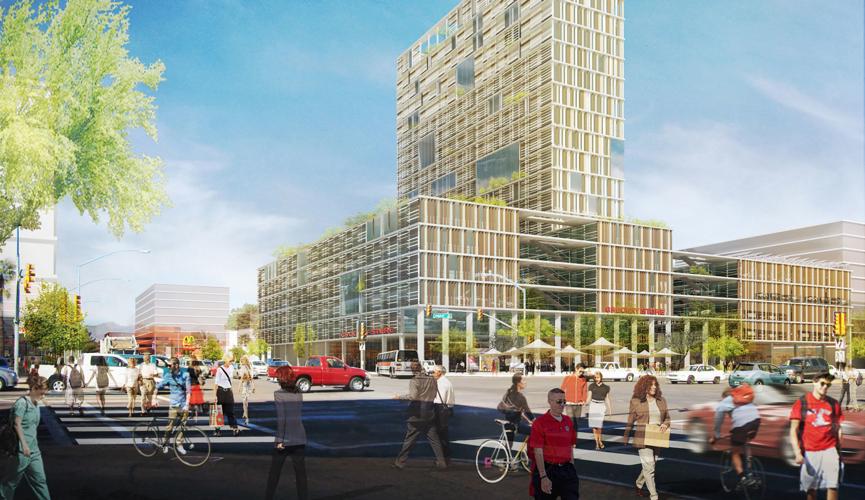
The memory occurred to me last week as I listened to the debate over a proposed 20-story tower on the northwest corner of that intersection. The tower, though very tall for that area, seems to represent the fruition of a couple of hopes Tucsonans have been holding for years. And it’s not the only example.
Since the recession hit in 2008, we’ve been waiting for Tucson’s economy to take off. And for decades, Tucsonans and planners have hoped for development to move from the edges of town into the center, keeping the city in the city and the desert in the desert.
Finally, the bare lots and underdeveloped spots in central Tucson are being filled and redeveloped. But now that it’s happening, we don’t really want what we had wished for. Or some of us don’t.
You can see that in some of the objections to the high- and mid-rise projects planned for North Fourth Avenue and the Benedictine Monastery site, as well as the Speedway/Campbell tower. It’s out of scale, opponents say. Anti-historical. Gentrification. Changes the character.
I say, it’s what we’ve been waiting for. We should go ahead and fight over the details of design and usage, especially whether the project is planned to be student housing, the bane of the university area. But realize that the heart of Tucson is finally getting some investment, and overall that’s a good thing to be channeled, not dammed.
At Tuesday’s Tucson City Council meeting, some residents of neighborhoods adjacent to the planned tower had familiar complaints about the Speedway/Campbell project. Former City Councilwoman Molly McKasson panned the project as unsustainable and “way out of scale at 20 stories.”
“Also,” she said, “it hardly encourages home ownership. It will be rentals, I guess luxury rentals and perhaps a hotel. Not the sort of thing that brings sustainability to the central city.”
“This attractive 20-story tower would be fantastic downtown,” she said, not at Campbell and Speedway.
Two other neighbors complained that residents were not adequately informed, including one who said it shouldn’t just be neighborhood associations that get notices and hold meetings about projects. There should be more outreach.
To that I say: Try harder. The neighborhood associations are the correct venue for these discussions. Read the paper. Go to council meetings. If you care, get involved, and then you’ll be clued in early enough.
That is not a problem anymore on North Fourth Avenue or on North Country Club Road, where proposed projects are provoking even more resistance. On North Fourth, the Bohemian capital of Southern Arizona, change is coming, and long-timers are trying to channel it.
Thanks to the streetcar that runs through there, property values are rising, rents are rising, and marginal businesses are being driven out. It’s a threat to the old character of the street. The latest business to be pushed out by rising rents was Revolutionary Grounds, a leftist bookstore-coffee shop. But the change can only be managed, not stopped.
Two mid-rise buildings are planned for North Fourth Avenue, one on the south end, where Maloney’s is, and the other about three blocks north, at the corner of Fourth and East Sixth Street. A mixed-use project, The Trinity, is planned for North Fourth Avenue between East Fourth Street and East University Boulevard, on property formerly owned by Trinity Presbyterian Church.
A group has formed, Save Fourth Avenue, attempting not to stop the projects but to ensure they fit well on the avenue, rather than imposing change thoughtlessly.
“We are concerned about them dropping a fortress in the middle of the street that doesn’t integrate well,” said Dee Dee Koenen, owner of Pop Cycle and leader of the group.
So far, they’ve succeeded in getting commitments for a minimum of 4,000 square feet of locally owned retail at the Maloney’s site, and they’re working on a commitment for 100 percent locally owned retail at the Fourth and Sixth site. They’re hoping to enter into “community benefits agreements” with developers that ensure the projects integrate well.
Of course, as Fred Ronstadt, the former council member who is head of the Fourth Avenue Merchants Association, told me, there is a simple way to ensure local retailers remain on the avenue: Shop there.
“If you want to preserve the culture and the nature of Fourth Avenue, then get your bottoms down to Fourth Avenue and support our merchants,” he said.

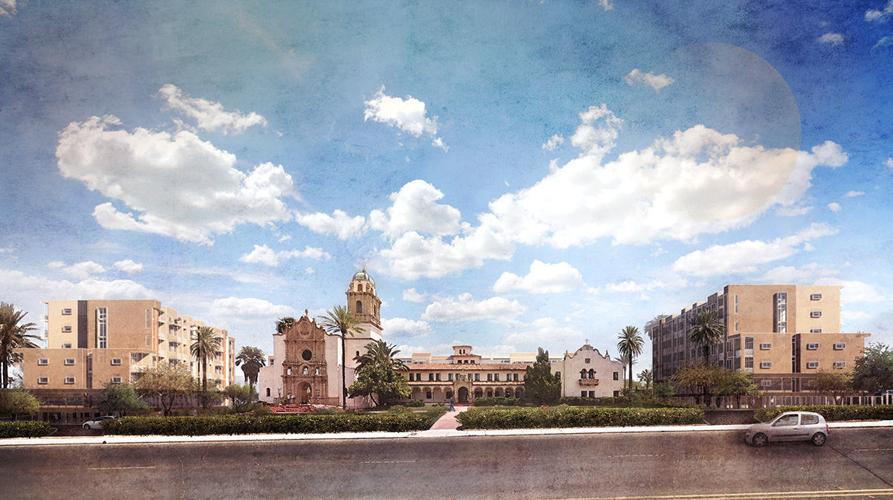
This rendering shows the Benedictine Monastery on Country Club Road, flanked by proposed housing complexes.
Over on North Country Club Road, at the site of the old Benedictine Monastery, the streetcar is not the catalyst. It’s just a redevelopment opportunity that presented itself when the Sisters of Perpetual Adoration could no longer support the place.
Neighbors have successfully lobbied to have the developer reduce the proposed height of apartments on the site and commit to preserving the historic building, but that fight is continuing, as my colleague Gabriela Rico reports on Page D1. They’re right to want to keep the height down, but they’re going to have to give on something to keep the local developer in the project and not have him sell it off.
The one line that I have no problem with neighbors drawing is over student housing complexes where tenants rent by the bed. These cheaply made structures shouldn’t be viewed as buildings at all, Tucson architect Bob Vint once told me, but as rent-extraction mechanisms constructed to funnel money to out-of-town investment groups. No wonder they’re so ugly.
And they’ve come to dominate, or destroy, one section of town, southeast of the intersection of Euclid and Speedway. The university has some responsibility for this. As Councilman Steve Kozachik told me, the UA should tear down some of its old dorms or other small buildings and build taller dorms on campus. As it is, the UA is offloading its housing problem on the rest of the city.
But student-housing aside, infill projects are good. They’re what we’ve been waiting for, and just need adequate neighborhood input to keep atrocities from happening, like the many Hub-branded student monstrosities, and to ensure they integrate into the neighborhoods.
I liked how Councilwoman Regina Romero put it in discussing the 20-story tower at Tuesday’s meeting: “Adding infill to our city is scary. Most of the time I support it if it’s in an area that is appropriate and if the conversations have been had. This project fulfills that to a ‘T.’”
As residents we can and should put guide rails on the projects that are inevitably coming up. But we should also appreciate these projects for what they represent: The fulfillment of our hopes for investment, economic growth and saving the desert.
In the end, it’ll make for a more interesting city for the young, new guys in town like I was in 1996, as well as the longtimers like I am now.

