



You can put down your rakes, America.
While President Trump is right that we need better forest management across the West, removing leaves won’t play a big part in it. And the federal government will.
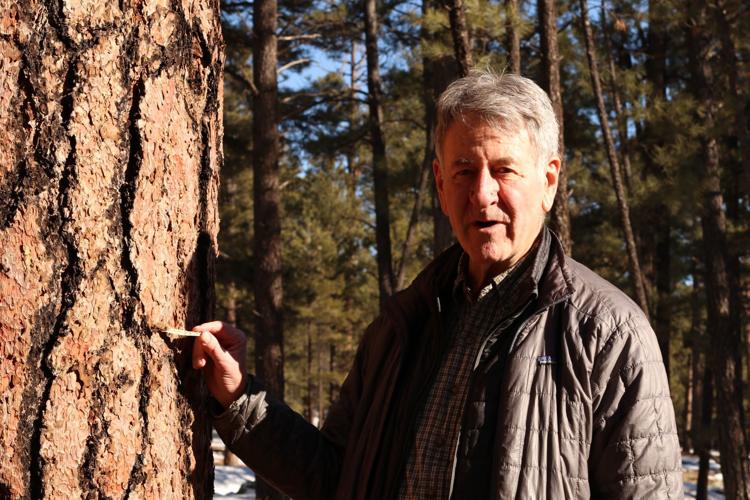
That’s according to Wally Covington, an emeritus professor of forestry at Northern Arizona University and one of the West’s leading experts in forest restoration and fire management.
I spoke with Covington on Tuesday morning, as he paused during a drive to a research plot near the South Rim of the Grand Canyon. My specific interest was forest litter. The debris that accumulates on forest floors has gotten a bad name in recent years because if it’s allowed to build up, it helps cause more catastrophic wildfires.
But forest debris is also a key source of nutrients in forest soils. And it’s not the only key factor driving the increasingly catastrophic fires across the West.
Here’s how Covington answered questions about the topic he’s dedicated his life to since 1976.
Q: Is there any truth to the idea that if we remove the leaves from the forest floor, that will help prevent wildfires?
A: To be charitable, which is hard, immediately around the footprint of a house raking 100 feet, maybe 150 feet around the footprint of the house could be part of creating a defensible space. As part of a program of protecting individual houses or other kinds of buildings, raking can make sense.
To be uncharitable — I mean, no. Goodness gracious. You know, he (Trump) heard something somewhere and oversimplified it, as he often does, and came up with some simplistic idea of how to deal with a problem. But raking — there is no place in the world where raking is an important part of extensive forest management. It just doesn’t happen.
Q: Isn’t the decomposition of forest litter essential to the health of a forest?
A: In deciduous forests like the hardwood forest of the northern tier of states, decomposition is the main mechanism for recycling nutrients. As you move in to warmer and drier types of forest, decomposition is slower. So decomposition by itself can’t keep up with the amount of litter that’s cast off from the trees.
In those situations, it’s the synergy between periodic fire and decomposition that results in the recycling of the nutrients that sustains forests and understory vegetation or shrubs and grasslands and so on. That maintains our productivity, diversity and health.
Q: How much clearing of younger trees and brush do you do in a ponderosa pine forest, in a given acre or so? Do you cut everything under a certain diameter and pile it up and burn it?
A: We call this ecological restoration treatments. On the average acre, there were, before fire exclusion around the 1870s and 1880s, somewhere between 15 and 50 trees per acre. These were mostly large-diameter yellow bark trees that ranged in age from 100 years up to 700 years in age. And then after heavy livestock grazing and fire exclusion, those densities increased to between 400 and 1,500 trees per acre on average.
How do you clear those trees out? If there’s road access, you can harvest and sell, but that’s only a minority of the trees that are there. The majority of the trees, as you implied, they’re smaller diameter. There’s not much of a market for them right now. So those you either have to pile and burn or in cases where they’re near housing developments, you can haul them off and burn them off-site.
Q: Isn’t burning them on-site important to the soil health of these areas?
A: We’ve actually looked at that, and our restoration prescriptions would call for lopping and scattering the tree tops. It’s called broadcast burning. You know, most of the nutrients are in the tops of trees, the pine needles and the small twigs, so you lop and scatter that before the burning.
Now, when you burn that material, it releases not only carbon, but also nitrogen, potassium, calcium, magnesium. Some of that, especially the nitrogen and phosphorus, can go up in the air, in smoke. But a lot of it stays on site. We’ve measured it after burning. We’ve gotten some nitrogen levels in the soil after burning that are equivalent to fertilizing with 200 or 300 pounds of nitrogen per acre, which is a lot of nitrogen.
Q: The president dismissed climate change as a factor in the recent wildfires. What do you think?
A: There’s no doubt that climate change is in full force. I personally started writing about this back in the ’80s in my research. And we’ve been following the effects of climate change on some of our plots.
Climate change causes several problems. It extends the fire season. The temperatures are higher. The fuels are drier because of temperature and the extended fire season. And then when fires actually occur, we get much stronger winds.
The other thing I’d say is this is a global phenomenon. If it were just occurring in the western USA, you could say they’re just managing the forest poorly there. But we’ve had it occur in the Eastern forest. This is also occurring in Australia and it’s occurring in Europe and it’s occurring in South America. It’s occurring in Siberia. The fact that it’s occurring everywhere makes it highly unlikely that this is solely a consequence of forest management, as President Trump has said.
Q: How should the increasingly hot climate change how we manage forests?
A: Among forest ecologists and restoration ecologists, we’ve been talking about this for 30, 40 years now. There are a couple of fundamental approaches. One of them would be to restore the area and all the natural self-regulatory mechanisms. Then the ecosystems will be able to better deal with climate change. Many of us are concerned that the climate change is occurring so rapidly that the natural mechanisms may not be able to keep up with it.
That leads us to what we think of as a more engineering approach, where we try to anticipate what’s going to happen, what kind of vegetation is most likely to be self-sustaining on this site in 30 years time, and we managed toward that. That’s called facilitated migration. Right now, it’s about evenly divided among scientists about which approach to do. My personal thinking is we need to not put all our eggs in one basket, but let’s do a variety of approaches, monitor them, and see which ones work.
Q: The U.S. Forest Service manages most of the forests in the states that have been affected by burning. Are they doing enough?
A: They’re doing what they can with the money they have. Congress provided them about three years ago an additional $187 million to implement the national fire plan, the cohesive strategy that the Western governors put together. That has resulted in an acceleration of treatments. In my opinion, we need to be doing about 10 times that much.
Photos: Massive destruction from wildfires in Washington, Oregon, California
California Wildfires
Updated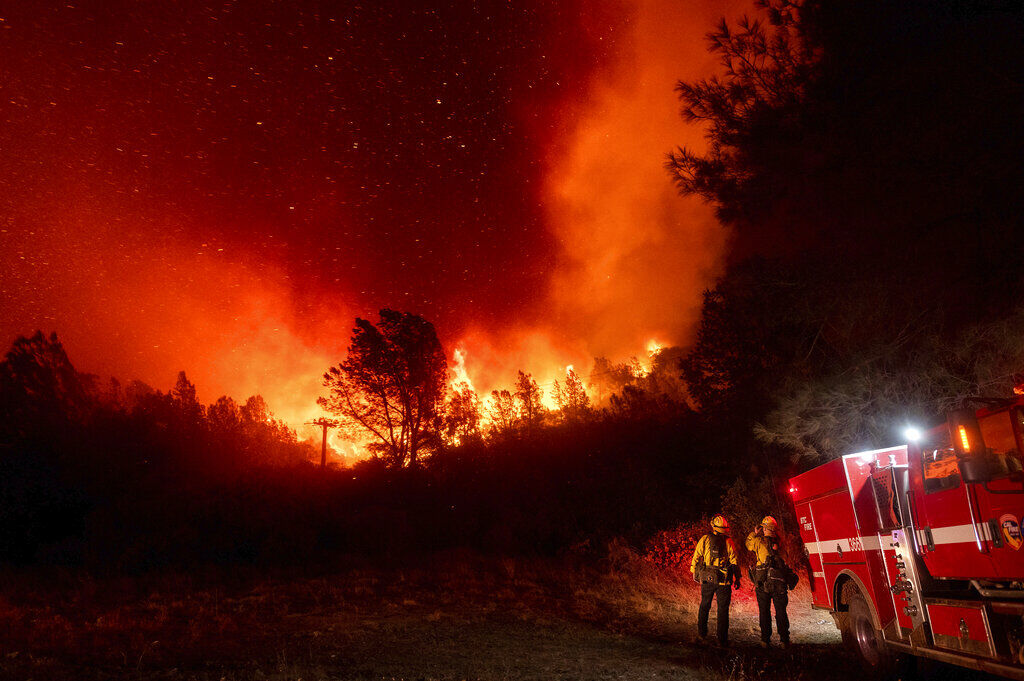
Firefighters watch the Bear Fire approach in Oroville, Calif., on Wednesday, Sept. 9, 2020. The blaze, part of the lightning-sparked North Complex, expanded at a critical rate of spread as winds buffeted the region. (AP Photo/Noah Berger)
California Wildfires
Updated
The Bobcat fire rages above Rincon Fire Station on Highway 39 on Wednesday, Sept. 9, 2020 in San Gabriel Mountain, California. (Irfan Khan/Los Angeles Times/TNS)
California Wildfires
Updated
The San Francisco Bay Bridge and city skyline are obscured in orange smoke and haze as their seen from Treasure Island in San Francisco, California on September 9, 2020. (Photo by BRITTANY HOSEA-SMALL/AFP via Getty Images/TNS)
California Wildfires
Updated
The smoldering remains of a structure along Auberry Road, where Creek Fire tore through and jumped CA-168 on Tuesday, Sept. 8, 2020 in Fresno County, CA. (Kent Nishimura/Los Angeles Times/TNS)
California Wildfires
Updated
An ariel view of Paradise off of Clark Road on Nov. 15, 2018. Wildfires in the region are threatening the town and others around it once again. (Carolyn Cole/Los Angeles Times/TNS)
California Wildfires
Updated
Flames lick above vehicles on Highway 162 as the Bear Fire burns in Oroville, Calif., on Wednesday, Sept. 9, 2020. The blaze, part of the lightning-sparked North Complex, expanded at a critical rate of spread as winds buffeted the region. (AP Photo/Noah Berger)
California Wildfires
Updated
In this image taken with a slow shutter speed, embers light up a hillside behind the Bidwell Bar Bridge as the Bear Fire burns in Oroville, Calif., on Wednesday, Sept. 9, 2020. The blaze, part of the lightning-sparked North Complex, expanded at a critical rate of spread as winds buffeted the region. (AP Photo/Noah Berger)
California Wildfires
Updated
Flames shoot from a window as the Bear Fire burns through the Berry Creek area of Butte County, Calif., on Wednesday, Sept. 9, 2020. The blaze, part of the lightning-sparked North Complex, expanded at a critical rate of spread as winds buffeted the region. (AP Photo/Noah Berger)
California Wildfires
Updated
Flames shoot from a home as the Bear Fire burns through the Berry Creek area of Butte County, Calif., on Wednesday, Sept. 9, 2020. The blaze, part of the lightning-sparked North Complex, expanded at a critical rate of spread as winds buffeted the region. (AP Photo/Noah Berger)
California Wildfires
Updated
A hand crew works to save a home as the Bear Fire burns through the Berry Creek area of Butte County, Calif., on Wednesday, Sept. 9, 2020. The blaze, part of the lightning-sparked North Complex, expanded at a critical rate of spread as winds buffeted the region. (AP Photo/Noah Berger)
California Wildfires
Updated
FILE - In this Sept. 8, 2020 file photo a table stands outside the destroyed Cressman's General Store after the Creek Fire burned through Fresno County, Calif. A weekend wildfire east of Fresno exploded so fast that it trapped hundreds of holiday campers who were airlifted to safety in a dramatic rescue that strained the limits of two California National Guard helicopters. (AP Photo/Noah Berger,File)
California Wildfires
Updated
This GOES-16 GeoColor satellite image taken at 20:00 UTC (4 p.m. EDT) and provided by the National Oceanic and Atmospheric Administration (NOAA), shows brown smoke from wildfires blowing westward in the atmosphere from California's Sierra Nevada to the Coast Ranges and from Oregon, top, on Wednesday, Sept. 9, 2020. (NOAA via AP)
California Wildfires
Updated
Scorched vehicles rest in a clearing following the Bear Fire in Butte County, Calif., on Wednesday, Sept. 9, 2020. The blaze, part of the lightning-sparked North Complex, expanded at a critical rate of spread as winds buffeted the region. (AP Photo/Noah Berger)
California Wildfires
Updated
A hand crew works a fire break as they establish a hose line along a ridge during the El Dorado Fire along Highway 38 west of Forest Falls, Calif., Thursday afternoon, Sept. 10, 2020, as a hand crew establishes a hose line along a ridge. The fire was started by a device at a gender reveal party Sat., Sept. 5. (Will Lester/The Orange County Register/SCNG via AP)
Wildfires in Oregon, Washington
Updated
Dora Negrete is consoled consoled by her son Hector Rocha after seeing their destroyed mobile home at the Talent Mobile Estates, Thursday, Sept. 10, 2020, in Talent, Ore., after wildfires devastates the region. (AP Photo/Paula Bronstein)
Wildfires in Oregon, Washington
Updated
Artemio Guterrez, a single father of four, holds a cross, Thursday, Sept. 10, 2020, made of two pieces of glass that melded together in a crosswise formation during the intense heat from the wildfire that swept through Talent, Ore., earlier in the week. Guterrez barely had time to escape with his children as a wildfire raced through the Talent Mobile Estates, where he and other Mexican immigrants lost their homes. The fires in southern Oregon have taken the most from those with the least, leveling multiple trailer parks in both Talent and nearby Phoenix, Ore. (AP Photo/Gillian Flaccus)
Wildfires in Oregon, Washington
Updated
The McKenzie River flows through a drained Leaburg Lake near Leaburg, Ore., Thursday, Sept., 10, 2020. The lake was drained to allow the river to flow freely avoiding potential damage by debris dislodged by the Holiday Farm Fire. (Andy Nelson/The Register-Guard via AP)
Wildfires in Oregon, Washington
Updated
The sign for Ben and Kay Dorris Park was toppled by the Holiday Farm Fire as the park sustained substantial damage near Vida, Ore., Thursday, Sept., 10, 2020. (Andy Nelson/The Register-Guard via AP)
Wildfires in Oregon, Washington
Updated
Burned out vehicles destroyed by the Holiday Farm Fire sit outside a shop in Nimrod, Ore., Thursday, Sept. 10, 2020. (Andy Nelson/The Register-Guard via AP)
Wildfires in Oregon, Washington
Updated
A neighborhood destroyed by fire is seen as wildfires devastate the region, Thursday Sept. 10, 2020 in Talent, Ore. (AP Photo/Paula Bronstein)
Wildfires in Oregon, Washington
Updated
A couple, who declined to give their names, embrace while touring in an area devastated by the Almeda Fire, Thursday, Sept. 10, 2020, in Phoenix, Ore. (AP Photo/John Locher)
Wildfires in Oregon, Washington
Updated
Eden McCarthy pets her dog Hina in the rubble of her home destroyed by the Almeda Fire, Thursday, Sept. 10, 2020, in Talent, Ore. (AP Photo/John Locher)
Wildfires in Oregon, Washington
Updated
The ground still smolders from the Cold Springs fire that swept through Okanogan County, Thursday, Sept. 10, 2020. near Omak, Wash. (Amanda Snyder/The Seattle Times via AP)

