


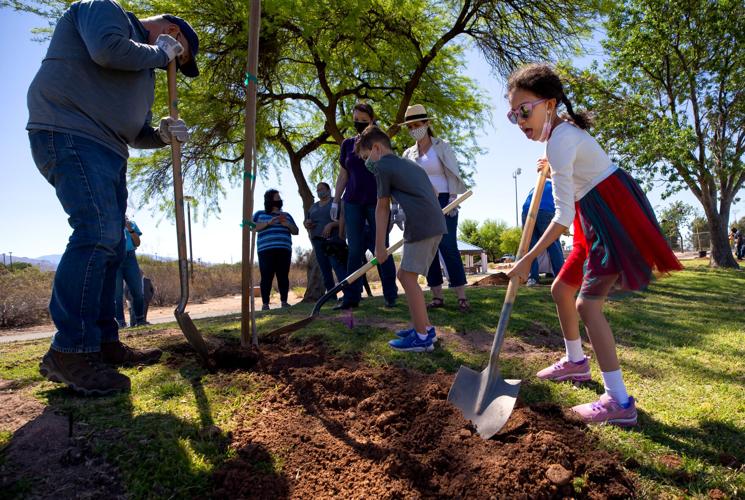




Across Lincoln Park Friday, crews of three or four people dug up dirt, put young trees in the ground, and filled in the holes.
By the end of the Arbor Day event, 62 new velvet mesquite, live oak, netleaf hackberry and other trees were planted near the park’s soccer fields. It was part of Mayor Regina Romero’s initiative to establish a million new trees in Tucson by 2030.
What they did Friday is the easy part.
The hard part began weeks before and will continue for years after. The hard part, in the desert, is keeping trees alive through their first couple of years, then on through the overheated summers and unending drought.
That, of course, means watering. The paradoxical effect of our warming, drying climate is that we need more trees to protect ourselves from its effects, but that means using precious, dwindling water to grow trees where, in some cases, they wouldn’t naturally thrive.
At Lincoln Park, the solution is simple, and just required some parts and work: irrigation with reclaimed water. Before the event Friday, city parks workers tied each of the tree-planting sites into the park’s irrigation system, as Dominic Rullo, the irrigation supervisor for Tucson parks, explained to me.
Each tree will be watered by six emitters, two at the base and four further out under the canopy, each providing two gallons of water per hour. In the first few weeks, the water will flow every day, but then that will be dialed back to three times a week, Rullo said. Then it will be adjusted again as the trees become established and need less help.
The site is also among 120 in the city that has its irrigation linked to a weather center. So, for example, if it rains, the system will automatically delay the next watering.
“I can’t plant a tree and not add irrigation,” Rullo said of the park properties where he oversees watering. “I don’t know when the rain is coming. There’s way too much effort put in to not put water to them.”
Doing some back-of-the-envelope multiplication, he estimated each tree might get 1,500 gallons of water per year when they are getting established. In Tucson, trees need to go through two summers, or at least 18 months, before they are considered established.
Those running the tree-planting initiative are deeply aware of the water issue, which is perhaps the biggest obstacle to the whole idea — using increasingly scarce water to fight the effects of climate change.
The million-trees effort is getting going at the same time Central Arizona Project is preparing to cut its deliveries to Arizona, because the water level on Lake Mead is dropping so low. Tucson, which has been storing CAP water in the ground for years, will not lose any water if this initial cut happens.
I asked Nicole Gillett, the city’s new urban forestry manager, to step away from digging a hole Friday, and we talked about water in the shade of a big, beautiful mesquite full of catkins.
Gillett, the city staffer overseeing the million-tree initiative, told me that at minimum, every tree planted in the city’s effort will have a basin to help slow and collect water, letting it percolate into the ground under the tree. More elaborate water-collecting infrastructure, some of it paid for through a green-infrastructure line on Tucson Water bills, will also be built where needed, especially in places without irrigation.
“From there we can look at other non-potable sources of water first,” she said. “Those vary across the city. We have rainwater, we have storm water, we also have tons of AC condensate, which I think is an underutilized water resource in the city. Especially for urban trees, every building probably has an AC, and that produces quite a bit of high quality water. Then we have gray water and other on-site water use.”
The other main water sources are reclaimed water, like that used at Lincoln Park and other parks, and finally potable water. That’s what most of us use when we pull out our hoses to water plants.
That water, of course, costs money. Wherever the city provides the water to irrigate the trees, inevitably we the rate-payers and taxpayers will be covering it, as the former director of Phoenix Water Services, Kathryn Sorensen, explained.
“Even in a theoretical situation when the water department doesn’t charge the parks department, somebody else pays,” said Sorensen, who is now at ASU’s Kyl Center for Water Policy. “There’s no free water. Everything gets paid for by the customers in the system.”
So it’s going to take water to create the shade the initiative envisions, and we’ll probably pay for it, though the cost may not be noticeable since it will be spread out over time.
But there is payback. The trees themselves stop water from running off, through their canopies and roots, and the shade they produce reduces warming and drying.
One water source we should not worry about is groundwater, Gillett said. Thanks to our decades of pumping, few trees can reach it.
“I’m not concerned at all about groundwater,” Gillett said. “In Tucson, where our water table is so far down, even with trees with those amazing taproots, they’re not making a dent.”
Another of the keys to minimizing water use is simply picking the right trees. The Tucson effort is focused on native species, though the city will also plant drought-adapted non-natives where water is available.
Pima County has a small nursery where they grow trees needed to replace ones removed in developments, road projects and other disturbances. They even collect seeds from the areas where they’re going to plant, then grow trees adapted just for those spots from the seeds.
“We grow our plants with very tough love,” nursery manager Amy Belk told me. “We aren’t like a traditional nursery in that we’re watering our plants every day. We’re watching our plants and waiting till they show some stress to water them. We don’t use fertilizers.”
“Some of ours look a little worse than for the wear when they leave here, but they’re tough.”
City officials have toured the county facility and are considering starting their own nursery. If they do, they ought to adopt the tough-love approach for desert seedlings.
Over time, the climate conditions that are making massive tree planting a priority may make large-scale watering seem too big a luxury.

