

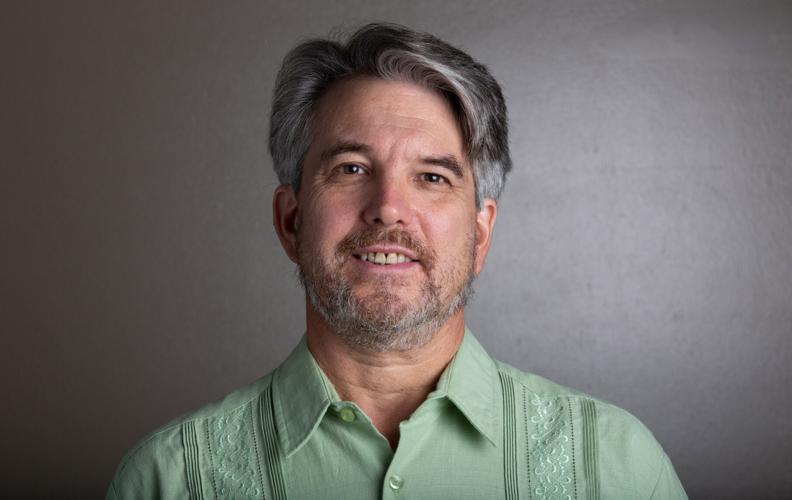
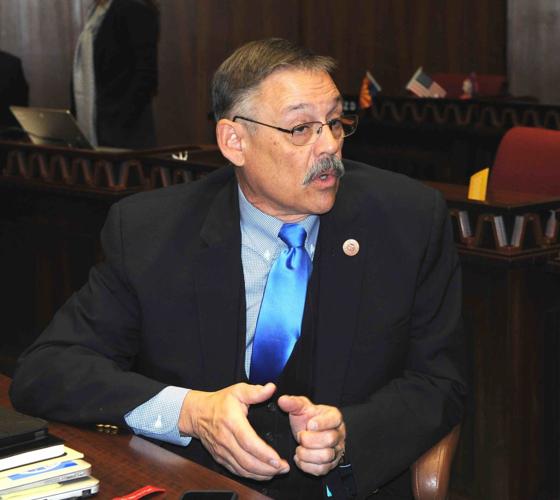


Before and after Monday, Dec. 13's so-called hearing on Pima County elections, Rep. Mark Finchem said the idea was to provide proof.
On a video he posted before the event, Finchem said: “The purpose of this is no more than to hear from constituents and to gather evidence, testimony that will either prove or disprove alleged discrepancies in the election.”
At the end of the daylong discussion on “election integrity,” he said, “The whole point of this is to develop evidence, develop testimony and to prove or disprove discrepancies in the 2020 election.”
In between, though, no proof was offered — hardly even anything you could call evidence, certainly not of election fraud.
As Pima County GOP Chair Shelley Kais put it, while laying out what she considered questionable voter-registration data: “My position today is to raise inquiry.”
So, more than a year on from the 2020 election, Finchem and his band of election dead-enders are still in the stage of raising questions, now about Pima County.
They’re so far from offering anything you could call proof of discrepancies that it makes you wonder what they’re really up to. They didn’t even call for a “full forensic audit,” even though chief Cyber Ninja Doug Logan, who headed the Maricopa County election review, attended and made a presentation.
Finchem, an Oro Valley Republican, started the meeting by reading a supposed whistleblower email from an anonymous source claiming Democrats had “injected” 35,000 fraudulent ballots into Pima County’s total. This is the same email first discussed publicly in November 2020, more than a year ago.
And it still sounds like it came from a Republican, or someone who doesn’t like the Democratic Party, which makes it hard to believe it was an insider account, as purported.
“Please be advised the Pima County recorder and the Democrat Party added ‘fraud votes’ in the initial count of the Vote By Mail totals released at 8 p.m. on Nov. 3 2020,” the email says, as read by Finchem.
A subsequent sentence says, “in a meeting I was invited to by the Democrat Party in Pima County Arizona on Sept. 10, 2020, no phones or recording devices were allowed.”
The logical inconsistency is this: Democrats don’t refer to their party as the Democrat Party — that’s a Republican phrasing. Democrats call it the “Democratic Party.” So we’re being asked to believe that someone who was not a Democratic insider got invited to a big election-fraud planning meeting. Come on.
Anyway, there’s no more evidence that this email is legitimate today than there was a year ago. The people accused in the email, such as then-Recorder F. Ann Rodriguez, scoffed at the idea that anything like that took place.
‘Be prepared’
Monday’s meeting was organized by Finchem but also attended by seven other Republican legislators, seated at a head table at the El Conquistador resort. Public attendance was sparse — Finchem blamed that on an attempt to hijack online ticketing. Again, no proof was provided. I watched much of it online.
For context, Finchem has been an outspoken supporter of the idea that the 2020 presidential election was stolen from former President Donald Trump since soon after that election.
He held a similar meeting to Monday’s event on Nov. 30, 2020 in Phoenix, but it featured stars from the Trump world such as Rudy Giuliani. Neither event could formally be called a legislative hearing, because they were not sanctioned by the state legislative leaders.
Finchem ended that Phoenix meeting, watched broadly by Trump true believers nationwide, by telling the cheering crowd: “Be on your guard, put on the full armor of God, and be prepared to fight.”
Thirty-seven days later, Finchem was on the grounds of the U.S. Capitol when the contingent he told to fight did just that. Trump supporters stormed the Capitol, in what we now know was part of a broader coup attempt, as Joe Biden’s election was being certified.
Now Finchem is not just a state representative traveling the country talking up election fraud, but he’s also the Trump-endorsed Republican candidate for secretary of state in Arizona. If elected, he would be our state’s top elections officer.
As a candidate for secretary of state, he of course is fundraising for his campaign. I get those emails just about every day. He also runs a nonprofit group called Guardian Defense Fund, originally established to push back against people accusing Finchem and others of wrongdoing on Jan. 6.
The fund hasn’t reported how much it has raised, but in June the charity’s director described its fundraising as enthusiastic from Republicans around the state.
Questions have answers
So, Finchem can benefit no matter if he spends the next year just raising questions about the election. Even if those questions have logical answers, as in the case of the Pima GOP chair.
Kais pointed out, among other examples, that there were 380 people registered to vote who gave an address at the Pima County Recorder’s Office, 240 N. Stone Ave. Similarly, 19 people were registered at the Fred G. Acosta Job Corps office, 901 S. Campbell Ave.
Separately she noted there are 1,133 registered voters at this address on the Tohono O’odham Nation: 0 W Sells Village, Sells AZ 85634. She suggested that more voters are registered in Sells than reside in the town.
Of course, as Kais said, she was only asking questions. But those questions have answers, if you’ll just ask the right people. I asked the Pima County Recorder’s Office, and they told me, “The 240 N. Stone and 901 S. Campbell addresses are used by people who don’t have a permanent physical address.”
Homeless people, in other words.
“The 0 W Sells Village address is for people who live in the Sells District, on the Tohono O’odham Nation.” So, it’s not just people in the town of Sells but in the whole district of Sells — similar to a county within the reservation — who are registered there. That’s why the numbers are so high.
It shouldn’t be acceptable anymore that those like Finchem on the “election integrity” circuit are still just asking questions and implying fraud. The answers are available, if that’s what they really want.

