


They all knew Blake Masters was smart.
They just never thought he would use his brilliant brain for this.
Masters, 35, grew up in Tucson and, after a yearslong adventure working in California, has lived in Tucson with his wife and kids for almost four years. Now he is running for the GOP nomination for U.S. Senate.
That he’s pursuing such an office is no great surprise to the alumni of Green Fields Country Day School, a small private school in Tucson that closed in 2019 after producing hundreds of worldly and bright graduates.
Masters is one of them, and so is his wife Catherine. His father-in-law was a teacher there. But Masters has shaken that little Tucson-based social network with his increasingly radical campaign pronouncements, culminating Nov. 4 in a public attack on one of his best Green Fields friends.
Of course, winning the tiny Green Fields vote means nothing in the race for the GOP nomination, but Masters’ bad breakup with his school buddies, his siccing an online mob on one of them, may mean something. It may say more about this little-known, first-time candidate than any policy pronouncement does.
Tweet leads to abuse
The aggravation had been building in Collin Wedel for months when Masters, his childhood buddy, posted this on Twitter Nov. 4:
“covid vaccine mandates are evil.”
Wedel, an appellate attorney in Los Angeles, has a private Twitter account, meaning he selects who can read his posts. Masters’ tweet upset him because he thought it would discourage Masters’ thousands of Twitter followers from getting vaccinated.
Masters, whom he had been close friends with at Green Fields, was one of the 40-or-so people Wedel had allowed to see his tweets. So Masters saw it when a fed-up Wedel responded:
“Shame on you. I’m so utterly disappointed in what you’ve done with yourself. People will get sick, and die, because of your reckless rhetoric. As someone who loves and used to respect you: What happened to you?”
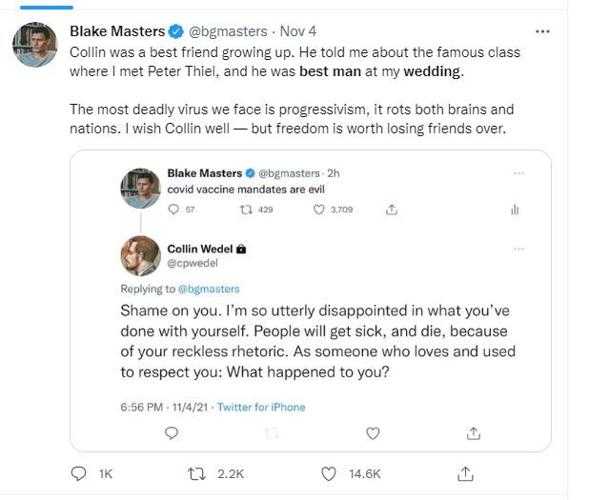
Nobody outside of Wedel’s small circle would have known about this tweet, except for what Masters did next. In short, he put Wedel, the best man at Masters’ wedding in 2012, on blast. He took a screen shot of Wedel’s post, then posted it as an image attached to a follow-up tweet. In that, Masters said:
“Collin was a best friend growing up. He told me about the famous class where I met Peter Thiel, and he was best man at my wedding.
“The most deadly virus we face is progressivism, it rots both brains and nations. I wish Collin well — but freedom is worth losing friends over.”

Blake Masters' best man and childhood close friend called him out in a private tweet on Nov. 4. Masters responded by posting a screen shot of that private tweet, prompting his followers to harass the longtime friend.
When he sent that tweet, Wedel’s name and the text of his tweet went out to the more than 50,000 followers Masters has accumulated, as well as anyone else who viewed Masters’ public account.
“It led to a lot of nasty grams and mean messages left on my personal phone and my work phone,” Wedel told me Wednesday. “I got a piece of hate mail in my mailbox yesterday. We had to call the police to come and investigate.”
“Suffice to say I’ve been subjected to a range of abuse and hateful rhetoric from a bunch of followers who he had to know would react this way to someone he publicly called out as a nuisance to him.”
Whatever your politics, that’s not how you treat an old friend. But maybe it was foreseeable Masters would arrive at this point.
“A beautiful mind”
Masters did not accept invitations to an interview that I’ve been offering since July. However, I’ve gotten familiar with him through interviews with Green Fields friends, reading the book he co-wrote with tech mogul Peter Thiel, listening to other people’s interviews and following him on Twitter.
In a recent episode of the podcast Moment of Truth, Masters said, “I grew up super conservative libertarian. I can remember in middle school my dad had all the Ayn Rand, Milton Friedman on his book shelf. So I was the kid in high school debating free market capitalism, good, versus my communist high school friends.”
Among his high school friends was Noah Gustafson, now a Spanish teacher in New York City. He, Wedel and Masters were among a group of friends who went to school together and often spent hours after school at one of their houses before returning for basketball practice when the girls’ team vacated the gym.
“He was just such a beautiful mind,” Gustafson said. “I had come from a public school, and to be sitting next to a kid who wanted to learn and was excited about everything is part of why I loved Green Fields.”
From this elite, cozy Tucson high school, Masters went off to Stanford University, where he was a Ron Paul supporter in 2008. After graduating, he spent a year at Duke University Law School, intent on transferring back to Stanford Law or one of the other top three schools, said Gustafson, who lived with Masters in North Carolina.
Masters ended up back at Stanford where he took the courses from Thiel that changed his life and put him in the position he’s in now. Thiel had co-founded PayPal, was an early investor in Facebook and founded Palantir Technologies, among other companies.
Masters took careful, copious notes on a Thiel course and posted them online, where they became a popular follow, eventually earning him a mention in the New York Times and drawing Thiel’s attention. They ended up co-authoring a book based on Masters’ notes on Thiel’s lectures called “Zero to One: Notes on Startups, or How to Build the Future.”

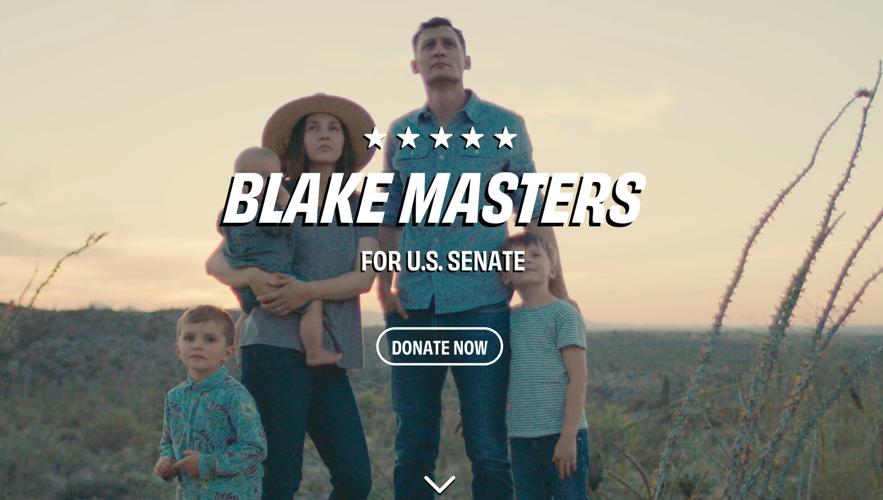
Website for Blake Masters for U.S. Senate.
Masters went to work for the billionaire Thiel, who endorsed Donald Trump in 2016, and Masters became a Trump enthusiast himself. Masters remains an executive at two entities bearing his patron’s name — chief operating officer at Thiel Capital and president of the Thiel Foundation.
An anti-elite elite
Masters is one of two novice candidates for U.S. Senate who have realistic chances because of Thiel’s money. Thiel put $10 million into a super PAC called Saving Arizona intended to back Masters, and he has hosted a fundraiser for Masters in California.
Thiel’s done much the same for J.D. Vance, the author of “Hillbilly Elegy,” who is running for the GOP nomination for Senate in his home state, Ohio.
Masters started his campaign with a video that called for a return to an American Golden Age.
“The country I grew up in was optimistic,” he said. “People thought all you had to do was go to school and work hard and you’d be able to buy a house and raise a family. But it hasn’t worked out that way.”
Of course, since he’s so young, many of us in Tucson lived through the years he’s referring to — the 1990s to early 2000s — right where he lived them. I was a reporter here during those years. The main things I find fundamentally different are that housing prices have accelerated again to out-of-reach levels in the last year or two, and that we are politically polarized.
But as he and Thiel noted in their book, “Every culture has a myth of decline from some golden age.” Masters is simply restating an idea that Trump popularized with his Make America Great Again motto, which resonates with GOP primary-election voters, most of whom tend to be over age 60.
Now, I find a couple of Masters’ campaign stands to be appealing. He says we should build an economy in which a family can thrive on a single income. While some liberals have taken that as a sign that he wants women to go back in the kitchen, I agree that it’s a goal worth striving for, as long as the couple can choose who is the breadwinner.
And Masters has spoken out for regulation of Big Tech, objecting in that podcast interview to “the mass addiction of all of our children” to their phones, promulgated by tech companies. Of course, in this and the single-income case, the solution demands government intervention in the free market, which would violate the libertarian principles held by Masters and many of his backers.
But I laugh whenever I hear Masters’ frequent mentions of taking on “elites.” Few Americans have had a more elite life than he has.
Pursuing Trump nod
As time has gone on, since Masters announced his candidacy in July, his positions have grown more extreme — and caught the attention of his old Green Fields friends. Much of his focus is on “The Left,” a mythical creature that functions as a straw enemy in the right-wing media.
“They’re ascendant,” Masters said of progressives in the podcast interview. “They’ve taken over almost every institution in our country.”
He’s repeatedly complained of “anti-white racism” being peddled in schools as “critical race theory.”
He commented “not everything has to be gay” in response to the naming of a Navy ship for Harvey Milk. Milk was a Navy veteran and gay rights leader, discharged from the service after four years for being gay, who was an elected member of the San Francisco Board of Supervisors when he was assassinated in 1978. Masters did not serve in the military.
On Oct. 28, he embraced the “Great Replacement Theory” in a video on Twitter. He said, “What The Left really wants to do is change the demographics of this country and consolidate power so they can never lose another election.” This is the same racist rhetoric that inspired mass shooters at a Pittsburgh synagogue in 2018 and an El Paso Walmart in 2019.
And on Nov. 9 he proclaimed: “I think Trump won in 2020.” His explanation was interestingly absent of claims that there was electoral fraud, as Trump falsely alleges. Instead, Masters emphasized rule changes that allowed more mail-in ballots, and accusations of bias in the news media and social media.
In other words, Masters has veered toward an extreme Trump line — demonizing opponents and catastrophizing about the present. Politically, it’s no surprise he’s done so. As he and Thiel wrote in their book:
“Politicians have always been officially accountable to the public at election time, but today they are attuned to what the public thinks at every moment. Modern polling enables politicians to tailor their image to match preexisting public opinion exactly, so for the most part they do.”
Masters has. And last week he got one reward: Trump himself hosted a fundraiser for Masters at his Mar-a-Lago resort.
But the real reward that Masters seems to be seeking has still eluded him: a Trump endorsement. That, plus Thiel’s money, could make him a serious contender for the GOP nomination to run against Sen. Mark Kelly, a Tucson Democrat, positioning him to win the John McCain seat back for Republicans.
Of course, everything he has done to get this close to the Trump nod has made him a grotesque caricature to some of the people he grew up with in Tucson. And the same sort of posturing for Trump’s approval proved fatal, twice, to candidate Martha McSally’s efforts to win the same U.S. Senate seat.
“He really is unrecognizable to me, even his voice and facial expressions,” Gustafson said. “He seems like a different person. The one connection I can make is he definitely always believed his ideas were the best ideas. He enjoyed discussion and discourse, but I don’t know that he was ever listening to you.”
Wedel, the friend who Masters called out online, said, “I don’t know where Blake’s policies are coming from. That’s part of my confusion. I don’t know whether he believes them or if they’re a ploy for votes.”
Embracing them has changed Masters, his friends said. Ironically, considering his accusation against Wedel and progressives, it appears politics have rotted the beautiful brain his friends so admired at Green Fields.

Tim Steller, Metro columnist for the Arizona Daily Star.

