


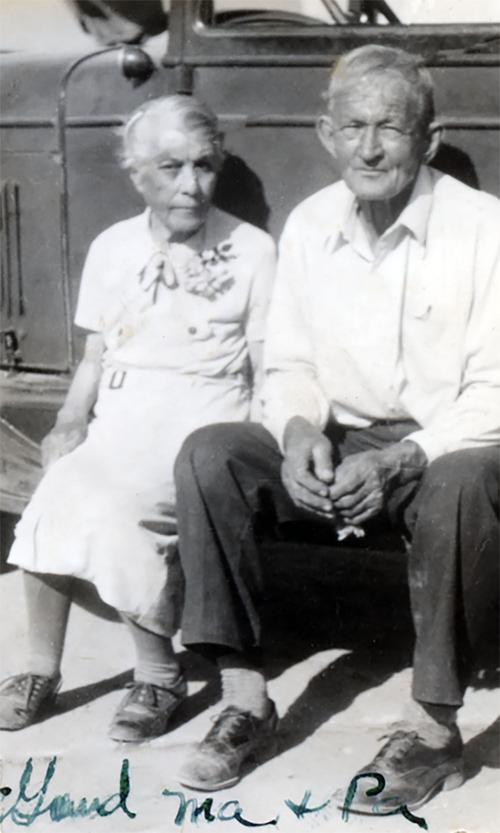
Pioneering homesteader Leonard G. Wagner — who has a new street named after him in Vail — worked in mining, law enforcement and railroading in Pantano, Vail, Helvetia and Tucson starting in about 1900.
The son of a carpet weaver, he was born around 1869 in Wisconsin or possibly Germany.
By 1891, while residing in La Crosse, Wisconsin, he had joined with Otto Bauer to establish the Bauer & Wagner saloon. After that he worked as a teamster for J. Paul L. Company, which was his job at the time of his marriage.
Wagner married Mary Lillian "Lillie" Chase on March 21, 1896, at the St. Johannes German Reformed Church in La Crosse.
He would adopt his wife's four sons from her previous marriage to lumberman John William McCulloch: Arthur, born in 1876; Charles, born in 1883; Harry, born in 1884; and Norman, who came along in about 1894. Harry and Norman took on Wagner's last name, while Charles and Arthur kept their biological father's surname, McCulloch.
The couple apparently no longer wanted to stay in Wisconsin and by June 1900, Wagner and family were in Arizona, residing in Pantano (now a ghost town), which was little more than a railroad town in the middle of the desert southeast of Vail.
By 1907, Wagner was employed by The Verde Queen Mining Co. as superintendent of a lead mine about 12 miles from Pantano. The lead ore was hauled over the old stage road to Pantano Station and then sent by train to the smelter in Deming, New Mexico.
Three years later, records show the family living in the Pantano Precinct, although they are believed to have been temporarily residing and working as teamsters in mining towns in the area such as Helvetia, Total Wreck and maybe Greaterville.
In 1911, Wagner for the first known time worked as an election official, a side job he would participate in for many more years.
His main job continued to be in mining, though. By late 1912, Wagner was manager of the United Mining and Smelting Co. located in the Helvetia Mining District in the Santa Rita Mountains. The family by this time likely had moved their permanent residence from Pantano to Vail.
In 1912, Charles E. McCulloch wed Nicola Celaya in Tucson and began a family there. Later they would move to Vail. Two years later Norman Wagner married Juanita Leon and set up home in Vail also.
By mid-1914, Wagner had switched careers and was a station engineer at the Vail Train Station. The following year he filed for a 320-acre homestead that would one day be bisected by the railroad track and Mary Ann Cleveland Way in Vail. Part of this land is located caddy corner from the present-day Vail Unified School District Transportation Department on the north side of M.A.C. Way.
By 1917, he was serving as a Pima County deputy sheriff in Vail. On one occasion he was one of the first persons on the scene of an accident of a man who had been sleeping on the railroad track and had been decapitated. Most days involved less exciting or gruesome work, such as recovering stolen cars.
During the 1920s, Wagner's role as a deputy seems to have expanded and he traveled all over Pima County including places that no longer exist including Silver Bell (now a ghost town) and Postvale (now part of Marana).
By 1930, however, he was running a store and service station in Vail and was also serving on the Vail School Board. His time as a merchant came to an end soon after when he was rehired by the Sheriff’s Department, as a jailor.
Wagner and Lillie also likely spent family time at the small adobe house — located near the now-historic Vail post office and the Shrine of the Santa Rita in the Desert Church, both on Colossal Cave Road and Old Vail Road — of son Norman and daughter-in-law Juanita.
This house also had an outdoor platform, a concrete slab, near it where every Saturday night, locals like Jimmy Leon and his friends would play their guitars and sing and the community danced the night away. At other times, Norman would strum his guitar and his children would play other instruments on this concrete slab that still exists today.
When Wagner and Lillie visited their son they likely ate a lot of pinto beans since economic times were tough; they may also have enjoyed a family dish comprised of cottontail rabbit, fried potatoes and homemade tortillas.
Late in the year, Juanita’s red chile tamales came to life. She began making these locally famous tamales before Dec. 12th because it was something that could be warmed easily as the Mexican-American community gathered to celebrate the feast day for the Virgin of Guadalupe. During Christmas time, the tamales became gifts.
By 1933 if not sooner, Wagner and Lillie had relocated to Tucson. In 1938, Lillie would pass away at home and in 1950 Wagner died of a heart attack while shopping at a local store.
In 2025, Brittany Butler, of K.B. Home in Tucson, asked the author of this Street Smarts column in the Star for suggestions for a street name for the company's new subdivision, The Landing at Rancho del Lago, located along Mary Ann Cleveland Way.
Since the piece of property for the new subdivision — located caddy corner from the Vail school district's transportation department — was part of Leonard Wagner’s homestead, his name was suggested and the result is Wagner Street.
KB Home’s The Landing at Rancho del Lago subdivision will feature 61 homesites. Model homes will be open for tours this spring.

