

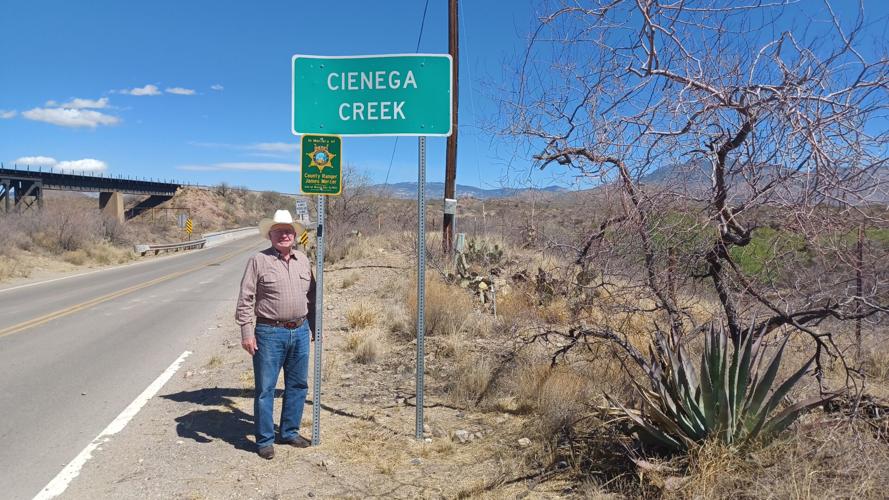
Near the Vail area, southeast of Tucson, along Marsh Station Road right before one comes to the Cienega Bridge over Cienega Creek, is a small sign put up by the Pima County Sheriff’s Department that reads:
“In Memory of County Ranger, James Mercer. End of Watch Dec. 11, 1914.”
Here is the story of the only Pima County sheriff’s county ranger killed in the line of duty:
James A. Mercer was born to Andrew V. and Isabella K. (Newton) Mercer on Aug. 12, 1870, in Bramley, Yorkshire (now a district of the City of Leeds, West Yorkshire), England.

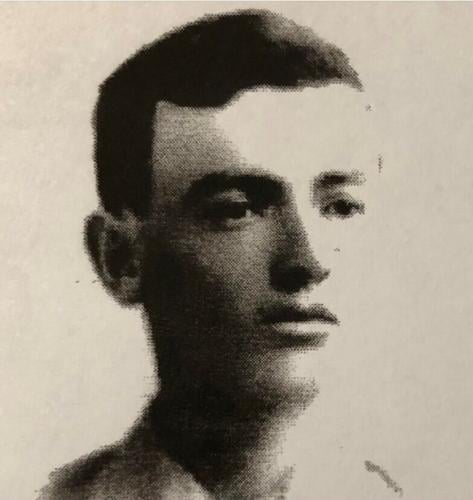
James Mercer at about 17 years old.
He was the first child of the couple that had married that year in Bramley. A brother and a sister were born in 1872 and 1881, respectively.
In 1881 or 1882, Andrew’s brother T. Lillie Mercer wrote and encouraged him to come to the Arizona Territory and settle in Tubac, where he had settled for a few years.
On Sept. 27, 1882, under the “Tubac Doings” section in the Arizona Daily Star, the family’s arrival was announced: “Andrew Mercer, wife and three children have arrived here from Leeds, England.”
At the time of the family’s arrival, the Tubac village contained about 130 residents, two stores, a stage and express office, a hotel and corral, a polling precinct with an average of 30 voters, a justice of the peace and a post office. T. Lillie Mercer owned one of the two stores, was postmaster and also justice of the peace.
While Andrew and Isabella were likely hopeful for a new life together when they arrived in Tubac, they had marital problems and by July 1883 they were divorced.
Around the time of his parents’ divorce, the family history says that James Mercer, age 12 or 13, went to live with pioneer and family friend Pete Kitchen, who at the time was residing in Tucson.

Ken Mercer at his grandfather James Mercer’s memorial sign.
Around 1885, James and his father are believed to have relocated to the area of Mammoth. What originally drew them here is unknown, but this new mining town may have offered opportunity in mining or it’s possible they were drawn by the ranching and agricultural possibilities provided by the nearby San Pedro River.
The following year, his father, Andrew, enrolled James in the Mammoth School in District 8. At this point, he was 16 years old.
On Oct. 6, 1892, in the First Judicial District of the Territory of Arizona, in Tucson, James Mercer renounced his British citizenship and received his U.S. citizenship.
On July 16, 1898, Mercer tied the knot with Bessie McKinney at Mammoth. They would have sons Arthur in 1900, Dell (namesake of Mercer Spring in the Molino Basin, Mount Lemmon) in 1903 and Edgar in 1906.
A year after his wedding, he received his homestead patent for almost 160 acres of land, north of Mammoth, on the east side of the San Pedro River.
By 1910, however, Mercer appears to have been divorced, with Bessie remaining with their children in Mammoth and Mercer relocating to Tucson. The following year, Bessie would marry John Rhodes in Oracle, Arizona. The couple would have sons John Lloyd Rhodes, who drowned in his grandfather’s stock tank when he was 2 years old, and Tom Rhodes (namesake of Tom Rhodes Ranch Road, south of Mammoth).
In early 1911, Tucson Mayor P.N. Jacobus (pronounced Jay-KAH-bus) appointed Mercer the day jailer of the Tucson Police Department. By July 1911, he held the rank of sergeant in the police force. He was sometimes referred to in the newspaper as the day police sergeant. He owned a small white puppy that acted as the mascot of the police force.

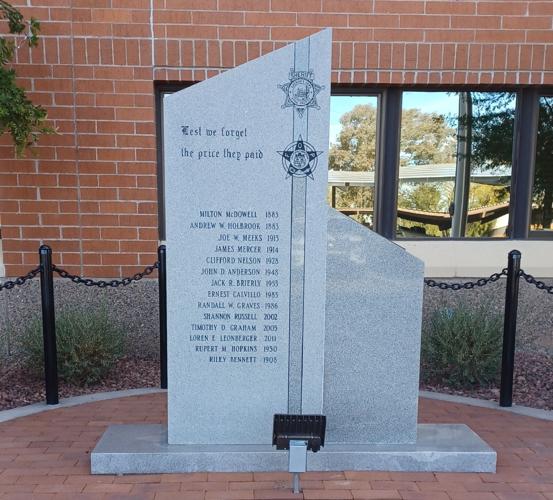
James Mercer, killed 1914, is listed on the Pima County Sheriff’s Department’s Fallen Officer Memorial at the Clarence W. Dupnik Sheriff’s Center in Tucson.
In January 1912, Mercer took a leave of absence for several months from the police force and spent time at Pima County Sheriff John Nelson’s cattle ranch in the Tortolita Mountains. This time spent together likely contributed to Nelson appointing Mercer to the Pima County Sheriff’s Department two months later. By April 1912, Mercer is listed in the newspaper as a Pima County ranger.
The following month, he joined fellow County Ranger Luke Short on a two-week trip to the Papago District (Tohono O’odham Nation Reservation) looking for evidence of cattle theft.
The Pima County Board of Supervisors in July 1912 decided to add an additional county ranger to join Mercer and Short, appointing Willard S. Wright, but by late August 1912, Mercer was the only county ranger in Pima County. This was a very dangerous position to be in, having to go miles from any town sometimes by himself to investigate cattle rustling and horse thievery. About three months later, Sidney T. Simpson was appointed a county ranger.
On Nov. 1, 1913, Mercer married Harriet Brown, the wedding taking place at her parents’ home in town. They would have son James A. Mercer Jr. the following year.
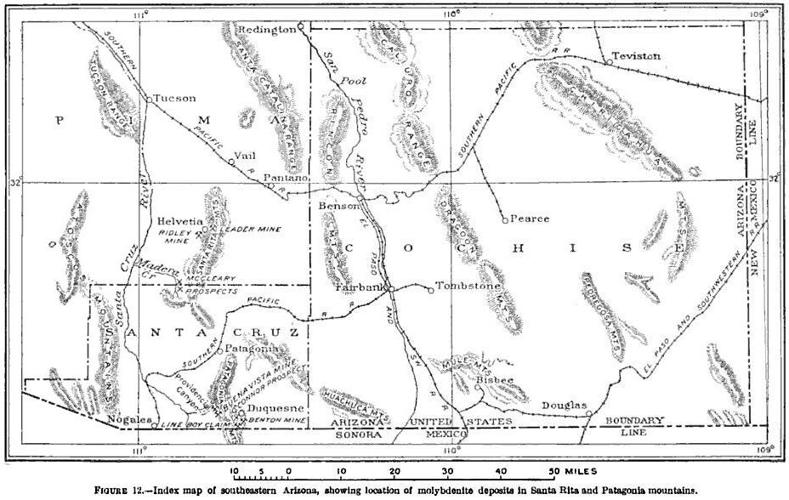
On Dec. 2, 1914, Mercer and a rancher named Robert Fenter rode to a Mr. Padilla’s property, a small ranch with only about six or seven head of cattle, located about four miles north of the railroad town of Pantano, which was located southeast of the Vail Station along the railroad tracks.
The purpose of the visit was to investigate a report that Padilla had a stolen calf. As the county tanger and the rancher approached Padilla’s corral, Mercer shouted to Padilla that he was going to take the calf. Padilla, an old man, who had a Winchester rifle, was walking towards the men. When he reached about 50 to 75 yards, he raised his weapon and at this point both men fired their respective firearms at one another. Mercer was struck in the left thigh, and Padilla ran around his house and away into the canyon.
Fenter helped put Mercer on his horse, and they rode to the nearest train station. From there, the injured man was put on the train to Tucson.

1910 USGS map of Southeastern Arizona with Pantano shown.
Upon arrival, having lost a considerable amount of blood and having a shattered left thigh bone, he was rushed to Rodgers Hospital, 123 S. Stone Ave., and was attended to by Dr. C.A. Schrader. Mercer’s wife was in Douglas at the time but headed back to Tucson, arriving that evening.
During his time in the hospital, there was some talk of amputating his leg, but Mercer firmly replied, “No, I will get well or die all together.” His End of Watch was on Dec. 10, 1914 (Not Dec. 11, 1914) at 6:40 a.m.
As his grandson Ken Mercer puts it today, “My father Dell Mercer was a young boy when his father James Mercer passed and I wasn’t even a thought. Just another reminder of how thankful we should be to those that pay the ultimate sacrifice to keep us safe and protect our freedoms and way of life.”
If you live in Arizona, it's only right that you should know a few facts about our fair state. Play along with this quiz and see if you can correctly answer five questions about the Grand Canyon State!
How well do you know Arizona? Here is another quiz to test your knowledge on Arizona history and facts. Video by Pascal Albright / Arizona Daily Star
This is the third of our history quizzes. How much do you know?

